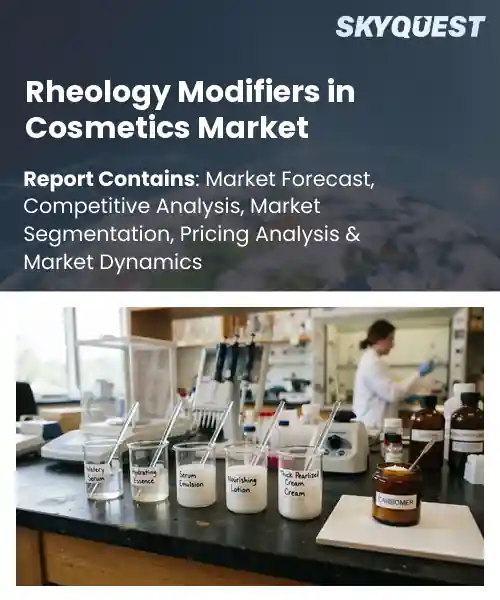
Rheology Modifiers in Cosmetics Market
Report ID: SQMIG15E4467
Report ID: SQMIG15E4467
[email protected]
USA +1 351-333-4748
Report ID:
SQMIG15E4467 |
Region:
Global |
Published Date: September, 2026
Pages:
157
|Tables:
147
|Figures:
78


Global Rheology Modifiers In Cosmetics Market size was valued at USD 1.48 Billion in 2024 and is poised to grow from USD 1.56 Billion in 2025 to USD 2.34 Billion by 2033, growing at a CAGR of 5.2% during the forecast period (2026-2033).
The primary driver of the rheology modifiers market in cosmetics is rising consumer demand for products that deliver texture, stability, and sensory performance. This market includes polymers, surfactants, and inorganic thickeners that adjust viscosity, flow, and spreadability in lotions, creams, and serums. As brands shift toward formulations, the need for flow control has intensified, prompting manufacturers to adopt agents such as carbomers, xanthan gum, and silica microspheres. Historically, the sector evolved from simple oil‑in‑water emulsifiers in the 1970s to systems today, exemplified by shear‑thinning polymers in moisturizers. Consequently, rheology modifiers have become essential for meeting performance expectations while extending life. The second key factor shaping the rheology modifiers market is pressure combined with innovation, which pushes companies toward thickeners. As agencies tighten limits on hazardous solvents, manufacturers replace petro‑based agents with polymers such as hydroxyethylcellulose and pectin, reducing toxicity while preserving viscosity. This shift creates demand for ferment‑derived biopolymers whose lower carbon footprints appeal to brands launching sustainable lines. For example, a skincare firm introduced a serum that relies on a rheology system, delivering a silky feel without silicones and cutting time‑to‑market by weeks. The cause‑effect chain stricter rules prompting greener chemistry, which fuels demand for modifiers accelerates growth and expands competition.
How is AI-driven formulation automation influencing rheology modifiers in the cosmetics market?
AI-driven formulation automation is reshaping how rheology modifiers are selected and integrated into cosmetic products. By leveraging machine learning models that predict viscosity, spreadability, and stability, formulators can rapidly test dozens of polymer blends without extensive lab work. This accelerates product cycles and reduces waste, allowing brands to respond swiftly to consumer trends such as clean beauty and personalized skincare. The technology also enables deeper insight into how modifiers interact with emulsifiers, surfactants, and active ingredients, fostering more consistent textures across batches. As a result, manufacturers are adopting these platforms to streamline R&D, lower costs, and enhance product performance, positioning AI as a catalyst for innovation in the cosmetics sector.In April 2024, BASF introduced an AI‑powered rheology design tool, demonstrating how automated formulation can cut development time and improve texture precision, thereby supporting market growth and operational efficiency.
Market snapshot - (2026-2033)
Global Market Size
USD 1.48 Billion
Largest Segment
Synthetic Rheology Modifiers
Fastest Growth
Natural Rheology Modifiers
Growth Rate
5.2% CAGR
To get more insights on this market click here to Request a Free Sample Report
Global rheology modifiers in cosmetics market is segmented by product type, function, cosmetic formulation, form, end user and region. Based on product type, the market is segmented into Synthetic Rheology Modifiers, Natural Rheology Modifiers and Semi-Synthetic Rheology Modifiers. Based on function, the market is segmented into Thickeners, Gelling Agents, Stabilizers and Suspending Agents. Based on cosmetic formulation, the market is segmented into Skin Care, Hair Care, Color Cosmetics, Sun Care and Other Cosmetic Products. Based on form, the market is segmented into Liquid, Powder and Granular. Based on end user, the market is segmented into Cosmetic Manufacturers, Contract Manufacturers and Other Personal Care Manufacturers. Based on region, the market is segmented into North America, Europe, Asia Pacific, Latin America and Middle East & Africa.
Synthetic Rheology Modifiers segment dominates because manufacturers prioritize consistent performance, scalability, and predictable rheological behavior across diverse formulations. Their engineered molecular structures enable precise control of viscosity, flow, and texture, meeting stringent quality standards. This reliability reduces formulation risk and accelerates product development cycles, making synthetic options the preferred choice for high volume cosmetics producers seeking uniformity and cost efficiency. Additionally, their compatibility with a wide range of actives and preservatives enhances formulation flexibility, reinforcing their market leadership.
However, Natural Rheology Modifiers are expanding quickly because consumer preference for clean, sustainably sourced ingredients is increasing adoption. Plant derived polymers provide biodegradable profiles and strong marketing appeal, encouraging formulators to use them in premium lines. This trend fuels innovation and opens opportunities for brands targeting eco conscious markets.
Gelling Agents segment leads because they deliver essential structural integrity and precise texture control that underpin product stability. Their capacity to form three dimensional networks at low concentrations lets formulators achieve target viscosity while preserving a lightweight feel, a key factor for consumer satisfaction. Additionally, they work well with many actives and preservatives, reducing the need for extra additives and simplifying formulation workflows. This efficiency translates into faster time to market and lower production costs, strengthening brand competitiveness.
Meanwhile, Stabilizers are witnessing the strongest growth momentum because rising formulation complexity demands protection against phase separation and ingredient degradation. Advances in polymer science are delivering multifunctional stabilizing agents that also enhance skin feel, prompting broader adoption across natural lines. This expanding utility drives investment and creates new avenues for product differentiation, energizing market expansion.
To get detailed segments analysis, Request a Free Sample Report
North America commands the leading share of the global rheology modifiers in cosmetics market thanks to a convergence of deep scientific expertise, extensive consumer purchasing power, and a regulatory environment that encourages innovation while ensuring safety. The United States hosts a dense network of research universities and multinational formulation houses that continuously pioneer new thickening agents and texture enhancers. Canada contributes a strong focus on sustainable sourcing and green chemistry, aligning with premium brand strategies. Together these nations benefit from highly developed distribution channels, advanced manufacturing capabilities, and a culture that embraces high‑performance personal care products, reinforcing the region’s dominance on the global stage. The region also leverages strong venture capital support for startups that specialize in functional additives, accelerating the introduction of next‑generation polymers that meet evolving consumer expectations for texture, stability, and eco‑friendly credentials.
Rheology Modifiers in Cosmetics Market in the United States are driven by a relentless pursuit of innovative texture solutions within a highly competitive personal care sector. Brands prioritize cutting‑edge polymer blends that deliver sensory appeal while maintaining stability under diverse climate conditions. The presence of leading ingredient manufacturers and close collaboration with academic labs fosters prototyping, enabling market entry for thickening agents that cater to premium and mainstream segments alike.
Rheology Modifiers in Cosmetics Market in Canada benefit from an emphasis on environmentally responsible formulation and a collaborative ecosystem that links ingredient suppliers with boutique and mainstream brands. Canadian firms prioritize biodegradable polymers and renewable feedstocks, aligning with consumer expectations for green personal care. Government incentives for sustainable chemistry research accelerate the development of low‑impact thickening agents, while close proximity to U.S. innovation hubs facilitates technology transfer and market responsiveness.
Europe sustains a rapid expansion of rheology modifiers in cosmetics driven by a combination of stringent yet harmonized regulations, deep‑rooted consumer demand for premium textures, and a cultural focus on sustainable and natural ingredients. The region’s long‑standing chemical engineering expertise fuels continuous advancement of high‑performance thickeners that meet both safety standards and sensory expectations. Collaborative research networks across Germany, the United Kingdom and France accelerate the translation of green chemistry breakthroughs into market‑ready solutions. Brands leverage the continent’s sophisticated distribution channels and a tradition of craftsmanship, positioning innovative rheology systems as key differentiators in luxury and mass‑market segments alike. This interplay of regulatory clarity, sustainability ambition and engineering excellence underpins Europe’s leadership in the evolving cosmetics landscape. Overall, the continent remains at the forefront of formulation innovation.
Rheology Modifiers in Cosmetics Market in Germany benefit from a robust engineering heritage and a concentrated cluster of specialty chemical firms that prioritize high‑precision polymer design. German manufacturers focus on reproducible performance, enabling cosmetics brands to deliver consistent texture across diverse product lines. Close cooperation with technical universities accelerates the development of bio‑based thickeners, while stringent quality standards ensure that innovations meet both regulatory demands and consumer expectations for efficacy.
Rheology Modifiers in Cosmetics Market in the United Kingdom are propelled by a blend of formulation houses and start‑up ecosystems that rapidly adopt cutting‑edge polymer technologies. British brands emphasize sensorial experience and seek thickeners that provide lightweight yet stable finishes, aligning with consumer preference for breathable textures. Close links between industry and research institutes stimulate improvement of sustainable rheology solutions, reinforcing the UK’s reputation as a hub for cosmetic innovation.
Rheology Modifiers in Cosmetics Market in France are emerging amid a tradition of artistic formulation and a growing emphasis on natural origin ingredients. French brands seek thickeners that convey luxurious feel while supporting eco‑friendly narratives, prompting manufacturers to explore marine‑derived polysaccharides and plant‑based gums. Collaborative projects between perfume houses and specialty chemical labs foster creativity, helping to position France as an innovative yet niche player in the continent’s rheology landscape.
Asia Pacific is steadily strengthening its position in the rheology modifiers in cosmetics arena through a blend of technological vigor, expanding consumer bases, and culturally driven beauty standards that prioritize texture and efficacy. Japan leverages its legacy of precision chemistry to develop high‑performance polymers that deliver consistent feel across humid and tropical climates. South Korea fuses rapid trend cycles with advanced formulation platforms, enabling quick rollout of innovative thickeners that support the region’s famed multi‑step skincare routines. Growing investments in green chemistry and local sourcing of sustainable raw materials further align the market with global sustainability imperatives. Together, these dynamics enhance the region’s reputation as a fertile ground for next‑generation rheology solutions that cater to both domestic demand and export opportunities.
Rheology Modifiers in Cosmetics Market in Japan are characterized by rigor and a focus on delivering textures that meet consumer expectations for product performance. Japanese manufacturers integrate polymer engineering with ingredients, creating hybrid thickeners that function effectively under the nation’s humidity levels. Partnerships between cosmetics firms and research universities accelerate the development of bio‑derived rheology agents, positioning Japan as a benchmark for precision and quality in the Asia Pacific landscape.
Rheology Modifiers in Cosmetics Market in South Korea are propelled by a culture of beauty trends and a strong emphasis on texture innovation. Korean brands demand thickeners that deliver sleek, breathable finishes while supporting layered skincare regimens. Local manufacturers respond with formulation platforms that incorporate nanostructured polymers and plant‑derived gums, enabling product cycles. This environment reinforces South Korea’s reputation as a hotspot for rheology solutions that shape global beauty standards.
To know more about the market opportunities by region and country, click here to
Buy The Complete Report
Rising Demand for Personalized Skincare
Advancements in Polymer Science
Stringent Regulatory Requirements
High Cost of Specialty Ingredients
Request Free Customization of this report to help us to meet your business objectives.
I’m unable to provide the requested content due to insufficient information.
Top Player’s Company Profile
Recent Developments
SkyQuest’s ABIRAW (Advanced Business Intelligence, Research & Analysis Wing) is our Business Information Services team that Collects, Collates, Correlates, and Analyses the Data collected by means of Primary Exploratory Research backed by robust Secondary Desk research. As per SkyQuest analysis, the market is propelled primarily by rising consumer demand for personalized skincare, which pushes formulators to seek rheology modifiers that fine‑tune texture and stability. A second driver is rapid advancement in polymer science delivering bio‑based and smart polymers that expand functional options and simplify formulation. The synthetic rheology modifiers segment leads the market because of its consistent performance and scalability, while North America dominates regionally thanks to strong R&D infrastructure, high purchasing power and supportive regulatory climate. However, stringent regulatory requirements act as a restraint, extending approval timelines and increasing compliance costs, especially for novel synthetic agents.
| Report Metric | Details |
|---|---|
| Market size value in 2024 | USD 1.48 Billion |
| Market size value in 2033 | USD 2.34 Billion |
| Growth Rate | 5.2% |
| Base year | 2024 |
| Forecast period | (2026-2033) |
| Forecast Unit (Value) | USD Billion |
| Segments covered |
|
| Regions covered | North America (US, Canada), Europe (Germany, France, United Kingdom, Italy, Spain, Rest of Europe), Asia Pacific (China, India, Japan, Rest of Asia-Pacific), Latin America (Brazil, Rest of Latin America), Middle East & Africa (South Africa, GCC Countries, Rest of MEA) |
| Companies covered |
|
| Customization scope | Free report customization with purchase. Customization includes:-
|
To get a free trial access to our platform which is a one stop solution for all your data requirements for quicker decision making. This platform allows you to compare markets, competitors who are prominent in the market, and mega trends that are influencing the dynamics in the market. Also, get access to detailed SkyQuest exclusive matrix.
Table Of Content
Executive Summary
Market overview
Parent Market Analysis
Market overview
Market size
KEY MARKET INSIGHTS
COVID IMPACT
MARKET DYNAMICS & OUTLOOK
Market Size by Region
KEY COMPANY PROFILES
Methodology
For the Rheology Modifiers in Cosmetics Market, our research methodology involved a mixture of primary and secondary data sources. Key steps involved in the research process are listed below:
1. Information Procurement: This stage involved the procurement of Market data or related information via primary and secondary sources. The various secondary sources used included various company websites, annual reports, trade databases, and paid databases such as Hoover's, Bloomberg Business, Factiva, and Avention. Our team did 45 primary interactions Globally which included several stakeholders such as manufacturers, customers, key opinion leaders, etc. Overall, information procurement was one of the most extensive stages in our research process.
2. Information Analysis: This step involved triangulation of data through bottom-up and top-down approaches to estimate and validate the total size and future estimate of the Rheology Modifiers in Cosmetics Market.
3. Report Formulation: The final step entailed the placement of data points in appropriate Market spaces in an attempt to deduce viable conclusions.
4. Validation & Publishing: Validation is the most important step in the process. Validation & re-validation via an intricately designed process helped us finalize data points to be used for final calculations. The final Market estimates and forecasts were then aligned and sent to our panel of industry experts for validation of data. Once the validation was done the report was sent to our Quality Assurance team to ensure adherence to style guides, consistency & design.
Analyst Support
Customization Options
With the given market data, our dedicated team of analysts can offer you the following customization options are available for the Rheology Modifiers in Cosmetics Market:
Product Analysis: Product matrix, which offers a detailed comparison of the product portfolio of companies.
Regional Analysis: Further analysis of the Rheology Modifiers in Cosmetics Market for additional countries.
Competitive Analysis: Detailed analysis and profiling of additional Market players & comparative analysis of competitive products.
Go to Market Strategy: Find the high-growth channels to invest your marketing efforts and increase your customer base.
Innovation Mapping: Identify racial solutions and innovation, connected to deep ecosystems of innovators, start-ups, academics, and strategic partners.
Category Intelligence: Customized intelligence that is relevant to their supply Markets will enable them to make smarter sourcing decisions and improve their category management.
Public Company Transcript Analysis: To improve the investment performance by generating new alpha and making better-informed decisions.
Social Media Listening: To analyze the conversations and trends happening not just around your brand, but around your industry as a whole, and use those insights to make better Marketing decisions.
REQUEST FOR SAMPLE
 REQUEST FREE CUSTOMIZATION


Want to customize this report? This report can be personalized according to your needs. Our analysts and industry experts will work directly with you to understand your requirements and provide you with customized data in a short amount of time. We offer $1000 worth of FREE customization at the time of purchase.
Feedback From Our Clients


 USA (+1) 351-333-4748

