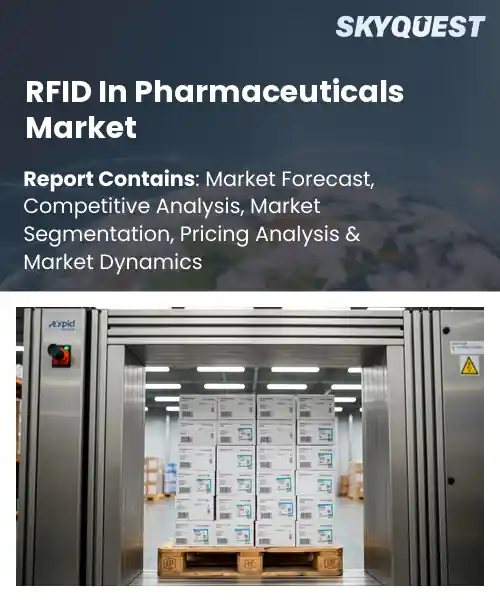
RFID In Pharmaceuticals Market
Report ID: SQMIG45F2359
Report ID: SQMIG45F2359
[email protected]
USA +1 351-333-4748
Report ID:
SQMIG45F2359 |
Region:
Global |
Published Date: May, 2026
Pages:
157
|Tables:
177
|Figures:
79


Global Rfid In Pharmaceuticals Market size was valued at USD 5.7 Billion in 2024 and is poised to grow from USD 6.15 Billion in 2025 to USD 11.25 Billion by 2033, growing at a CAGR of 7.85% during the forecast period (2026-2033).
The driving force behind this is the critical need to protect intricate supply chains from counterfeits and diversions that threaten patient safety and regulatory compliance. As costs have dropped and standards have converged, the industry has historically moved from barcode serialization to passive and active RFID implementations, with early pilots by manufacturers and logistics providers proving reduced recalls and faster lot tracing. With more regulatory scrutiny and more cold-chain therapies, RFID went from a niche technology to a strategic one. Driving wider commercial adoption.
Regulatory mandates and the industry’s move towards digitized supply chains are reinforcing that evolution, which is the single largest growth driver, as it requires manufacturers and distributors to utilize automated identification for compliance and operational resilience. Regulators’ calls for traceability have prompted companies to invest in RFID-enabled serialization and readers, creating demand for tags, sensors, middleware and analytics. The effect shows in real-life deployments: cold-chain vaccine shipments equipped with temperature-sensing RFID reduce spoilage risk and enable faster liability resolution, and hospitals using RFID cut inventory cycles and prevent expiries. These cause-and-effect dynamics create opportunities for integrated solution vendors and data-driven logistics optimization.
How is IoT integration improving RFID-driven traceability in the pharmaceuticals market?
Continuous environmental sensing and automated read points connecting serialization records to shipment movement are critical. The market today is demanding transparency and tighter regulation so solutions are focused on cold chain integrity and anti-counterfeiting. In practice, manufacturers are combining RFID with sensors and analytics to catch temperature excursions, speed targeted recalls and cut manual checks. Vendors are expanding RFID reach with battery-free sensing and cloud-based analytics so traceability moves from passive auditing to proactive supply chain management.
May 2026 - Antares Vision Group announced an integrated ecosystem for life sciences combining RFID based serialization with IoT enabled inspection and cloud analytics . This development will support market efficiency by simplifying compliance, improving end-to-end visibility and reducing operational risk across manufacturing and distribution.
Market snapshot - (2026-2033)
Global Market Size
USD 5.7 Billion
Largest Segment
RFID Tags
Fastest Growth
RFID Middleware & Software
Growth Rate
7.85% CAGR
To get more insights on this market click here to Request a Free Sample Report
Global rfid in pharmaceuticals market is segmented by component, tag type, frequency, application, deployment mode, end user and region. Based on component, the market is segmented into RFID Tags, RFID Readers, RFID Middleware & Software and Services. Based on tag type, the market is segmented into Passive RFID Tags, Active RFID Tags and Semi-Passive RFID Tags. Based on frequency, the market is segmented into Low Frequency (LF), High Frequency (HF) and Ultra-High Frequency (UHF). Based on application, the market is segmented into Drug Tracking & Tracing, Inventory Management, Anti-Counterfeiting, Cold Chain Monitoring, Asset Tracking and Others. Based on deployment mode, the market is segmented into On-Premises and Cloud-Based. Based on end user, the market is segmented into Pharmaceutical Manufacturers, Hospitals & Clinics, Pharmacies, Contract Manufacturing Organizations (CMOs), Logistics & Distribution Companies and Others. Based on region, the market is segmented into North America, Europe, Asia Pacific, Latin America and Middle East & Africa.
This ubiquity creates complete traceability footprints and consistent data capture at each touchpoint driving automated scanning workflows, supporting serialization compliance and reducing manual reconciliation while enabling downstream interoperability across inventory, anti-counterfeiting and recall processes.
The fastest growing area, however, is Active RFID Tags because the onboard power and extended read ranges enable continuous location and condition monitoring of high value shipments and temperature sensitive products. Integration with IoT platforms and embedded sensors is paving the way for real-time tracking, predictive alerts and enhanced cold chain assurance, creating new service offerings and accelerating adoption among stakeholders looking for dynamic visibility and agile risk management.
Middleware translates raw reads into actionable events and enforces business rules, reducing deployment complexity and accelerating cross-enterprise data sharing and analytics-driven decision making, encouraging investment by manufacturers, distributors and clinical operators looking for cohesive visibility and regulatory adherence.
On the other hand, Services is the fastest growing area as pharmaceutical companies increasingly outsource installation, validation and managed monitoring to specialist providers. The adoption of integration and ongoing support services, which create recurring revenue models, lower barriers to implementation and enable faster scaling of RFID-enabled traceability and cold chain capabilities, are driven by greater regulatory expectations and the demand for rapid rollouts.
To get detailed segments analysis, Request a Free Sample Report
North America is at the forefront as a result of a perfect storm of advanced healthcare infrastructure, proactive regulatory focus on patient safety and traceability and a highly developed vendor and implementation ecosystem supporting end-to-end deployments. Regulators, manufacturers, distributors and logistics providers have been working together strongly to build standard approaches and practical pilots that scale up quickly. Advanced data systems and integration capabilities now enable enterprise platforms and analytics to connect with RFID solutions, adding additional operational value. Investment is being driven by continued market demand for anti-counterfeiting, cold chain assurance and seamless serialization integration. Complex rollouts across manufacturing, distribution, and care delivery are supported by a deep pool of experienced implementation partners and technology suppliers. This keeps the regional leadership and the continued enhancement of RFID use cases in pharma.
In the United States, the RFID in Pharmaceuticals Market is characterized by early adoption by manufacturers, distributors and hospital systems, driven by patient safety priorities and sophisticated logistics networks. The market wants integrated solutions that link RFID to enterprise systems and analytics for real-time visibility and secure distribution. Strong vendor presence and implementation partners support roll-outs. Pilots in cold chain integrity and anti-counterfeiting strongly underline the practical value of RFID deployments.
Pragmatic Approach of RFID In Pharmaceuticals Market in Canada: Health authorities and Supply chain Players focus on Traceability, Patient safety and Cold chain Reliability across regions Needs for interoperability, collaboration among health systems and partnerships with technology vendors that customize solutions to regional logistics are what drive adoption. The emphasis on standard data exchange, pilot installations in hospital networks and integration with national serialization initiatives give a glimpse of a path forward for broader RFID adoption.
Europe’s fast growth in RFID is being driven by a regulatory focus on tracing medicine, a dense base of pharmaceutical manufacturers, and coordinated efforts to upgrade supply chain security across member states. Strong interoperability initiatives, industry consortia and funding for digital health projects foster cross-border pilots and standard adoption. Large logistics hubs and experienced contract manufacturers are looking for scalable deployments whereas healthcare providers are looking for higher inventory accuracy and patient safety. The rate of market maturity varies in different parts of the world, providing opportunities for tailored solutions. We have early adopters who are already seeing operational benefits, and that leads to wider rollouts. Public-private partnerships and research clusters for sensor integration and data analytics support innovation. The need for temperature controlled supply chains coupled with the emphasis on anti-counterfeiting measures strengthens use cases across manufacturing, distribution and delivery environments.
Strong pharmaceutical manufacturing base and sophisticated logistics infrastructure for large deployments supports Germany’s RFID in pharmaceuticals market. Traceability and anti-counterfeiting are the focus for industry and regulators and implementations are being built out across the production and distribution chain. The ability to develop custom tag and reader solutions for demanding environments, the collaboration between logistics providers, hospitals and technology vendors, leads to interoperable ecosystems and pilots that demonstrate tangible operational gains for stakeholders.
Demand for better traceability is driven by the digitization of healthcare and modernization of procurement. The United Kingdom RFID in Pharmaceuticals Market is gaining traction. Distributors, technology providers and national health services need to work together to create an environment that will allow pilots and scaled rollouts. Initiatives include hospital inventory optimization, temperature sensitive logistics, and anti-counterfeiting. Strong vendor communities and flexible procurement paths speed up adoption across supply chains and give more visibility into supply chains.
Traceability is becoming a key driver in the French RFID in Pharmaceuticals Market thanks to increased interest from both hospital groups and manufacturers and specific pilot projects. National digital health strategies and research hubs for temperature sensitive logistics and anti-counterfeiting support RFID adoption. Interoperability and a focus on European standards drive vendor innovation. Case studies from specific regions can help increase stakeholders’ confidence for gradual adoption through healthcare and distribution channels within national networks.
The Asia Pacific is strengthening its position with technological capability, favourable policy frameworks and concentrated demand from domestic manufacturers and global supply chains operating in the region. Advanced electronics industries provide a strong local supply of RFID components and integration expertise, and logistics operators and contract manufacturers are adopting digital tools to control temperature controlled products and complex distribution networks. Innovation in tag design, sensor integration and data platforms is being propelled by government initiatives to modernize supply chains and active industry-academia partnerships. Across serialization, anti-counterfeiting, and inventory optimization, use cases quickly maturing provide transferable models for enabling adoption across different markets. Regional Centers of Excellence are supporting pilot programs that combine RFID with IoT and cloud analytics to speed up learning cycles and reduce risk. Growing collaboration with multinational pharmaceutical companies builds confidence among local stakeholders and enables scale by establishing best practices for regulatory compliance and logistics harmonization.
Japan RFID In Pharmaceuticals market is driven by strong electronics manufacturing and system integration capabilities of the country required for complex tagging solutions for pharmaceutical supply chains. Domestic vendors and research institutions are collaborating to develop high-performance tags for harsh environments, while logistics providers are focusing on temperature-controlled handling and regulatory compliance. The hospital systems and manufacturers are interested in the efficiency of operations and authenticity of the product. This opens the door for massive RFID deployments and industry innovation.
The South Korea RFID in Pharmaceuticals Market is driven by the strong electronics and semiconductor capabilities that provide cutting-edge components and systems integration. Logistics providers and healthcare institutions are rapidly adopting technology and conducting pilots in temperature monitoring, serialization and anti-counterfeiting. Scalable proofs of concept are being developed through public-private initiatives and collaboration between manufacturers, carriers and vendors The focus on connectivity, cloud integration, and the design of compact tags is driving the RFID market for supply chain deployments.
To know more about the market opportunities by region and country, click here to
Buy The Complete Report
Regulatory Compliance and Traceability Needs
Demand For Counterfeit Prevention
Implementation Cost and Complexity
Integration With Legacy Systems
Request Free Customization of this report to help us to meet your business objectives.
Strategic M&A, cross-sector partnerships and rapid product innovation, especially in the area of item level authentication and cold chain integrity, are driving the global RFID in pharmaceuticals market. Recent consolidation examples include the acquisition of rfxcel by Antares Vision. Top vendors collaborate with IoT logistics providers for temperature telemetry. Crypto-secure NFC, tagged-item standards helping differentiate suppliers, forge vendor partnerships
SkyQuest’s ABIRAW (Advanced Business Intelligence, Research & Analysis Wing) is our Business Information Services team that Collects, Collates, Correlates and Analyses the Data collected by means of Primary Exploratory Research supported by robust Secondary Desk research.
SkyQuest’s analysis indicates that the global RFID in pharmaceuticals market is primarily driven by regulatory mandates and the industry’s drive towards digitized supply chains. The demand for counterfeit prevention is a second driver that is encouraging the adoption. High implementation costs and integration complexity are a significant restraint that can hamper rollouts, particularly for smaller players. The dominating region is North America due to mature healthcare infrastructure and strong vendor ecosystems. The dominating segment is passive RFID tags due to their low cost enabling wide item level tagging. Such dynamics favor integrated IoT, middleware and service offerings that translate gains in traceability into operational and patient safety benefits.
| Report Metric | Details |
|---|---|
| Market size value in 2024 | USD 5.7 Billion |
| Market size value in 2033 | USD 11.25 Billion |
| Growth Rate | 7.85% |
| Base year | 2024 |
| Forecast period | (2026-2033) |
| Forecast Unit (Value) | USD Billion |
| Segments covered |
|
| Regions covered | North America (US, Canada), Europe (Germany, France, United Kingdom, Italy, Spain, Rest of Europe), Asia Pacific (China, India, Japan, Rest of Asia-Pacific), Latin America (Brazil, Rest of Latin America), Middle East & Africa (South Africa, GCC Countries, Rest of MEA) |
| Companies covered |
|
| Customization scope | Free report customization with purchase. Customization includes:-
|
To get a free trial access to our platform which is a one stop solution for all your data requirements for quicker decision making. This platform allows you to compare markets, competitors who are prominent in the market, and mega trends that are influencing the dynamics in the market. Also, get access to detailed SkyQuest exclusive matrix.
Table Of Content
Executive Summary
Market overview
Parent Market Analysis
Market overview
Market size
KEY MARKET INSIGHTS
COVID IMPACT
MARKET DYNAMICS & OUTLOOK
Market Size by Region
KEY COMPANY PROFILES
Methodology
For the RFID In Pharmaceuticals Market, our research methodology involved a mixture of primary and secondary data sources. Key steps involved in the research process are listed below:
1. Information Procurement: This stage involved the procurement of Market data or related information via primary and secondary sources. The various secondary sources used included various company websites, annual reports, trade databases, and paid databases such as Hoover's, Bloomberg Business, Factiva, and Avention. Our team did 45 primary interactions Globally which included several stakeholders such as manufacturers, customers, key opinion leaders, etc. Overall, information procurement was one of the most extensive stages in our research process.
2. Information Analysis: This step involved triangulation of data through bottom-up and top-down approaches to estimate and validate the total size and future estimate of the RFID In Pharmaceuticals Market.
3. Report Formulation: The final step entailed the placement of data points in appropriate Market spaces in an attempt to deduce viable conclusions.
4. Validation & Publishing: Validation is the most important step in the process. Validation & re-validation via an intricately designed process helped us finalize data points to be used for final calculations. The final Market estimates and forecasts were then aligned and sent to our panel of industry experts for validation of data. Once the validation was done the report was sent to our Quality Assurance team to ensure adherence to style guides, consistency & design.
Analyst Support
Customization Options
With the given market data, our dedicated team of analysts can offer you the following customization options are available for the RFID In Pharmaceuticals Market:
Product Analysis: Product matrix, which offers a detailed comparison of the product portfolio of companies.
Regional Analysis: Further analysis of the RFID In Pharmaceuticals Market for additional countries.
Competitive Analysis: Detailed analysis and profiling of additional Market players & comparative analysis of competitive products.
Go to Market Strategy: Find the high-growth channels to invest your marketing efforts and increase your customer base.
Innovation Mapping: Identify racial solutions and innovation, connected to deep ecosystems of innovators, start-ups, academics, and strategic partners.
Category Intelligence: Customized intelligence that is relevant to their supply Markets will enable them to make smarter sourcing decisions and improve their category management.
Public Company Transcript Analysis: To improve the investment performance by generating new alpha and making better-informed decisions.
Social Media Listening: To analyze the conversations and trends happening not just around your brand, but around your industry as a whole, and use those insights to make better Marketing decisions.
REQUEST FOR SAMPLE
 REQUEST FREE CUSTOMIZATION
Global Rfid In Pharmaceuticals Market size was valued at USD 5.7 Billion in 2024 and is poised to grow from USD 6.15 Billion in 2025 to USD 11.25 Billion by 2033, growing at a CAGR of 7.85% during the forecast period (2026-2033).
Competition in the global RFID in pharmaceuticals market is shaped by strategic M&A, cross‑sector partnerships, and rapid product innovation aimed at item level authentication and cold chain integrity. Recent consolidation examples include Antares Vision’s acquisition of rfxcel. Major vendors partner with logistics IoT firms to add temperature telemetry. Crypto‑secure NFC and tagged‑item standards adoption are driving supplier differentiation and vendor partnerships. 'Zebra Technologies Corporation', 'Avery Dennison Corporation', 'Checkpoint Systems, Inc.', 'Impinj, Inc.', 'SATO Holdings Corporation', 'Honeywell International Inc.', 'Alien Technology LLC', 'NXP Semiconductors N.V.', 'CCL Industries Inc.', 'Tageos SAS', 'GAO RFID Inc.', 'Invengo Information Technology Co., Ltd.', 'HID Global Corporation', 'Identiv, Inc.', 'Siemens AG', 'IBM Corporation', 'Oracle Corporation', 'SAP SE', 'Nedap N.V.', 'GlaxoSmithKline plc'
RFID adoption is propelled by stricter regulatory compliance requirements that mandate reliable product traceability across complex supply chains. By enabling automated identification and persistent item level records, RFID helps pharmaceutical organizations maintain chain of custody visibility, demonstrate adherence to serialization and recall procedures, and reduce the operational burden of manual audits. This capability directly supports product integrity and patient safety objectives, encourages collaborative supply chain practices, and motivates investment in RFID systems as a practical solution to meet evolving compliance expectations and strengthen overall quality assurance.
Supply Chain Traceability Surge: RFID adoption is accelerating across manufacturing, distribution, and dispensing touchpoints to enable end-to-end visibility, provenance verification, and real-time condition monitoring. Stakeholders emphasize transparent, auditable product journeys to reduce diversion, ensure authenticity, and protect patient safety, while facilitating smoother recalls and targeted interventions. Increased interoperability between RFID systems and pharmaceutical logistics partners supports collaborative inventory reconciliation and exception management, driving operational shifts toward predictive replenishment and adaptive routing based on live location and status feeds and enhancing compliance reporting capabilities globally.
Why does North America Dominate the Global RFID In Pharmaceuticals Market? |@12


Want to customize this report? This report can be personalized according to your needs. Our analysts and industry experts will work directly with you to understand your requirements and provide you with customized data in a short amount of time. We offer $1000 worth of FREE customization at the time of purchase.
Feedback From Our Clients


 USA (+1) 351-333-4748

