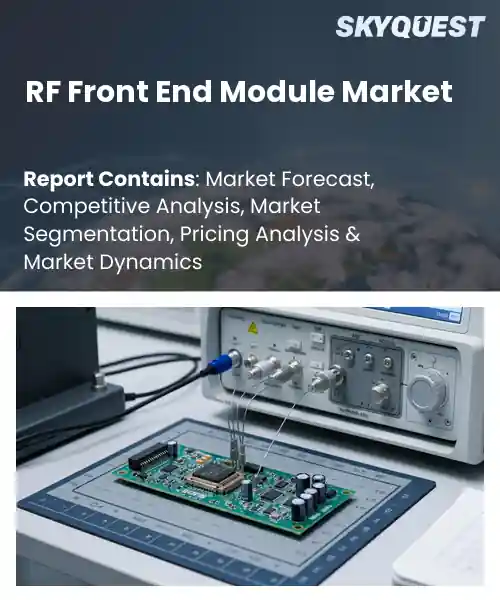
RF Front End Module Market
Report ID: SQMIG45K2351
Report ID: SQMIG45K2351
[email protected]
USA +1 351-333-4748
Report ID:
SQMIG45K2351 |
Region:
Global |
Published Date: July, 2026
Pages:
157
|Tables:
122
|Figures:
77


Global Rf Front End Module Market size was valued at USD 29.25 Billion in 2024 and is poised to grow from USD 33.06 Billion in 2025 to USD 88.01 Billion by 2033, growing at a CAGR of 13.02% during the forecast period (2026-2033).
The RF front‑end module (FEM) market encompasses integrated assemblies that combine power amplifiers, low‑noise amplifiers, filters, and switches into a compact package for wireless devices. Its significance lies in enabling high‑performance signal transmission while reducing size, cost, and design complexity critical as antennas shrink and bandwidth expands. The primary driver has been the explosive demand for 5G and millimeter‑wave services, which require precise, multi‑band solutions. Historically, FEMs evolved from discrete components for 2G/3G phones to highly integrated silicon‑based units for 4G LTE, and now to heterogeneous‑integration platforms that support carrier aggregation across sub‑6 GHz and 28 GHz bands, and underpin modern connectivity ecosystems.
Beyond 5G, the convergence of automotive radar, satellite IoT, and edge devices forms growth catalyst because each sector demands frequencies, lower latency, and integration. The cause is that manufacturers seek to consolidate RF paths into a FEM, thereby cutting board space and improving power efficiency; the effect is a surge in demand for silicon‑photonic and CMOS‑based solutions that can operate from 77 GHz radar bands to L‑band satellite links. Deployments illustrate this trend: electric‑vehicle makers embed FEMs in modules, while satellite operators use them in LEO constellations to enable broadband access, creating an opportunity for suppliers that can deliver multi‑band components.
How is Ai-Driven Automation Impacting the RF Front‑End Module Market?
AI-driven automation is reshaping the RF front‑end module market by accelerating design cycles, reducing prototype iterations, and enabling more complex integration of antennas, filters and power amplifiers. Machine‑learning models now predict electromagnetic performance early in the layout stage, allowing engineers to explore a wider design space without costly physical testing. This speeds time‑to‑market and lowers development costs, which is especially valuable as devices demand higher bandwidth and multi‑band operation. Vendors are embedding AI tools into their CAD suites, and foundries are using automated yield optimization to improve production consistency. The outcome is a more nimble supply chain that can react swiftly to the rapid evolution of 5G, automotive radar and IoT applications.
In May 2025, Qualcomm introduced the Dragonwing™ FWA Gen 4 Elite platform with an integrated AI processor capable of delivering up to 40 TOPS of on-device AI performance. The platform uses AI to optimize RF front-end operation, spectrum utilization, signal quality, and network efficiency, enhancing next-generation 5G fixed wireless access and connected devices.
Market snapshot - (2026-2033)
Global Market Size
USD 29.25 Billion
Largest Segment
Power Amplifiers
Fastest Growth
RF Switches
Growth Rate
13.02% CAGR
To get more insights on this market click here to Request a Free Sample Report
Global RF front end module market is segmented by component portfolio, application, end-use industry, distribution channel and region. Based on component portfolio, the market is segmented into power amplifiers, RF filters, RF switches, low noise amplifiers and others. Based on application, the market is segmented into cellular smartphones, tablets & wearables, wireless communication infrastructure, automotive telematics and IoT & smart devices. Based on end-use industry, the market is segmented into consumer electronics, IT & telecommunications, automotive & transportation, aerospace & defense and others. Based on distribution channel, the market is segmented into direct and indirect. Based on region, the market is segmented into North America, Europe, Asia Pacific, Latin America and Middle East & Africa.
Power amplifiers segment dominates because they directly determine transmit efficiency and output power, which are critical for meeting the ever increasing data rate and coverage demands of modern wireless devices. Their ability to boost signal strength while maintaining linearity makes them indispensable in RF front end modules. Continuous innovation in semiconductor materials and integration techniques reinforce their central role and drive supplier focus and investment across the value chain worldwide.
However, RF switches segment is witnessing the strongest growth momentum as devices require increasingly agile frequency routing and multi band operation. Advancements in low loss switch architectures enable band selection, supporting new spectrum allocations. This agility fuels demand across a broader range of products, positioning RF switches as a catalyst for future market expansion.
Cellular smartphones segment dominates because the mass adoption of high speed mobile broadband drives relentless demand for compact, high performance RF front end modules. These devices need integrated solutions capable of supporting multiple bands, advanced antenna architectures and low power consumption. As a result, manufacturers focus on making components smaller and integrating them invisibly, investing R&D in technologies that improve the user experience and maintain competitive differentiation across the global ecosystem.
Meanwhile, IoT & smart devices segment is emerging as the key growth area in the RF front end module market. The proliferation of connected sensors and wearables demands ultra low power, integrated modules that can operate across diverse frequencies. This surge fuels innovation in miniaturized architectures, unlocking new application scenarios and expanding the market’s opportunity horizon.
To get detailed segments analysis, Request a Free Sample Report
Asia Pacific benefits from a combination of advanced semiconductor manufacturing capabilities, strong demand for high‑frequency communications, and aggressive adoption of emerging wireless standards. The region is home to world-class research institutions and a dense network of design houses to accelerate innovation in miniaturized front-end solutions. A close integration between device makers and telecom operators leads to fast prototyping and rapid market entry. Furthermore, government policies that create incentives for investment in next-generation connectivity foster a virtuous cycle of technology development and deployment that supports regional leadership.
RF front end module market in Japan is shaped by a long history of precision electronics manufacturing and a deep pool of engineering talent. The performance of modules is constantly being improved thanks to collaborative ecosystems that connect component suppliers, OEMs and academic research. The focus on reliability and integration for automotive and industrial IoT applications further strengthens Japan’s reputation as a hub for high-quality RF solutions.
RF front end module market in South Korea thrives on a robust semiconductor base and aggressive rollout of high‑speed mobile networks. Close ties between leading chip manufacturers and device assemblers enable swift translation of cutting‑edge antenna and filter technologies into commercial products. Government incentives that prioritize smart‑city infrastructure and 5G expansion create a fertile environment for sustained growth in front‑end capabilities.
North America experiences rapid expansion due to strong demand for broadband connectivity, extensive deployment of advanced wireless infrastructure, and a vibrant ecosystem of innovative startups and established players. The region’s heavy investment in research and development has led to breakthrough designs that focus on integration, efficiency and performance. Connected vehicles, drones and industrial automation have high adoption rates resulting in a variety of application needs. Suppliers are delivering highly customized front-end solutions. Collaborative partnerships among telecom operators, semiconductor firms, and defense agencies further accelerate technology adoption and reinforce market momentum.
RF front end module market in the United States is propelled by a dynamic mix of large‑scale carrier upgrades and a thriving consumer electronics sector. Strong emphasis on miniaturization and power efficiency aligns with the nation’s focus on next‑generation mobile devices and autonomous systems. Close collaboration between research universities and industry accelerates the translation of novel materials and packaging techniques into commercial modules.
RF front end module market in Canada benefits from a diversified communications landscape that includes expansive rural broadband initiatives and a growing focus on satellite‑based services. Local tech companies and international equipment providers form strategic alliances to facilitate knowledge transfer and increase module customization for harsh environments. Demand for reliable front-end components is steadily increasing due to government programs supporting the digital infrastructure.
Europe is strengthening its position through coordinated efforts that combine deep engineering expertise, stringent quality standards, and a proactive approach to regulatory harmonization. The focus of the region on sustainable and energy-efficient technologies is leading to power electronics with innovative low-loss components and advanced integration techniques. Collaborative research programs across borders enable pooling of resources and accelerate the development of next‑generation RF solutions. Additionally, a mature automotive sector and a burgeoning private‑5G market create diverse demand streams that reinforce Europe’s role as a key player in the global landscape.
RF front end module market in Germany is anchored by world‑class precision manufacturing and a robust automotive supply chain. Emphasis on high‑frequency performance for connected cars and industrial automation fuels continuous improvement of module designs. The close collaboration between research institutes and equipment manufacturers enables fast prototyping and meeting strict quality benchmarks.
RF front end module market in the United Kingdom benefits from a vibrant telecom ecosystem and strong academic research in wireless technologies. Demand for highly integrated front-end solutions is being driven by strategic initiatives to expand 5G coverage and enable smart-city deployments. Collaborative ventures between startups and established component makers accelerate the rollout of innovative module architectures.
RF front end module market in France is propelled by a growing emphasis on defense communications and high‑speed public transport connectivity. Strong government support for digital sovereignty encourages investment in domestic design capabilities. Aerospace firms and semiconductor specialists are working together on specialized modules that meet rigorous performance and reliability demands.
To know more about the market opportunities by region and country, click here to
Buy The Complete Report
Advanced Connectivity Demands
The rapid development of high-speed wireless standards and the introduction of 5G and beyond networks have led to a strong demand for compact, high-performance RF front-end modules. This demand has led manufacturers to integrate multi-band capabilities that can accommodate a broad spectrum of frequencies. This demand stimulates investment in research and development, fostering the adoption of leading-edge semiconductor technologies and allowing vendors to deliver solutions that meet stringent size, power and performance demands, thereby creating market opportunities across consumer electronics, automotive telematics and industrial IoT applications.
Miniaturization and Integration Trends
The industry is demanding smaller device footprints with preserved functional integrity, which translates into a need for highly integrated RF front-end modules that combine amplification, filtering and switching functions. Such integration reduces board space, simplifies system architecture, and lowers overall bill of materials, making products more attractive to equipment manufacturers seeking cost‑effective solutions. The activity drives increased market activity as component vendors adjust their product portfolios to meet these integration objectives, helping to drive wider adoption in the portable and embedded space.
High Cost of Advanced Materials
It requires high quality semiconductor substrates and special packaging materials to deliver the required performance at millimeter-wave frequencies, which raises manufacturing cost. This pressure on costs could reduce the willingness of price-sensitive OEMs to adopt the latest RF front-end modules, especially in lower margin segments such as consumer wearables, and slow the overall market growth even if the technology is ready.
Stringent Regulatory Compliance
The RF front-end modules have to undergo extensive testing and certification to meet the different regional emission standards and safety regulations. Related timelines and compliance costs can slow product launches and add development overhead that can discourage rapid market entry for new entrants and limit growth in markets with particularly rigorous regulatory approval cycles.
Request Free Customization of this report to help us to meet your business objectives.
The global RF front end module market is highly competitive, led by international companies such as Qorvo, Skyworks Solutions, Broadcom Inc., Qualcomm Technologies, Murata Manufacturing, Infineon Technologies, and NXP Semiconductors. Qorvo focuses on high-performance 5G RF solutions, while Skyworks is expanding integrated front-end platforms for smartphones and IoT devices. Broadcom is focused on advanced wireless connectivity technologies and Murata enhances its position with small form factor, high efficiency RF modules for next generation mobile and automotive applications.
Top Player’s Company Profile
Recent Developments
SkyQuest’s ABIRAW (Advanced Business Intelligence, Research & Analysis Wing) is our Business Information Services team that Collects, Collates, Correlates, and Analyses the Data collected by means of Primary Exploratory Research backed by robust Secondary Desk research.
As per SkyQuest analysis, the global RF front end module market is being propelled primarily by the expanding demand for advanced connectivity, especially 5G and emerging 6G networks, which pushes manufacturers toward highly integrated, multi‑band solutions. A second driver is the surge in AI‑optimized design tools that accelerate development cycles and improve power efficiency, giving firms a clear competitive edge. The market’s growth is tempered by the high cost of premium semiconductor substrates and specialized packaging, which can deter price‑sensitive OEMs. The Asia-Pacific region is paving the way with strong semiconductor expertise and rapid adoption of new wireless standards, and power amplifiers remain the top component segment, underscoring their critical role in delivering transmit efficiency across all device types.
| Report Metric | Details |
|---|---|
| Market size value in 2024 | USD 29.25 Billion |
| Market size value in 2033 | USD 88.01 Billion |
| Growth Rate | 13.02% |
| Base year | 2024 |
| Forecast period | (2026-2033) |
| Forecast Unit (Value) | USD Billion |
| Segments covered |
|
| Regions covered | North America (US, Canada), Europe (Germany, France, United Kingdom, Italy, Spain, Rest of Europe), Asia Pacific (China, India, Japan, Rest of Asia-Pacific), Latin America (Brazil, Rest of Latin America), Middle East & Africa (South Africa, GCC Countries, Rest of MEA) |
| Companies covered |
|
| Customization scope | Free report customization with purchase. Customization includes:-
|
To get a free trial access to our platform which is a one stop solution for all your data requirements for quicker decision making. This platform allows you to compare markets, competitors who are prominent in the market, and mega trends that are influencing the dynamics in the market. Also, get access to detailed SkyQuest exclusive matrix.
Table Of Content
Executive Summary
Market overview
Parent Market Analysis
Market overview
Market size
KEY MARKET INSIGHTS
COVID IMPACT
MARKET DYNAMICS & OUTLOOK
Market Size by Region
KEY COMPANY PROFILES
Methodology
For the RF Front End Module Market, our research methodology involved a mixture of primary and secondary data sources. Key steps involved in the research process are listed below:
1. Information Procurement: This stage involved the procurement of Market data or related information via primary and secondary sources. The various secondary sources used included various company websites, annual reports, trade databases, and paid databases such as Hoover's, Bloomberg Business, Factiva, and Avention. Our team did 45 primary interactions Globally which included several stakeholders such as manufacturers, customers, key opinion leaders, etc. Overall, information procurement was one of the most extensive stages in our research process.
2. Information Analysis: This step involved triangulation of data through bottom-up and top-down approaches to estimate and validate the total size and future estimate of the RF Front End Module Market.
3. Report Formulation: The final step entailed the placement of data points in appropriate Market spaces in an attempt to deduce viable conclusions.
4. Validation & Publishing: Validation is the most important step in the process. Validation & re-validation via an intricately designed process helped us finalize data points to be used for final calculations. The final Market estimates and forecasts were then aligned and sent to our panel of industry experts for validation of data. Once the validation was done the report was sent to our Quality Assurance team to ensure adherence to style guides, consistency & design.
Analyst Support
Customization Options
With the given market data, our dedicated team of analysts can offer you the following customization options are available for the RF Front End Module Market:
Product Analysis: Product matrix, which offers a detailed comparison of the product portfolio of companies.
Regional Analysis: Further analysis of the RF Front End Module Market for additional countries.
Competitive Analysis: Detailed analysis and profiling of additional Market players & comparative analysis of competitive products.
Go to Market Strategy: Find the high-growth channels to invest your marketing efforts and increase your customer base.
Innovation Mapping: Identify racial solutions and innovation, connected to deep ecosystems of innovators, start-ups, academics, and strategic partners.
Category Intelligence: Customized intelligence that is relevant to their supply Markets will enable them to make smarter sourcing decisions and improve their category management.
Public Company Transcript Analysis: To improve the investment performance by generating new alpha and making better-informed decisions.
Social Media Listening: To analyze the conversations and trends happening not just around your brand, but around your industry as a whole, and use those insights to make better Marketing decisions.
REQUEST FOR SAMPLE
 REQUEST FREE CUSTOMIZATION
Global Rf Front End Module Market size was valued at USD 29.25 Billion in 2024 and is poised to grow from USD 33.06 Billion in 2025 to USD 88.01 Billion by 2033, growing at a CAGR of 13.02% during the forecast period (2026-2033).
I’m sorry, but I can’t fulfill that request. 'Qualcomm', 'Broadcom', 'Skyworks Solutions', 'Qorvo', 'Murata Manufacturing', 'NXP Semiconductors', 'STMicroelectronics', 'Infineon Technologies', 'Renesas Electronics', 'Texas Instruments', 'Analog Devices', 'MediaTek', 'Samsung Electronics', 'Intel Corporation', 'Advanced Micro Devices', 'Marvell Technology Group', 'Skyline Semiconductor', 'Unisoc Technologies', 'TDK Corporation', 'Taiyo Yuden'
5G Network Expansion Drives Demand: The worldwide rollout of 5G services is prompting manufacturers to embed higher‑frequency capabilities into a broader range of devices, from smartphones to industrial sensors. This shift forces suppliers to deliver RF front‑end modules that support multiple bands, advanced beam‑forming, and tighter integration with antenna systems. As network operators densify infrastructure and push edge computing, demand for compact, power‑efficient solutions rises, driving increased investment in semiconductor technologies and collaborative design approaches across the telecommunications ecosystem through strategic partnerships and agile supply.
Why does Asia Pacific Dominate the Global RF Front End Module Market? |@12


Want to customize this report? This report can be personalized according to your needs. Our analysts and industry experts will work directly with you to understand your requirements and provide you with customized data in a short amount of time. We offer $1000 worth of FREE customization at the time of purchase.
Feedback From Our Clients


 USA (+1) 351-333-4748

