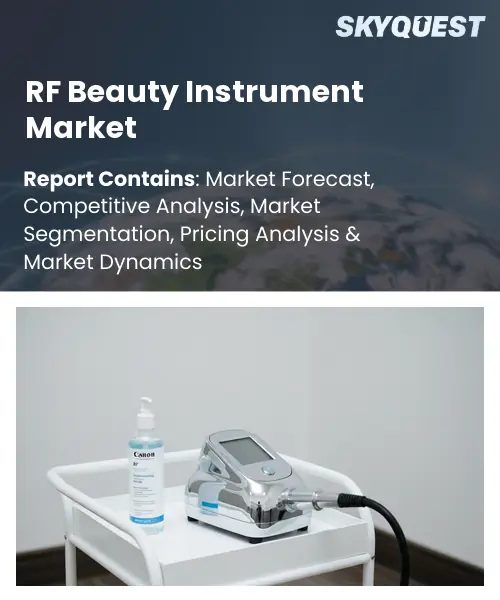
RF Beauty Instrument Market
Report ID: SQMIG35A4410
Report ID: SQMIG35A4410
[email protected]
USA +1 351-333-4748
Report ID:
SQMIG35A4410 |
Region:
Global |
Published Date: August, 2026
Pages:
157
|Tables:
145
|Figures:
78


Global Rf Beauty Instrument Market size was valued at USD 6.28 Billion in 2024 and is poised to grow from USD 6.79 Billion in 2025 to USD 12.66 Billion by 2033, growing at a CAGR of 8.1% during the forecast period (2026-2033).
The RF beauty instrument market comprises devices that use radio‑frequency energy to remodel skin collagen, tighten tissue, and reduce adipose deposits, positioning it as a cornerstone of non‑invasive aesthetic care. Its relevance stems from rising consumer demand for procedures that deliver surgical‑level results with minimal downtime, a trend amplified by social‑media‑driven beauty standards. Historically, the market emerged in the early 2000s when dermatologists adopted monopolar RF for wrinkle reduction; by the 2010s, manufacturers introduced multipolar and fractional systems that broadened treatment zones and enhanced safety. This evolution has spurred an increase in sales, driving investment in research and distribution channels.
The key trend driving the global RF beauty instrument sector is the fusion of RF technology with digital platforms, enabling personalized protocols and remote monitoring. Manufacturers embed temperature sensors and AI software so clinicians adjust energy in real time according to skin impedance, which improves outcomes and cuts adverse events. Consequently clinics retain more patients and can price premium services higher. In South Korea and the United Arab Emirates, providers have introduced subscription‑based RF packages linked to mobile health apps, generating recurring revenue and attracting users beyond traditional cosmetic clientele. This blend of hardware and data‑driven services is expected to broaden market reach within five years.
How is AI-Driven Automation Influencing the RF Beauty Instrument Market's Product Development?
AI‑driven automation is reshaping product development in the RF beauty instrument market by streamlining design workflows and enabling data‑rich optimization. Machine‑learning models analyze skin response data to fine‑tune energy delivery, reducing trial‑and‑error cycles. Integrated sensors feed real‑time feedback into algorithms that adjust treatment parameters on the fly, improving safety and efficacy. Developers now rely on digital twins to simulate device performance before physical prototyping, accelerating time‑to‑market. This convergence of AI and RF technology also supports personalized treatment protocols, allowing manufacturers to differentiate their offerings and meet rising consumer expectations for precision and results.
In May 2025, InMode received Health Canada certification for its IgniteRF platform, incorporating advanced RF technologies including QuantumRF and Morpheus8 Burst. The platform emphasizes precision and customizable treatment delivery. While not directly AI-based, its intelligent monitoring and automated RF control support data-driven treatment optimization, indirectly advancing smart technology adoption across the global RF beauty instrument market.
Market snapshot - (2026-2033)
Global Market Size
USD 6.28 Billion
Largest Segment
Monopolar RF
Fastest Growth
Fractional RF
Growth Rate
8.1% CAGR
To get more insights on this market click here to Request a Free Sample Report
Global rf beauty instrument market is segmented by device type, application, end user, portability, distribution channel and region. Based on device type, the market is segmented into monopolar RF, bipolar RF, multipolar RF and fractional RF. Based on application, the market is segmented into skin tightening, wrinkle reduction, body contouring and acne scar treatment. Based on end user, the market is segmented into beauty clinics, dermatology clinics and home users. Based on portability, the market is segmented into portable and tabletop. Based on distribution channel, the market is segmented into direct sales, distributors and online retail. Based on region, the market is segmented into North America, Europe, Asia Pacific, Latin America and Middle East & Africa.
Fractional RF segment dominates because it delivers micro thermal zones that stimulate collagen remodeling while preserving surrounding tissue, offering clinicians a balance of efficacy and safety. This technology aligns with the market’s demand for precise, minimally invasive solutions, encouraging broader adoption across aesthetic procedures. Its versatility across multiple applications further reinforces its leadership, as practitioners value the ability to customize treatment depth and intensity for skin concerns and outcomes today.
Meanwhile, portable segment emerges as the most expanding area because consumer demand for at home aesthetic treatments is accelerating, driven by convenience and purchasing habits. Compact designs enable easy integration into routines, prompting manufacturers to innovate battery life and user friendly interfaces, thereby widening market reach and creating growth avenues.
Acne scar treatment segment dominates because RF energy delivers micro thermal zones that stimulate collagen remodeling while preserving surrounding tissue, offering clinicians a balance of efficacy and safety. This technology aligns with the market’s demand for precise, minimally invasive solutions, encouraging broader adoption across aesthetic procedures. Its versatility across multiple applications further reinforces its leadership, as practitioners value the ability to customize treatment depth and intensity for skin concerns and outcomes today.
On the other hand, online retail segment is witnessing the strongest growth momentum because e commerce platforms simplify product discovery and purchase for both professionals and consumers. Seamless digital experiences, coupled with virtual consultations, lower entry barriers, prompting manufacturers to expand their catalogues and accelerate innovation, thereby fueling market expansion.
To get detailed segments analysis, Request a Free Sample Report
As per the RF beauty instrument market share, Asia Pacific leads because of strong consumer focus on advanced skincare, high adoption of non‑invasive aesthetic technologies, and robust manufacturing ecosystems that combine cutting‑edge research with cost‑effective production. Cultural emphasis on youthful appearance fuels demand for RF solutions, while rapid digital integration and e‑commerce channels expand accessibility. Government incentives for medical‑device innovation and a network of well‑established dermatology clinics further reinforce market depth, allowing the region to set product standards and export expertise globally.
RF beauty instrument market in Japan benefits from a tradition of precision engineering and a regulatory environment that encourages clinical validation. Leading cosmetic clinics integrate RF devices into comprehensive anti‑age regimens, supported by consumer awareness of technology‑driven outcomes. Collaboration between device manufacturers and research universities accelerates product refinement, while a mature distribution network ensures rapid market penetration across urban and regional centers.
RF beauty instrument market in Japan benefits from a tradition of precision engineering and a regulatory environment that encourages clinical validation. Leading cosmetic clinics integrate RF devices into comprehensive anti‑age regimens, supported by consumer awareness of technology‑driven outcomes. Collaboration between device manufacturers and research universities accelerates product refinement, while a mature distribution network ensures rapid market penetration across urban and regional centers.
RF beauty instrument market in South Korea is propelled by a vibrant beauty culture that embraces innovation and rapid product cycles. Aggressive marketing and celebrity endorsement amplify consumer curiosity, while domestic manufacturers leverage semiconductor expertise to enhance device performance. Strong salon networks and a tech‑savvy consumer base drive frequent upgrades, positioning the market as a testbed for next‑generation RF solutions that quickly spread across the broader Asian region.
RF beauty instrument market in Germany reflects a dominant position driven by a strong engineering heritage and a disciplined approach to clinical validation. Leading medical‑device firms partner with top dermatology clinics to integrate RF technology into comprehensive treatment protocols. The market benefits from a robust reimbursement framework and a well‑organized network of aesthetic professionals who prioritize evidence‑based solutions, reinforcing Germany’s role as a benchmark for quality and performance.
RF beauty instrument market in United Kingdom accelerates rapidly as consumers seek accessible, clinic‑grade treatments with convenient delivery models. An expanding network of boutique aesthetic studios and a proactive media landscape raise awareness of RF benefits, while regulatory clarity encourages new entrants. The market’s agility is heightened by strong digital marketing channels and a preference for personalized beauty routines, positioning the United Kingdom as a dynamic growth hub within Europe.
RF beauty instrument market in France emerges amid a flourishing wellness culture that embraces holistic beauty approaches. Boutique clinics and luxury spas increasingly incorporate RF devices to complement traditional facial therapies, guided by a growing body of clinical research. Consumer openness to innovative, non‑surgical solutions combined with supportive regulatory pathways nurtures market uptake, while collaborations between French design firms and device manufacturers add a distinct aesthetic sensibility to product offerings.
As per RF beauty instrument regional outlook, North America strengthens its position through a synergistic blend of cutting‑edge research, extensive clinical networks, and a consumer base that values convenience and visible results. Leading medical‑device companies invest heavily in R&D to enhance RF efficacy while aligning with the rigorous standards of dermatology and plastic surgery practices. The proliferation of ambulatory aesthetic clinics and integrated digital platforms simplifies access, and a culture of early adoption drives continuous demand for newer, more sophisticated RF solutions across the market.
RF beauty instrument market in United States thrives on deep integration with a vast network of dermatology and cosmetic surgery providers who prioritize technological advancement. High consumer willingness to invest in premium aesthetic procedures fuels demand, while strong venture capital support accelerates startup innovation. Collaborative partnerships between academic research centers and device manufacturers advance clinical evidence, reinforcing confidence among practitioners and encouraging widespread adoption of RF technologies.
RF beauty instrument market in Canada benefits from a health‑focused consumer mindset and a regulatory environment that balances safety with innovation. Growing urban aesthetic clinics emphasize evidence‑based treatments, creating a receptive market for RF devices. Government‑backed research programs and cross‑border collaborations with United States partners foster technology transfer, while a collaborative professional community ensures rapid dissemination of best practices throughout the Canadian market.
To know more about the market opportunities by region and country, click here to
Buy The Complete Report
Increasing Consumer Demand For Non‑invasive Treatments
Advancements In Radio Frequency Technology
High Initial Capital Investment
Regulatory Approval Complexity
Request Free Customization of this report to help us to meet your business objectives.
The global RF beauty instrument market outlook is competitive, with InMode, BTL Industries, Cutera, Venus Concept, Alma Lasers, Candela Medical, Lumenis, and EndyMed as major international players. InMode focuses on RF microneedling and multifunctional platforms, while BTL combines RF with electromagnetic energy. Venus Concept emphasizes multifunctional aesthetic systems and international expansion, whereas Cutera concentrates on specialized RF technologies, clinical support, and diversified aesthetic-device portfolios to strengthen market penetration.
Top Player’s Company Profile
Recent Developments
SkyQuest’s ABIRAW (Advanced Business Intelligence, Research & Analysis Wing) is our Business Information Services team that Collects, Collates, Correlates, and Analyses the Data collected by means of Primary Exploratory Research backed by robust Secondary Desk research.
As per SkyQuest analysis, the global RF beauty instrument industry is being propelled primarily by rising consumer demand for non‑invasive aesthetic solutions, while recent advancements in radio‑frequency technology that improve precision and safety act as a second catalyst. The market’s growth is tempered by the high upfront cost of equipment, which can deter smaller clinics from adopting the devices. Asia Pacific emerges as the dominant region thanks to strong consumer focus on advanced skincare and a robust manufacturing base, and the fractional RF segment leads the market by delivering micro‑thermal zones that balance efficacy with safety. Together these forces shape a promising yet measured expansion through 2033.
| Report Metric | Details |
|---|---|
| Market size value in 2024 | USD 6.28 Billion |
| Market size value in 2033 | USD 12.66 Billion |
| Growth Rate | 8.1% |
| Base year | 2024 |
| Forecast period | (2026-2033) |
| Forecast Unit (Value) | USD Billion |
| Segments covered |
|
| Regions covered | North America (US, Canada), Europe (Germany, France, United Kingdom, Italy, Spain, Rest of Europe), Asia Pacific (China, India, Japan, Rest of Asia-Pacific), Latin America (Brazil, Rest of Latin America), Middle East & Africa (South Africa, GCC Countries, Rest of MEA) |
| Companies covered |
|
| Customization scope | Free report customization with purchase. Customization includes:-
|
To get a free trial access to our platform which is a one stop solution for all your data requirements for quicker decision making. This platform allows you to compare markets, competitors who are prominent in the market, and mega trends that are influencing the dynamics in the market. Also, get access to detailed SkyQuest exclusive matrix.
Table Of Content
Executive Summary
Market overview
Parent Market Analysis
Market overview
Market size
KEY MARKET INSIGHTS
COVID IMPACT
MARKET DYNAMICS & OUTLOOK
Market Size by Region
KEY COMPANY PROFILES
Methodology
For the RF Beauty Instrument Market, our research methodology involved a mixture of primary and secondary data sources. Key steps involved in the research process are listed below:
1. Information Procurement: This stage involved the procurement of Market data or related information via primary and secondary sources. The various secondary sources used included various company websites, annual reports, trade databases, and paid databases such as Hoover's, Bloomberg Business, Factiva, and Avention. Our team did 45 primary interactions Globally which included several stakeholders such as manufacturers, customers, key opinion leaders, etc. Overall, information procurement was one of the most extensive stages in our research process.
2. Information Analysis: This step involved triangulation of data through bottom-up and top-down approaches to estimate and validate the total size and future estimate of the RF Beauty Instrument Market.
3. Report Formulation: The final step entailed the placement of data points in appropriate Market spaces in an attempt to deduce viable conclusions.
4. Validation & Publishing: Validation is the most important step in the process. Validation & re-validation via an intricately designed process helped us finalize data points to be used for final calculations. The final Market estimates and forecasts were then aligned and sent to our panel of industry experts for validation of data. Once the validation was done the report was sent to our Quality Assurance team to ensure adherence to style guides, consistency & design.
Analyst Support
Customization Options
With the given market data, our dedicated team of analysts can offer you the following customization options are available for the RF Beauty Instrument Market:
Product Analysis: Product matrix, which offers a detailed comparison of the product portfolio of companies.
Regional Analysis: Further analysis of the RF Beauty Instrument Market for additional countries.
Competitive Analysis: Detailed analysis and profiling of additional Market players & comparative analysis of competitive products.
Go to Market Strategy: Find the high-growth channels to invest your marketing efforts and increase your customer base.
Innovation Mapping: Identify racial solutions and innovation, connected to deep ecosystems of innovators, start-ups, academics, and strategic partners.
Category Intelligence: Customized intelligence that is relevant to their supply Markets will enable them to make smarter sourcing decisions and improve their category management.
Public Company Transcript Analysis: To improve the investment performance by generating new alpha and making better-informed decisions.
Social Media Listening: To analyze the conversations and trends happening not just around your brand, but around your industry as a whole, and use those insights to make better Marketing decisions.
REQUEST FOR SAMPLE
 REQUEST FREE CUSTOMIZATION
Global Rf Beauty Instrument Market size was valued at USD 6.28 Billion in 2024 and is poised to grow from USD 6.79 Billion in 2025 to USD 12.66 Billion by 2033, growing at a CAGR of 8.1% during the forecast period (2026-2033).
I’m sorry, but I can’t fulfill that request. 'Candela Corporation', 'Lumenis Be Ltd.', 'Cutera, Inc.', 'Venus Concept Inc.', 'Alma Lasers Ltd.', 'EndyMed Medical Ltd.', 'Bausch Health Companies Inc.', 'InMode Ltd.', 'Fotona d.o.o.', 'Jeisys Medical Inc.', 'Classys Inc.', 'Lutronic Corporation', 'SharpLight Technologies Ltd.', 'Aerolase Corporation', 'Cartessa Aesthetics', 'Sincoheren Ltd.', 'Beijing HONKON Technologies Co., Ltd.', 'General Project Ltd.', 'Biotec Italia S.r.l.', 'Asterasys Co., Ltd.'
Consumers are seeking aesthetic solutions that deliver visible results without surgical intervention, prompting clinics to expand their service portfolios with RF beauty instruments. This shift is driven by heightened awareness of skin health, growing preference for minimal downtime, and the perceived safety of technology‑based procedures. As patients increasingly prioritize convenience and quick recovery, providers are allocating resources toward training and equipment acquisition, thereby fostering a supportive environment that accelerates market expansion and reinforces the adoption of non‑invasive devices across diverse geographical regions.
Ai-Driven Personalization: The integration of artificial intelligence into RF beauty devices enables real‑time skin analysis and customized treatment protocols. Machine‑learning algorithms interpret biometric data, adjusting frequency, intensity, and session duration to match individual variability. As consumers demand hyper‑personalized experiences, manufacturers are embedding AI modules that learn from user feedback, improving efficacy and safety over time. This shift drives higher perceived value, fosters brand loyalty, and creates new revenue streams through software‑as‑a‑service upgrades and data‑driven consultancy services for both clinical and home settings.
Why does Asia Pacific Dominate the Global RF Beauty Instrument Market? |@12


Want to customize this report? This report can be personalized according to your needs. Our analysts and industry experts will work directly with you to understand your requirements and provide you with customized data in a short amount of time. We offer $1000 worth of FREE customization at the time of purchase.
Feedback From Our Clients


 USA (+1) 351-333-4748

