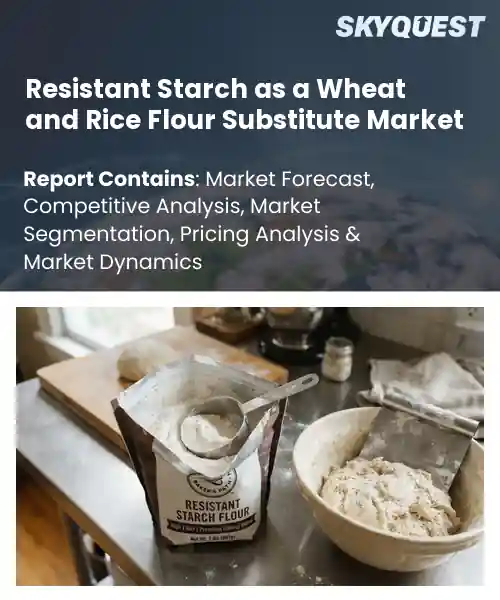
Resistant Starch as a Wheat and Rice Flour Substitute Market
Report ID: SQMIG30I3282
Report ID: SQMIG30I3282
[email protected]
USA +1 351-333-4748
Report ID:
SQMIG30I3282 |
Region:
Global |
Published Date: October, 2026
Pages:
157
|Tables:
150
|Figures:
78


Global Resistant Starch As A Wheat And Rice Flour Substitute Market size was valued at USD 510.0 Million in 2024 and is poised to grow from USD 551.82 Million in 2025 to USD 1036.62 Million by 2033, growing at a CAGR of 8.2% during the forecast period (2026-2033).
The primary driver of the resistant‑starch‑as‑a‑flour‑substitute market is consumer demand for healthier carbohydrate options that lower glycemic response while preserving familiar textures. In this niche, resistant starch derived from modified wheat or rice replaces conventional flour in baked goods, noodles, and snack bars, offering up to 30 % more dietary fiber without altering taste. The market emerged as food manufacturers responded to rising diabetes prevalence and regulatory pressure for nutrition labeling in the early 2010s. Early adopters such as a European bakery chain introduced high‑fiber baguettes, while Asian snack producers launched low‑glycemic rice crackers, illustrating rapid product diversification across global retail channels worldwide today. The next key factor propelling market expansion is the integration of resistant starch into functional‑food formulations that meet clean‑label expectations while delivering health benefits. Manufacturers can claim reduced post‑prandial glucose spikes, a claim that drives pricing and opens distribution in health‑focused supermarkets. Consequently, partnerships between ingredient suppliers and plant‑based protein producers have accelerated, exemplified by a North American snack company that combined rice‑based resistant starch with pea protein to create a high‑fiber, low‑glycemic chip now stocked in chains. This cause‑and‑effect chain consumer health awareness prompting regulatory incentives, which in turn stimulate R&D investment creates a virtuous loop that fuels both product innovation and market penetration.
How is AI-driven formulation accelerating resistant starch adoption as a wheat and rice flour substitute?
AI driven formulation is reshaping how manufacturers replace wheat and rice flour with resistant starch. By feeding large data sets into predictive models, companies can forecast texture, moisture retention and shelf life without lengthy lab tests. This accelerates product cycles and lowers costs, making resistant starch a viable alternative for gluten free breads, snack bars and ready meals. The market is responding to consumer demand for higher fiber and lower glycemic options, and sustainability goals are pushing producers toward plant based ingredients. Early adopters report smoother dough handling and consistent crumb structure, which builds confidence across the supply chain.Ingredion March 2024 launched an AI formulation platform that tailors resistant starch blends for bakery and snack applications, reducing development time and improving functional performance. The technology enables precise substitution of wheat and rice flour, strengthening market growth and operational efficiency. It also supports ingredient sourcing flexibility and aligns with sustainability targets.
Market snapshot - (2026-2033)
Global Market Size
USD 510.0 Million
Largest Segment
Wheat-Based Resistant Starch
Fastest Growth
Other Plant Sources
Growth Rate
8.2% CAGR
To get more insights on this market click here to Request a Free Sample Report
Global resistant starch as a wheat and rice flour substitute market is segmented by source, type, application, function, end user and region. Based on source, the market is segmented into Corn-Based Resistant Starch, Potato-Based Resistant Starch, Wheat-Based Resistant Starch and Other Plant Sources. Based on type, the market is segmented into RS1, RS2, RS3 and RS4. Based on application, the market is segmented into Bakery Products, Pasta & Noodles, Snacks, Cereals & Breakfast Products and Other Food Applications. Based on function, the market is segmented into Flour Replacement, Texture Improvement, Fiber Enrichment and Glycemic Reduction. Based on end user, the market is segmented into Food Manufacturers, Bakery Manufacturers, Foodservice and Household Consumers. Based on region, the market is segmented into North America, Europe, Asia Pacific, Latin America and Middle East & Africa.
Flour Replacement segment dominates because it directly addresses the core need of substituting wheat and rice flours with resistant starch, offering manufacturers a seamless ingredient swap without compromising product integrity. Its versatility across multiple product lines, from breads to noodles, builds confidence among formulators. Moreover, the functional synergy of fiber enrichment and texture stability reinforces its appeal, making it the go to solution for cost effective, health focused reformulations in the evolving market landscape.
However, Glycemic Reduction segment is witnessing the strongest growth momentum because rising consumer awareness of blood sugar management drives demand for low glycemic ingredients. Innovative processing techniques enhance its functional profile, enabling broader application in health focused snacks and beverages. This momentum fuels product pipelines and expands market opportunities for manufacturers globally.
Corn-Based Resistant Starch segment leads because its abundant raw material supply and established processing infrastructure enable cost effective production at scale. The familiar corn origin aligns with consumer acceptance, while its functional properties water absorption and stable retrogradation enhance dough handling and shelf life. These advantages position it as the preferred choice for manufacturers seeking flour substitution its versatility supports a wide range of baked and extruded items, enhancing formulation flexibility.
Meanwhile, Other Plant Sources segment is emerging as the key high growth area because emerging sustainability mandates and consumer preference for novel non cereal fibers drive interest. Advances in extraction technologies improve functionality, allowing integration into gluten free and allergen free formulations. This momentum expands market reach and creates new product innovation pathways significantly.
To get detailed segments analysis, Request a Free Sample Report
The region benefits from a confluence of deep culinary traditions that value texture and health, paired with a rapidly evolving consumer palate that seeks functional ingredients. Strong governmental support for food innovation encourages research institutions and major flour producers to collaborate on fiber‑rich solutions. Large manufacturers leverage extensive supply chains to integrate resistant starch into staple products, while rising awareness of digestive health drives demand across both urban and emerging markets. Moreover, cultural acceptance of alternative grains and a proactive approach to dietary diversification reinforce the region’s leadership, positioning Asia Pacific as the primary engine for product development, market penetration, and consumer education in this niche.
Resistant Starch as a Wheat and Rice Flour Substitute Market in Japan is propelled by a cultural emphasis on longevity and preventive nutrition, encouraging manufacturers to embed functional fibers into traditional bakery and noodle items. Collaborative research between universities and food corporations accelerates ingredient optimization, while consumers readily adopt products that align with low‑glycemic and gut‑health narratives. Retail channels showcase fortified snacks, reinforcing the perception of added value and supporting market momentum.
Resistant Starch as a Wheat and Rice Flour Substitute Market in South Korea flourishes under a strong trend toward health‑focused snacking and convenience foods. Government‑backed initiatives promote dietary fiber intake, prompting bakeries and ready‑meal producers to experiment with resistant starch blends. Consumer enthusiasm for innovative textures and perceived digestive benefits drives brand differentiation, while foodservice establishments incorporate the ingredient into fusion dishes, expanding its reach beyond packaged goods.
Consumer demand for plant‑based and fiber‑rich products fuels a dynamic environment where manufacturers seek to enhance nutritional profiles without sacrificing functionality. Strong research ecosystems and advanced processing capabilities enable scalable production of high‑quality resistant starch, meeting the expectations of health‑conscious shoppers. Retailers prioritize shelf‑stable, clean‑label offerings, encouraging extensive trials in baked goods, cereals, and snack bars. Collaborative ventures between ingredient suppliers and food innovators accelerate product pipelines, while educational campaigns underscore digestive benefits, reinforcing purchasing decisions and sustaining market acceleration across the continent.
Resistant Starch as a Wheat and Rice Flour Substitute Market in the United States thrives on a robust ecosystem of food‑tech startups and established manufacturers pursuing wellness trends. Consumer openness to functional ingredients drives experimentation in gluten‑free and high‑fiber formulations. Large retail chains allocate premium shelf space to fortified products, reinforcing visibility. Academic research institutions partner with industry to refine processing methods, ensuring consistency and taste, while nutrition advocacy groups amplify health messaging, further energizing demand.
Resistant Starch as a Wheat and Rice Flour Substitute Market in Canada benefits from strong public health initiatives that encourage increased dietary fiber consumption. Food processors integrate the ingredient into a range of bakery and cereal offerings to meet label claims and consumer expectations. Collaborative projects between government agencies and research centres focus on sustainable sourcing and product innovation, while consumer awareness of gut health sustains interest in fortified options across both urban and regional markets.
European stakeholders are advancing the market through coordinated policy frameworks that prioritize sustainable nutrition and fiber enrichment. Industry consortia foster knowledge exchange, enabling seamless adoption of resistant starch across bakery, confectionery, and dairy alternatives. A shared emphasis on clean‑label ingredients resonates with consumers seeking transparency, prompting brands to highlight functional benefits. Investment in advanced extrusion and milling technologies ensures product consistency while meeting stringent regulatory standards. Cross‑border collaborations amplify research outputs, positioning Europe as a hub for innovative applications and reinforcing its competitive edge in the global landscape.
Resistant Starch as a Wheat and Rice Flour Substitute Market in Germany is shaped by a strong tradition of scientific rigor and a consumer base that values health‑enhancing foods. Food manufacturers integrate the ingredient into whole‑grain breads and snack formulations, aligning with market expectations for natural fortification. Collaborative networks between research institutes and industry accelerate product development, while sustainability considerations guide ingredient sourcing, reinforcing Germany’s leadership in functional food innovation.
Resistant Starch as a Wheat and Rice Flour Substitute Market in the United Kingdom is driven by heightened public interest in gut health and dietary fiber. Leading bakeries and convenience brands experiment with resistant starch to improve texture and nutritional claims, while retail chains highlight fortified options within health‑focused aisles. Academic partnerships provide insight into consumer behavior, supporting strategic rollouts of enriched products across diverse market segments.
Resistant Starch as a Wheat and Rice Flour Substitute Market in France benefits from a culinary culture that embraces innovation while honoring traditional techniques. Artisan bakers and large‑scale producers alike adopt the ingredient to enhance fiber content without compromising flavor. Government nutrition programs encourage the inclusion of functional fibers, and collaborative research between culinary schools and ingredient specialists drives creative applications, solidifying France’s role in advancing the market within the European context.
To know more about the market opportunities by region and country, click here to
Buy The Complete Report
Rising Demand for Low‑Glycemic Foods
Food Manufacturers leveraging Functional Ingredients
Higher Cost of Resistant Starch
Supply Constraints for Specialty Flours
Request Free Customization of this report to help us to meet your business objectives.
Top Player’s Company Profile
Recent Developments
SkyQuest’s ABIRAW (Advanced Business Intelligence, Research & Analysis Wing) is our Business Information Services team that Collects, Collates, Correlates, and Analyses the Data collected by means of Primary Exploratory Research backed by robust Secondary Desk research. As per SkyQuest analysis, the market is propelled primarily by rising consumer demand for low‑glycemic foods, which encourages manufacturers to swap wheat and rice flours with resistant starch to maintain taste while lowering blood‑sugar impact. A second important driver is the widespread adoption of functional‑ingredient strategies, where producers exploit resistant starch’s fiber and texture benefits to launch clean‑label, health‑focused products. The flour‑replacement segment leads the market because it directly addresses the core need for seamless ingredient swaps across baked goods, noodles and snacks. Asia Pacific dominates globally, supported by strong culinary traditions, government innovation incentives and extensive supply networks. The main restraint remains the higher cost of resistant starch, which can limit price‑sensitive adoption.
| Report Metric | Details |
|---|---|
| Market size value in 2024 | USD 510.0 Million |
| Market size value in 2033 | USD 1036.62 Million |
| Growth Rate | 8.2% |
| Base year | 2024 |
| Forecast period | (2026-2033) |
| Forecast Unit (Value) | USD Million |
| Segments covered |
|
| Regions covered | North America (US, Canada), Europe (Germany, France, United Kingdom, Italy, Spain, Rest of Europe), Asia Pacific (China, India, Japan, Rest of Asia-Pacific), Latin America (Brazil, Rest of Latin America), Middle East & Africa (South Africa, GCC Countries, Rest of MEA) |
| Companies covered |
|
| Customization scope | Free report customization with purchase. Customization includes:-
|
To get a free trial access to our platform which is a one stop solution for all your data requirements for quicker decision making. This platform allows you to compare markets, competitors who are prominent in the market, and mega trends that are influencing the dynamics in the market. Also, get access to detailed SkyQuest exclusive matrix.
Table Of Content
Executive Summary
Market overview
Parent Market Analysis
Market overview
Market size
KEY MARKET INSIGHTS
COVID IMPACT
MARKET DYNAMICS & OUTLOOK
Market Size by Region
KEY COMPANY PROFILES
Methodology
For the Resistant Starch as a Wheat and Rice Flour Substitute Market, our research methodology involved a mixture of primary and secondary data sources. Key steps involved in the research process are listed below:
1. Information Procurement: This stage involved the procurement of Market data or related information via primary and secondary sources. The various secondary sources used included various company websites, annual reports, trade databases, and paid databases such as Hoover's, Bloomberg Business, Factiva, and Avention. Our team did 45 primary interactions Globally which included several stakeholders such as manufacturers, customers, key opinion leaders, etc. Overall, information procurement was one of the most extensive stages in our research process.
2. Information Analysis: This step involved triangulation of data through bottom-up and top-down approaches to estimate and validate the total size and future estimate of the Resistant Starch as a Wheat and Rice Flour Substitute Market.
3. Report Formulation: The final step entailed the placement of data points in appropriate Market spaces in an attempt to deduce viable conclusions.
4. Validation & Publishing: Validation is the most important step in the process. Validation & re-validation via an intricately designed process helped us finalize data points to be used for final calculations. The final Market estimates and forecasts were then aligned and sent to our panel of industry experts for validation of data. Once the validation was done the report was sent to our Quality Assurance team to ensure adherence to style guides, consistency & design.
Analyst Support
Customization Options
With the given market data, our dedicated team of analysts can offer you the following customization options are available for the Resistant Starch as a Wheat and Rice Flour Substitute Market:
Product Analysis: Product matrix, which offers a detailed comparison of the product portfolio of companies.
Regional Analysis: Further analysis of the Resistant Starch as a Wheat and Rice Flour Substitute Market for additional countries.
Competitive Analysis: Detailed analysis and profiling of additional Market players & comparative analysis of competitive products.
Go to Market Strategy: Find the high-growth channels to invest your marketing efforts and increase your customer base.
Innovation Mapping: Identify racial solutions and innovation, connected to deep ecosystems of innovators, start-ups, academics, and strategic partners.
Category Intelligence: Customized intelligence that is relevant to their supply Markets will enable them to make smarter sourcing decisions and improve their category management.
Public Company Transcript Analysis: To improve the investment performance by generating new alpha and making better-informed decisions.
Social Media Listening: To analyze the conversations and trends happening not just around your brand, but around your industry as a whole, and use those insights to make better Marketing decisions.
REQUEST FOR SAMPLE
 REQUEST FREE CUSTOMIZATION


Want to customize this report? This report can be personalized according to your needs. Our analysts and industry experts will work directly with you to understand your requirements and provide you with customized data in a short amount of time. We offer $1000 worth of FREE customization at the time of purchase.
Feedback From Our Clients


 USA (+1) 351-333-4748

