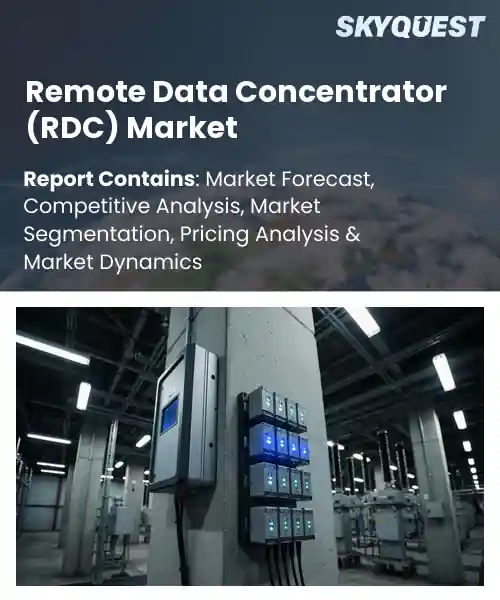
Remote Data Concentrator (RDC) Market
Report ID: SQMIG45K2245
Report ID: SQMIG45K2245
[email protected]
USA +1 351-333-4748
Report ID:
SQMIG45K2245 |
Region:
Global |
Published Date: March, 2026
Pages:
157
|Tables:
116
|Figures:
77


Global Remote Data Concentrator (Rdc) Market size was valued at USD 0.75 Billion in 2024 and is poised to grow from USD 0.81 Billion in 2025 to USD 1.5 Billion by 2033, growing at a CAGR of 8.0% during the forecast period (2026-2033).
The primary driver of the remote data concentrator market is the rapid proliferation of distributed sensors and endpoints across utilities, industry and cities, which creates an urgent need to collect, filter and forward telemetry at scale. Remote data concentrators aggregate meter, sensor and control signals, normalize protocols and provide analytics so operators can improve reliability, reduce outages and optimize maintenance. The market evolved from terminal units and simple data loggers into multifunctional edge devices supporting IEC protocols, IP networks and cloud APIs. For example, smart grid deployments across Europe and North America and oilfield telemetry in Asia show this progression.Building on this progression, regulatory mandates for grid resilience combined with utility digitalization initiatives drive demand for remote data concentrators because organizations must gather granular data and demonstrate compliance. As distributed generation and EV charging proliferate, data volumes and control points multiply, which compels operators to deploy RDCs with edge analytics to reduce bandwidth and speed fault detection. Improvements in cellular networks and 5G lower latency, making remote control feasible and expanding RDCs into microgrid control. These shifts create opportunities for vendors offering integrated hardware and SaaS analytics, evidenced by pilots aggregating smart meter and oilfield telemetry for predictive maintenance.
How is IoT adoption impacting the remote data concentrator (RDC) market?
IoT adoption is turning remote data concentrators into intelligent edge platforms that do more than collect meter readings. Key aspects include pervasive sensor connectivity richer telemetry and local analytics that reduce cloud load and speed operational response. The current market sees utilities replacing legacy concentrators with IoT ready devices that support diverse protocols stronger security and cloud integration. This evolution enables modular hardware and software upgrades and supports predictive maintenance and faster fault isolation. Examples in the field include tighter integration with smart meters distribution automation and EV charging infrastructure which makes data more timely and actionable for grid balancing and outage restoration.Landis+Gyr 02/2026, showcased IoT ready data concentrators and edge intelligence at DTECH which streamlines meter aggregation and enables local analytics. That development supports market growth by improving operational efficiency and by enabling quicker integration of distributed energy resources through richer telemetry and device orchestration at the edge.
Market snapshot - (2026-2033)
Global Market Size
USD 0.75 Billion
Largest Segment
Smart Grid & Power Distribution
Fastest Growth
Industrial IoT (IIoT) Factory Floors
Growth Rate
8.0% CAGR
To get more insights on this market click here to Request a Free Sample Report
Global remote data concentrator (rdc) market is segmented by application domain, communication protocol, architecture/complexity, end-use vertical and region. Based on application domain, the market is segmented into Aerospace & Defense, Smart Grid & Power Distribution and Industrial IoT (IIoT) Factory Floors. Based on communication protocol, the market is segmented into ARINC 429 / AFDX, Modbus/Profibus and Wireless. Based on architecture/complexity, the market is segmented into Discrete RDC Units and Integrated Modular Avionics (IMA) Components. Based on end-use vertical, the market is segmented into Commercial Aircraft, Military UAVs & Fighter Jets and Energy & Utilities Infrastructure. Based on region, the market is segmented into North America, Europe, Asia Pacific, Latin America and Middle East & Africa.
ARINC 429 / AFDX segment dominates because avionics ecosystems demand deterministic, certified data buses that align directly with remote data concentrator functions, enabling predictable telemetry aggregation and stringent timing. The protocol maturity enforces interoperability and compliance, which reduces integration risk and accelerates OEM adoption. As a result system designers favor RDCs built around these interfaces, driving suppliers to prioritize certified porting, diagnostics and redundancy that sustain mission critical aircraft operations.
However, Wireless is the most rapidly expanding area because factory and sensor networks favor flexible RDC placement and simplified retrofits, reducing installation burden. Secure wireless stacks and low power mesh designs enable untethered telemetry, driving new use cases and vendor innovation that open wider integration opportunities for RDCs across industrial control environments.
Wireless segment dominates because factory floors demand flexible, low cost connectivity that enables remote data concentrators to be placed at optimal measurement points without extensive cabling, reducing downtime during upgrades and supporting mobile equipment. The proliferation of industrial wireless standards and improved reliability encourages integrators to design RDCs with native wireless stacks, driving supplier focus on hardened radios, edge analytics and lifecycle management that together simplify deployment and maintenance in complex manufacturing environments.
However, Modbus/Profibus is emerging as the most rapidly expanding area because brownfield plants require reliable serial and fieldbus integration, prompting RDC vendors to add protocol gateway and translation features. Strong demand for predictable industrial control loops and interoperability drives retrofit projects, enabling vendors to monetize integration services and expand RDC footprints across legacy operations.
To get detailed segments analysis, Request a Free Sample Report
North America dominates the global Remote Data Concentrator (RDC) market due to a convergence of mature infrastructure, deep technology adoption across utilities and industrial sectors, and a dense ecosystem of solution providers and integrators. Widespread digitization initiatives in smart grid, oil and gas, and healthcare drive demand for reliable edge aggregation and protocol translation capabilities. Strong market confidence and supportive regulatory frameworks encourage pilot to production transitions, while abundant technical expertise and investment capacity enable rapid deployment of secure, scalable RDC solutions. Emphasis on interoperability and cybersecurity further strengthens procurement preferences for advanced RDC offerings, solidifying the region as a primary hub for innovation, implementation, and commercial scale up. Collaborations among utilities, original equipment manufacturers and software vendors accelerate integration of RDC into broader operational architectures. Presence of standards bodies and active participation in protocol development reinforce North America market leadership and influence global interoperability norms.
Remote Data Concentrator (RDC) Market United States Remote Data Concentrator deployments benefit from a large base of utility and industrial operators that prioritize resilience and interoperability. Vendors and integrators collaborate closely with system operators to tailor edge aggregation, protocol bridging and cyber resilient architectures. Emphasis on standards alignment and rigorous security testing informs procurement decisions, while an active vendor landscape and demand for operational continuity drive refinement of RDC features.
Remote Data Concentrator (RDC) Market Canada implementations reflect diverse geography and emphasis on remote connectivity and resilience. Utilities, indigenous and municipal operators prioritize ruggedized RDC units for integration with microgrids and distributed generation. Vendors adapt solutions for low bandwidth environments and strong security requirements, enabling reliable aggregation and protocol mediation. Collaborative pilots between technology providers and grid operators foster tailored deployment approaches that balance reliability, interoperability and local operational needs.
Rapid expansion of the Remote Data Concentrator market in Asia Pacific is driven by a combination of accelerating digitalization across manufacturing, utilities and urban infrastructure, and by regional emphasis on automation and resilience. Strong demand emerges from semiconductor fabrication, smart city programs and distributed energy projects that require local aggregation and protocol mediation at the network edge. Local engineering talent and vendor specialization create tailored RDC configurations for dense industrial campuses and constrained connectivity environments. Cross border collaboration between global technology providers and regional integrators expedites knowledge transfer, while regulatory focus on operational reliability and localized supply chain availability supports faster adoption. The resulting market dynamic favors agile, interoperable RDC solutions adapted to varied operational contexts across the region. Investment in edge orchestration capabilities further underpins deployment momentum.
Remote Data Concentrator (RDC) Market Japan industrial and utilities customers demand high reliability, compact form factors and close integration with factory automation. Local vendors and integrators prioritize deterministic communications and standards alignment for demanding operational cycles. Focus on equipment longevity and rigorous testing produces RDC solutions built for sustained field performance. Collaboration among manufacturers, utilities and research institutions supports steady innovation that customizes RDC capabilities for domestic automation needs today.
Remote Data Concentrator (RDC) Market South Korea demand is shaped by advanced manufacturing clusters and strong telecommunication capabilities that enable low latency edge deployments. System integrators and equipment manufacturers design RDC solutions to support dense industrial sites and diverse protocol ecosystems. Emphasis on interoperability testing and high throughput hardware meets stringent operational expectations. Public and private collaboration promotes tailored RDC deployments that complement priorities for industrial efficiency and digital transformation.
Europe is strengthening its position in the Remote Data Concentrator market through coordinated modernization efforts across utilities, manufacturing and transport sectors, coupled with emphasis on interoperability and regulatory compliance. Regional initiatives to integrate distributed energy resources and retrofit legacy control systems create demand for adaptable, standards friendly RDC solutions. Strong engineering heritage and a dense network of specialized vendors support modular and secure product designs suited to diverse national grid practices. Cross border collaboration among operators and harmonization of technical requirements enable scalable deployments, while attention to data protection and functional safety bolsters market confidence in European RDC offerings. Investment in research and close ties between equipment makers and academic centers accelerate protocol optimization and field validation. Emphasis on retrofitability and lifecycle support positions European vendors to meet operator demand for long term integration and maintenance.
Remote Data Concentrator (RDC) Market Germany benefits from robust industrial automation demand and focus on energy sector modernization. Engineering quality and rigorous certification encourage adoption of durable, secure RDC platforms. System integrators apply local expertise to embed RDC solutions within manufacturing and grid control architectures, supporting interoperability with legacy systems. Collaborative testing facilities and dense supplier ecosystem enable tailored designs that satisfy stringent operational expectations in industry and utilities sectors.
Remote Data Concentrator (RDC) Market United Kingdom activity is driven by utility modernization and a strong services sector that supports system integration and managed deployments. Emphasis on security and compliance with operational standards shapes vendor offerings toward resilient, auditable RDC platforms. Integration with distribution automation and monitoring programs encourages modular deployments. Consultancy and engineering firms accelerate tailored RDC adoption that aligns with operator governance and reliability priorities and operational resilience.
Remote Data Concentrator (RDC) Market France reflects energy transition priorities and an established utilities sector that values operational stability. Vendors and integrators prioritize scalable, serviceable RDC designs suitable for centralized and distributed generation. Focus on robust communication stacks and secure remote management supports varied field conditions. Collaboration among utilities, manufacturers and research organizations drives tailored RDC solutions that enhance grid flexibility and maintenance efficiency and support long term planning effectively.
To know more about the market opportunities by region and country, click here to
Buy The Complete Report
Growth In IoT Device Integration
Demand For Real Time Monitoring
Limited Interoperability With Legacy Systems
Data Security and Privacy Concerns
Request Free Customization of this report to help us to meet your business objectives.
Competition in the global Remote Data Concentrator market is intensifying as vendors use targeted M&A, cloud partnerships and edge innovations to win utility contracts and lock in managed services. Notable moves include Itron’s integration of Silver Spring and its Azure collaboration for cloud MDMS, and Landis+Gyr’s acquisitions to add cybersecurity and EV capabilities, driving faster uptake of NB-IoT, 5G backhaul and edge compute in AMI architectures.
Top Player’s Company Profile
Recent Developments
SkyQuest’s ABIRAW (Advanced Business Intelligence, Research & Analysis Wing) is our Business Information Services team that Collects, Collates, Correlates, and Analyses the Data collected by means of Primary Exploratory Research backed by robust Secondary Desk research. As per SkyQuest analysis, a key driver is the rapid proliferation of distributed sensors and endpoints that require edge aggregation and protocol normalization, and a second driver is regulatory mandates and utility digitalization pushing granular telemetry and compliance. A key restraint is limited interoperability with legacy systems, which increases integration complexity and deployment timelines. The dominating region is North America given mature infrastructure, strong utility digitization and supplier ecosystems, while the dominating segment is ARINC 429 / AFDX where certified deterministic avionics interfaces favor RDC adoption. Vendors focusing on edge analytics and secure modular designs are best positioned to capture growth.
| Report Metric | Details |
|---|---|
| Market size value in 2024 | USD 0.75 Billion |
| Market size value in 2033 | USD 1.5 Billion |
| Growth Rate | 8.0% |
| Base year | 2024 |
| Forecast period | (2026-2033) |
| Forecast Unit (Value) | USD Billion |
| Segments covered |
|
| Regions covered | North America (US, Canada), Europe (Germany, France, United Kingdom, Italy, Spain, Rest of Europe), Asia Pacific (China, India, Japan, Rest of Asia-Pacific), Latin America (Brazil, Rest of Latin America), Middle East & Africa (South Africa, GCC Countries, Rest of MEA) |
| Companies covered |
|
| Customization scope | Free report customization with purchase. Customization includes:-
|
To get a free trial access to our platform which is a one stop solution for all your data requirements for quicker decision making. This platform allows you to compare markets, competitors who are prominent in the market, and mega trends that are influencing the dynamics in the market. Also, get access to detailed SkyQuest exclusive matrix.
Table Of Content
Executive Summary
Market overview
Parent Market Analysis
Market overview
Market size
KEY MARKET INSIGHTS
COVID IMPACT
MARKET DYNAMICS & OUTLOOK
Market Size by Region
KEY COMPANY PROFILES
Methodology
For the Remote Data Concentrator (RDC) Market, our research methodology involved a mixture of primary and secondary data sources. Key steps involved in the research process are listed below:
1. Information Procurement: This stage involved the procurement of Market data or related information via primary and secondary sources. The various secondary sources used included various company websites, annual reports, trade databases, and paid databases such as Hoover's, Bloomberg Business, Factiva, and Avention. Our team did 45 primary interactions Globally which included several stakeholders such as manufacturers, customers, key opinion leaders, etc. Overall, information procurement was one of the most extensive stages in our research process.
2. Information Analysis: This step involved triangulation of data through bottom-up and top-down approaches to estimate and validate the total size and future estimate of the Remote Data Concentrator (RDC) Market.
3. Report Formulation: The final step entailed the placement of data points in appropriate Market spaces in an attempt to deduce viable conclusions.
4. Validation & Publishing: Validation is the most important step in the process. Validation & re-validation via an intricately designed process helped us finalize data points to be used for final calculations. The final Market estimates and forecasts were then aligned and sent to our panel of industry experts for validation of data. Once the validation was done the report was sent to our Quality Assurance team to ensure adherence to style guides, consistency & design.
Analyst Support
Customization Options
With the given market data, our dedicated team of analysts can offer you the following customization options are available for the Remote Data Concentrator (RDC) Market:
Product Analysis: Product matrix, which offers a detailed comparison of the product portfolio of companies.
Regional Analysis: Further analysis of the Remote Data Concentrator (RDC) Market for additional countries.
Competitive Analysis: Detailed analysis and profiling of additional Market players & comparative analysis of competitive products.
Go to Market Strategy: Find the high-growth channels to invest your marketing efforts and increase your customer base.
Innovation Mapping: Identify racial solutions and innovation, connected to deep ecosystems of innovators, start-ups, academics, and strategic partners.
Category Intelligence: Customized intelligence that is relevant to their supply Markets will enable them to make smarter sourcing decisions and improve their category management.
Public Company Transcript Analysis: To improve the investment performance by generating new alpha and making better-informed decisions.
Social Media Listening: To analyze the conversations and trends happening not just around your brand, but around your industry as a whole, and use those insights to make better Marketing decisions.
REQUEST FOR SAMPLE
 REQUEST FREE CUSTOMIZATION


Want to customize this report? This report can be personalized according to your needs. Our analysts and industry experts will work directly with you to understand your requirements and provide you with customized data in a short amount of time. We offer $1000 worth of FREE customization at the time of purchase.
Feedback From Our Clients


 USA (+1) 351-333-4748

