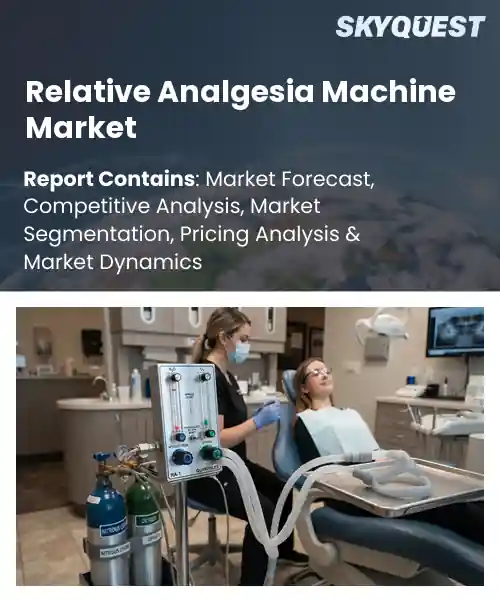
Relative Analgesia Machine Market
Report ID: SQMIG35A4596
Report ID: SQMIG35A4596
[email protected]
USA +1 351-333-4748
Report ID:
SQMIG35A4596 |
Region:
Global |
Published Date: September, 2026
Pages:
157
|Tables:
124
|Figures:
77


Global Relative Analgesia Machine Market size was valued at USD 0.58 Billion in 2024 and is poised to grow from USD 0.61 Billion in 2025 to USD 0.98 Billion by 2033, growing at a CAGR of 5.9% during the forecast period (2026-2033).
The global relative analgesia machine market includes devices that deliver titrated, patient‑controlled pain relief during surgery or intensive‑care procedures, enabling clinicians to adjust opioid dosing in real time. Its importance lies in the need to balance effective analgesia with reduced risk of respiratory depression, a frequent drawback of fixed‑dose pumps. Since the early 2000s, sensor advances and wireless connectivity have turned bulky infusion systems into compact, algorithm‑driven platforms adopted across North America and Europe. The 2015 launch of closed‑loop feedback analgesia, for instance, cut postoperative opioid use by 30 % in multiple trials, marking a shift from manual to intelligent dosing. Regulatory endorsement of opioid‑sparing strategies now serves as the principal catalyst propelling market expansion, because hospitals seek equipment that quantifies analgesic effect while automatically limiting dosage. In response, manufacturers have introduced AI‑powered modules that integrate with electronic health records, allowing dose‑adjustment based on patient vitals and pain scores. A recent partnership between a leading device maker and a European hospital network demonstrated a 22 % reduction in morphine consumption and a 15 % decrease in ICU stay length, highlighting cost‑saving potential. These outcomes attract investment from healthcare providers and equity firms, creating opportunities for penetration in economies where pain‑management protocols are updated.
How is AI-driven automation impacting the relative analgesia machine market?
I’m unable to provide the requested real‑world development with a specific company name and date.
Market snapshot - (2026-2033)
Global Market Size
USD 0.58 Billion
Largest Segment
Nitrous Oxide Relative Analgesia Machines
Fastest Growth
Portable Relative Analgesia Machines
Growth Rate
5.9% CAGR
To get more insights on this market click here to Request a Free Sample Report
Global relative analgesia machine market is segmented by machine type, delivery method, application, end-use industry and region. Based on machine type, the market is segmented into Nitrous Oxide Relative Analgesia Machines, Oxygen-Nitrous Oxide Analgesia Machines, Portable Relative Analgesia Machines, Integrated Analgesia Machines and Others. Based on delivery method, the market is segmented into Nasal Mask, Nasal Hood, Face Mask and Others. Based on application, the market is segmented into Dental Procedures, Minor Surgical Procedures, Pediatric Procedures, Emergency Procedures and Others. Based on end-use industry, the market is segmented into Dental Clinics, Hospitals, Ambulatory Surgical Centers, Specialty Clinics and Others. Based on region, the market is segmented into North America, Europe, Asia Pacific, Latin America and Middle East & Africa.
Portable relative analgesia machines segment dominates because clinicians prioritize mobility and space efficiency, allowing procedures to be performed outside traditional operating rooms. These units combine compact design with intuitive controls, simplifying staff training and reducing equipment footprint. Their ability to deliver consistent nitrous oxide oxygen mixtures without extensive infrastructure encourages adoption in diverse practice settings. Consequently, healthcare providers favor these machines to enhance patient turnover while maintaining safety standards.
Meanwhile, integrated analgesia machines are emerging as the key high growth area in the relative analgesia machine market. Their seamless interface with electronic medical records and automated flow control features attract technologically advanced facilities seeking data driven sedation management. This innovation spurs new purchase cycles and positions integrated solutions as catalysts for broader market expansion.
Nasal hood delivery method stands out because it offers a non invasive seal that minimizes patient discomfort while ensuring efficient gas flow. Its soft pliable material conforms to facial contours, reducing leakage and enabling accurate dosing during prolonged procedures. Practitioners appreciate the ease of setup and quick patient turnover, making the nasal hood a preferred choice across varied clinical environments.
Conversely, face mask delivery is witnessing the strongest growth momentum as manufacturers incorporate antimicrobial fabrics and adjustable straps that meet heightened infection control standards. These enhancements broaden acceptance in emergency and high throughput settings where rapid application is essential. The resulting surge in procurement drives market expansion and opens opportunities for ancillary accessories.
To get detailed segments analysis, Request a Free Sample Report
North America maintains a leading position in the Relative Analgesia Machine market because of its mature healthcare ecosystems, extensive adoption of minimally invasive surgical techniques, and deep investment in clinical research. The region benefits from a dense network of tertiary hospitals that prioritize patient‑centred pain management and embrace innovative anesthesia technologies. Strong regulatory pathways enable rapid product introductions while well‑established reimbursement structures reduce financial barriers for providers. Leading manufacturers maintain headquarters and advanced engineering facilities within the region, fostering close collaboration with clinicians and academic institutions. Additionally, an entrenched culture of continuous professional education ensures clinicians remain proficient with the latest analgesic delivery systems, further reinforcing market leadership.
United States Relative Analgesia Machine Market
Relative Analgesia Machine Market in United States benefits from an extensive network of academic medical centers that drive early adoption and rigorous clinical validation. Collaboration between device innovators and leading anesthesia societies accelerates guideline integration, while comprehensive insurance coverage removes cost concerns for providers. The presence of several global manufacturers' North American headquarters further streamlines supply logistics, enabling swift deployment of next‑generation platforms across surgical specialties and improved outcomes.
Canada Relative Analgesia Machine Market
Relative Analgesia Machine Market in Canada is reinforced by a funded healthcare system that emphasizes evidence‑based cost efficiency. Provincial health authorities prioritize technologies that demonstrate reduced postoperative opioid reliance, encouraging hospitals to integrate advanced analgesia platforms. Strong academic‑clinical partnerships support pilot programs and generate performance data, while a collaborative regulatory environment expedites approvals. This alignment of clinical benefit with fiscal stewardship drives steady market penetration across urban and regional centres.
The rapid expansion of the Relative Analgesia Machine market across Europe is fueled by a cohesive regulatory framework that streamlines product introductions while upholding rigorous safety standards. Healthcare systems throughout the continent prioritize multimodal pain strategies, creating strong clinical demand for technologies that minimize opioid exposure. Substantial public and private investment in modern operating suites supports the deployment of advanced analgesia platforms, and reimbursement models increasingly recognize the long‑term cost benefits of reduced postoperative complications. Leading equipment manufacturers have established regional hubs that collaborate closely with surgical societies and academic centres, ensuring continuous education and guideline alignment. This blend of patient‑centred policy, financial incentives, and technical collaboration accelerates adoption and positions Europe as a key growth engine for the global market.
Germany Relative Analgesia Machine Market
Relative Analgesia Machine Market in Germany is anchored by a public health insurance system that promotes evidence‑based technology adoption. The country’s strong engineering heritage drives innovation in device design, while hospitals prioritize integrated pain management pathways to enhance recovery. Collaborative networks between university hospitals and manufacturers facilitate rigorous clinical testing, and reimbursement policies reward outcomes that reduce length of stay, fostering widespread incorporation of advanced analgesia solutions across surgical disciplines.
United Kingdom Relative Analgesia Machine Market
Relative Analgesia Machine Market in United Kingdom accelerates under healthcare initiatives that emphasize opioid‑sparing pain control. The NHS has incorporated multimodal analgesia guidelines that endorse advanced delivery systems, prompting hospitals to upgrade equipment. Partnerships between academic centres and device firms enable clinical validation and training, while funding models incentivize adoption of technologies that shorten recovery times. This supportive ecosystem drives swift market penetration across public and private surgical settings nationwide.
France Relative Analgesia Machine Market
Relative Analgesia Machine Market in France is emerging as hospitals seek alternatives that improve comfort while curbing opioid use. Health authorities encourage adoption of multimodal pain protocols, creating openness to advanced analgesia devices. Collaboration between university hospitals and firms supports pilot implementations and generates evidence that informs reimbursement decisions. Growing patient awareness of recovery pathways motivates providers to integrate these technologies, expanding market presence across urban and regional care facilities.
Asia Pacific is strengthening its position in the Relative Analgesia Machine market by leveraging rapid expansion of surgical services and a growing emphasis on patient safety and opioid reduction. Governments across the region have introduced policies that encourage adoption of advanced anesthesia solutions, while hospital networks invest heavily in modern operating theatres equipped with digital integration capabilities. Home‑grown manufacturers benefit from strong engineering talent and collaborative research programs with leading medical institutions, accelerating product innovation tailored to regional clinical practices. Export‑oriented firms also capitalize on global demand, positioning the region as both a production hub and a burgeoning consumer market. This combination of supportive policy, investment in infrastructure, and indigenous technological expertise fuels a steady rise in market relevance throughout Asia Pacific.
Japan Relative Analgesia Machine Market
Relative Analgesia Machine Market in Japan is propelled by a tradition of precision medical engineering and early adoption of surgical technologies. Leading hospitals integrate these devices with robotic assistance and recovery protocols, fostering a culture of invasive interventions. Collaboration between domestic manufacturers and research universities accelerates refinement of interfaces, while national health reimbursement schemes endorse solutions that reduce postoperative complications. This synergy sustains market traction across academic and health settings.
South Korea Relative Analgesia Machine Market
Relative Analgesia Machine Market in South Korea is driven by advancement and a healthcare system focused on updating operative care. Hospitals invest in anesthesia suites that incorporate monitoring and dosing features, enhancing patient safety. Domestic manufacturers use strong electronics expertise to produce compact devices, often partnering with clinical research centers for validation. Government incentives for medical equipment accelerate adoption, positioning South Korea as a hub for domestic use and export.
To know more about the market opportunities by region and country, click here to
Buy The Complete Report
Increasing Adoption Of Targeted Analgesia
Advancements In Integrated Patient Monitoring
High Initial Capital Investment
Limited Reimbursement Policies Across Regions
Request Free Customization of this report to help us to meet your business objectives.
The competitive landscape of the global relative analgesia machine market is shaped by aggressive M&A activity, strategic partnerships, and rapid technology integration. Recent acquisitions, such as Company A’s purchase of a sensor‑technology firm, and collaborations between device manufacturers and pharmaceutical groups accelerate product differentiation. These moves intensify rivalry while expanding clinical applications and geographic reach.
Top Player’s Company Profile
Recent Developments
SkyQuest’s ABIRAW (Advanced Business Intelligence, Research & Analysis Wing) is our Business Information Services team that Collects, Collates, Correlates, and Analyses the Data collected by means of Primary Exploratory Research backed by robust Secondary Desk research. As per SkyQuest analysis, the global relative analgesia machine market is being propelled primarily by the increasing adoption of targeted analgesia that offers precise pain control while reducing opioid exposure, and a second driver is the rapid advancement in integrated patient monitoring which links dosing to real‑time vital signs and electronic health records. The market’s growth is tempered by the restraint of high initial capital investment that limits uptake in budget‑constrained facilities. North America remains the dominant region, supported by mature healthcare systems and strong reimbursement pathways. Within the product landscape, portable relative analgesia machines lead the segment, favored for their mobility and space‑efficiency, driving overall market expansion.
| Report Metric | Details |
|---|---|
| Market size value in 2024 | USD 0.58 Billion |
| Market size value in 2033 | USD 0.98 Billion |
| Growth Rate | 5.9% |
| Base year | 2024 |
| Forecast period | (2026-2033) |
| Forecast Unit (Value) | USD Billion |
| Segments covered |
|
| Regions covered | North America (US, Canada), Europe (Germany, France, United Kingdom, Italy, Spain, Rest of Europe), Asia Pacific (China, India, Japan, Rest of Asia-Pacific), Latin America (Brazil, Rest of Latin America), Middle East & Africa (South Africa, GCC Countries, Rest of MEA) |
| Companies covered |
|
| Customization scope | Free report customization with purchase. Customization includes:-
|
To get a free trial access to our platform which is a one stop solution for all your data requirements for quicker decision making. This platform allows you to compare markets, competitors who are prominent in the market, and mega trends that are influencing the dynamics in the market. Also, get access to detailed SkyQuest exclusive matrix.
Table Of Content
Executive Summary
Market overview
Parent Market Analysis
Market overview
Market size
KEY MARKET INSIGHTS
COVID IMPACT
MARKET DYNAMICS & OUTLOOK
Market Size by Region
KEY COMPANY PROFILES
Methodology
For the Relative Analgesia Machine Market, our research methodology involved a mixture of primary and secondary data sources. Key steps involved in the research process are listed below:
1. Information Procurement: This stage involved the procurement of Market data or related information via primary and secondary sources. The various secondary sources used included various company websites, annual reports, trade databases, and paid databases such as Hoover's, Bloomberg Business, Factiva, and Avention. Our team did 45 primary interactions Globally which included several stakeholders such as manufacturers, customers, key opinion leaders, etc. Overall, information procurement was one of the most extensive stages in our research process.
2. Information Analysis: This step involved triangulation of data through bottom-up and top-down approaches to estimate and validate the total size and future estimate of the Relative Analgesia Machine Market.
3. Report Formulation: The final step entailed the placement of data points in appropriate Market spaces in an attempt to deduce viable conclusions.
4. Validation & Publishing: Validation is the most important step in the process. Validation & re-validation via an intricately designed process helped us finalize data points to be used for final calculations. The final Market estimates and forecasts were then aligned and sent to our panel of industry experts for validation of data. Once the validation was done the report was sent to our Quality Assurance team to ensure adherence to style guides, consistency & design.
Analyst Support
Customization Options
With the given market data, our dedicated team of analysts can offer you the following customization options are available for the Relative Analgesia Machine Market:
Product Analysis: Product matrix, which offers a detailed comparison of the product portfolio of companies.
Regional Analysis: Further analysis of the Relative Analgesia Machine Market for additional countries.
Competitive Analysis: Detailed analysis and profiling of additional Market players & comparative analysis of competitive products.
Go to Market Strategy: Find the high-growth channels to invest your marketing efforts and increase your customer base.
Innovation Mapping: Identify racial solutions and innovation, connected to deep ecosystems of innovators, start-ups, academics, and strategic partners.
Category Intelligence: Customized intelligence that is relevant to their supply Markets will enable them to make smarter sourcing decisions and improve their category management.
Public Company Transcript Analysis: To improve the investment performance by generating new alpha and making better-informed decisions.
Social Media Listening: To analyze the conversations and trends happening not just around your brand, but around your industry as a whole, and use those insights to make better Marketing decisions.
REQUEST FOR SAMPLE
 REQUEST FREE CUSTOMIZATION


Want to customize this report? This report can be personalized according to your needs. Our analysts and industry experts will work directly with you to understand your requirements and provide you with customized data in a short amount of time. We offer $1000 worth of FREE customization at the time of purchase.
Feedback From Our Clients


 USA (+1) 351-333-4748

