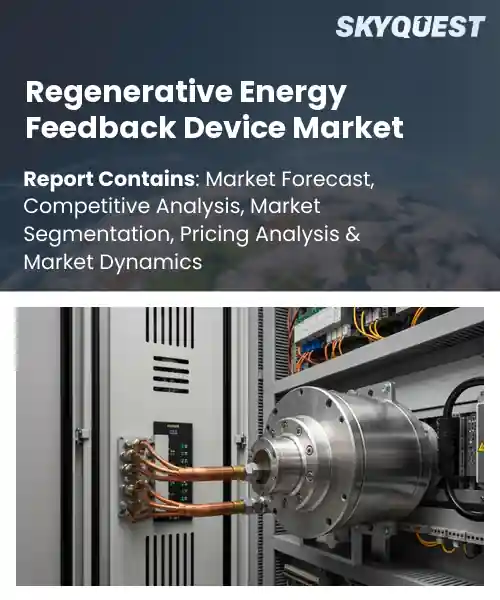
Regenerative Energy Feedback Device Market
Report ID: SQMIG20D2579
Report ID: SQMIG20D2579
[email protected]
USA +1 351-333-4748
Report ID:
SQMIG20D2579 |
Region:
Global |
Published Date: March, 2026
Pages:
157
|Tables:
118
|Figures:
77


Global Regenerative Energy Feedback Device Market size was valued at USD 4.00 Billion in 2024 and is poised to grow from USD 4.30 Billion in 2025 to USD 7.73 Billion by 2033, growing at a CAGR of 7.6% during the forecast period (2026-2033).
Growing need to reduce energy consumption, increasing focus on carbon emission reduction, rising adoption of energy-efficient technologies, and advancements in power electronics are driving sales of regenerative energy feedback devices.
Increased integration with smart grids and smart energy networks will fuel further growth of the market by sending it back into the grid. Due to advancements in two-way inverters and communication devices, there is increased compatibility between different systems, which encourages retrofitting within industrial equipment and infrastructure. At the same time, increased use within manufacturing plants and commercial premises leads to reduced electricity consumption peaks and increased return on investment. Growing emphasis on sustainability and cost optimization across industrial and commercial sectors coupled with increasing deployment of electrified systems such as elevators, cranes, and electric vehicles are expected to primarily drive regenerative energy feedback device market growth. Policy incentives and declining costs of power electronics are also creating new opportunities for regenerative energy feedback device companies.
On the contrary, high initial installation costs, technical complexity, limited awareness in developing regions, and integration challenges with existing infrastructure are forecasted to impede regenerative energy feedback device market penetration through 2033.
How is IoT Enhancing Performance in the Regenerative Energy Feedback Device Market?
IoT systems are enhancing regenerative energy feedback systems through sensor connections and control devices to harness energy from sources like motors, brakes, and drives. These systems have capabilities such as monitoring energy flow continuously, connectivity to optimize the process remotely, edge computing to adjust quickly, and cloud computing to analyze long-term data. IoT can increase equipment availability, prolong asset life, and increase efficiency. Some uses are elevator systems that harness breaking energy for reuse back in buildings or even local energy storage systems.
In November 2025, Otis Worldwide Corporation expanded its Gen3 Core elevator with the Otis ONE IoT platform and ReGen drive. This solution combines energy recovery with cloud monitoring and predictive maintenance to optimize energy use and reduce downtime, supporting market growth and improved operational efficiency.
Market snapshot - 2026-2033
Global Market Size
USD 4.0 Billion
Largest Segment
Active Front End (AFE) Units
Fastest Growth
Matrix Converters
Growth Rate
7.6% CAGR
To get more insights on this market click here to Request a Free Sample Report
Global regenerative energy feedback device market is segmented by technology/architecture, capacity/power rating, application domain, end-use industry, and region. Based on technology/architecture, the market is segmented into Active Front End (AFE) Units, matrix converters, and common DC Bus Systems. Based on capacity/power rating, the market is segmented into low power, medium power, and high power. Based on application domain, the market is segmented into elevators & escalators, industrial cranes & hoists, centrifuges & high-inertia fans, and electric vehicle test benches. Based on end-use industry, the market is segmented into commercial buildings & infrastructure, manufacturing & metallurgy, and renewable energy integration. Based on region, the market is segmented into North America, Europe, Asia Pacific, Latin America, and Middle East & Africa.
The Active Front End (AFE) units segment is slated to lead the global regenerative energy feedback device market revenue generation going forward. Their inherent bidirectional power conversion and active rectification enable efficient capture and controlled return of regenerated energy allowing this segment to hold sway over others. These devices’ sophisticated control algorithms enable reduction in harmonic distortion and enhance power quality, thus making them capable of being interfaced with any drive system. Their reliability and compliance with safety regulations have been instrumental in their implementation not only in retrofits but also in new constructions.
However, matrix converters are emerging as the fastest growing segment as per this regenerative energy feedback device market forecast. their compact form and direct AC to AC conversion removes bulky intermediate components. Improved power semiconductor performance and control reduce losses and mass, allowing for machine-level integration and lightweight designs suitable for application in space-limited or mobile regenerative energy feedback systems.
The electric vehicle test benches segment is slated to account for the highest global regenerative energy feedback device market share going forward. High demand for precise, high bandwidth regenerative control to emulate vehicle drivetrains and capture braking energy under rapid transient conditions helps this segment cement its dominance. Accuracy of battery modeling, dynamic load characteristics, and safe bi-directional power flow necessitate the use of dependable regenerative feedback systems with rapid response capabilities and superior power quality. The validation processes by OEMs and testing requirements within laboratories also emphasize the need for precise feedback systems.
Nonetheless, elevators & escalators represent the fastest-growing segment owing to energy efficiency considerations and the shift towards building electrification which focuses on regenerative braking recovery. Advances in compact regenerative drive systems and feedback modules make installation easier and reduce operational expenses, leading to ongoing demand for upgrades from building management companies.
To get detailed segments analysis, Request a Free Sample Report
Industrial strengths, policy emphasis on energy transition, and concentrated technological capability are helping this region lead the demand for regenerative energy feedback device going forward. Government and private sector investments into modernizing the grid and electric mobility create a near-term demand path. Also, collaboration between research, OEMs and system integrators will help add to a quickened pace of innovation and standardization. Export-oriented industries and regional integration lead to additional opportunities for market expansion; furthermore, companies that are developing specific skills to address interoperability, safety and lifecycle service capabilities will help to create a broad talent pool that supports long-term market leadership. Established manufacturing ecosystem also facilitates prototyping and rapid deployment of power electronics and batteries across Asia Pacific.
Advanced electronics fabrication processes as well as a culture of precision engineering are contributing towards high regenerative energy feedback devices demand in Japan. The development of demand for retrofitting and installation is facilitated by policies that seek to modernize and increase resilience. Research and production facility collaboration leads to consistent enhancements in functionality.
Concentrated cluster of technology firms and system integrators that excel in power conversion and energy storage help support steady sales of regenerative energy feedback device in South Korea. Efficient production infrastructure coupled with collaboration between the industry and regulatory bodies to facilitate testing and certification processes. Alignment of interest between big corporate players and startups helps accelerate innovation and the adoption of feedback devices suitable for use in urban transport and industry electrification.
An enabling policy environment that prioritizes decarbonization, energy efficiency, and grid resilience is primarily boosting regenerative energy feedback devices demand in Europe. Harmonized standards and cross-border initiatives have further reduced barriers to deployment, thereby creating a greater potential for deployment across markets. As such, the financing models and existing service providers supporting lifecycle maintenance and performance contracting have allowed for the acceleration of commercial adoption of energy efficiency technologies, through significant collaboration between utilities, technology vendors, and research institutions. The need for retrofits and smart integration has created substantial industrial demand across Europe, and many countries have developed a concentration of manufacturing and engineering expertise dedicated to delivering high-quality interoperable solutions to a variety of infrastructure environments.
Deep engineering expertise and a dense network of industrial players focused on energy transition are helping boost demand for regenerative energy feedback device across Germany. The demand for the product is driven by large-scale industrial retrofits and grid integration initiatives which demand high levels of feedback reliability. Strong collaboration between manufacturing companies and research institutions fosters optimization efforts, while existing certification systems and maintenance services allow for reliable operations in the long run and build consumer trust.
Dynamic regenerative energy feedback device deployment across offshore energy, urban mobility, and distributed generation sectors shapes demand in the United Kingdom. Efficient policy tools and robust investments by the private sector create conditions for pilot and scaled initiatives to occur. The dynamic innovative ecosystem, along with service-oriented suppliers, facilitates module-based products that can be deployed within a networked architecture.
Strategic emphasis on electrification and resilience in industrial and urban systems are boosting demand for regenerative energy feedback devices in France. Emphasis on reliability and sustainability is forecasted to be of utmost importance for French regenerative energy feedback device manufacturers in the long run. An increase in the demand for incorporating feedback devices into the nation’s energy resources, coupled with extensive research backing, propels the maturity of technology.
Strategic investments in grid modernization and a thriving ecosystem of technology providers and utilities are shaping regenerative energy feedback devices demand in North America. Collaboration between private innovators and major system operators to conduct pilot programs has demonstrated the capabilities of these solutions under real-world conditions, thereby accelerating commercial confidence. Efforts to reshore the supply chain and target manufacturing investments are being made to reduce lead time and improve quality. Focused on developing its workforce and aligning with industry standards, the United States is leveraging these factors through scalable deployments and increasing competitiveness in the global market. Adoption of modular, serviceable designs along with strong software integration is slated to be high in the region going forward.
Broad innovation ecosystem and active collaboration between technology firms and large-scale energy providers are slated to boost the sales of regenerative energy feedback device in the United States. Focus on software leads to device management and compatibility with contemporary grid systems, allowing for flexible implementation among utilities and businesses. Emphasis on homegrown production and robust logistics is also creating new business scope.
Emphasis on resilience and remote grid applications that favor modular, robust device designs shape regenerative energy feedback devices demand in Canada. Collaborative initiatives between provincial electricity companies and developers aid the testing of devices in diverse climactic and grid conditions. Sustainable purchasing and maintenance strategies encourage their use in urban and remote applications, resulting in gradual growth of the market.
To know more about the market opportunities by region and country, click here to
Buy The Complete Report
Technological Advancements In Systems
Policy Incentives and Support
High Initial Capital Investment
Technical Interoperability and Standards
Request Free Customization of this report to help us to meet your business objectives.
Competitive dynamics in the global regenerative energy feedback device market are driven by strategic corporate venture investments, licensing, and pilot partnerships that accelerate commercialization. Established manufacturers use acquisitions and supply chain partnerships to expand their business scope. Here are a couple of startups that are focusing on innovating novel regenerative energy feedback devices.
SkyQuest’s ABIRAW (Advanced Business Intelligence, Research & Analysis Wing) is our Business Information Services team that Collects, Collates, Correlates, and Analyses the Data collected by means of Primary Exploratory Research backed by robust Secondary Desk research.
As per SkyQuest analysis, increasing emphasis on reducing energy consumption and carbon emissions along with increasing adoption of energy-efficient industrial systems are anticipated to drive the demand for regenerative energy feedback devices going forward. However, high initial installation costs and integration challenges with existing infrastructure are slated to slow down the adoption of regenerative energy feedback devices in the future. Asia Pacific is slated to spearhead the demand for regenerative energy feedback devices owing to rapid industrialization, growing electrification, and strong focus on sustainability initiatives. Development of IoT-enabled energy monitoring solutions and integration with smart grid systems are anticipated to be key trends driving the regenerative energy feedback device industry across the study period.
| Report Metric | Details |
|---|---|
| Market size value in 2024 | USD 4.00 Billion |
| Market size value in 2033 | USD 7.73 Billion |
| Growth Rate | 7.6% |
| Base year | 2024 |
| Forecast period | 2026-2033 |
| Forecast Unit (Value) | USD Billion |
| Segments covered |
|
| Regions covered | North America (US, Canada), Europe (Germany, France, United Kingdom, Italy, Spain, Rest of Europe), Asia Pacific (China, India, Japan, Rest of Asia-Pacific), Latin America (Brazil, Rest of Latin America), Middle East & Africa (South Africa, GCC Countries, Rest of MEA) |
| Companies covered |
|
| Customization scope | Free report customization with purchase. Customization includes:-
|
To get a free trial access to our platform which is a one stop solution for all your data requirements for quicker decision making. This platform allows you to compare markets, competitors who are prominent in the market, and mega trends that are influencing the dynamics in the market. Also, get access to detailed SkyQuest exclusive matrix.
Table Of Content
Executive Summary
Market overview
Parent Market Analysis
Market overview
Market size
KEY MARKET INSIGHTS
COVID IMPACT
MARKET DYNAMICS & OUTLOOK
Market Size by Region
KEY COMPANY PROFILES
Methodology
For the Regenerative Energy Feedback Device Market, our research methodology involved a mixture of primary and secondary data sources. Key steps involved in the research process are listed below:
1. Information Procurement: This stage involved the procurement of Market data or related information via primary and secondary sources. The various secondary sources used included various company websites, annual reports, trade databases, and paid databases such as Hoover's, Bloomberg Business, Factiva, and Avention. Our team did 45 primary interactions Globally which included several stakeholders such as manufacturers, customers, key opinion leaders, etc. Overall, information procurement was one of the most extensive stages in our research process.
2. Information Analysis: This step involved triangulation of data through bottom-up and top-down approaches to estimate and validate the total size and future estimate of the Regenerative Energy Feedback Device Market.
3. Report Formulation: The final step entailed the placement of data points in appropriate Market spaces in an attempt to deduce viable conclusions.
4. Validation & Publishing: Validation is the most important step in the process. Validation & re-validation via an intricately designed process helped us finalize data points to be used for final calculations. The final Market estimates and forecasts were then aligned and sent to our panel of industry experts for validation of data. Once the validation was done the report was sent to our Quality Assurance team to ensure adherence to style guides, consistency & design.
Analyst Support
Customization Options
With the given market data, our dedicated team of analysts can offer you the following customization options are available for the Regenerative Energy Feedback Device Market:
Product Analysis: Product matrix, which offers a detailed comparison of the product portfolio of companies.
Regional Analysis: Further analysis of the Regenerative Energy Feedback Device Market for additional countries.
Competitive Analysis: Detailed analysis and profiling of additional Market players & comparative analysis of competitive products.
Go to Market Strategy: Find the high-growth channels to invest your marketing efforts and increase your customer base.
Innovation Mapping: Identify racial solutions and innovation, connected to deep ecosystems of innovators, start-ups, academics, and strategic partners.
Category Intelligence: Customized intelligence that is relevant to their supply Markets will enable them to make smarter sourcing decisions and improve their category management.
Public Company Transcript Analysis: To improve the investment performance by generating new alpha and making better-informed decisions.
Social Media Listening: To analyze the conversations and trends happening not just around your brand, but around your industry as a whole, and use those insights to make better Marketing decisions.
REQUEST FOR SAMPLE
 REQUEST FREE CUSTOMIZATION
Global Regenerative Energy Feedback Device Market size was valued at USD 4.0 Billion in 2024 and is poised to grow from USD 4.3 Billion in 2025 to USD 7.73 Billion by 2033, growing at a CAGR of 7.6% during the forecast period (2026-2033).
Competitive dynamics in the global regenerative energy feedback device market are driven by strategic corporate venture investments, licensing and pilot partnerships that accelerate commercialisation. Established manufacturers use acquisitions and supply chain partnerships to secure sensor and low light PV sources, exemplified by Amazon Climate Pledge leading Ambient Photonics Series A. Deep tech startups pursue patent protection and accelerator collaborations to win licensing and pilot deals. 'Tesla, Inc.', 'Siemens AG', 'Schneider Electric', 'General Electric', 'ABB Ltd.', 'Enphase Energy', 'NextEra Energy', 'Vestas Wind Systems', 'First Solar', 'SunPower Corporation', 'Bloom Energy', 'Cypress Creek Renewables', 'Duke Energy', 'Canadian Solar', 'Orsted A/S', 'Xcel Energy', 'Sempra Energy', 'Renewable Energy Group', 'Fuels Infrastructure', 'Ballard Power Systems'
Continuous improvements in component efficiency, sensor integration, and control algorithms have enhanced the functional reliability and performance of regenerative energy feedback devices, enabling smoother integration with existing power infrastructures and diverse applications. These advancements reduce operational complexity and perceived risk for adopters, encourage wider implementation across sectors, and stimulate supplier innovation and product differentiation. As systems become more capable and interoperable, procurement decisions favor advanced solutions, which in turn supports market expansion through broader acceptance and increased demand from both new and established end users.
Decentralized Grid Integration: Adoption of regenerative feedback devices is accelerating integration of localized energy sources with distributed grids, enabling smoother bidirectional energy flows and improved system resilience. Stakeholders increasingly prioritize modular devices that support microgrid operations, demand response participation, and peer to peer energy exchange, creating value chains for utilities and service providers. This trend encourages product architectures that favor scalability, ease of deployment, and compatibility with energy projects, while fostering partnerships among vendors, grid operators and decentralized energy developers, unlocking operational models.
Asia Pacific Dominate the Global Regenerative Energy Feedback Device Market.


Want to customize this report? This report can be personalized according to your needs. Our analysts and industry experts will work directly with you to understand your requirements and provide you with customized data in a short amount of time. We offer $1000 worth of FREE customization at the time of purchase.
Feedback From Our Clients


 USA (+1) 351-333-4748

