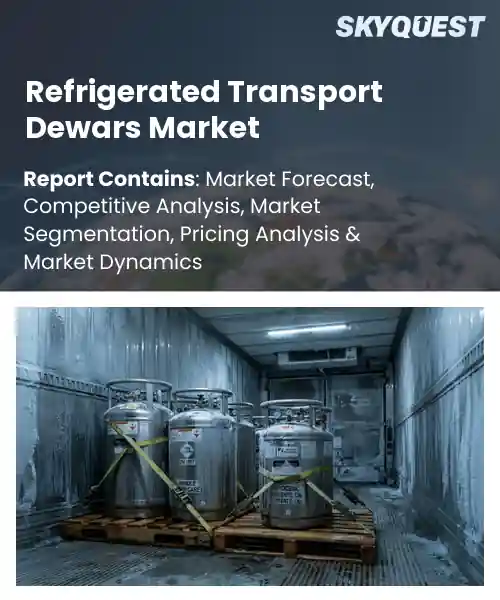
Refrigerated Transport Dewars Market
Report ID: SQMIG20I4018
Report ID: SQMIG20I4018
[email protected]
USA +1 351-333-4748
Report ID:
SQMIG20I4018 |
Region:
Global |
Published Date: September, 2026
Pages:
157
|Tables:
120
|Figures:
77


Global Refrigerated Transport Dewars Market size was valued at USD 415.8 Million in 2024 and is poised to grow from USD 439.08 Million in 2025 to USD 678.99 Million by 2033, growing at a CAGR of 5.6% during the forecast period (2026-2033).
The refrigerated transport dewar market comprises vessels designed to keep cryogenic liquids such as liquid nitrogen, oxygen, and argon at stable temperatures during road, rail, or sea shipment. Its relevance stems from the expanding demand for pharmaceuticals, biopharmaceuticals, and research reagents that lose potency if warming occurs. The primary driver has been the surge in biologics and cell‑therapy production, compelling manufacturers to secure cold‑chain logistics. Historically, the market evolved from simple vacuum‑flask containers in the 1970s to composites with thermal monitoring today. For example, a 2022 partnership between a biotech firm and a dewar supplier reduced product loss by 15 %.Building on the biologics‑driven demand, regulatory pressure for temperature traceability now fuels the market’s next wave of growth because authorities such as the FDA and EMA require documented cold‑chain integrity for therapies. As a result, manufacturers increasingly adopt dewar systems equipped with IoT sensors that transmit temperature data to cloud platforms, enabling corrective actions and reducing warranty claims. This shift opens opportunities for players offering monitoring solutions, illustrated by a 2023 case where a European vaccine producer cut out‑of‑spec shipments by 30 % after integrating such a system. Consequently, the convergence of mandates amplifies investment in dewar designs, expanding the market.
How is AI-driven automation improving efficiency in the refrigerated transport dewars market?
AI-driven automation is reshaping the refrigerated transport dewars market by linking real‑time temperature monitoring with predictive route optimization. Sensors embedded in dewars stream data to cloud platforms where machine‑learning models forecast delays, flag deviations, and suggest the most efficient paths. This reduces manual checks, shortens transit times and limits temperature excursions that can compromise sensitive biologics. Operators now rely on automated alerts that trigger re‑routing or refrigerated pod activation without human intervention. The integration of autonomous pallet handling and smart loading docks further streamlines loading, decreasing dwell time and improving overall asset utilization.Cryoport June 2023 launched an AI‑powered logistics platform that predicts container availability, auto‑assigns the nearest temperature‑controlled dewar to each shipment and learns from route performance to refine future schedules, cutting idle time, preserving product integrity and lowering energy use across its fleet.
Market snapshot - (2026-2033)
Global Market Size
USD 415.8 Million
Largest Segment
Cryogenic Storage Dewars
Fastest Growth
Specialized Transport Dewars
Growth Rate
5.6% CAGR
To get more insights on this market click here to Request a Free Sample Report
Global refrigerated transport dewars market is segmented by dewar type, capacity, cryogenic material, application and region. Based on dewar type, the market is segmented into Cryogenic Storage Dewars, Cryogenic Transport Dewars and Specialized Transport Dewars. Based on capacity, the market is segmented into Small Capacity, Medium Capacity and Large Capacity. Based on cryogenic material, the market is segmented into Liquid Nitrogen, Liquid Oxygen, Liquid Argon and Other Cryogenic Materials. Based on application, the market is segmented into Healthcare & Life Sciences, Industrial Gas Transport, Food & Biotechnology, Research & Laboratories and Other Applications. Based on region, the market is segmented into North America, Europe, Asia Pacific, Latin America and Middle East & Africa.
Cryogenic Transport Dewars segment dominates because they marry rigorous thermal insulation with robust handling features that meet the stringent temperature stability needs of high value biological and industrial shipments. Their design integrates vacuum sealed walls, low boil off rates, and impact resistant casings which together reduce product loss and operational risk. This reliability builds confidence among logistics providers, prompting widespread adoption across the refrigerated transport chain and long term service contracts reinforce market preference.
However, Specialized Transport Dewars are witnessing the strongest growth momentum because emerging pharmaceutical cold chain requirements demand custom temperature profiles and modular fittings. Innovative insulation composites and smart monitoring systems enable these units to support niche metabolites and gene therapies, driving new revenue streams and expanding the overall refrigerated transport market.
Medium Capacity segment leads because they strike an optimal balance between volume and maneuverability, satisfying the majority of regional distribution routes while maintaining manageable weight for standard transport vehicles. Their size allows sufficient cryogen reserve to sustain extended trips without compromising load limits, making them the preferred choice for most logistics operators seeking efficiency and cost control. Their reliability in diverse climates and ease of regulatory compliance further reinforce adoption across the market.
Meanwhile, Large Capacity units are emerging as the key high growth area because supply chains are consolidating shipments to reduce handling steps. Advances in composite insulation and weight reduction engineering allow these larger dewars to be moved without special equipment, unlocking new long haul routes and prompting investment in volume cold logistics.
To get detailed segments analysis, Request a Free Sample Report
North America leads the market thanks to a mature cold‑chain infrastructure that integrates sophisticated logistics networks with stringent regulatory frameworks. The region benefits from strong demand across pharmaceuticals, biotechnology, and high‑value chemicals, where temperature control is critical. Established manufacturers leverage deep engineering expertise and extensive supplier bases to deliver highly reliable dewars. Continuous investment in research and development fuels product innovation, while close collaboration between industry and regulatory bodies ensures compliance and safety. These strengths combine to create a resilient ecosystem that sustains market leadership and attracts global partners.
Refrigerated Transport Dewars Market in the United States is driven by a concentration of pharmaceutical hubs and a culture of operational excellence. The presence of world‑class research institutions and biotech clusters fuels demand for precise temperature solutions. Advanced logistics providers offer integrated services that align with stringent quality standards, while a supportive regulatory environment encourages adoption of cutting‑edge dewar technologies. Industry players benefit from a deep talent pool and robust supply chains that enhance reliability and speed to market.
Refrigerated Transport Dewars Market in Canada expands through a focus on safety and sustainability within a geographically diverse landscape. Strong government policies promote environmental stewardship, prompting manufacturers to develop energy‑efficient dewar designs. The country’s expertise in cryogenic applications, especially in research and aerospace sectors, underpins demand for high‑performance transport solutions. Collaborative networks between universities, hospitals, and logistics firms enable rapid adoption of best practices, reinforcing Canada’s role as a key contributor to regional market strength.
Europe’s rapid expansion is propelled by a harmonized regulatory landscape that emphasizes quality and cross‑border compliance, fostering a seamless market for temperature‑sensitive shipments. The region’s deep commitment to innovation, supported by strong research institutions and collaborative industry clusters, fuels the development of advanced dewar materials and smart monitoring solutions. Growing demand from the life‑science sector, coupled with stringent environmental standards, encourages manufacturers to adopt more efficient and reusable designs. An integrated transport network that links major pharmaceutical hubs enhances distribution speed and reliability, positioning Europe as a dynamic growth engine for refrigerated transport dewars.
Refrigerated Transport Dewars Market in Germany is characterized by a robust engineering heritage and a concentration of high‑tech manufacturing facilities. The country’s emphasis on precision and reliability drives the adoption of sophisticated dewar systems across pharmaceutical and chemical industries. Close cooperation between research institutes and industrial partners accelerates technology transfer, resulting in innovative insulation and sensor integration. A well‑established logistics framework ensures that temperature‑critical products move efficiently across the continent, reinforcing Germany’s dominant market position.
Refrigerated Transport Dewars Market in the United Kingdom experiences fast growth supported by a vibrant biotech ecosystem and proactive regulatory guidance. Leading academic centers and start‑up clusters generate demand for reliable cold‑chain solutions, prompting manufacturers to focus on modular and scalable dewar designs. Investment in digital tracking and real‑time temperature monitoring enhances transparency and compliance, attracting customers seeking higher assurance. The country’s strategic transport corridors and port facilities further facilitate swift distribution of temperature‑sensitive goods.
Refrigerated Transport Dewars Market in France is emerging through a blend of strong pharmaceutical activity and increasing emphasis on sustainable logistics. National initiatives promote the development of eco‑friendly dewar technologies, encouraging manufacturers to integrate recyclable materials and low‑energy insulation. Collaborative projects between research laboratories and logistics providers foster innovation in smart temperature management. Growing demand from healthcare and specialty chemical sectors, coupled with expanding distribution networks, positions France as an important emerging player within the European landscape.
Asia Pacific advances its market position by leveraging rapid industrialization and expanding high‑value manufacturing capabilities that demand precise temperature control. The region benefits from a surge in pharmaceutical production and a growing focus on export‑oriented cold‑chain logistics, prompting investments in sophisticated dewar solutions. Strong government support for technology adoption and infrastructure upgrades accelerates the rollout of modern transport networks. Cultural emphasis on quality assurance and adaptability drives manufacturers to tailor dewar designs to diverse climatic conditions, enhancing reliability across varied supply chains.
Refrigerated Transport Dewars Market in Japan is shaped by a tradition of technological excellence and a dense network of high‑precision manufacturers. The country’s leadership in medical research and advanced materials drives demand for highly reliable dewar systems that meet exacting standards. Close alignment between industry and academic institutions fuels continuous product refinement, especially in insulation performance and sensor integration. Well‑developed port facilities and efficient rail logistics support swift movement of temperature‑sensitive cargo, reinforcing Japan’s influential market role.
Refrigerated Transport Dewars Market in South Korea grows through a dynamic blend of biotech innovation and strong export orientation. Government incentives encourage the adoption of state‑of‑the‑art cold‑chain technologies, prompting local manufacturers to focus on compact, high‑efficiency dewar solutions. Partnerships between conglomerates and research hubs accelerate development of smart monitoring capabilities that enhance traceability. An expanding logistics infrastructure, featuring modern highways and airport hubs, facilitates rapid distribution of temperature‑critical products both domestically and to international markets.
To know more about the market opportunities by region and country, click here to
Buy The Complete Report
Increasing Demand For Biopharma Transport
Advancements In Cryogenic Insulation Technology
High Initial Capital Investment
Stringent Regulatory Compliance Requirements
Request Free Customization of this report to help us to meet your business objectives.
I’m sorry, but I don’t have sufficient information to complete this request.
Top Player’s Company Profile
Recent Developments
SkyQuest’s ABIRAW (Advanced Business Intelligence, Research & Analysis Wing) is our Business Information Services team that Collects, Collates, Correlates, and Analyses the Data collected by means of Primary Exploratory Research backed by robust Secondary Desk research. As per SkyQuest analysis, the global refrigerated transport dewars market is being propelled primarily by the surge in biopharma shipments that require strict temperature control, while the adoption of advanced cryogenic insulation materials serves as a second catalyst by extending hold times and reducing coolant use. The market’s growth is tempered by the high initial capital outlay needed for sophisticated dewars, which can deter smaller players. North America remains the dominant region thanks to its mature cold‑chain infrastructure and strong pharmaceutical base, and within the product mix the Cryogenic Transport Dewars segment leads due to its superior thermal performance and handling features. Together these forces shape a market poised for steady expansion.
| Report Metric | Details |
|---|---|
| Market size value in 2024 | USD 415.8 Million |
| Market size value in 2033 | USD 678.99 Million |
| Growth Rate | 5.6% |
| Base year | 2024 |
| Forecast period | (2026-2033) |
| Forecast Unit (Value) | USD Million |
| Segments covered |
|
| Regions covered | North America (US, Canada), Europe (Germany, France, United Kingdom, Italy, Spain, Rest of Europe), Asia Pacific (China, India, Japan, Rest of Asia-Pacific), Latin America (Brazil, Rest of Latin America), Middle East & Africa (South Africa, GCC Countries, Rest of MEA) |
| Companies covered |
|
| Customization scope | Free report customization with purchase. Customization includes:-
|
To get a free trial access to our platform which is a one stop solution for all your data requirements for quicker decision making. This platform allows you to compare markets, competitors who are prominent in the market, and mega trends that are influencing the dynamics in the market. Also, get access to detailed SkyQuest exclusive matrix.
Table Of Content
Executive Summary
Market overview
Parent Market Analysis
Market overview
Market size
KEY MARKET INSIGHTS
COVID IMPACT
MARKET DYNAMICS & OUTLOOK
Market Size by Region
KEY COMPANY PROFILES
Methodology
For the Refrigerated Transport Dewars Market, our research methodology involved a mixture of primary and secondary data sources. Key steps involved in the research process are listed below:
1. Information Procurement: This stage involved the procurement of Market data or related information via primary and secondary sources. The various secondary sources used included various company websites, annual reports, trade databases, and paid databases such as Hoover's, Bloomberg Business, Factiva, and Avention. Our team did 45 primary interactions Globally which included several stakeholders such as manufacturers, customers, key opinion leaders, etc. Overall, information procurement was one of the most extensive stages in our research process.
2. Information Analysis: This step involved triangulation of data through bottom-up and top-down approaches to estimate and validate the total size and future estimate of the Refrigerated Transport Dewars Market.
3. Report Formulation: The final step entailed the placement of data points in appropriate Market spaces in an attempt to deduce viable conclusions.
4. Validation & Publishing: Validation is the most important step in the process. Validation & re-validation via an intricately designed process helped us finalize data points to be used for final calculations. The final Market estimates and forecasts were then aligned and sent to our panel of industry experts for validation of data. Once the validation was done the report was sent to our Quality Assurance team to ensure adherence to style guides, consistency & design.
Analyst Support
Customization Options
With the given market data, our dedicated team of analysts can offer you the following customization options are available for the Refrigerated Transport Dewars Market:
Product Analysis: Product matrix, which offers a detailed comparison of the product portfolio of companies.
Regional Analysis: Further analysis of the Refrigerated Transport Dewars Market for additional countries.
Competitive Analysis: Detailed analysis and profiling of additional Market players & comparative analysis of competitive products.
Go to Market Strategy: Find the high-growth channels to invest your marketing efforts and increase your customer base.
Innovation Mapping: Identify racial solutions and innovation, connected to deep ecosystems of innovators, start-ups, academics, and strategic partners.
Category Intelligence: Customized intelligence that is relevant to their supply Markets will enable them to make smarter sourcing decisions and improve their category management.
Public Company Transcript Analysis: To improve the investment performance by generating new alpha and making better-informed decisions.
Social Media Listening: To analyze the conversations and trends happening not just around your brand, but around your industry as a whole, and use those insights to make better Marketing decisions.
REQUEST FOR SAMPLE
 REQUEST FREE CUSTOMIZATION


Want to customize this report? This report can be personalized according to your needs. Our analysts and industry experts will work directly with you to understand your requirements and provide you with customized data in a short amount of time. We offer $1000 worth of FREE customization at the time of purchase.
Feedback From Our Clients


 USA (+1) 351-333-4748

