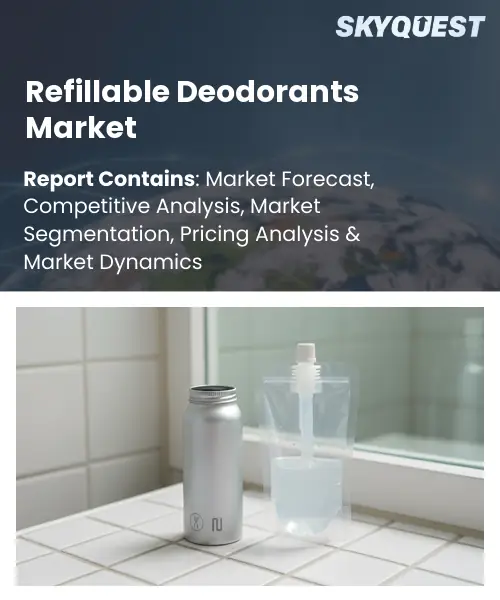
Refillable Deodorants Market
Report ID: SQMIG30L2422
Report ID: SQMIG30L2422
[email protected]
USA +1 351-333-4748
Report ID:
SQMIG30L2422 |
Region:
Global |
Published Date: June, 2026
Pages:
157
|Tables:
121
|Figures:
77


Global Refillable Deodorants Market size was valued at USD 1.8 Billion in 2024 and is poised to grow from USD 1.92 Billion in 2025 to USD 3.23 Billion by 2033, growing at a CAGR of 6.7% during the forecast period (2026-2033).
A growing consumer and regulatory demand to reduce the amount of single-use plastic and packaging waste has transformed a niche sustainable movement into a mainstream retail opportunity, fuelling the refillable deodorant market. Refillable deodorants – Personal care formats where consumers replace cartridges or return containers, instead of disposing of full plastic sticks. Why they matter: They directly reduce lifecycle emissions and raw material demand, and signal brand sustainability. In the last decade, the segment has evolved from artisanal zero-waste offerings to big-brand pilots and omnichannel distribution, as startups introduced cartridge systems and retailers rolled out in-store refill stations across the country.
An important growth driver, building on early adoption patterns, is the establishment of circular refill infrastructure, as when manufacturers and retailers implement cartridge systems, return loops and subscription services, unit costs decrease and consumer friction diminishes, in turn boosting repeat purchase rates. For instance, brands with mail-back aluminum tins or in-store refill dispensers have a higher lifetime value because consumers are willing to sacrifice convenience for a lower effective cost per use. Regulatory incentives and corporate net-zero commitments together are driving investment, fueling packaging innovation and retail rollouts. The cumulative result is faster mainstreaming, larger production runs and new opportunities in emerging markets around the globe.
How is AI optimizing inventory management for the refillable deodorants market?
AI aids in demand sensing replenishment and end to end visibility across retail and direct to optimize inventory management for refillable deodorants market. Smart Forecasting with Refill Cadence & Customer Reorder Behavior Dynamic replenishment, moving inventory to high demand location IoT and RFID systems to track reusable cases and refills Now agentic AI platforms are being paired with legacy planning to automate ordering allocation and exception handling so that launches and subscription flows meet customer expectations and don’t lead to excess stock.
Unilever Jan-26 4 That’s why AI-powered inventory systems are so important for refill formats, as is the case with Dove’s refillable deodorant launch. AI helps manage individual refill SKUs, reusable cases and mixed channel demand to reduce waste and smooth replenishment. That gives brands more confidence to grow programs and align retail and subscription inventory so customers can find refills when they want them.
Market snapshot - (2026-2033)
Global Market Size
USD 1.8 Billion
Largest Segment
Refillable Sticks
Fastest Growth
Refillable Creams
Growth Rate
6.7% CAGR
To get more insights on this market click here to Request a Free Sample Report
Global refillable deodorants market is segmented by product type, material type, distribution channel, end-user and region. Based on product type, the market is segmented into Refillable Sticks, Refillable Sprays, Refillable Roll-ons, Refillable Creams and Others. Based on material type, the market is segmented into Stainless Steel, Aluminum, Compostable Materials, Recycled Plastics and Others. Based on distribution channel, the market is segmented into Online, Offline and Others. Based on end-user, the market is segmented into Men, Women and Others. Based on region, the market is segmented into North America, Europe, Asia Pacific, Latin America and Middle East & Africa.
The refillable sticks segment is the largest segment as it is in line with consumer habits with traditional solid formats and can result in change in behaviour towards refillable formats. They have the same push up mechanics we’re used to and they use refill cartridges so it makes it easier for manufacturing and retail integration. It’s less friction for the shopper. Compatibility with existing production and merchandising practices further encourages retailer acceptance and re-purchase, further entrenching brand investment in stick-based refill systems.
Refill pouch formats and formulation flexibility that reduce waste and support personalized offerings benefit Refillable Creams, the fastest growing product type. Their suitability for natural ingredients and premium DTC positioning drives brand innovation, subscription models and expanded use cases, creating new revenue streams and accelerating market opportunity.
The packaging is being led by the Recycled Plastics segment, fuelled by sustainability needs and consumer demand for refill shells and cartridges made with reclaimed resin. Recycling feedstock makes it possible to make products, cut reliance on raw materials and allows refill programs to be rolled out at a cost-effective level. Proven moulding techniques and environmental claims are helping to drive supplier partnerships and a retailer’s willingness to stock refill options and greater brand differentiation around circularity.
But the fastest growing material is aluminum, buoyed by perceptions of premium, inherent recyclability and compatibility with durable refillable containers that support repeat use. Its strength and light weight allow for sleek packaging that differentiates the brand and allows for premium positioning and therefore investment in aluminum refill systems and opportunities for upscale distribution.
To get detailed segments analysis, Request a Free Sample Report
Europe leads the global refillable deodorants market due to a mature sustainability agenda, strong regulatory frameworks and a solid culture of circular consumption. Established and innovative indie challengers alike in the personal care sector are partnering with retailers to scale refill systems and subscription models, and investment in consumer education has fueled a preference for durable, refillable formats. Urban distribution networks and high visibility across premium and mass channels allow the trial and repetition. Cross border trade in the region and harmonized standards lower barriers for rollouts and allow brands to iterate fast on product design and refill mechanics. Continued collaboration with stakeholders across manufacturing, retail and waste management continues to drive market leadership.
Germany’s refilled deodorant market is being driven by a high degree of environmental awareness and a developed retail infrastructure. Domestic brands focus on durable refillable carriers and recyclable materials, and retailers implement refill programs and omnichannel support. Clear policy and strong partnerships in the industry lend credibility to claims and help build consumer trust. Germany is a hub for product development and operational scaling within the European refillable deodorant market as the cities are good test markets for new, more concentrated refill formats.
United Kingdom Refillable Deodorants Market to be defined by retail innovation and consumer interest in sustainable personal care Brands are partnering with premium retailers and going direct to consumer with refill cartridges and returnable systems that focus on transparency of ingredients and ethical sourcing. We are educating and testing urban centers for retail pilots. Industry partnerships for reverse logistics The UK deodorant refills market was born out of the collaboration of commercial and institutional organisations.
Refillable Deodorants Market In France merges artisan beauty traditions with changing preference for low waste packaging. Brands and designers are trialing refill cartridges and metal carriers. Boutique retailers are launching refill stations and sample programs. The public focus on eco labeling increases the clarity of claims and informed purchase behavior. Brands, retailers and logistics providers working together across sectors support refill systems that meet the expectations of French consumers for performance and environmental responsibility.
The North America refillable deodorants market is witnessing a rapid growth owing to the innovation by entrepreneurs, the strong backing from the venture and retail and the active interest of consumers in sustainable lifestyle choices. New refill formats and subscription models are being introduced by start-up brands with convenience at the forefront, as legacy personal care brands are rolling out premium refillable lines in mainstream channels. Retailers and e-commerce sites help to reduce the barriers to adoption by offering curated guides and learning information to make it easier to try out products. This broader set of retailers is the result of vocal consumer advocacy and media attention, as well as investments in refill logistics and reverse supply chain pilots that speed up market visibility. Industry standards are evolving to improve refill compatibility and consumer confidence. Local policy discussions and incentives also promote circular solutions.
Start up innovation, retailer trials and increasing consumer preference for low waste personal care are driving the Refillable Deodorants Market in United States. To make their products easier to adopt, brands are focusing on things like cartridge swaps, recyclable parts and subscription services. Awareness is driven through retail and e commerce channels with curated assortments and experiential activations while collaborative pilots for reverse logistics and refill collection improve convenience and support further retail integration of refillable deodorant offerings.
Retail programs and brands focusing on eco friendly consumer’s preferences are key drivers for Refillable Deodorants Market in Canada. Retailers will develop displays and events for refills, and brands will alter the format and packaging of refills for omnichannel distribution. We build trust and partnerships with logistics providers by being transparent about our ingredients and providing certification, and by piloting efficient return and refill pathways. These kinds of partnerships increase accessibility and work to make refillable deodorant a regular commodity in the Canadian market.
Asia Pacific is strengthening its position in the refillable deodorants market with a combination of technology led product development, changing consumer perceptions towards sustainability and focused retail innovations. Manufacturers are investing in compact refill mechanisms and localized formulations to match regional preferences, and premium and mass market retailers are trialing refill kiosks and integrated loyalty programs to reduce entry friction. Trendsetting cities are using social media to raise awareness and cross-sector partnerships between beauty brands, packaging suppliers and logistics companies to develop culturally appropriate refill solutions. Consumer confidence is also supported by voluntary eco-labeling initiatives and regulatory interest in the management of packaging waste. Local innovation hubs accelerate product adaptation and distribution.
Targeted product engineering, high efficacy expectations and minimal waste packaging characterize the Japanese market for refillable deodorant. Brands are creating small refill cartridges, improving scent profiles and creating better carriers that can be built into everyday grooming habits. Retail and ecommerce channels offer curated refill assortments and subscriptions to encourage repeat purchase. We partner with packaging specialists and local recycling programs to make refills easy and Japan is on track to be a hub for refillable deodorant formats in the Asia Pacific, he added.
South Korea Refillable Deodorant Market Beauty Culture and Retail Formats Brands are providing sleek refillable packaging, personalized scent profiles and multifunctional formulas to fit the urban routine. Social commerce and flagship stores, along with pop-up refill stations, are driving trial and amplification. Logistics collaborations are exploring return schemes for refills. South Korea’s culture and retail nimbleness are an inventive market for refillable deodorant concepts.
To know more about the market opportunities by region and country, click here to
Buy The Complete Report
Sustainable Packaging Drives Demand
Premiumization and Product Innovation
Limited Retail Infrastructure and Availability
Higher Upfront Costs and Perception
Request Free Customization of this report to help us to meet your business objectives.
Competitive pressure on the refillable deodorant market comes from CPG M&A of indie clean brands, retailer partnerships to install refill stations and specialist startups licensing of refill hardware. These include P&G and Unilever acquiring natural deodorant brands, Respray opening refill stations with Rossmann and venture-backed UK brands raising investment to scale retail distribution.
SkyQuest’s ABIRAW (Advanced Business Intelligence, Research & Analysis Wing) is our Business Information Services team that collects, collates, correlates and analyses the data collected by means of Primary Exploratory Research supported by strong Secondary Desk research.
SkyQuest analysis reveals that the growth of the global refillable deodorants market is being driven by the demand for sustainable packaging to cut down on single-use plastic, while the limited retail infrastructure and availability are among the major restraints. Europe is the dominant region and refillable sticks are the dominant segment, as familiarity with solid formats makes the transition easier for consumers. A second factor is the growth of circular refill infrastructure such as cartridge systems, return loops and subscriptions that lower unit costs and increase repeat purchases. These forces are driving mainstream adoption and enabling brand differentiation and premiumization but require coordinated investment in retail and logistics to scale effectively.
| Report Metric | Details |
|---|---|
| Market size value in 2024 | USD 1.8 Billion |
| Market size value in 2033 | USD 3.23 Billion |
| Growth Rate | 6.7% |
| Base year | 2024 |
| Forecast period | (2026-2033) |
| Forecast Unit (Value) | USD Billion |
| Segments covered |
|
| Regions covered | North America (US, Canada), Europe (Germany, France, United Kingdom, Italy, Spain, Rest of Europe), Asia Pacific (China, India, Japan, Rest of Asia-Pacific), Latin America (Brazil, Rest of Latin America), Middle East & Africa (South Africa, GCC Countries, Rest of MEA) |
| Companies covered |
|
| Customization scope | Free report customization with purchase. Customization includes:-
|
To get a free trial access to our platform which is a one stop solution for all your data requirements for quicker decision making. This platform allows you to compare markets, competitors who are prominent in the market, and mega trends that are influencing the dynamics in the market. Also, get access to detailed SkyQuest exclusive matrix.
Table Of Content
Executive Summary
Market overview
Parent Market Analysis
Market overview
Market size
KEY MARKET INSIGHTS
COVID IMPACT
MARKET DYNAMICS & OUTLOOK
Market Size by Region
KEY COMPANY PROFILES
Methodology
For the Refillable Deodorants Market, our research methodology involved a mixture of primary and secondary data sources. Key steps involved in the research process are listed below:
1. Information Procurement: This stage involved the procurement of Market data or related information via primary and secondary sources. The various secondary sources used included various company websites, annual reports, trade databases, and paid databases such as Hoover's, Bloomberg Business, Factiva, and Avention. Our team did 45 primary interactions Globally which included several stakeholders such as manufacturers, customers, key opinion leaders, etc. Overall, information procurement was one of the most extensive stages in our research process.
2. Information Analysis: This step involved triangulation of data through bottom-up and top-down approaches to estimate and validate the total size and future estimate of the Refillable Deodorants Market.
3. Report Formulation: The final step entailed the placement of data points in appropriate Market spaces in an attempt to deduce viable conclusions.
4. Validation & Publishing: Validation is the most important step in the process. Validation & re-validation via an intricately designed process helped us finalize data points to be used for final calculations. The final Market estimates and forecasts were then aligned and sent to our panel of industry experts for validation of data. Once the validation was done the report was sent to our Quality Assurance team to ensure adherence to style guides, consistency & design.
Analyst Support
Customization Options
With the given market data, our dedicated team of analysts can offer you the following customization options are available for the Refillable Deodorants Market:
Product Analysis: Product matrix, which offers a detailed comparison of the product portfolio of companies.
Regional Analysis: Further analysis of the Refillable Deodorants Market for additional countries.
Competitive Analysis: Detailed analysis and profiling of additional Market players & comparative analysis of competitive products.
Go to Market Strategy: Find the high-growth channels to invest your marketing efforts and increase your customer base.
Innovation Mapping: Identify racial solutions and innovation, connected to deep ecosystems of innovators, start-ups, academics, and strategic partners.
Category Intelligence: Customized intelligence that is relevant to their supply Markets will enable them to make smarter sourcing decisions and improve their category management.
Public Company Transcript Analysis: To improve the investment performance by generating new alpha and making better-informed decisions.
Social Media Listening: To analyze the conversations and trends happening not just around your brand, but around your industry as a whole, and use those insights to make better Marketing decisions.
REQUEST FOR SAMPLE
 REQUEST FREE CUSTOMIZATION
Global Refillable Deodorants Market size was valued at USD 1.8 Billion in 2024 and is poised to grow from USD 1.92 Billion in 2025 to USD 3.23 Billion by 2033, growing at a CAGR of 6.7% during the forecast period (2026-2033).
Competitive pressure in the refillable deodorant market is driven by CPG M&A of indie clean brands, retailer partnerships to install refill stations, and licensing of refill hardware by specialist startups. Examples include P&G and Unilever acquisitions of natural deodorant brands, Respray’s refill station rollouts with Rossmann, and venture-backed UK brands securing investment to scale retail distribution. 'Unilever', 'Procter & Gamble', 'Wild Deodorant', 'Fussy', 'By Humankind', 'Native', 'Myro', 'Bite', 'Salt of the Earth', 'Maltie', 'Public Goods', 'Hammond Herbs', 'Helmm', 'Noniko', 'Akt London', 'Papr', 'Routine', 'Lush', 'Asystem', 'Aera'
Refillable packaging appeals to environmentally conscious consumers seeking to reduce single use waste, prompting brands to prioritize reusable designs and refill systems. This preference encourages retailers to expand refill offerings and supports product differentiation, which strengthens brand loyalty and repeat purchases. Designers and manufacturers are investing in accessible refill formats and in store refill stations to improve convenience and perceived value, thereby lowering barriers to adoption. As consumers align purchasing decisions with sustainability values, demand for refillable deodorants is reinforced through sustained preference and broader market acceptance.
Collaborative Circular Packaging: Brands, refill system manufacturers and retailers form partnerships to design modular reusable deodorant formats that integrate returns, cleaning and redistribution. These collaborations prioritize standardized cartridges, shared collection networks, refill stations to reduce waste and drive convenience. Emphasis on supply chain cooperation and pooled investment lowers barriers to adoption, while storytelling about collaborative sustainability reinforces brand trust. The trend shifts value creation from single use sales to lifecycle services and encourages cross sector alliances that scale refill ecosystems.
Why does Europe Dominate the Global Refillable Deodorants Market? |@12


Want to customize this report? This report can be personalized according to your needs. Our analysts and industry experts will work directly with you to understand your requirements and provide you with customized data in a short amount of time. We offer $1000 worth of FREE customization at the time of purchase.
Feedback From Our Clients


 USA (+1) 351-333-4748

