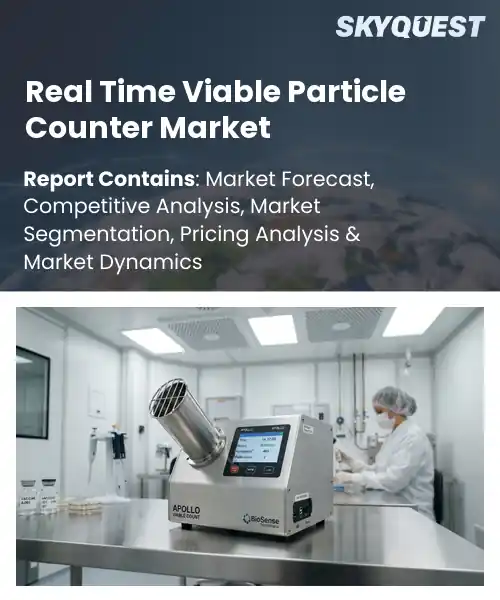
Real Time Viable Particle Counter Market
Report ID: SQMIG45J2823
Report ID: SQMIG45J2823
[email protected]
USA +1 351-333-4748
Report ID:
SQMIG45J2823 |
Region:
Global |
Published Date: August, 2026
Pages:
157
|Tables:
118
|Figures:
77


Global Real Time Viable Particle Counter Market size was valued at USD 356.0 Million in 2024 and is poised to grow from USD 388.4 Million in 2025 to USD 779.61 Million by 2033, growing at a CAGR of 9.1% during the forecast period (2026-2033).
The viable particle counter market comprises instruments that measure airborne particles capable of sustaining activity, serving sectors such as pharmaceuticals, cleanrooms, and environmental monitoring. Its importance stems from heightened regulatory scrutiny on contamination control and the need for corrective actions in processes. Historically, the market evolved from manual microscopy in the 1970s to laser optical counters in the 2000s, then to integrated IoT devices that stream data to cloud platforms. This progression was driven by advances in photonics, data analytics, and the rising cost of product recalls, exemplified by a 2018 FDA warning that prompted manufacturers to adopt monitoring solutions. Regulatory harmonization across regions acts as the primary catalyst driving the viable particle counter market toward broader adoption. When agencies such as the EU EMA and the US FDA tighten clean‑room standards, manufacturers must prove compliance, prompting investment in counters that deliver continuous data. This pressure creates opportunities for vendors to bundle analytics software, maintenance, and calibration services, expanding revenue beyond hardware. For example, a biotech firm integrated counters into its filling line, cutting batch failures by 30 percent and shortening release cycles. As a result, demand for cloud‑linked solutions is set to outpace standalone units, reshaping the competitive landscape.
How is AI integration shaping growth in the real-time viable particle counter market?
AI is becoming a core driver in the real time viable particle counter market. By embedding machine learning algorithms into sensors, manufacturers can turn raw particle data into actionable insights, enabling faster detection of contamination events and automated root cause analysis. AI enhanced analytics also allow continuous calibration and predictive maintenance, reducing downtime and improving reliability. Companies such as Plair SA with its Rapid C+ system illustrate how AI powered bio fluorescent detection can deliver immediate viability assessments. Similarly, TSI’s BioTrak line leverages AI to streamline data interpretation for aseptic manufacturing environments, making monitoring more intuitive and efficient.TSI Jan 2026, introduced an upgraded BioTrak real time viable particle counter that integrates AI driven pattern recognition to instantly flag abnormal microbial loads, cutting response times and supporting tighter quality control in sterile production. The system also feeds data into cloud dashboards, enabling remote monitoring and collaborative troubleshooting across facilities.
Market snapshot - (2026-2033)
Global Market Size
USD 356.0 Million
Largest Segment
Portable Real-Time Viable Particle Counters
Fastest Growth
Remote Real-Time Viable Particle Counters
Growth Rate
9.1% CAGR
To get more insights on this market click here to Request a Free Sample Report
Global real time viable particle counter market is segmented by product type, technology, application, end user and region. Based on product type, the market is segmented into Portable Real-Time Viable Particle Counters and Remote Real-Time Viable Particle Counters. Based on technology, the market is segmented into Fluorescence-Based Detection and Laser Scattering-Based Detection. Based on application, the market is segmented into Cleanroom Monitoring, Aseptic Process Monitoring, Environmental Monitoring and Indoor Air Quality Monitoring. Based on end user, the market is segmented into Pharmaceutical & Biotechnology Companies, Medical Device Manufacturers, Hospitals & Healthcare Facilities, Research Laboratories and Food & Beverage Manufacturers. Based on region, the market is segmented into North America, Europe, Asia Pacific, Latin America and Middle East & Africa.
Fluorescence Based Detection segment dominates because it directly visualizes microbial viability, offering unmistakable confirmation of biocontaminants, which is critical for stringent sterility standards. The technique provides rapid differentiation between viable and non viable particles, reducing false alarms and enabling precise corrective actions. Its compatibility with compact optics and real time data output appeals to users needing immediate insights, reinforcing its preference across laboratories and manufacturing environments throughout the production cycle and quality assurance.
However, Laser Scattering Based Detection segment is witnessing the strongest growth momentum because advancements in detector sensitivity enable viable particle sizing without labeling, attracting cost conscious users. The method integrates easily with existing monitoring infrastructure, expanding its reach into new cleanroom and environmental applications, thereby accelerating market expansion and new opportunity creation.
Portable Real Time Viable Particle Counters segment leads because they deliver onsite, instantaneous biocontamination data without the need for fixed infrastructure, satisfying the agility demanded by modern production lines. Their battery operation and lightweight design allow deployment in diverse environments, from cleanrooms to field clinics, ensuring continuous compliance monitoring. Users value the reduced sample transport risk and immediate feedback, which together foster higher adoption rates across critical manufacturing and healthcare settings globally today.
Meanwhile, Remote Real Time Viable Particle Counters segment is emerging as the key high growth area because cloud connectivity enables centralized data analytics and predictive maintenance across multiple sites. This capability reduces operational overhead and meets increasing regulatory demands for time oversight, spurring broader deployment in manufacturing networks and expanding market opportunity.
To get detailed segments analysis, Request a Free Sample Report
North America leads the global Real Time Viable Particle Counter market through a confluence of technological maturity, robust industrial demand, and supportive policy frameworks. The region hosts a dense network of advanced manufacturing facilities that require precise particle monitoring to meet stringent quality standards. Academic and corporate research centers collaborate closely, accelerating innovation in sensor design and data analytics. A well‑established supply chain ensures rapid availability of high‑performance instruments, while regulatory bodies enforce rigorous environmental and safety criteria that drive adoption. Moreover, strong investment in cleanroom and pharmaceutical sectors creates a sustained need for reliable viable particle detection, reinforcing the region’s leadership position. Collaborative initiatives between industry leaders and government agencies further embed real‑time monitoring into national quality agendas, encouraging continuous improvement and cross‑border standardization. Emerging focus on sustainable manufacturing practices amplifies interest in technologies that can differentiate between viable and inert particles, supporting resource efficiency and waste reduction.
Real Time Viable Particle Counter Market in United States benefits from a concentrated ecosystem of leading research universities and high‑tech firms that push the envelope of detection capabilities. Close proximity to major pharmaceutical and aerospace hubs creates a persistent demand for precise monitoring solutions. Strong intellectual property protection encourages commercial translation of breakthroughs, while industry consortia facilitate shared standards and best practices across sectors. Regulatory clarity and government grants further stimulate adoption in critical infrastructure and clinical environments.
Real Time Viable Particle Counter Market in Canada is propelled by a strong emphasis on environmental stewardship and advanced health‑care research. Collaborative projects between national laboratories and biotech clusters drive tailored solutions for cleanroom and water‑treatment applications. Government incentives for clean technology adoption encourage early integration of viable particle monitoring into manufacturing workflows. A skilled technical workforce supports ongoing refinement of sensor accuracy, reinforcing Canada’s reputation for precision instrumentation.
Europe experiences accelerated growth in the Real Time Viable Particle Counter market thanks to an integrated regulatory landscape that mandates rigorous contamination control across high‑value sectors. Robust public‑private research initiatives foster cross‑border collaboration, enabling rapid prototyping of advanced sensor technologies. Emphasis on circular economy practices drives demand for precise differentiation between viable and inert particles, supporting waste minimisation and product quality. Strong pharmaceutical and aerospace clusters in central and western regions create a sustained appetite for reliable monitoring tools. Governmental funding programmes further de‑risk innovation pathways, while a dense network of specialty manufacturers ensures swift commercialization. Continual harmonisation of testing standards across member states reduces barriers to entry, while corporate sustainability commitments amplify investment in technologies that ensure product integrity and environmental compliance.
Real Time Viable Particle Counter Market in Germany is anchored by a formidable engineering tradition and a dense industrial base that spans automotive, chemicals, and medical devices. Federal research programmes prioritize sensor precision and data integration, fostering collaborations between universities and multinational corporations. Stringent national quality standards compel manufacturers to adopt advanced viable particle detection, while export‑oriented strategies promote technology diffusion across global supply chains. enhancing Germany’s reputation as a leader in high‑precision instrumentation.
Real Time Viable Particle Counter Market in United Kingdom accelerates through a vibrant ecosystem of biotech hubs and aerospace innovators that demand real‑time contamination insight. Government‑backed innovation clusters provide access to cutting‑edge research facilities, enabling rapid iteration of sensor platforms. Emphasis on digital twins and predictive analytics integrates viable particle data into broader operational intelligence, driving efficiency gains. Strong export focus and collaborative standards bodies further embed advanced monitoring within industry practices.
Real Time Viable Particle Counter Market in France is emerging thanks to strategic investments in clean‑technology research and a growing network of pharmaceutical start‑ups. National initiatives encourage joint development projects that combine sensor expertise with advanced data analytics, fostering differentiated solutions for sterile environments. Commitment to European sustainability goals amplifies interest in technologies that can precisely identify viable contaminants, supporting both regulatory compliance and resource optimisation. Collaborative industry forums accelerate knowledge transfer and market adoption.
Asia Pacific is reinforcing its role in the Real Time Viable Particle Counter market through a combination of rapid industrial scaling, focused governmental support, and a surge in technology adoption across high‑tech sectors. Nations in the region invest heavily in research parks that blend materials science with advanced data processing, enabling the creation of ultra‑sensitive detectors tailored for semiconductor fabrication and biomedical manufacturing. Strategic initiatives to enhance air‑quality monitoring and food‑safety standards further broaden application horizons. Collaborative frameworks between local manufacturers and multinational partners accelerate knowledge transfer and reduce time‑to‑market for innovative solutions. Growing emphasis on artificial intelligence and edge computing integrates viable particle data into real‑time decision loops, delivering operational efficiencies that attract additional investment and reinforce the region’s competitive edge.
Real Time Viable Particle Counter Market in Japan thrives on a legacy of precision engineering and a concerted focus on advanced manufacturing. Close collaboration between leading instrument makers and automotive, semiconductor, and pharmaceutical sectors drives continuous refinement of detection capabilities. Government policies that promote Industry 4.0 adoption encourage integration of viable particle metrics into smart factory ecosystems. A culture of rigorous quality assurance ensures that Japanese manufacturers prioritize reliable, high‑sensitivity solutions, reinforcing the nation’s reputation for technological excellence.
Real Time Viable Particle Counter Market in South Korea is propelled by aggressive investment in semiconductor and biotech infrastructure, where contamination control is a critical success factor. Strong collaboration between research institutes and global equipment vendors accelerates the development of compact, high‑throughput sensors suited for cleanroom environments. National initiatives to bolster digital transformation integrate viable particle data with real‑time analytics platforms, enhancing operational visibility. This synergistic approach positions South Korea as a key innovator in delivering sophisticated monitoring solutions to both domestic and export
To know more about the market opportunities by region and country, click here to
Buy The Complete Report
Increasing Demand for Air Quality
Regulatory Support for Particle Monitoring
High Initial Investment Costs
Limited Technical Expertise Availability
Request Free Customization of this report to help us to meet your business objectives.
The market is shaped by intense competition among established manufacturers and emerging entrants that are leveraging advanced sensor fusion, cloud analytics and strategic acquisitions to differentiate their real‑time viable particle counters; recent partnership between a leading instrument maker and a cloud‑platform provider accelerated product integration, while a high‑profile M&A brought a niche optical‑technology firm into the fold, enhancing detection sensitivity and expanding service footprints.
Top Player’s Company Profile
Recent Developments
SkyQuest’s ABIRAW (Advanced Business Intelligence, Research & Analysis Wing) is our Business Information Services team that Collects, Collates, Correlates, and Analyses the Data collected by means of Primary Exploratory Research backed by robust Secondary Desk research. As per SkyQuest analysis, the market is being propelled primarily by the growing demand for indoor air quality, which pushes manufacturers and healthcare facilities to adopt real‑time viable particle counters, while the integration of IoT analytics serves as a second catalyst by turning raw counts into actionable, cloud‑based insights. The dominant region remains North America, where advanced manufacturing and stringent regulatory frameworks drive adoption, and the fluorescence‑based detection segment leads the market thanks to its rapid viability confirmation. However, the high initial investment cost of these sophisticated instruments acts as a restraint, limiting uptake among smaller players and slowing broader diffusion.
| Report Metric | Details |
|---|---|
| Market size value in 2024 | USD 356.0 Million |
| Market size value in 2033 | USD 779.61 Million |
| Growth Rate | 9.1% |
| Base year | 2024 |
| Forecast period | (2026-2033) |
| Forecast Unit (Value) | USD Million |
| Segments covered |
|
| Regions covered | North America (US, Canada), Europe (Germany, France, United Kingdom, Italy, Spain, Rest of Europe), Asia Pacific (China, India, Japan, Rest of Asia-Pacific), Latin America (Brazil, Rest of Latin America), Middle East & Africa (South Africa, GCC Countries, Rest of MEA) |
| Companies covered |
|
| Customization scope | Free report customization with purchase. Customization includes:-
|
To get a free trial access to our platform which is a one stop solution for all your data requirements for quicker decision making. This platform allows you to compare markets, competitors who are prominent in the market, and mega trends that are influencing the dynamics in the market. Also, get access to detailed SkyQuest exclusive matrix.
Table Of Content
Executive Summary
Market overview
Parent Market Analysis
Market overview
Market size
KEY MARKET INSIGHTS
COVID IMPACT
MARKET DYNAMICS & OUTLOOK
Market Size by Region
KEY COMPANY PROFILES
Methodology
For the Real Time Viable Particle Counter Market, our research methodology involved a mixture of primary and secondary data sources. Key steps involved in the research process are listed below:
1. Information Procurement: This stage involved the procurement of Market data or related information via primary and secondary sources. The various secondary sources used included various company websites, annual reports, trade databases, and paid databases such as Hoover's, Bloomberg Business, Factiva, and Avention. Our team did 45 primary interactions Globally which included several stakeholders such as manufacturers, customers, key opinion leaders, etc. Overall, information procurement was one of the most extensive stages in our research process.
2. Information Analysis: This step involved triangulation of data through bottom-up and top-down approaches to estimate and validate the total size and future estimate of the Real Time Viable Particle Counter Market.
3. Report Formulation: The final step entailed the placement of data points in appropriate Market spaces in an attempt to deduce viable conclusions.
4. Validation & Publishing: Validation is the most important step in the process. Validation & re-validation via an intricately designed process helped us finalize data points to be used for final calculations. The final Market estimates and forecasts were then aligned and sent to our panel of industry experts for validation of data. Once the validation was done the report was sent to our Quality Assurance team to ensure adherence to style guides, consistency & design.
Analyst Support
Customization Options
With the given market data, our dedicated team of analysts can offer you the following customization options are available for the Real Time Viable Particle Counter Market:
Product Analysis: Product matrix, which offers a detailed comparison of the product portfolio of companies.
Regional Analysis: Further analysis of the Real Time Viable Particle Counter Market for additional countries.
Competitive Analysis: Detailed analysis and profiling of additional Market players & comparative analysis of competitive products.
Go to Market Strategy: Find the high-growth channels to invest your marketing efforts and increase your customer base.
Innovation Mapping: Identify racial solutions and innovation, connected to deep ecosystems of innovators, start-ups, academics, and strategic partners.
Category Intelligence: Customized intelligence that is relevant to their supply Markets will enable them to make smarter sourcing decisions and improve their category management.
Public Company Transcript Analysis: To improve the investment performance by generating new alpha and making better-informed decisions.
Social Media Listening: To analyze the conversations and trends happening not just around your brand, but around your industry as a whole, and use those insights to make better Marketing decisions.
REQUEST FOR SAMPLE
 REQUEST FREE CUSTOMIZATION


Want to customize this report? This report can be personalized according to your needs. Our analysts and industry experts will work directly with you to understand your requirements and provide you with customized data in a short amount of time. We offer $1000 worth of FREE customization at the time of purchase.
Feedback From Our Clients


 USA (+1) 351-333-4748

