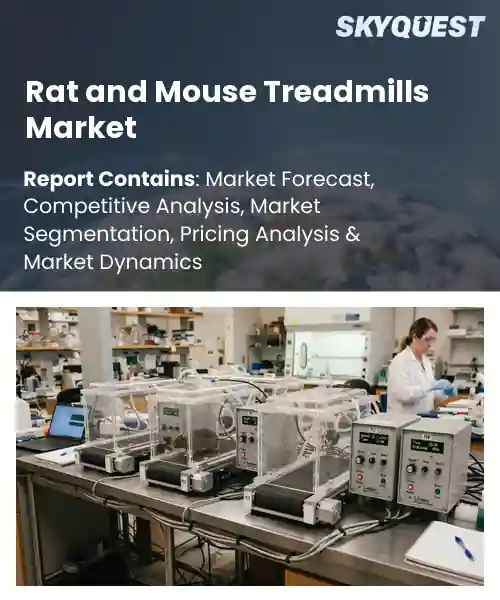
Rat and Mouse Treadmills Market
Report ID: SQMIG35J2852
Report ID: SQMIG35J2852
[email protected]
USA +1 351-333-4748
Report ID:
SQMIG35J2852 |
Region:
Global |
Published Date: October, 2026
Pages:
157
|Tables:
119
|Figures:
77


Global Rat And Mouse Treadmills Market size was valued at USD 85.0 Million in 2024 and is poised to grow from USD 88.91 Million in 2025 to USD 127.42 Million by 2033, growing at a CAGR of 4.6% during the forecast period (2026-2033).
The global rat and mouse treadmill market supplies platforms that record locomotor performance in laboratory rodents, a niche yet pivotal segment of research equipment. Its primary driver is the escalating need for quantifiable functional endpoints in drug development, especially for neurodegenerative and musculoskeletal disorders. Historically, researchers relied on manual runway assays, but the 2000s introduced belt systems that offered speed control and data capture. By 2015, integrations with video tracking and wireless sensors expanded depth, allowing studies of Parkinson’s models and obesity interventions to produce reproducible results. Consequently, the market has transitioned from a peripheral tool to a core asset. As the treadmill platform becomes a core asset, adoption accelerates because academic consortia and biotech firms seek phenotyping to shorten pre‑clinical timelines. The key growth factor is the convergence of automation and data analytics, which reduces labor costs and improves power. For example, a leading pharmaceutical company integrated a gait analysis module with its treadmill fleet, cutting the number of animals required for a traumatic brain injury study by 30 % while delivering richer kinetic profiles. This efficiency fuels demand for devices, contracts, and upgrades, creating revenue streams beyond the initial hardware sale and inviting venture capital focused on translational tools.
How is AI improving data accuracy in the rat and mouse treadmill research market?
AI is sharpening data accuracy in rat and mouse treadmill research by automating video tracking, synchronizing sensor outputs, and applying machine‑learning algorithms to filter noise. Modern platforms integrate high‑resolution cameras with pose‑estimation models that label each limb movement without manual annotation. Real‑time analytics align speed, incline, and metabolic readouts, reducing human error and improving reproducibility across laboratories. Researchers can now compare longitudinal studies with confidence because AI flags outliers and corrects drift in sensor calibration. This convergence of robotics and intelligent software is expanding the market as more institutions adopt automated systems for behavioral and physiological experiments.In March 2024 a leading supplier introduced an AI‑enhanced treadmill that automatically corrects gait measurements and synchronizes metabolic data, boosting experimental precision and accelerating study timelines. This innovation illustrates how intelligent automation drives growth and efficiency in the rat and mouse treadmill market.
Market snapshot - (2026-2033)
Global Market Size
USD 85.0 Million
Largest Segment
Motorized Treadmills
Fastest Growth
Specialized Small-Animal Treadmills
Growth Rate
4.6% CAGR
To get more insights on this market click here to Request a Free Sample Report
Global rat and mouse treadmills market is segmented by product type, animal type, application, end user and region. Based on product type, the market is segmented into Manual Treadmills, Motorized Treadmills and Specialized Small-Animal Treadmills. Based on animal type, the market is segmented into Rat Treadmills and Mouse Treadmills. Based on application, the market is segmented into Exercise Physiology Research, Cardiovascular Research, Metabolic & Obesity Research, Neuroscience Research and Rehabilitation & Other Preclinical Studies. Based on end user, the market is segmented into Academic & Research Institutions, Pharmaceutical & Biotechnology Companies, Contract Research Organizations and Government Research Laboratories. Based on region, the market is segmented into North America, Europe, Asia Pacific, Latin America and Middle East & Africa.
Motorized Treadmills segment dominates because they provide precise speed control, programmable incline, and integrated data acquisition, which are essential for reproducible preclinical exercise protocols. Their ability to synchronize with physiological monitoring systems reduces experimental variability and enhances translational relevance. Researchers favor these devices for both acute and chronic studies, driving widespread adoption across academic labs and industry collaborations, thereby cementing their leadership in the rat and mouse treadmill market.
Meanwhile, Specialized Small Animal Treadmills experience the fastest growth as innovators integrate miniaturized sensors and modular designs tailored for high throughput phenotyping. This flexibility attracts neuroscience and metabolic labs seeking scalable platforms, expanding the market’s reach and prompting manufacturers to invest in next generation features that accelerate adoption across diverse research programs.
Neuroscience Research segment dominates because the ability to link controlled locomotor activity with neural circuit interrogation is central to unraveling brain function. Rat and mouse treadmills enable simultaneous electrophysiology, calcium imaging, and optogenetic stimulation during defined behavioral bouts, providing temporal precision that static cages cannot. This methodological advantage fuels demand among investigators exploring cognition, motor disorders, and synaptic plasticity, positioning neuroscience as the primary driver of treadmill utilization.
On the other hand, Metabolic and Obesity Research is witnessing the strongest growth as obesity prevalence fuels interest in exercise interventions that can be precisely quantified. Treadmills tailored for metabolic phenotyping allow continuous monitoring of energy expenditure and glucose dynamics, prompting labs to adopt these platforms and expanding the market’s application base.
To get detailed segments analysis, Request a Free Sample Report
North America leads the global rat and mouse treadmill market because of its deep integration of academic research, pharmaceutical development, and advanced manufacturing capabilities. The United States hosts a dense network of universities and biotech hubs that prioritize translational studies, creating sustained demand for precise locomotion equipment. Robust public and private funding streams encourage innovation in metabolic and neurological research, while regulatory frameworks provide clear pathways for product validation. Canada complements this environment with strong collaborative programs and a focus on animal welfare standards that drive adoption of high‑quality treadmill systems. Together, these factors generate a resilient ecosystem that supports continuous product refinement, skilled technical support, and a broad customer base, reinforcing North America’s dominant position.
Rat and Mouse Treadmills Market in the United States thrives on a dense concentration of research universities and pharmaceutical innovators that prioritize preclinical locomotion studies. Grant programs and venture capital activity sustain continuous demand for sophisticated treadmill platforms. Collaborative networks between academia and industry accelerate product customization, while stringent animal care guidelines ensure high adoption of reliable equipment. This ecosystem creates a pipeline of users seeking advanced functional assessment tools.
Rat and Mouse Treadmills Market in Canada benefits from research initiatives that emphasize translational animal studies and collaborative projects across provinces. Academic centers with neuroscience and metabolic programs drive consistent demand for precise treadmill systems. Emphasis on humane research practices encourages adoption of equipment that meets welfare standards, while ties with U.S. biotech firms facilitate technology transfer and development. This supportive environment nurtures a flow of investigators seeking reliable locomotion assessment solutions.
Europe’s rat and mouse treadmill market expands rapidly due to a confluence of scientific ecosystems, coordinated funding mechanisms, and a unified regulatory landscape that encourages collaboration across borders. Germany anchors the region with renowned biomedical institutes and a tradition of precision engineering, fostering demand for reliable locomotion platforms. The United Kingdom leverages its strong translational research community and attractive investment climate, accelerating adoption of advanced treadmill technologies. France contributes emerging expertise in metabolic and neurobehavioral studies, supported by national research initiatives that prioritize innovative animal models. The region’s emphasis on open‑science collaborations and shared data repositories amplifies the utility of treadmill data, enabling researchers to benchmark findings across laboratories. Strong intellectual‑property frameworks provide confidence for companies to invest in treadmill designs tailored to disease models.
Rat and Mouse Treadmills Market in Germany is driven by a network of research hospitals and engineering firms that prioritize precision instrumentation. Collaborative projects between biomedical departments and equipment manufacturers ensure that treadmill designs meet rigorous scientific standards. Strong emphasis on reproducibility and data integrity fuels continuous demand for platforms. Additionally, national funding programs that support translational animal studies reinforce the market’s stability and encourage innovation in locomotion assessment tools.
Rat and Mouse Treadmills Market in the United Kingdom benefits from a community that bridges academic discoveries with development. Government incentives and schemes attract teams focused on neurodegenerative and metabolic disease models, driving demand for adaptable treadmill systems. Leading biotech firms partner with university laboratories to develop platforms that integrate data capture capabilities. This synergy between hubs and funding bodies sustains a market environment that expands scope of locomotion research.
Rat and Mouse Treadmills Market in France is emerging as research institutions prioritize innovative animal models for metabolic and neurobehavioral investigations. Government research programs provide targeted support for equipment acquisition, encouraging laboratories to adopt treadmill systems. Collaboration between academic centers and specialized manufacturers facilitates customization of platforms to suit experimental protocols. The growing emphasis on translational outcomes and projects strengthens demand, positioning France as a hub for locomotion research tools.
Asia Pacific is strengthening its role in the rat and mouse treadmill market through a combination of strategic government investment, rapid biotech expansion, and a cultural emphasis on precision engineering. Japan leverages its long‑standing expertise in biomedical instrumentation and a collaborative network of universities and contract research organizations that prioritize high‑throughput animal studies. South Korea’s dynamic pharmaceutical sector and strong focus on digital health technologies drive demand for treadmill systems that integrate real‑time data analytics and automation. Both economies benefit from supportive regulatory frameworks that streamline preclinical device approval, encouraging manufacturers to introduce innovative platforms tailored to disease‑specific models. The region’s commitment to interdisciplinary research and technology transfer further accelerates adoption, positioning Asia Pacific as an emerging hub for advanced locomotion assessment solutions.
Rat and Mouse Treadmills Market in Japan is propelled by a tradition of precision biomedical engineering and collaboration between research universities and testing facilities. Government programs that fund innovation encourage laboratories to adopt treadmill systems capable of gait analysis. Partnerships with equipment manufacturers enable customization of platforms to align with disease models, while a focus on data reproducibility drives improvement of performance. This ecosystem sustains demand for locomotion assessment tools.
Rat and Mouse Treadmills Market in South Korea is driven by a pharmaceutical sector and governmental emphasis on integration. Research institutes prioritize animal studies, creating demand for treadmill platforms that incorporate monitoring and data processing. Collaboration between biotech firms and local device manufacturers enables prototyping of systems tailored to disease pathways. The regulatory environment and focus on innovation accelerate adoption, positioning South Korea as a contributor to locomotion research capabilities.
To know more about the market opportunities by region and country, click here to
Buy The Complete Report
Increasing Research on Rodent Models
Advancements in Treadmill Technology
High Initial Equipment Cost
Limited Accessibility in Emerging Regions
Request Free Customization of this report to help us to meet your business objectives.
Several established manufacturers are intensifying competition by forming partnerships with biotech firms to embed advanced sensor technologies into their rodent treadmill platforms, while others are pursuing acquisitions of niche data‑analytics companies to enhance AI‑driven behavioral analysis capabilities. Recent strategic moves include collaborations that integrate wireless telemetry modules for real‑time monitoring and joint development programs aimed at miniaturizing treadmill designs for high‑throughput screening environments.
Top Player’s Company Profile
Recent Developments
SkyQuest’s ABIRAW (Advanced Business Intelligence, Research & Analysis Wing) is our Business Information Services team that Collects, Collates, Correlates, and Analyses the Data collected by means of Primary Exploratory Research backed by robust Secondary Desk research. As per SkyQuest analysis, the global rat and mouse treadmill market is propelled primarily by the surge in rodent‑based research for neurodegenerative and metabolic studies, which fuels demand for precise locomotion platforms; a second important driver is the rapid integration of advanced sensors, programmable speed profiles and AI‑enhanced data capture that make experiments more reproducible and efficient. Motorized treadmills remain the dominating segment because they offer accurate speed control and seamless data integration. North America leads the market thanks to its dense network of academic institutions, biotech firms and strong funding streams, however, high upfront equipment costs restrain adoption among smaller labs and emerging economies, tempering overall growth.
| Report Metric | Details |
|---|---|
| Market size value in 2024 | USD 85.0 Million |
| Market size value in 2033 | USD 127.42 Million |
| Growth Rate | 4.6% |
| Base year | 2024 |
| Forecast period | (2026-2033) |
| Forecast Unit (Value) | USD Million |
| Segments covered |
|
| Regions covered | North America (US, Canada), Europe (Germany, France, United Kingdom, Italy, Spain, Rest of Europe), Asia Pacific (China, India, Japan, Rest of Asia-Pacific), Latin America (Brazil, Rest of Latin America), Middle East & Africa (South Africa, GCC Countries, Rest of MEA) |
| Companies covered |
|
| Customization scope | Free report customization with purchase. Customization includes:-
|
To get a free trial access to our platform which is a one stop solution for all your data requirements for quicker decision making. This platform allows you to compare markets, competitors who are prominent in the market, and mega trends that are influencing the dynamics in the market. Also, get access to detailed SkyQuest exclusive matrix.
Table Of Content
Executive Summary
Market overview
Parent Market Analysis
Market overview
Market size
KEY MARKET INSIGHTS
COVID IMPACT
MARKET DYNAMICS & OUTLOOK
Market Size by Region
KEY COMPANY PROFILES
Methodology
For the Rat and Mouse Treadmills Market, our research methodology involved a mixture of primary and secondary data sources. Key steps involved in the research process are listed below:
1. Information Procurement: This stage involved the procurement of Market data or related information via primary and secondary sources. The various secondary sources used included various company websites, annual reports, trade databases, and paid databases such as Hoover's, Bloomberg Business, Factiva, and Avention. Our team did 45 primary interactions Globally which included several stakeholders such as manufacturers, customers, key opinion leaders, etc. Overall, information procurement was one of the most extensive stages in our research process.
2. Information Analysis: This step involved triangulation of data through bottom-up and top-down approaches to estimate and validate the total size and future estimate of the Rat and Mouse Treadmills Market.
3. Report Formulation: The final step entailed the placement of data points in appropriate Market spaces in an attempt to deduce viable conclusions.
4. Validation & Publishing: Validation is the most important step in the process. Validation & re-validation via an intricately designed process helped us finalize data points to be used for final calculations. The final Market estimates and forecasts were then aligned and sent to our panel of industry experts for validation of data. Once the validation was done the report was sent to our Quality Assurance team to ensure adherence to style guides, consistency & design.
Analyst Support
Customization Options
With the given market data, our dedicated team of analysts can offer you the following customization options are available for the Rat and Mouse Treadmills Market:
Product Analysis: Product matrix, which offers a detailed comparison of the product portfolio of companies.
Regional Analysis: Further analysis of the Rat and Mouse Treadmills Market for additional countries.
Competitive Analysis: Detailed analysis and profiling of additional Market players & comparative analysis of competitive products.
Go to Market Strategy: Find the high-growth channels to invest your marketing efforts and increase your customer base.
Innovation Mapping: Identify racial solutions and innovation, connected to deep ecosystems of innovators, start-ups, academics, and strategic partners.
Category Intelligence: Customized intelligence that is relevant to their supply Markets will enable them to make smarter sourcing decisions and improve their category management.
Public Company Transcript Analysis: To improve the investment performance by generating new alpha and making better-informed decisions.
Social Media Listening: To analyze the conversations and trends happening not just around your brand, but around your industry as a whole, and use those insights to make better Marketing decisions.
REQUEST FOR SAMPLE
 REQUEST FREE CUSTOMIZATION


Want to customize this report? This report can be personalized according to your needs. Our analysts and industry experts will work directly with you to understand your requirements and provide you with customized data in a short amount of time. We offer $1000 worth of FREE customization at the time of purchase.
Feedback From Our Clients


 USA (+1) 351-333-4748

