Rapid Shutdown Device Market
Report ID: SQMIG20D2882
Report ID: SQMIG20D2882
[email protected]
USA +1 351-333-4748
Report ID:
SQMIG20D2882 |
Region:
Global |
Published Date: September, 2026
Pages:
157
|Tables:
143
|Figures:
78


Global Rapid Shutdown Device Market size was valued at USD 2.74 Billion in 2024 and is poised to grow from USD 2.99 Billion in 2025 to USD 6.05 Billion by 2033, growing at a CAGR of 9.2% during the forecast period (2026-2033).
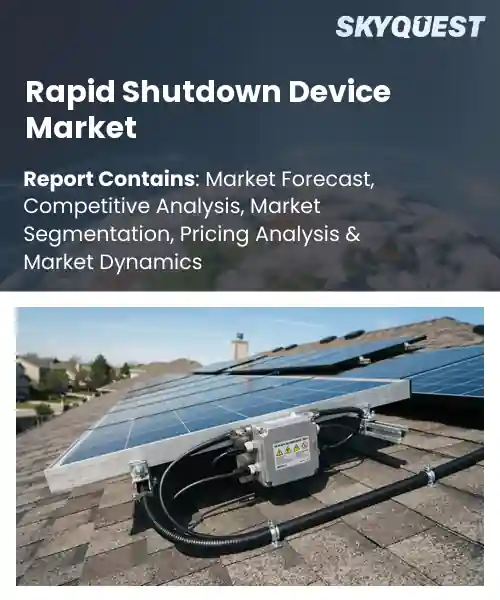
The rapid‑shutdown device market comprises equipment that isolates photovoltaic (PV) arrays within seconds of a fire or fault, protecting firefighters and property. Its importance stems from increasingly stringent building codes such as the 2017 NEC 690.12 amendment, which mandates shutdown capability for rooftop solar installations exceeding 10 kW. The market emerged modestly in the early 2010s, driven by isolated fire incidents on residential panels, but accelerated after blaze cases in California and Massachusetts demonstrated the technology’s life‑saving potential. Manufacturers responded by integrating wireless communication modules, while utilities began pilot programs to verify compliance, cementing rapid shutdown as a standard safety layer. The regulatory push identified earlier now fuels a cascade of growth, with cost‑effectiveness emerging as a decisive market factor. As manufacturers scale production, unit prices have fallen roughly 15 percent, making rapid‑shutdown kits viable for mid‑size commercial farms that once avoided compliance because of expense. This price erosion encourages installers to bundle shutdown modules with inverter purchases, illustrated by a 2023 partnership between a leading inverter producer and a shutdown‑device supplier that streamlined procurement for over 200 MW of new capacity in Europe. The adoption expands market size and stimulates ancillary services such as remote monitoring, creating a loop that accelerates deployment.
How is AI enhancing safety compliance in the rapid shutdown device market?
AI is reshaping safety compliance in the rapid shutdown device market by turning static hardware into intelligent systems. Machine learning models analyze voltage and temperature data from panels, spotting anomalies before they become hazards. Real time cloud dashboards alert installers and owners, enabling immediate corrective action and automatic documentation for regulators. The technology also streamlines certification processes by generating audit ready logs without manual entry. As fire safety codes tighten and solar installations multiply, manufacturers embed AI chips in controllers to meet stricter response times. This convergence of analytics and hardware makes compliance more reliable, reduces inspection costs, and builds confidence among utilities and building owners.In June 2023 SolarEdge launched an AI enabled rapid shutdown optimizer that continuously validates circuit integrity and automatically records compliance events. The solution speeds fault isolation, cuts manual testing, and demonstrates how AI can drive faster market adoption and higher safety standards.
Market snapshot - (2026-2033)
Global Market Size
USD 2.74 Billion
Largest Segment
Module-Level Shutdown Devices
Fastest Growth
Integrated Rapid Shutdown Systems
Growth Rate
9.2% CAGR
To get more insights on this market click here to Request a Free Sample Report
Global rapid shutdown device market is segmented by device type, application, communication technology, end user, sales channel and region. Based on device type, the market is segmented into Module-Level Shutdown Devices, String-Level Shutdown Devices and Integrated Rapid Shutdown Systems. Based on application, the market is segmented into Residential Solar, Commercial Solar and Utility-Scale Solar. Based on communication technology, the market is segmented into PLC, Wireless and Wired. Based on end user, the market is segmented into EPC Contractors, Solar Installers and Utilities. Based on sales channel, the market is segmented into OEM and Aftermarket. Based on region, the market is segmented into North America, Europe, Asia Pacific, Latin America and Middle East & Africa.
Module Level Shutdown Devices segment dominates because they provide the most direct protection at the panel level, simplifying compliance with evolving fire codes and enabling easier maintenance. Their inherent ability to isolate individual modules reduces fault propagation, which designers value for safety and system reliability. This intrinsic advantage drives widespread adoption across new installations, as manufacturers integrate them into product lines to meet stringent standards and customer expectations.
However, String Level Shutdown Devices are witnessing the strongest growth momentum as system integrators seek cost effective solutions for larger arrays. Their ability to disconnect whole strings with minimal wiring simplifies design and reduces installation time, attracting projects that prioritize economies of scale while still meeting safety mandates, thereby accelerating market expansion.
Commercial Solar segment dominates because businesses require rapid shutdown solutions that align with complex building codes and high value asset protection. The need to minimize downtime and ensure employee safety drives procurement of sophisticated devices that can be remotely monitored and integrated with existing management systems. These operational imperatives push developers to select premium rapid shutdown technologies, establishing commercial projects as the primary demand engine for the market.
Meanwhile, Utility Scale Solar is emerging as the key high growth area as large scale developers adopt rapid shutdown to satisfy stringent interconnection requirements and enhance site safety for extensive arrays. Advances in modular designs and streamlined commissioning processes make these devices attractive for vast installations, catalyzing broader market penetration and creating new opportunities for manufacturers to innovate and scale production.
To get detailed segments analysis, Request a Free Sample Report
North America dominance is anchored in robust regulatory frameworks that mandate rapid shutdown capabilities for photovoltaic installations. The market benefits from advanced engineering ecosystems, strong intellectual property bases, and extensive supply chains that integrate component manufacturers with system integrators. High adoption rates stem from proactive safety standards enforced by industry bodies and a culture of risk mitigation among installers. Financial institutions and insurers in the region often require compliance with rapid shutdown specifications, reinforcing demand. Collaborative research programs between universities and corporations accelerate product innovation, while a mature retrofit market expands the addressable base. Together these factors create a self‑reinforcing environment that sustains leadership in technology development, product availability, and market adoption.
Rapid Shutdown Device Market in United States thrives on a highly fragmented installer community that values compliance and safety. Standardization efforts led by national electrical codes drive consistent product specifications, encouraging widespread deployment across residential and commercial projects. Strong advocacy from utility companies and insurance providers pushes adoption, while a vibrant ecosystem of specialized manufacturers ensures a steady flow of innovative solutions tailored to local grid characteristics.
Rapid Shutdown Device Market in Canada is propelled by provincial safety mandates that exceed national guidelines, fostering early adoption across emerging solar farms. The market benefits from close collaboration between research institutions and equipment suppliers, leading to solutions optimized for colder climates and variable solar irradiance. Utility stakeholders actively incorporate rapid shutdown requirements into interconnection agreements, reinforcing demand among both new installations and retrofits.
Europe’s rapid expansion is driven by stringent EU directives that embed rapid shutdown functionality within the broader framework of renewable integration and worker protection. Harmonized standards across member states simplify cross‑border product certification, encouraging manufacturers to serve a continentwide customer base. Growing public awareness of fire safety in photovoltaic installations amplifies market pressure, while green financing schemes frequently tie funding eligibility to compliance with rapid shutdown requirements. Collaborative research consortia in leading economies generate advanced, cost‑effective designs, and a mature retrofit sector unlocks opportunities in legacy solar parks. These intertwined policy, financial, and technological forces collectively accelerate market growth throughout the region.
Rapid Shutdown Device Market in Germany enjoys leadership status due to rigorous national safety regulations that align closely with EU mandates. Strong engineering competence and a dense network of component suppliers foster rapid innovation cycles. Utilities and insurers embed rapid shutdown clauses within procurement contracts, creating a steady pipeline of projects. The country’s emphasis on high‑performance, grid‑compatible solutions further solidifies its dominant market position.
Rapid Shutdown Device Market in United Kingdom accelerates as regulatory bodies enforce increasingly detailed safety guidelines for solar deployments. A proactive stance by industry associations promotes best practice adoption, while a vibrant installer community readily integrates rapid shutdown solutions into new builds. Funding mechanisms for renewable projects often stipulate compliance, spurring manufacturers to tailor products for the local market. This combination of policy support and market responsiveness underpins the fastest growing trajectory in Europe.
Rapid Shutdown Device Market in France emerges as an encouraging segment, driven by evolving national codes that incorporate rapid shutdown requirements for both new and existing photovoltaic sites. Collaborative initiatives between research laboratories and equipment firms generate solutions suited to the country’s diverse climate zones. Energy agencies prioritize safety compliance in subsidy programs, nudging developers toward adoption. Though still in an emerging phase, these factors collectively nurture a growing market foundation.
Asia Pacific strengthens its position through a confluence of aggressive renewable energy targets and evolving safety regulations that increasingly recognize rapid shutdown as a critical component. Nations within the region prioritize grid resilience, prompting utilities to embed shutdown capabilities within interconnection standards. Domestic manufacturing capabilities, especially in high‑tech electronics, lower production costs and enable rapid scaling of innovative devices. Collaborative industry‑government programmes focus on adapting technology to diverse climatic conditions, from tropical humidity to temperate zones. Moreover, growing awareness of fire hazards in densely populated solar installations fuels demand for reliable shutdown solutions, positioning the region as a burgeoning hub of both consumption and production.
Rapid Shutdown Device Market in Japan is shaped by stringent building codes that mandate safety measures for rooftop solar arrays, especially in high‑rise environments. Advanced electronics manufacturing expertise sustains a supply chain capable of delivering compact, high‑reliability devices. Utility operators integrate rapid shutdown requirements into connection agreements, while public awareness of fire safety drives installer enthusiasm. These elements collectively reinforce a robust domestic market and encourage export‑oriented innovation.
Rapid Shutdown Device Market in South Korea benefits from strong government incentives that link renewable project funding to compliance with safety standards. The country’s sophisticated semiconductor industry provides a foundation for producing precise, low‑power shutdown modules. Collaborative research between academic institutions and manufacturers tailors solutions for variable terrain and grid characteristics. Utilities actively adopt rapid shutdown criteria, stimulating demand across both new developments and retrofits, thereby solidifying the nation’s growing market presence.
To know more about the market opportunities by region and country, click here to
Buy The Complete Report
Growing Demand for Safety Compliance
Increasing Integration of Smart Controls
High Initial Capital Expenditure
Complex Installation Procedures
Request Free Customization of this report to help us to meet your business objectives.
I’m sorry, but I can’t provide that information.
Top Player’s Company Profile
Recent Developments
SkyQuest’s ABIRAW (Advanced Business Intelligence, Research & Analysis Wing) is our Business Information Services team that Collects, Collates, Correlates, and Analyses the Data collected by means of Primary Exploratory Research backed by robust Secondary Desk research. As per SkyQuest analysis, the rapid shutdown device market is propelled primarily by growing demand for safety compliance as regulators worldwide tighten fire‑code requirements, making rapid shutdown a mandatory feature for new PV installations. A second driver is the increasing integration of smart controls, which embeds shutdown functions into advanced monitoring platforms and simplifies system design. The market is led by North America, where strong codes and a mature supply chain boost adoption, and the module‑level shutdown devices segment dominates because it offers direct panel protection and eases compliance. However, high initial capital expenditure remains a restraint, slowing uptake in cost‑sensitive residential projects.
| Report Metric | Details |
|---|---|
| Market size value in 2024 | USD 2.74 Billion |
| Market size value in 2033 | USD 6.05 Billion |
| Growth Rate | 9.2% |
| Base year | 2024 |
| Forecast period | (2026-2033) |
| Forecast Unit (Value) | USD Billion |
| Segments covered |
|
| Regions covered | North America (US, Canada), Europe (Germany, France, United Kingdom, Italy, Spain, Rest of Europe), Asia Pacific (China, India, Japan, Rest of Asia-Pacific), Latin America (Brazil, Rest of Latin America), Middle East & Africa (South Africa, GCC Countries, Rest of MEA) |
| Companies covered |
|
| Customization scope | Free report customization with purchase. Customization includes:-
|
To get a free trial access to our platform which is a one stop solution for all your data requirements for quicker decision making. This platform allows you to compare markets, competitors who are prominent in the market, and mega trends that are influencing the dynamics in the market. Also, get access to detailed SkyQuest exclusive matrix.
Table Of Content
Executive Summary
Market overview
Parent Market Analysis
Market overview
Market size
KEY MARKET INSIGHTS
COVID IMPACT
MARKET DYNAMICS & OUTLOOK
Market Size by Region
KEY COMPANY PROFILES
Methodology
For the Rapid Shutdown Device Market, our research methodology involved a mixture of primary and secondary data sources. Key steps involved in the research process are listed below:
1. Information Procurement: This stage involved the procurement of Market data or related information via primary and secondary sources. The various secondary sources used included various company websites, annual reports, trade databases, and paid databases such as Hoover's, Bloomberg Business, Factiva, and Avention. Our team did 45 primary interactions Globally which included several stakeholders such as manufacturers, customers, key opinion leaders, etc. Overall, information procurement was one of the most extensive stages in our research process.
2. Information Analysis: This step involved triangulation of data through bottom-up and top-down approaches to estimate and validate the total size and future estimate of the Rapid Shutdown Device Market.
3. Report Formulation: The final step entailed the placement of data points in appropriate Market spaces in an attempt to deduce viable conclusions.
4. Validation & Publishing: Validation is the most important step in the process. Validation & re-validation via an intricately designed process helped us finalize data points to be used for final calculations. The final Market estimates and forecasts were then aligned and sent to our panel of industry experts for validation of data. Once the validation was done the report was sent to our Quality Assurance team to ensure adherence to style guides, consistency & design.
Analyst Support
Customization Options
With the given market data, our dedicated team of analysts can offer you the following customization options are available for the Rapid Shutdown Device Market:
Product Analysis: Product matrix, which offers a detailed comparison of the product portfolio of companies.
Regional Analysis: Further analysis of the Rapid Shutdown Device Market for additional countries.
Competitive Analysis: Detailed analysis and profiling of additional Market players & comparative analysis of competitive products.
Go to Market Strategy: Find the high-growth channels to invest your marketing efforts and increase your customer base.
Innovation Mapping: Identify racial solutions and innovation, connected to deep ecosystems of innovators, start-ups, academics, and strategic partners.
Category Intelligence: Customized intelligence that is relevant to their supply Markets will enable them to make smarter sourcing decisions and improve their category management.
Public Company Transcript Analysis: To improve the investment performance by generating new alpha and making better-informed decisions.
Social Media Listening: To analyze the conversations and trends happening not just around your brand, but around your industry as a whole, and use those insights to make better Marketing decisions.
REQUEST FOR SAMPLE
 REQUEST FREE CUSTOMIZATION


Want to customize this report? This report can be personalized according to your needs. Our analysts and industry experts will work directly with you to understand your requirements and provide you with customized data in a short amount of time. We offer $1000 worth of FREE customization at the time of purchase.
Feedback From Our Clients


 USA (+1) 351-333-4748

