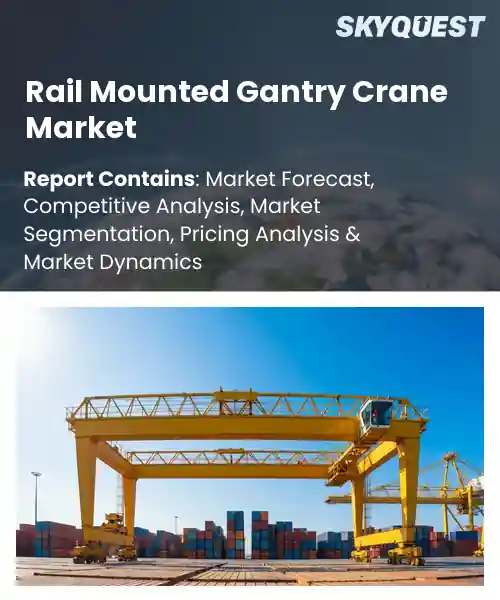
Rail Mounted Gantry Crane Market
Report ID: SQMIG20I3165
Report ID: SQMIG20I3165
[email protected]
USA +1 351-333-4748
Report ID:
SQMIG20I3165 |
Region:
Global |
Published Date: June, 2026
Pages:
157
|Tables:
204
|Figures:
80


Global Rail Mounted Gantry Crane Market size was valued at USD 521.0 Million in 2024 and is poised to grow from USD 541.84 Million in 2025 to USD 741.55 Million by 2033, growing at a CAGR of 4.0% during the forecast period (2026-2033).
The primary driver of the rail mounted gantry crane market is sustained expansion and automation of container terminals, which has raised productivity and operational precision demands. Rail mounted gantry cranes move containers along rails in yard and port environments and matter because they enable high-density stacking and fast rail-to-ship and rail-to-truck transfers, reducing dwell times and costs. Historically the market transitioned from manual gantries to electrified and automated systems as ports such as Shanghai and Rotterdam invested in deeper harbors and advanced terminal systems. Investments under initiatives like China’s Belt and Road accelerated replacement cycles and adoption of larger RMGs.
Building on expansion, innovation has emerged as the key growth factor shaping demand for rail mounted gantry cranes because automation, electrification and digitalization directly reduce operating costs, increasing throughput. For example, automated RMGs equipped with remote control, sensor arrays and predictive maintenance platforms cut unplanned downtime and labor expenses, prompting terminal operators in Singapore and Hamburg to upgrade fleets. Electrified drives with regenerative braking lower energy consumption and help meet stricter emissions standards, which in turn motivates procurement and retrofit activity. These cause-and-effect dynamics create opportunities for OEMs to offer modular service contracts and software firms to deploy yard analytics.
How is AI enabling predictive maintenance in the rail mounted gantry crane market?
AI enables predictive maintenance for rail mounted gantry cranes by combining onboard sensors, continuous condition monitoring, and machine learning that detects subtle wear patterns and emerging faults. The current state sees operators shift from time based servicing to data driven interventions. Edge analytics provide fast alerts while cloud platforms and digital twin models support trend analysis and planning. Practical instances include vibration sensing, motor current analysis, and image based inspection that feed anomaly detection models. These capabilities help reduce unplanned downtime, extend component life, and simplify spare parts planning, making crane fleets more reliable and easier to manage.
Konecranes May 2026, the company expanded its Predictive Services to include rail mounted gantry cranes worldwide, using AI driven condition monitoring to flag issues early and enable planned repairs. This development supports higher crane availability and leaner inventory which in turn boosts market adoption and operational efficiency.
Market snapshot - (2026-2033)
Global Market Size
USD 521.0 Million
Largest Segment
Non-Cantilever Rail Mounted Gantry Cranes
Fastest Growth
Cantilever Rail Mounted Gantry Cranes
Growth Rate
4.0% CAGR
To get more insights on this market click here to Request a Free Sample Report
Global rail mounted gantry crane market is segmented by type, lift capacity, technology, power source, span width, application, end user and region. Based on type, the market is segmented into Cantilever Rail Mounted Gantry Cranes and Non-Cantilever Rail Mounted Gantry Cranes. Based on lift capacity, the market is segmented into Below 50 Tons, 50–60 Tons and Above 60 Tons. Based on technology, the market is segmented into Manual RMG Cranes, Semi-Automated RMG Cranes and Fully Automated RMG Cranes. Based on power source, the market is segmented into Diesel Powered, Electric Powered and Hybrid Powered. Based on span width, the market is segmented into Below 30 m, 30–40 m and Above 40 m. Based on application, the market is segmented into Ports & Container Terminals, Rail Yards, Intermodal Logistics Facilities, Warehousing, Shipyards, Industrial Material Handling and Offshore Wind & Heavy Infrastructure. Based on end user, the market is segmented into Port Authorities, Logistics Companies, Railway Operators, Shipping Companies, Industrial Manufacturing Facilities and Others. Based on region, the market is segmented into North America, Europe, Asia Pacific, Latin America and Middle East & Africa.
Semi-Automated RMG Cranes segment dominates because operators value a pragmatic mix of automation and hands-on control that delivers measurable productivity improvements without large technology risks. Buyers prefer solutions that integrate with legacy yard practices and existing workforce capabilities, which reduces implementation friction and preserves operational continuity. The result is steady procurement driven by predictable returns, simpler change management, and compatibility with a wide range of terminal layouts and service models.
However, Fully Automated RMG Cranes are the most rapidly expanding area, propelled by breakthroughs in perception systems, advanced control algorithms, and digital yard orchestration that unlock step changes in density and throughput. Strong interest in unattended operations and efficiency improvements encourages greenfield projects and retrofits, creating new vendor opportunities and accelerating adoption of higher autonomy configurations.
Electric Powered segment dominates because electrification aligns with operator priorities for lower operating costs, regulatory compliance on emissions, and seamless integration with remote monitoring and automation platforms. Electric drive systems offer predictable energy consumption profiles and simpler maintenance regimes, making them attractive for terminals and industrial sites focused on long term efficiency and reliability. This preference shapes procurement decisions and drives specification standards across equipment fleets.
However, Hybrid Powered segment is witnessing the strongest growth momentum as operators seek a practical transition path where full electrification is infeasible, combining diesel resilience with battery supported emission reductions. Improvements in battery energy density and modular hybrid solutions enable cost effective retrofits and flexible deployment strategies, stimulating investment in staged modernization and broadening addressable market opportunities.
To get detailed segments analysis, Request a Free Sample Report
Asia Pacific dominates the global Rail Mounted Gantry Crane market due to a convergence of expansive port infrastructure, dense manufacturing clusters, and pronounced trade-driven demand for efficient container handling. Major economies in the region emphasize modernization of terminal equipment, fostering strong adoption of automated and semi-automated crane solutions. Local original equipment manufacturers and engineering specialists supply tailored systems suited to regional throughput and environmental conditions, while integrated logistics corridors and shipbuilding activity sustain steady replacement and upgrade cycles. Urbanization and industrial expansion encourage inland intermodal terminals that rely on rail-mounted gantries for efficient transfer. Policy focus on trade facilitation, coupled with competitive production costs and proximity to key maritime routes, reinforces the region's capacity to deliver large-scale projects and ongoing aftermarket services, consolidating leadership in both volume and technological advancement.
Rail Mounted Gantry Crane Market in Japan emphasizes precision engineering, durability, and close integration with automated terminal control systems. Manufacturers and service providers focus on customization, rigorous safety standards, and solutions for dense port configurations. Partnerships with technology firms enable predictive maintenance and remote monitoring to maximize uptime. Demand is driven by modernization of terminals and optimization of space-constrained logistics operations, while aftermarket support emphasizes long-term serviceability and training programs.
Rail Mounted Gantry Crane Market in South Korea reflects strong alignment with heavy industries, shipbuilding, and export-oriented logistics. Terminals prioritize high-capacity, robust gantry designs and integration with automated stacking and rail transfer systems. Domestic engineering firms collaborate with global suppliers to tailor equipment for tight operational cycles and harsh maritime conditions. Focus on lifecycle services, rapid maintenance response, and digital monitoring enhances terminal reliability and throughput efficiency across key gateways.
Expansion in Europe is propelled by a combination of terminal modernization programs, emphasis on intermodal logistics, and regulatory pressure to reduce environmental impact of port operations. Operators prioritize smart, energy-efficient gantry systems that integrate with terminal operating software, electrified handling, and quieter drive technologies. Refurbishment of legacy equipment and the development of inland rail-linked hubs support demand for adaptable rail-mounted gantry designs. Collaborative models between port authorities, logistics providers, and technology vendors accelerate deployment of tailored solutions. European manufacturers leverage engineering expertise to deliver modular, serviceable units that meet stringent safety standards. Market dynamics favor suppliers who offer robust aftermarket ecosystems, financing options, and customization for diverse berth layouts, further stimulating adoption across established and emerging terminals. Stakeholder focus on lifecycle cost reduction and skilled operator training underpins sustainable market growth.
Rail Mounted Gantry Crane Market in Germany is characterized by strong engineering capability, robust manufacturing, and focus on precision automation. Operators demand modular, high-quality units with advanced control systems and low-emission drive options. Local suppliers emphasize lifecycle services, compliance with strict safety regulations, and integration with inland rail infrastructure. Collaborative projects with ports and logistics firms support retrofit programs and customization for varied berth profiles, while emphasizing training and support.
Rail Mounted Gantry Crane Market in United Kingdom shows rapid adoption of automated and adaptable gantry solutions driven by port redevelopment and intermodal expansion. Terminal operators prioritize energy-efficient designs, digital integration with logistics platforms, and equipment configurations for variable throughput. Local suppliers respond with rapid solutions, retrofit expertise, and comprehensive service offerings. Financing models and partnerships with technology vendors enable swift deployment, while workforce training and safety programs support performance.
Rail Mounted Gantry Crane Market in France is emerging through targeted port upgrades, inland rail connectivity projects, and emphasis on low-emission solutions. Operators seek compact, adaptable gantries suited to mixed cargo terminals and constrained berth footprints. Local engineering firms and international vendors collaborate to deliver modular designs and digital monitoring features. Growing focus on lifecycle cost, regulatory compliance, and service networks supports steady adoption among regional gateways and workforce development.
North America is strengthening its role through coordinated investments in terminal modernization, intermodal connectivity, and adoption of advanced crane technologies. Port operators and terminal service providers emphasize electrification, automation, and integration with terminal operating systems to improve throughput and reduce operating costs. Retrofit programs update aging gantry fleets while new builds incorporate modular designs and remote monitoring capabilities. Market participants prioritize robust aftermarket support, operator training, and parts availability to maximize uptime. Public and private stakeholders pursue targeted upgrades at coastal gateways and inland rail hubs, fostering closer collaboration between ports, rail operators, and equipment suppliers. These dynamics encourage tailored solutions that address diverse cargo profiles and regulatory expectations, enhancing the region's competitiveness in equipment supply and services. Financing mechanisms and emphasis on lifecycle cost management further support adoption across major corridors.
Rail Mounted Gantry Crane Market in United States is driven by modernization at major seaports, emphasis on intermodal connectivity, and demand for higher productivity. Terminals adopt electrified drivetrains, digital controls, and automation to optimize berth cycles and reduce emissions. Equipment suppliers focus on scalable designs, rapid deployment, and extensive service networks to ensure uptime. Private investment models support upgrades, while operator training and predictive maintenance are central to strategies nationwide.
Rail Mounted Gantry Crane Market in Canada is characterized by focused upgrades at coastal and Great Lakes gateways and strong emphasis on environmental performance. Terminals prioritize low-emission drives, noise reduction, and efficient rail interfaces to improve hinterland connectivity. Local engineering firms work with international vendors to deliver modular, weather-resilient gantries and digital monitoring capabilities. Aftermarket services, rapid parts supply, and trained operators support reliability and regional collaboration to scale deployments.
To know more about the market opportunities by region and country, click here to
Buy The Complete Report
Increasing Intermodal Trade Demand
Technological Advancements In Automation
High Capital Expenditure Requirements
Infrastructure Compatibility And Constraints
Request Free Customization of this report to help us to meet your business objectives.
Competitive landscape for the global rail mounted gantry crane market is driven by consolidation, system integration and technology differentiation. OEMs pursue mergers and cross vendor alliances such as the Konecranes Cargotec merger filing, while suppliers form partnerships with software firms like Kalmar and Navis to deliver integrated automation. Electrification, digital motion control and terminal digital twins are concrete competitive levers that favour OEMs offering retrofit and integration services.
Top Player’s Company Profile
Recent Developments
SkyQuest’s ABIRAW (Advanced Business Intelligence, Research & Analysis Wing) is our Business Information Services team that Collects, Collates, Correlates, and Analyses the Data collected by means of Primary Exploratory Research backed by robust Secondary Desk research. As per SkyQuest analysis, the global rail mounted gantry crane market is being driven primarily by the sustained expansion and automation of container terminals, and additionally by rapid technological advancements in automation and electrification that boost throughput and lower operating costs. A major restraint remains the high upfront capital expenditure required for cranes and infrastructure, which slows procurement cycles. Asia Pacific continues to dominate demand thanks to large port investments and manufacturing clusters, while semi automated RMG cranes remain the leading segment as operators prefer a pragmatic balance of automation and manual control. These dynamics create steady retrofit and new build opportunities for OEMs and service providers.
| Report Metric | Details |
|---|---|
| Market size value in 2024 | USD 521.0 Million |
| Market size value in 2033 | USD 741.55 Million |
| Growth Rate | 4.0% |
| Base year | 2024 |
| Forecast period | (2026-2033) |
| Forecast Unit (Value) | USD Million |
| Segments covered |
|
| Regions covered | North America (US, Canada), Europe (Germany, France, United Kingdom, Italy, Spain, Rest of Europe), Asia Pacific (China, India, Japan, Rest of Asia-Pacific), Latin America (Brazil, Rest of Latin America), Middle East & Africa (South Africa, GCC Countries, Rest of MEA) |
| Companies covered |
|
| Customization scope | Free report customization with purchase. Customization includes:-
|
To get a free trial access to our platform which is a one stop solution for all your data requirements for quicker decision making. This platform allows you to compare markets, competitors who are prominent in the market, and mega trends that are influencing the dynamics in the market. Also, get access to detailed SkyQuest exclusive matrix.
Table Of Content
Executive Summary
Market overview
Parent Market Analysis
Market overview
Market size
KEY MARKET INSIGHTS
COVID IMPACT
MARKET DYNAMICS & OUTLOOK
Market Size by Region
KEY COMPANY PROFILES
Methodology
For the Rail Mounted Gantry Crane Market, our research methodology involved a mixture of primary and secondary data sources. Key steps involved in the research process are listed below:
1. Information Procurement: This stage involved the procurement of Market data or related information via primary and secondary sources. The various secondary sources used included various company websites, annual reports, trade databases, and paid databases such as Hoover's, Bloomberg Business, Factiva, and Avention. Our team did 45 primary interactions Globally which included several stakeholders such as manufacturers, customers, key opinion leaders, etc. Overall, information procurement was one of the most extensive stages in our research process.
2. Information Analysis: This step involved triangulation of data through bottom-up and top-down approaches to estimate and validate the total size and future estimate of the Rail Mounted Gantry Crane Market.
3. Report Formulation: The final step entailed the placement of data points in appropriate Market spaces in an attempt to deduce viable conclusions.
4. Validation & Publishing: Validation is the most important step in the process. Validation & re-validation via an intricately designed process helped us finalize data points to be used for final calculations. The final Market estimates and forecasts were then aligned and sent to our panel of industry experts for validation of data. Once the validation was done the report was sent to our Quality Assurance team to ensure adherence to style guides, consistency & design.
Analyst Support
Customization Options
With the given market data, our dedicated team of analysts can offer you the following customization options are available for the Rail Mounted Gantry Crane Market:
Product Analysis: Product matrix, which offers a detailed comparison of the product portfolio of companies.
Regional Analysis: Further analysis of the Rail Mounted Gantry Crane Market for additional countries.
Competitive Analysis: Detailed analysis and profiling of additional Market players & comparative analysis of competitive products.
Go to Market Strategy: Find the high-growth channels to invest your marketing efforts and increase your customer base.
Innovation Mapping: Identify racial solutions and innovation, connected to deep ecosystems of innovators, start-ups, academics, and strategic partners.
Category Intelligence: Customized intelligence that is relevant to their supply Markets will enable them to make smarter sourcing decisions and improve their category management.
Public Company Transcript Analysis: To improve the investment performance by generating new alpha and making better-informed decisions.
Social Media Listening: To analyze the conversations and trends happening not just around your brand, but around your industry as a whole, and use those insights to make better Marketing decisions.
REQUEST FOR SAMPLE
 REQUEST FREE CUSTOMIZATION
Global Rail Mounted Gantry Crane Market size was valued at USD 521.0 Million in 2024 and is poised to grow from USD 541.84 Million in 2025 to USD 741.55 Million by 2033, growing at a CAGR of 4.0% during the forecast period (2026-2033).
Competitive landscape for the global rail mounted gantry crane market is driven by consolidation, system integration and technology differentiation. OEMs pursue mergers and cross vendor alliances such as the Konecranes Cargotec merger filing, while suppliers form partnerships with software firms like Kalmar and Navis to deliver integrated automation. Electrification, digital motion control and terminal digital twins are concrete competitive levers that favour OEMs offering retrofit and integration services. 'Konecranes Oyj', 'Liebherr-International AG', 'Shanghai Zhenhua Heavy Industries Co., Ltd.', 'SANY Heavy Industry Co., Ltd.', 'Terex Corporation', 'Mi-Jack Products, Inc.', 'Doosan Corporation', 'Anupam Industries Limited', 'Kalmar Corporation', 'Cargotec Corporation', 'ABB Ltd.', 'Siemens AG', 'Hitachi, Ltd.', 'Mitsubishi Heavy Industries, Ltd.', 'Toshiba Corporation', 'Mac Port S.r.l.', 'Safex Industries Limited', 'Hartmann & König Stromzuführungs AG', 'TNT Crane & Rigging, Inc.', 'Henan Weihua Heavy Machinery Co., Ltd.'
Increasing intermodal trade volumes have expanded the need for efficient container handling and port operations, prompting terminal operators to invest in rail mounted gantry cranes that improve stacking density and throughput. These cranes enable smoother transfer between rail and yard, reduce handling complexity, and support longer trains and higher berth productivity. Their use optimizes available space and workflow, encouraging modern terminals to adopt such equipment as part of capacity enhancement strategies, thereby directly supporting market growth through sustained equipment replacement and new terminal development initiatives.
𝗠𝗼𝗱𝘂𝗹𝗮𝗿 𝗔𝘂𝘁𝗼𝗺𝗮𝘁𝗶𝗼𝗻 𝗜𝗻𝘁𝗲𝗴𝗿𝗮𝘁𝗶𝗼𝗻: Adoption of modular automation emphasizes plug and play crane subsystems and standardized interfaces that enable rapid configuration and easier retrofitting. Manufacturers and operators prioritize interoperability with terminal softwares and remote monitoring platforms to improve uptime and throughput while enabling predictive maintenance. This approach simplifies installation, reduces downtime reconfiguration, and supports phased automation rollouts. It fosters supplier ecosystems offering compatible modules and services, accelerating modernization of legacy fleets and aligning capital investments with evolving operational requirements and service based delivery models.
Why does Asia Pacific Dominate the Global Rail Mounted Gantry Crane Market? |@12


Want to customize this report? This report can be personalized according to your needs. Our analysts and industry experts will work directly with you to understand your requirements and provide you with customized data in a short amount of time. We offer $1000 worth of FREE customization at the time of purchase.
Feedback From Our Clients


 USA (+1) 351-333-4748

