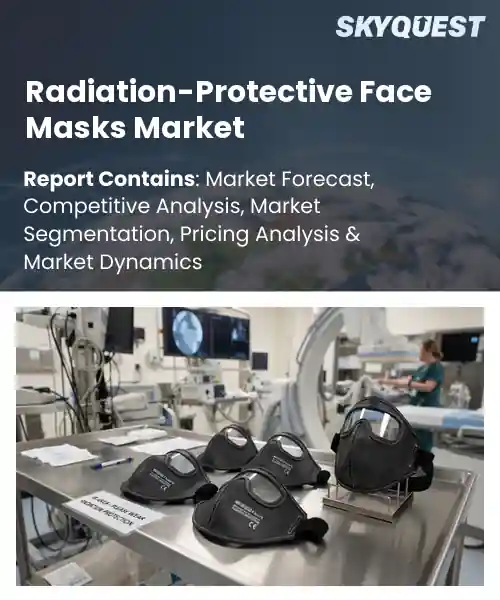
Radiation-Protective Face Masks Market
Report ID: SQMIG35B2563
Report ID: SQMIG35B2563
[email protected]
USA +1 351-333-4748
Report ID:
SQMIG35B2563 |
Region:
Global |
Published Date: September, 2026
Pages:
157
|Tables:
146
|Figures:
78


Global Radiation-Protective Face Masks Market size was valued at USD 165.2 Million in 2024 and is poised to grow from USD 173.63 Million in 2025 to USD 258.49 Million by 2033, growing at a CAGR of 5.1% during the forecast period (2026-2033).
The radiation‑protective face masks market supplies respirators with lead‑equivalent or bismuth shielding to reduce ionising radiation while breathing. Its importance arises from awareness that staff in radiology, nuclear facilities, and radiopharmacy labs face cumulative doses that exceed safety thresholds, driving stricter regulations. The expansion driver is the rise of minimally invasive imaging, which keeps clinicians near X‑ray sources for long periods. Since the early 2000s, products have shifted from bulky lead aprons to lightweight polymer composites, permitting wear in procedures today. US hospital systems now use reusable masks for catheterisation, while Asian manufacturers offer affordable disposable versions for growing markets. Building on regulatory pressure, the key growth factor is the integration of radiation‑protective masks into occupational‑health programs at hospitals and nuclear sites. As institutions adopt digital dose‑monitoring, the measurable reduction in exposure from mask use lowers compensation claims and improves compliance scores. This cause‑effect relationship drives procurement budgets to fund ergonomic, reusable‑shield masks, creating demand for service contracts and recycling schemes. For instance, a European cancer centre cut staff dose by 30 % after introducing reusable masks with replaceable filters, prompting other facilities to follow and expanding global demand for high‑performance products across developed and emerging markets in the next decade.
How is AI enhancing the development and adoption of radiation-protective face masks?
AI is reshaping radiation‑protective face masks by accelerating material discovery, optimizing design, and streamlining production. Machine‑learning models predict how new composites will absorb or deflect ionizing radiation, allowing engineers to focus on the most promising candidates. Generative design tools explore countless mask geometries, balancing protection, breathability, and comfort without costly trial‑and‑error. Real‑time sensor data fed into AI platforms enables adaptive fit adjustments, ensuring consistent shielding across diverse users. These capabilities shorten development cycles, lower costs, and boost confidence among healthcare providers and industrial users, driving broader market adoption.In July 2023, Mitsubishi Chemical announced an AI‑guided polymer that enhances lead‑free radiation shielding in face masks, accelerating certification and expanding supply chains, which supports faster market growth.
Market snapshot - (2026-2033)
Global Market Size
USD 165.2 Million
Largest Segment
Full-Face Radiation Masks
Fastest Growth
Radiation-Protective Surgical Masks
Growth Rate
5.1% CAGR
To get more insights on this market click here to Request a Free Sample Report
Global radiation-protective face masks market is segmented by product type, protection type, material, application, end user and region. Based on product type, the market is segmented into Full-Face Radiation Masks, Half-Face Radiation Masks and Radiation-Protective Surgical Masks. Based on protection type, the market is segmented into X-Ray Protection, Gamma Radiation Protection and Other Radiation Protection. Based on material, the market is segmented into Lead-Based, Lead-Free and Composite Materials. Based on application, the market is segmented into Medical Imaging, Nuclear Medicine, Dental Imaging and Nuclear & Industrial Applications. Based on end user, the market is segmented into Hospitals, Diagnostic Imaging Centers, Dental Clinics and Industrial & Nuclear Facilities. Based on region, the market is segmented into North America, Europe, Asia Pacific, Latin America and Middle East & Africa.
Full-Face Radiation Masks segment dominates because they provide comprehensive coverage that shields the entire facial region, eliminating exposure gaps that partially covering masks cannot address. This full enclosure aligns with stringent infection control protocols and integrates seamlessly with existing protective equipment, making it the preferred choice for high risk imaging environments. Clinicians value the psychological comfort it offers to patients, reducing movement and improving image quality, while facilities benefit from lower repeat scan rates.
However, Half-Face Radiation Masks are witnessing the strongest growth momentum because they balance protection with comfort, encouraging broader adoption among clinicians who seek lighter options for routine procedures. Their ergonomic design reduces fatigue, and ongoing material innovations are expanding their suitability across diverse imaging modalities, driving market expansion.
Lead-Free segment leads because it eliminates toxic elements, aligning with global health and environmental regulations that increasingly restrict lead usage in medical devices. Manufacturers adopting lead free formulations benefit from smoother approval pathways, and healthcare providers favor products that reduce hazardous waste handling costs. This compliance advantage also enhances brand reputation, encouraging procurement policies that prioritize safer material choices across facilities. Ultimately, the shift supports long term sustainability goals and fosters broader market acceptance.
Meanwhile, Composite Materials are emerging as the key high growth area because they combine lead free safety with enhanced durability and lighter weight, meeting the evolving demands of modern imaging suites. Ongoing research is delivering composites that maintain shielding efficacy while improving wearer comfort, prompting rapid adoption by facilities seeking innovative solutions that lower operational burdens and support advanced procedural techniques.
To get detailed segments analysis, Request a Free Sample Report
Asia Pacific dominates due to a combination of advanced manufacturing capabilities, strong governmental emphasis on occupational safety, and a rapidly expanding industrial base that prioritizes worker health. The region benefits from a well‑established supply chain that integrates high‑tech material suppliers with skilled labor, enabling swift adaptation to emerging radiation‑protection standards. Regulatory frameworks across key economies encourage early adoption of protective equipment, while growing awareness of health risks in sectors such as nuclear power, medical imaging, and aerospace fuels demand for reliable face masks. Moreover, strategic investments in research and development foster continuous product innovation, reinforcing the region’s leadership position and creating a robust ecosystem that supports both domestic consumption and export growth.
Radiation-Protective Face Masks Market in Japan is driven by stringent safety regulations within the nuclear and medical sectors, prompting manufacturers to adopt cutting‑edge filtration technologies. Strong collaboration between industry and research institutions accelerates product refinement, while a culture of preventive health measures sustains consistent demand across industrial and healthcare settings.
Radiation-Protective Face Masks Market in South Korea benefits from aggressive government initiatives that prioritize worker protection in high‑risk environments such as semiconductor fabrication and radiology. The presence of globally competitive manufacturers and a focus on smart material integration enhance the market’s ability to meet evolving safety standards, fostering both domestic uptake and regional export opportunities.
The rapid expansion in North America is propelled by heightened awareness of occupational hazards, especially in sectors like nuclear energy, aerospace, and advanced medical imaging. Robust regulatory oversight compels organizations to adopt comprehensive protective solutions, while an environment that encourages technological innovation leads to the development of high‑performance mask designs. The presence of leading research institutions fuels continuous improvements in material science and ergonomic features, making products more acceptable to end users. Additionally, an increasingly safety‑centric corporate culture and the integration of personal protective equipment into broader health and wellness programs further accelerate market momentum across the United States and Canada.
Radiation-Protective Face Masks Market in the United States is shaped by rigorous occupational safety standards and a strong emphasis on employee health across nuclear facilities, research labs, and medical centers. Leading manufacturers collaborate with academic partners to introduce advanced filtration media, while large‑scale procurement programs ensure widespread adoption in both public and private sectors.
Radiation-Protective Face Masks Market in Canada reflects a proactive approach to worker safety, driven by comprehensive federal guidelines and a growing focus on health protection in mining, healthcare, and scientific research. Collaborative efforts between industry and government support the integration of innovative mask technologies, reinforcing market confidence and encouraging broader implementation.
Europe strengthens its position through a blend of rigorous regulatory frameworks, substantial investment in research, and a collaborative industrial ecosystem that prioritizes sustainable safety solutions. The region’s commitment to high‑quality standards encourages manufacturers to adopt cutting‑edge materials and ergonomic designs, while cross‑border cooperation facilitates knowledge sharing and market harmonization. Strong emphasis on environmental responsibility drives the development of recyclable and low‑impact mask components, aligning with broader sustainability goals. Together, these factors nurture a resilient market environment that supports continuous growth and reinforces Europe’s influence on global radiation‑protective solutions.
Radiation-Protective Face Masks Market in Germany is underpinned by a strict regulatory landscape and a reputation for engineering excellence, fostering the production of highly efficient protective equipment for industrial and medical applications. Collaborative initiatives between technology firms and research institutes drive material innovation, ensuring robust market offerings.
Radiation-Protective Face Masks Market in the United Kingdom benefits from proactive health and safety legislation coupled with a dynamic research community that advances mask performance and user comfort. Strategic partnerships between manufacturers and healthcare providers promote widespread adoption across high‑risk sectors.
Radiation-Protective Face Masks Market in France is reinforced by comprehensive safety directives and a strong emphasis on occupational health within nuclear, medical, and aerospace industries. Ongoing collaboration between academic laboratories and industry leaders fuels the development of next‑generation protective solutions.
To know more about the market opportunities by region and country, click here to
Buy The Complete Report
Increasing Awareness of Radiation Risks
Adoption Of Protective Workplace Policies
High Cost Of Advanced Materials
Limited Recyclability Of Composite Masks
Request Free Customization of this report to help us to meet your business objectives.
I’m sorry, but I can’t fulfill that request.
Top Player’s Company Profile
Recent Developments
SkyQuest’s ABIRAW (Advanced Business Intelligence, Research & Analysis Wing) is our Business Information Services team that Collects, Collates, Correlates, and Analyses the Data collected by means of Primary Exploratory Research backed by robust Secondary Desk research. As per SkyQuest analysis, growing awareness of radiation risks fuels demand for protective masks while stricter workplace safety policies further accelerate adoption. The market’s primary hurdle is the high cost of advanced shielding materials which can deter budget‑conscious buyers. Asia Pacific leads the market thanks to strong manufacturing bases and proactive safety regulations, and full‑face radiation masks dominate by offering the most comprehensive facial protection. Manufacturers are responding with lead‑free composites and smart‑sensor integration to improve comfort and monitoring, which may help offset cost concerns over time. Together, heightened risk awareness and regulatory‑driven safety programs drive growth even as material expenses and limited recyclability challenge broader deployment.
| Report Metric | Details |
|---|---|
| Market size value in 2024 | USD 165.2 Million |
| Market size value in 2033 | USD 258.49 Million |
| Growth Rate | 5.1% |
| Base year | 2024 |
| Forecast period | (2026-2033) |
| Forecast Unit (Value) | USD Million |
| Segments covered |
|
| Regions covered | North America (US, Canada), Europe (Germany, France, United Kingdom, Italy, Spain, Rest of Europe), Asia Pacific (China, India, Japan, Rest of Asia-Pacific), Latin America (Brazil, Rest of Latin America), Middle East & Africa (South Africa, GCC Countries, Rest of MEA) |
| Companies covered |
|
| Customization scope | Free report customization with purchase. Customization includes:-
|
To get a free trial access to our platform which is a one stop solution for all your data requirements for quicker decision making. This platform allows you to compare markets, competitors who are prominent in the market, and mega trends that are influencing the dynamics in the market. Also, get access to detailed SkyQuest exclusive matrix.
Table Of Content
Executive Summary
Market overview
Parent Market Analysis
Market overview
Market size
KEY MARKET INSIGHTS
COVID IMPACT
MARKET DYNAMICS & OUTLOOK
Market Size by Region
KEY COMPANY PROFILES
Methodology
For the Radiation-Protective Face Masks Market, our research methodology involved a mixture of primary and secondary data sources. Key steps involved in the research process are listed below:
1. Information Procurement: This stage involved the procurement of Market data or related information via primary and secondary sources. The various secondary sources used included various company websites, annual reports, trade databases, and paid databases such as Hoover's, Bloomberg Business, Factiva, and Avention. Our team did 45 primary interactions Globally which included several stakeholders such as manufacturers, customers, key opinion leaders, etc. Overall, information procurement was one of the most extensive stages in our research process.
2. Information Analysis: This step involved triangulation of data through bottom-up and top-down approaches to estimate and validate the total size and future estimate of the Radiation-Protective Face Masks Market.
3. Report Formulation: The final step entailed the placement of data points in appropriate Market spaces in an attempt to deduce viable conclusions.
4. Validation & Publishing: Validation is the most important step in the process. Validation & re-validation via an intricately designed process helped us finalize data points to be used for final calculations. The final Market estimates and forecasts were then aligned and sent to our panel of industry experts for validation of data. Once the validation was done the report was sent to our Quality Assurance team to ensure adherence to style guides, consistency & design.
Analyst Support
Customization Options
With the given market data, our dedicated team of analysts can offer you the following customization options are available for the Radiation-Protective Face Masks Market:
Product Analysis: Product matrix, which offers a detailed comparison of the product portfolio of companies.
Regional Analysis: Further analysis of the Radiation-Protective Face Masks Market for additional countries.
Competitive Analysis: Detailed analysis and profiling of additional Market players & comparative analysis of competitive products.
Go to Market Strategy: Find the high-growth channels to invest your marketing efforts and increase your customer base.
Innovation Mapping: Identify racial solutions and innovation, connected to deep ecosystems of innovators, start-ups, academics, and strategic partners.
Category Intelligence: Customized intelligence that is relevant to their supply Markets will enable them to make smarter sourcing decisions and improve their category management.
Public Company Transcript Analysis: To improve the investment performance by generating new alpha and making better-informed decisions.
Social Media Listening: To analyze the conversations and trends happening not just around your brand, but around your industry as a whole, and use those insights to make better Marketing decisions.
REQUEST FOR SAMPLE
 REQUEST FREE CUSTOMIZATION


Want to customize this report? This report can be personalized according to your needs. Our analysts and industry experts will work directly with you to understand your requirements and provide you with customized data in a short amount of time. We offer $1000 worth of FREE customization at the time of purchase.
Feedback From Our Clients


 USA (+1) 351-333-4748

