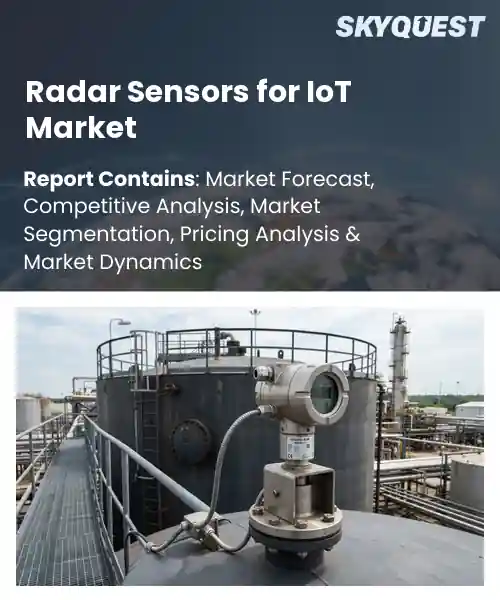
Radar Sensors for IoT Market
Report ID: SQMIG45J2969
Report ID: SQMIG45J2969
[email protected]
USA +1 351-333-4748
Report ID:
SQMIG45J2969 |
Region:
Global |
Published Date: September, 2026
Pages:
157
|Tables:
129
|Figures:
77


Global Radar Sensors For Iot Market size was valued at USD 3.22 Billion in 2024 and is poised to grow from USD 3.51 Billion in 2025 to USD 7.07 Billion by 2033, growing at a CAGR of 9.12% during the forecast period (2026-2033).
Radar sensors have become a component of the Internet‑of‑Things ecosystem, enabling devices to perceive distance, speed, and material characteristics without line‑of‑sight constraints. The market comprises production, integration, and deployment of millimeter‑wave radar chips within smart homes, automotive fleets, industrial automation, and wearable health monitors. Its importance stems from providing awareness where optical or ultrasonic methods fail, thereby expanding functions. Automotive radars of 2000s evolved into silicon‑based units that can be produced, exemplified by 2020‑era door sensors that detect occupants walls. This evolution shows how significant reductions and miniaturization have turned radar from niche safety technology into mainstream global IoT enabler. The accelerating demand for intelligence drives the second key factor, as radar provides raw data that can be processed locally to enable decision‑making without reliance on cloud latency. Manufacturers embed compact 77‑GHz modules into robotic arms, allowing collision avoidance that reduces downtime and improves safety on assembly lines. Similarly, smart‑city traffic lights equipped with radar can gauge vehicle speed and queue length, prompting signal timing that eases congestion and cuts emissions. These applications illustrate a loop: as sectors witness efficiency gains, investment in radar‑for‑IoT R&D rises, which in turn lowers component cost, spurring broader adoption across agriculture, logistics, and wearables.
How is AI enhancing radar sensor accuracy in the IoT market?
AI is reshaping radar sensors for IoT by embedding machine‑learning models directly on the chip. Key aspects include real‑time signal processing, adaptive beamforming and noise filtering that learn from each measurement. Today manufacturers integrate lightweight neural networks that distinguish true objects from clutter, boosting detection reliability in crowded environments. This shift is critical as IoT deployments expand from smart homes to factories where precise motion tracking and occupancy sensing are required. Companies such as Bosch and LeddarTech illustrate the trend by offering sensors that continuously refine their accuracy through on‑device learning, making deployments more robust and energy efficient.NXP announced an AI‑enabled radar platform for IoT in March 2024, delivering on‑chip learning that refines target classification with each use. The innovation reduces false detections and lowers power draw, enabling broader adoption of radar in smart‑city and industrial IoT applications. It also streamlines integration with edge processors, accelerating time‑to‑market for new services.
Market snapshot - (2026-2033)
Global Market Size
USD 3.22 Billion
Largest Segment
Continuous-Wave Radar
Fastest Growth
Ultra-Wideband Radar
Growth Rate
9.12% CAGR
To get more insights on this market click here to Request a Free Sample Report
Global radar sensors for iot market is segmented by radar type, frequency band, sensing function, application and region. Based on radar type, the market is segmented into Continuous-Wave Radar, Frequency-Modulated Continuous-Wave Radar, Pulse Radar, Ultra-Wideband Radar and Others. Based on frequency band, the market is segmented into Below 6 GHz, 24 GHz, 60 GHz, 77–81 GHz and Others. Based on sensing function, the market is segmented into Motion Detection, Presence Detection, Distance Measurement, Velocity Measurement, Gesture Recognition, Object Detection and Others. Based on application, the market is segmented into Smart Home, Industrial IoT, Smart Buildings, Smart Cities, Automotive IoT, Healthcare and Others. Based on region, the market is segmented into North America, Europe, Asia Pacific, Latin America and Middle East & Africa.
Frequency‑Modulated Continuous‑Wave Radar segment dominates because it enables high resolution distance and velocity detection, integrates well with low‑power iot nodes, supports robust performance in cluttered indoor environments, aligns with cost‑sensitive smart home devices, provides versatile data for occupancy and gesture analytics, and benefits from mature semiconductor processes, driving its widespread adoption across the radar sensors for iot market. Manufacturers also leverage open‑source firmware ecosystems that accelerate integration, while ecosystem partners prioritize interoperability, further cementing its lead.
Meanwhile, Ultra‑Wideband Radar segment is witnessing the strongest growth momentum because its fine‑range resolution enables precise object detection in crowded spaces, unlocking new use cases in gesture control and health monitoring. Continuous innovation in antenna designs and regulatory encouragement for higher bandwidths are fueling rapid adoption and expanding market opportunities.
Presence Detection segment stands out because it offers a non‑contact method to verify occupancy, reducing reliance on traditional proximity sensors that often require line‑of‑sight or physical installation. Its ability to operate through walls and dust makes it ideal for harsh factory floors, while low power consumption aligns with battery‑free designs. These attributes simplify asset tracking, improve safety protocols, and enable real‑time process optimization, cementing its pivotal role in industrial iot deployments.
On the other hand, Gesture Recognition segment is emerging as the key high‑growth area because manufacturers embed radar chips that interpret hand motions into control interfaces, driving demand in contact‑less machine operation. Advances in AI‑enabled signal processing accelerate accuracy, opening revenue streams and expanding the scope of industrial iot solutions.
To get detailed segments analysis, Request a Free Sample Report
Asia Pacific leverages a unique blend of advanced manufacturing capabilities, deep engineering expertise, and strong policy frameworks that together create a fertile environment for radar sensor innovation. The region benefits from a concentration of world‑leading semiconductor and electronics firms that accelerate component integration and cost efficiencies. Close collaboration between automotive manufacturers and technology providers drives rapid adoption in advanced driver assistance and autonomous vehicle projects. Moreover, government initiatives focused on smart city development and industrial digitalization reinforce demand across logistics, warehousing, and infrastructure monitoring, reinforcing a virtuous cycle of investment and market expansion.
Radar Sensors for IoT Market in Japan thrive on a legacy of precision engineering and a robust automotive supply chain that continually pushes the envelope of safety and autonomy. Leading electronics conglomerates partner closely with vehicle manufacturers to embed high‑resolution radar modules into next‑generation platforms. Strong academic research institutions feed a pipeline of talent and breakthrough algorithms, while collaborative standards bodies ensure interoperability across sectors ranging from robotics to urban mobility solutions.
Radar Sensors for IoT Market in South Korea are energized by a dynamic semiconductor ecosystem and aggressive national strategies that prioritize intelligent transport and smart manufacturing. Homegrown chip makers deliver highly integrated radar solutions that advantage domestic automakers and logistics firms seeking compact, power‑efficient designs. The country’s fast‑adopting consumer electronics culture also fuels cross‑industry experimentation, supporting pilot projects in unmanned delivery, drone navigation, and connected infrastructure.
North America’s expansion is propelled by a culture of open innovation, substantial research funding, and a thriving ecosystem of start‑ups that translate cutting‑edge radar technologies into commercial products. Strong emphasis on safety standards across automotive and industrial domains encourages early adoption of high‑performance sensing solutions. The logistics sector’s push for greater visibility and efficiency, combined with an emerging focus on autonomous freight movement, creates a broad base of applications. Collaboration among universities, defense agencies, and private enterprises further accelerates technology maturation, positioning the region as a hub for next‑generation radar‑enabled IoT deployments.
Radar Sensors for IoT Market in the United States benefit from deep venture capital support and a concentration of leading automotive OEMs that prioritize advanced driver assistance and autonomous capabilities. Leading technology firms integrate radar modules with AI‑driven perception stacks, enhancing reliability in complex traffic scenarios. Federal research programs and defense contracts also stimulate high‑resolution radar development, which cascades into civilian uses such as smart logistics hubs, predictive maintenance, and public safety monitoring.
Radar Sensors for IoT Market in Canada is shaped by a strong emphasis on sustainable transportation and a collaborative research environment linking universities with industry partners. The country’s extensive natural resource sectors adopt radar solutions for remote site monitoring and autonomous equipment operation, while urban centers experiment with smart traffic management. Government incentives for clean technology further encourage integration of radar sensors into electric vehicle platforms and connected infrastructure projects.
Europe advances its position through stringent safety and environmental regulations that compel manufacturers to embed sophisticated radar sensing in vehicles and industrial machinery. A tightly knit network of research consortia and standard‑setting bodies fosters interoperability and accelerates technology transfer across borders. The region’s established automotive heritage, combined with a growing focus on electric mobility and smart city initiatives, drives demand for compact, low‑power radar modules. Additionally, cross‑industry partnerships in sectors such as rail, aerospace, and maritime expand the application landscape, reinforcing Europe’s role as a catalyst for radar‑enabled IoT solutions.
Radar Sensors for IoT Market in Germany draws strength from a world‑renowned engineering tradition and a dense cluster of automotive suppliers that prioritize precision and reliability. German manufacturers integrate radar arrays into both conventional and electric vehicle platforms, emphasizing high‑resolution object detection for safety and efficiency. Collaborative research institutes contribute advanced signal‑processing algorithms, while industry alliances focus on harmonizing standards for seamless integration across logistics, manufacturing, and infrastructure sectors.
Radar Sensors for IoT Market in the United Kingdom is propelled by a vibrant ecosystem of innovation hubs and a strategic push toward autonomous transport solutions. Leading universities partner with technology firms to develop radar systems that complement AI‑driven perception in both road and rail contexts. The UK’s emphasis on smart cities encourages deployment of radar‑based traffic monitoring and pedestrian safety networks, creating a fertile environment for cross‑sector growth.
Radar Sensors for IoT Market in France benefits from strong governmental support for automotive research and a vibrant network of startups focusing on sensor fusion. French automotive groups incorporate radar technology into a broad range of vehicle segments, emphasizing safety and energy efficiency. The nation’s commitment to sustainable mobility and connected urban services drives adoption of radar sensors in public transport, traffic management, and industrial automation, reinforcing its strategic role in the European market.
To know more about the market opportunities by region and country, click here to
Buy The Complete Report
Increasing Adoption Of Smart Devices
Advancements In Low‑Power Radar
High Initial Cost Barriers
Complex Integration With Legacy Systems
Request Free Customization of this report to help us to meet your business objectives.
The competitive landscape is shaped by major semiconductor firms accelerating IoT radar adoption through targeted M&A, strategic alliances and rapid technology roll‑outs; for example, Bosch’s partnership with NXP to embed 60 GHz radar in smart‑meter platforms and Infineon’s acquisition of a radar‑IP portfolio in 2023 have intensified pressure on niche players while expanding ecosystem integration.
Top Player’s Company Profile
Recent Developments
SkyQuest’s ABIRAW (Advanced Business Intelligence, Research & Analysis Wing) is our Business Information Services team that Collects, Collates, Correlates, and Analyses the Data collected by means of Primary Exploratory Research backed by robust Secondary Desk research. As per SkyQuest analysis the global radar‑sensors‑for‑IoT market is projected to grow at a 9.1 % CAGR, propelled primarily by the increasing adoption of smart devices that demand reliable, line‑of‑sight‑free sensing, while a second driver comes from recent advances in low‑power radar that enable battery‑operated nodes to run continuously. The dominant segment is frequency‑modulated continuous‑wave radar, favored for its high‑resolution distance and velocity detection in compact IoT modules. Asia Pacific leads the market thanks to its deep semiconductor base and strong smart‑city initiatives. Growth is tempered by high initial cost barriers that can delay large‑scale deployments across cost‑sensitive sectors and slow overall market penetration.
| Report Metric | Details |
|---|---|
| Market size value in 2024 | USD 3.22 Billion |
| Market size value in 2033 | USD 7.07 Billion |
| Growth Rate | 9.12% |
| Base year | 2024 |
| Forecast period | (2026-2033) |
| Forecast Unit (Value) | USD Billion |
| Segments covered |
|
| Regions covered | North America (US, Canada), Europe (Germany, France, United Kingdom, Italy, Spain, Rest of Europe), Asia Pacific (China, India, Japan, Rest of Asia-Pacific), Latin America (Brazil, Rest of Latin America), Middle East & Africa (South Africa, GCC Countries, Rest of MEA) |
| Companies covered |
|
| Customization scope | Free report customization with purchase. Customization includes:-
|
To get a free trial access to our platform which is a one stop solution for all your data requirements for quicker decision making. This platform allows you to compare markets, competitors who are prominent in the market, and mega trends that are influencing the dynamics in the market. Also, get access to detailed SkyQuest exclusive matrix.
Table Of Content
Executive Summary
Market overview
Parent Market Analysis
Market overview
Market size
KEY MARKET INSIGHTS
COVID IMPACT
MARKET DYNAMICS & OUTLOOK
Market Size by Region
KEY COMPANY PROFILES
Methodology
For the Radar Sensors for IoT Market, our research methodology involved a mixture of primary and secondary data sources. Key steps involved in the research process are listed below:
1. Information Procurement: This stage involved the procurement of Market data or related information via primary and secondary sources. The various secondary sources used included various company websites, annual reports, trade databases, and paid databases such as Hoover's, Bloomberg Business, Factiva, and Avention. Our team did 45 primary interactions Globally which included several stakeholders such as manufacturers, customers, key opinion leaders, etc. Overall, information procurement was one of the most extensive stages in our research process.
2. Information Analysis: This step involved triangulation of data through bottom-up and top-down approaches to estimate and validate the total size and future estimate of the Radar Sensors for IoT Market.
3. Report Formulation: The final step entailed the placement of data points in appropriate Market spaces in an attempt to deduce viable conclusions.
4. Validation & Publishing: Validation is the most important step in the process. Validation & re-validation via an intricately designed process helped us finalize data points to be used for final calculations. The final Market estimates and forecasts were then aligned and sent to our panel of industry experts for validation of data. Once the validation was done the report was sent to our Quality Assurance team to ensure adherence to style guides, consistency & design.
Analyst Support
Customization Options
With the given market data, our dedicated team of analysts can offer you the following customization options are available for the Radar Sensors for IoT Market:
Product Analysis: Product matrix, which offers a detailed comparison of the product portfolio of companies.
Regional Analysis: Further analysis of the Radar Sensors for IoT Market for additional countries.
Competitive Analysis: Detailed analysis and profiling of additional Market players & comparative analysis of competitive products.
Go to Market Strategy: Find the high-growth channels to invest your marketing efforts and increase your customer base.
Innovation Mapping: Identify racial solutions and innovation, connected to deep ecosystems of innovators, start-ups, academics, and strategic partners.
Category Intelligence: Customized intelligence that is relevant to their supply Markets will enable them to make smarter sourcing decisions and improve their category management.
Public Company Transcript Analysis: To improve the investment performance by generating new alpha and making better-informed decisions.
Social Media Listening: To analyze the conversations and trends happening not just around your brand, but around your industry as a whole, and use those insights to make better Marketing decisions.
REQUEST FOR SAMPLE
 REQUEST FREE CUSTOMIZATION


Want to customize this report? This report can be personalized according to your needs. Our analysts and industry experts will work directly with you to understand your requirements and provide you with customized data in a short amount of time. We offer $1000 worth of FREE customization at the time of purchase.
Feedback From Our Clients


 USA (+1) 351-333-4748

