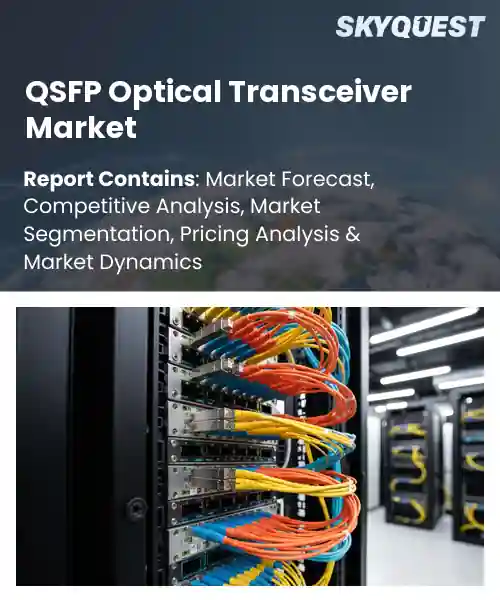
QSFP Optical Transceiver Market
Report ID: SQMIG20I2947
Report ID: SQMIG20I2947
[email protected]
USA +1 351-333-4748
Report ID:
SQMIG20I2947 |
Region:
Global |
Published Date: April, 2026
Pages:
157
|Tables:
88
|Figures:
76


Global Qsfp Optical Transceiver Market size was valued at USD 6.42 Billion in 2024 and is poised to grow from USD 7.24 Billion in 2025 to USD 6.4 Billion by 2033, growing at a CAGR of 12.8% during the forecast period (2026-2033).
As a research analyst I identify escalating hyperscale data traffic as the primary driver shaping the QSFP optical transceiver market, where compact quad small form-factor pluggable modules enable high-density multi‑lane interfaces in switches, routers and servers. The market matters because QSFP modules translate rising application bandwidth into interoperable hardware, permitting cloud providers and telecom operators to scale capacity without redesigning systems. Over the last decade the industry progressed from 40G QSFP+ through 100G QSFP28 to 200G/400G QSFP56 and QSFP‑DD variants as operators pursued higher per-port speeds, and examples such as hyperscaler 400G rollouts and 5G backhaul expansion demonstrate evolutionary trajectory.Building on the capacity trends described above, one key factor driving global QSFP market growth is the rapid adoption of bandwidth-hungry applications, because increased AI training, video streaming and multi-cloud architectures force operators to deploy denser, higher-speed ports. As a consequence vendors invest in 200G/400G QSFP optics, lower-power modulation schemes and richer testing ecosystems, which reduces per-bit costs and accelerates deployment in hyperscale data centers and telco aggregation for 5G midhaul. Real-world cases include AI clusters adopting 400G interconnects and mobile operators upgrading fronthaul, creating supplier opportunities for optical engines, silicon photonics start-ups and aftermarket test and integration services today.
How is AI driving demand for QSFP optical transceivers in high-speed data centers?
QSFP optical transceivers are compact pluggable modules that provide high bandwidth low latency links between servers switches and accelerators in modern data centers. AI workloads generate massive east west traffic and demand non blocking fabrics which pushes the need for higher lane rates and denser QSFP variants. The market is shifting from legacy modules toward 200G 400G and beyond while vendors explore co packaged optics and silicon photonics to reduce power and improve signal integrity. Hyperscalers and cloud builders are ordering advanced lasers DSPs and denser optics leading to tight supply and fast innovation in the QSFP ecosystem.NVIDIA March 2026, announced multiyear strategic investments in Lumentum and Coherent to expand photonics capacity and accelerate advanced laser production for QSFP optical transceivers, helping data centers meet AI driven bandwidth and efficiency needs while easing supply constraints and enabling higher density optics deployments across hyperscale environments.
Market snapshot - (2026-2033)
Global Market Size
USD 6.42 Billion
Largest Segment
DNA-based HPV Testing (High Sensitivity)
Fastest Growth
RNA-based HPV Testing
Growth Rate
12.8% CAGR
To get more insights on this market click here to Request a Free Sample Report
Global qsfp optical transceiver market is segmented by test type, application/indication, end-user and region. Based on test type, the market is segmented into DNA-based HPV Testing (High Sensitivity) and RNA-based HPV Testing. Based on application/indication, the market is segmented into Cervical Cancer Screening (Dominant Segment) and Vaginal & Vulvar Cancer Screening. Based on end-user, the market is segmented into Diagnostic Laboratories & Genomic Centers, Hospitals & Gynecology Clinics and Others (Research Institutes & Public Health Centers). Based on region, the market is segmented into North America, Europe, Asia Pacific, Latin America and Middle East & Africa.
DNA-based HPV Testing (High Sensitivity) segment dominates because its data-intensive sequencing and analysis pipelines compel deployment of robust, high-bandwidth optical fabrics. Clinical labs running these assays require reliable, low-latency connectivity to move large genomic files between instruments, storage and compute clusters, driving demand for interoperable QSFP designs. Long validation cycles and vendor partnerships reinforce procurement of proven transceivers that meet stringent uptime and latency requirements.
However, RNA-based HPV Testing is emerging as the fastest growing area because its real time analysis potential is accelerating adoption of distributed analytics and edge compute in clinical networks. This trend increases demand for flexible, short reach QSFP modules optimized for lower power and compact form factors, prompting vendors to innovate and expanding opportunities for new QSFP variants across diagnostic infrastructures.
Diagnostic Laboratories & Genomic Centers segment dominates because centralized sequencing operations concentrate high-throughput data flows and consolidated compute, making dense optical interconnects essential. Their specification-driven procurement favors standardized, interoperable QSFP modules to ensure compatibility across instruments and pipelines. Predictable upgrade cycles, high utilization and collaboration with network providers drive demand for advanced QSFP capabilities and influence supplier roadmaps.
Meanwhile, Hospitals & Gynecology Clinics are the fastest growing area as clinical networks modernize with point of care diagnostics and telehealth, increasing need for compact, energy efficient QSFP links at hospital core and edge. Integration of bedside devices, imaging and real time analytics compels suppliers to deliver versatile QSFP solutions that support diverse topologies and future scaling within care delivery environments.
To get detailed segments analysis, Request a Free Sample Report
Asia Pacific dominance in the QSFP optical transceiver market reflects a concentration of advanced manufacturing capabilities, dense hyperscale data center development, and integrated supply chain ecosystems across leading technology hubs. Regional suppliers benefit from close proximity to specialist component makers, strong fabrication capacity, and coordinated public and private investment in optical interconnects. Robust adoption of high bandwidth networking by telecommunications operators and cloud service providers accelerates demand for higher port density transceivers. Collaborative innovation between module manufacturers and system vendors fosters rapid product validation and deployment across carrier and enterprise environments. Strategic partnerships and localized service networks further strengthen market position by enabling quick customization and lifecycle support, creating a competitive edge that sustains regional leadership. A skilled engineering workforce and mature testing infrastructure improve time to market and product reliability.
QSFP Optical Transceiver Market in Japan is characterized by strong collaboration between component manufacturers, system integrators, and carriers. Established electronics firms provide rigorous quality control and specialized modules tailored to domestic network requirements. Local service providers emphasize long term reliability and interoperability. Procurement practices favor proven suppliers and comprehensive support agreements, resulting in steady demand for high performance, highly reliable transceiver solutions across fixed and mobile network backbones and campuses.
QSFP Optical Transceiver Market in South Korea is driven by tight integration between semiconductor foundries and module manufacturers and by collaboration with telecommunications operators. Focus on compact form factors, thermal efficiency, and rigorous validation supports use in dense metropolitan data centers and carrier interconnects. Local procurement favors suppliers that offer rapid customization and reliable supply. Emphasis on field support and engineering partnerships accelerates deployment across enterprise and service provider networks.
Rapid expansion in North America stems from intense demand from cloud service providers, enterprise network modernization, and large scale investments in backbone capacity. The region benefits from close alignment between data center operators, optical module suppliers, and cutting edge networking vendors that prioritize interoperable, high density solutions. Strong emphasis on performance validation, vendor neutrality, and compliance with evolving interface standards boosts adoption of QSFP form factors across multi vendor environments. Active engagement by service providers in open networking initiatives and advanced testing programs accelerates integration of new transceiver variants. Additionally, a mature vendor ecosystem that offers comprehensive technical support and expedited supply chain responsiveness reinforces market growth and encourages broader deployment across carrier, hyperscale, and enterprise segments. Proximity to major research institutions further drives product innovation and testing.
QSFP Optical Transceiver Market in the United States is driven by cloud operators, content providers, and telecommunications carriers seeking high density, interoperable modules. Emphasis on interoperability testing, qualification processes, and responsive vendor support guides procurement. Collaboration between chipset vendors and system integrators accelerates adoption of evolving form factors. Network architects focus on scalability, energy efficiency, and maintainability, encouraging tailored solutions and technical partnerships for deployment across carrier and enterprise infrastructures.
QSFP Optical Transceiver Market in Canada reflects service provider upgrades and enterprise modernization projects. Local demand is shaped by priorities on reliability, vendor accountability, and long term service agreements. Suppliers that provide robust testing, regional support, and adaptable module configurations gain preference. Integration of transceivers into metro and campus networks requires attention to environmental resilience and compatibility with heterogeneous vendor ecosystems, prompting collaborative engineering and focused after sales support locally.
Europe is strengthening its position through targeted investment in research collaboration, emphasis on interoperability testing, and a growing preference for locally supported supply chains. Regional vendors and system integrators are enhancing product portfolios to meet stringent network reliability and energy efficiency requirements demanded by carriers and large enterprises. Cross border partnerships among manufacturers, test laboratories, and academic centers enable faster validation of specialized transceiver designs and compliance with regional standards. Procurement approaches favor suppliers that can provide tailored technical support and long term maintenance arrangements. Combined focus on sustainability, robust engineering, and modular deployment strategies is reinforcing Europe role in delivering resilient QSFP solutions for diversified networking environments. Regulatory clarity and incentive programs in several markets encourage localized manufacturing and testing services that meet procurement expectations. Collective emphasis on security and supply chain transparency further elevates demand for certified suppliers.
QSFP Optical Transceiver Market in Germany is characterized by precise engineering requirements and strong ties between industrial users and local vendors. Demand emphasizes ruggedized designs, energy efficient operation, and compatibility with industrial Ethernet and carrier networks. Suppliers that provide extensive validation and comprehensive after sales maintenance gain preference. Collaboration with technical institutes and test houses accelerates certification and supports adoption in manufacturing, research networks, and critical infrastructure projects across sectors.
QSFP Optical Transceiver Market in the United Kingdom is influenced by carrier network upgrades, financial sector demand and a strong ecosystem of research facilities. Operators prioritize interoperability, security, and vendor responsiveness. Suppliers that deliver comprehensive validation services and technical support are preferred for metropolitan and data center deployments. Collaboration between vendors and academic centers drives adoption of advanced modulation and testing methods, supporting resilient deployment across enterprise and public networks.
QSFP Optical Transceiver Market in France combines academic research with growing adoption by carriers and enterprises. Stakeholders emphasize energy efficient designs, modularity, and adherence to European interoperability standards. Suppliers that offer thorough validation, flexible configuration options, and service support gain traction. Close collaboration among manufacturers, test labs, and system integrators enables tailored solutions for metro and campus environments. Procurement decisions favor partners that demonstrate supply chain transparency and engagement.
To know more about the market opportunities by region and country, click here to
Buy The Complete Report
Rising Data Center Demand
Advancements In Optical Technology
High Component Costs
Interoperability And Standardization Challenges
Request Free Customization of this report to help us to meet your business objectives.
Competitive pressure in the global QSFP optical transceiver market is intensifying as consolidation and technology differentiation reshape supplier dynamics. Large incumbents have pursued acquisitions to add photonics and coherent capabilities, while startups secure partnerships and manufacturing deals to commercialize silicon photonics and PICs; examples include Cisco’s acquisition of Acacia, II VI’s consolidation with Finisar and Coherent, and NewPhotonics’ recent SoftBank and manufacturing collaborations.
Top Player’s Company Profile
Recent Developments
SkyQuest’s ABIRAW (Advanced Business Intelligence, Research & Analysis Wing) is our Business Information Services team that Collects, Collates, Correlates, and Analyses the Data collected by means of Primary Exploratory Research backed by robust Secondary Desk research. As per SkyQuest analysis, escalating hyperscale data traffic is a key driver for QSFP optical transceiver demand, while advancements in optical technology act as a second driver supporting higher-density, energy efficient modules. Growth is tempered by high component costs that constrain rapid refresh cycles and deployment in price sensitive segments. Asia Pacific emerges as the dominating region due to concentrated manufacturing, dense hyperscale development and integrated supply chains. The DNA-based HPV Testing (High Sensitivity) segment is identified as the dominating application given its data intensive sequencing and centralized compute requirements which favor interoperable, high-bandwidth QSFP solutions across clinical and research networks.
| Report Metric | Details |
|---|---|
| Market size value in 2024 | USD 6.42 Billion |
| Market size value in 2033 | USD 6.4 Billion |
| Growth Rate | 12.8% |
| Base year | 2024 |
| Forecast period | (2026-2033) |
| Forecast Unit (Value) | USD Billion |
| Segments covered |
|
| Regions covered | North America (US, Canada), Europe (Germany, France, United Kingdom, Italy, Spain, Rest of Europe), Asia Pacific (China, India, Japan, Rest of Asia-Pacific), Latin America (Brazil, Rest of Latin America), Middle East & Africa (South Africa, GCC Countries, Rest of MEA) |
| Companies covered |
|
| Customization scope | Free report customization with purchase. Customization includes:-
|
To get a free trial access to our platform which is a one stop solution for all your data requirements for quicker decision making. This platform allows you to compare markets, competitors who are prominent in the market, and mega trends that are influencing the dynamics in the market. Also, get access to detailed SkyQuest exclusive matrix.
Table Of Content
Executive Summary
Market overview
Parent Market Analysis
Market overview
Market size
KEY MARKET INSIGHTS
COVID IMPACT
MARKET DYNAMICS & OUTLOOK
Market Size by Region
KEY COMPANY PROFILES
Methodology
For the QSFP Optical Transceiver Market, our research methodology involved a mixture of primary and secondary data sources. Key steps involved in the research process are listed below:
1. Information Procurement: This stage involved the procurement of Market data or related information via primary and secondary sources. The various secondary sources used included various company websites, annual reports, trade databases, and paid databases such as Hoover's, Bloomberg Business, Factiva, and Avention. Our team did 45 primary interactions Globally which included several stakeholders such as manufacturers, customers, key opinion leaders, etc. Overall, information procurement was one of the most extensive stages in our research process.
2. Information Analysis: This step involved triangulation of data through bottom-up and top-down approaches to estimate and validate the total size and future estimate of the QSFP Optical Transceiver Market.
3. Report Formulation: The final step entailed the placement of data points in appropriate Market spaces in an attempt to deduce viable conclusions.
4. Validation & Publishing: Validation is the most important step in the process. Validation & re-validation via an intricately designed process helped us finalize data points to be used for final calculations. The final Market estimates and forecasts were then aligned and sent to our panel of industry experts for validation of data. Once the validation was done the report was sent to our Quality Assurance team to ensure adherence to style guides, consistency & design.
Analyst Support
Customization Options
With the given market data, our dedicated team of analysts can offer you the following customization options are available for the QSFP Optical Transceiver Market:
Product Analysis: Product matrix, which offers a detailed comparison of the product portfolio of companies.
Regional Analysis: Further analysis of the QSFP Optical Transceiver Market for additional countries.
Competitive Analysis: Detailed analysis and profiling of additional Market players & comparative analysis of competitive products.
Go to Market Strategy: Find the high-growth channels to invest your marketing efforts and increase your customer base.
Innovation Mapping: Identify racial solutions and innovation, connected to deep ecosystems of innovators, start-ups, academics, and strategic partners.
Category Intelligence: Customized intelligence that is relevant to their supply Markets will enable them to make smarter sourcing decisions and improve their category management.
Public Company Transcript Analysis: To improve the investment performance by generating new alpha and making better-informed decisions.
Social Media Listening: To analyze the conversations and trends happening not just around your brand, but around your industry as a whole, and use those insights to make better Marketing decisions.
REQUEST FOR SAMPLE
 REQUEST FREE CUSTOMIZATION


Want to customize this report? This report can be personalized according to your needs. Our analysts and industry experts will work directly with you to understand your requirements and provide you with customized data in a short amount of time. We offer $1000 worth of FREE customization at the time of purchase.
Feedback From Our Clients


 USA (+1) 351-333-4748

