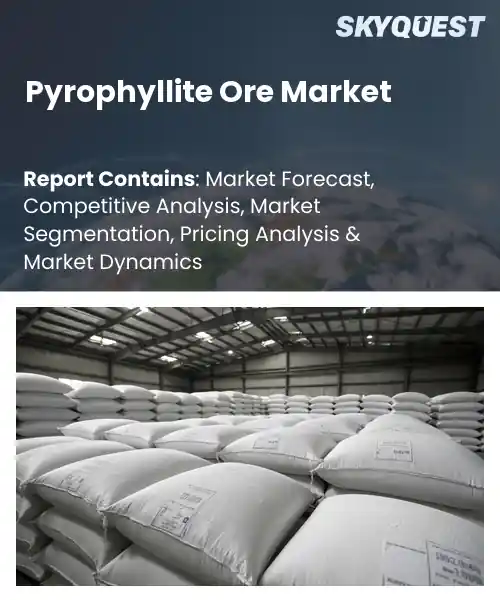
Pyrophyllite Ore Market
Report ID: SQMIG15M2024
Report ID: SQMIG15M2024
[email protected]
USA +1 351-333-4748
Report ID:
SQMIG15M2024 |
Region:
Global |
Published Date: June, 2026
Pages:
157
|Tables:
67
|Figures:
75


Global Pyrophyllite Ore Market size was valued at USD 3.1 Billion in 2024 and is poised to grow from USD 3.23 Billion in 2025 to USD 4.49 Billion by 2033, growing at a CAGR of 4.2% during the forecast period (2026-2033).
The primary driver of the pyrophyllite ore industry is industrial demand for heat-resistant, chemically inert aluminosilicate feedstock used in ceramics and refractories, which frames the market’s evolution. Pyrophyllite ore supports tile body formulations, sanitaryware, foundry coatings and furnace linings because its platelet structure and thermal stability enhance workability and high temperature performance.
Historically the market expanded with postwar industrialization and later with rapid urbanization in Asia, where large ceramics clusters in China and India scaled consumption. As manufacturers prioritized lower-cost abundant mineral fillers and stricter thermal management specifications, pyrophyllite moved from niche deposits into mainstream supply chains and regional dynamics.
How is AI improving demand forecasting in the Pyrophyllite ore market?
AI is helping to enhance demand forecasting for pyrophyllite by combining signals from industrial applications with supply chain data. There are several components of the improved forecasting process, including grade-specific demand, seasonal demand within the ceramics and refractory cycles, long lead times, and complexities associated with logistics. Current trends reflect an increase in mining and industrial mineral buyers adopting machine-learning models to forecast demand and optimize inventory. Forecasts are built from historically based orders, kiln schedule data, trade flow data, weather and sensor data, which reduces stockouts and mismatches of grade by improving procurement and production processes. AI-derived demand signals can provide insight into calcination scheduling and develop tailored distribution plans that align mining output with the needs of refractory and ceramics customers.
RHI Magnesita's acquisition of Resco in March 2024 provided the company with new sources of US pyrophyllite and increased control over raw material sourcing. This combined with supply security through the use of AI in demand forecasting, will allow companies to convert forecasted demand into more rapid allocation of inventories, more precise matching of grades, and a generally smoother flow of logistics across both the refractory and ceramics supply chains.
Market snapshot - (2026-2033)
Global Market Size
USD 3.1 Billion
Largest Segment
Natural Pyrophyllite
Fastest Growth
Synthetic Pyrophyllite
Growth Rate
4.2% CAGR
To get more insights on this market click here to Request a Free Sample Report
Global pyrophyllite ore market is segmented by type, application and region. Based on type, the market is segmented into Natural Pyrophyllite, Beneficiated Pyrophyllite, Synthetic Pyrophyllite and Others. Based on application, the market is segmented into Refractory Material, Ceramics, Filler Materials, Fiberglass, Fertilizers and Others. Based on region, the market is segmented into North America, Europe, Asia Pacific, Latin America and Middle East & Africa.
Beneficiated pyrophyllite segment dominates with large pyrophyllite ore market share because beneficiation removes impurities and standardizes particle properties, creating a reliable input for demanding industrial uses. Enhanced purity and the controlled granulometry improve performance in refractory linings, ceramics, and high grade fillers, which in turn incentivizes processors and manufacturers to prefer beneficiated material.
As per pyrophyllite ore market outlook, synthetic pyrophyllite is emerging as the fastest growing segment due to customizable purity and engineered particle characteristics that meet specialized high performance requirements. Innovations in synthesis allow tailored chemical composition and morphology for the niche applications, accelerating adoption in advanced ceramics and specialty fillers, and creating opportunities for proprietary supply chains and value added product differentiation across end use industries.
As per pyrophyllite ore market forecast, refractory material segment dominates because pyrophyllite’s intrinsic thermal stability and low thermal expansion meet critical performance requirements for high temperature linings. Consistent mineralogy and predictable behavior under heat allow manufacturers to design safer, longer lasting furnace components, which reduces maintenance cycles and operational risk. Strong alignment between pyrophyllite properties and the refractory specifications leads processors and end users to prioritize this application, reinforcing demand patterns and investment in quality controlled supply chains.
As per pyrophyllite ore market analysis, filler materials are gaining the strongest growth momentum as formulators seek low cost, high performance extenders for paints, polymers, and construction composites. Broadening application requirements and product innovation in surface treatment and particle sizing enhance compatibility across formulations, driving rising adoption and creating pathways for new value added pyrophyllite based products and differentiated supplier offerings within multiple industrial supply chains.
To get detailed segments analysis, Request a Free Sample Report
As per pyrophyllite ore industry analysis, the Asia Pacific region holds the most share in the market, due to rich natural reserves, developed mining and processing infrastructure and proximity to the key downstream industries. Regional strengths include closeness to large ceramic, refractory and specialized chemical firms needing consistent ore quality and integrated supply chains that shorten lead times. Higher value applications enabled by advanced processing technology and continued investment in research & development. Export orientation is supported by trade hubs and effective logistical networks, while regulatory frameworks and competitive production prices attract both domestic and foreign companies. This enables robust sourcing ecosystems by promoting collaboration among miners, processors and industrial consumers, allowing the region to retain supply reliability and technical specialization that consolidate its leadership in the global market.
As per pyrophyllite ore market regional forecast, Japan has inherent advantage of advanced mineral processing skills and concentrated demand from high precision ceramics & electronic materials companies. Manufacturers point to strong quality standards and material traceability, which facilitate specialized beneficiation and processing. Collaboration between research institutes and industrial partners promotes the development of specialist applications. Reliable port and logistics networks underpin export activity and reliable supply to technology demanding sectors that value predictable ore chemistry and performance overall.
As per pyrophyllite ore market regional outlook, South Korea is characterized by efficient beneficiation capacity and strong integration with domestic industry and advanced materials manufacturers. Industrial groups favor reliable feedstocks for refractory linings and fillers, prompting investment in beneficiation and quality assurance. Emphasis on process optimization and logistics efficiency supports export supply chains while maintaining consistent availability for consumers. Collaboration between technology providers and miners fosters innovation in processing techniques and tailored material development.
In Europe, the pyrophyllite ore market is expanding rapidly on the back of robust demand from different industrial sectors and a strategic focus on secure regional sourcing. The broader market development is supported by structural demand from ceramic and refractory producers and growing uses in specialized fillers and advanced materials. The policy emphasis on supply chain resilience and environmental compliance stimulates investment in the upgrading of mining and processing facilities. Application development and quality control is accelerated by the cooperation of industrial conglomerates, research institutions and mining operators. There are competing service providers and transport infrastructure to support distribution across the continent. There is growing interest in value added processing which creates prospects for higher margin products and closer integration between miners and down stream manufacturers. Investment in analytical laboratories and quality assurance skills is boosting material specification alignment for demanding end uses further underpinning market credibility and buyer confidence.
Germany features industrial demand and mature processing capabilities that secure its dominant role within Europe. Established mining operations and specialized beneficiation facilities supply consistent ore quality to refractory, ceramic and materials sectors. Strong engineering expertise and quality management support material development for specific applications. Close ties between industrial manufacturers and mining service providers enable efficient supply chains, while logistics infrastructure reinforce Germany position as a sourcing hub.
United Kingdom is emerging as a market focused on niche supply and application development. Local operators emphasize tailored material specifications and close collaboration with manufacturers in ceramics and composites. Investment by service providers in quality assurance and beneficiation enhances market credibility. Strategic partnerships between research centers and mining firms drive innovation in processing and end use performance, while distribution networks adapt to support domestic and export demand.
France is undergoing expansion driven by modernization of extraction and processing and growing interest from materials manufacturers. Producers prioritize quality control and tailored mineral specifications to serve ceramic, refractory and filler applications. Collaboration with research laboratories supports new formulations and high performance uses. Strengthening domestic supply chains and targeted investments in processing technology position France as a dynamic market with increasing appeal to regional and international buyers.
North America is strengthening its position in the pyrophyllite ore market through a combination of strategic resource development, targeted processing upgrades and closer alignment with downstream manufacturers. Regional operators are investing in beneficiation and quality assurance to meet demanding specifications from industrial users, while enhanced logistics and trade linkages improve market responsiveness. Collaboration with academic and technical institutions fosters innovation in processing and application development, enabling more competitive material offerings. There is growing emphasis on supply chain transparency and environmental stewardship, prompting modernization of extraction practices. Together these factors are enabling North America to expand its role as a dependable supplier of specialized pyrophyllite ore to both domestic industries and international partners. Investment in analytical laboratories and pilot processing facilities across United States and Canada improves specification matching for high performance applications and supports certification and buyer confidence.
United States is advancing through investment in beneficiation capacity and analytical capabilities that align materials with demanding industrial specifications. Producers are partnering with manufacturers in ceramics, refractories and chemicals to develop tailored grades. Improvements in logistics infrastructure enhance responsiveness to regional and export demand, while collaboration with universities and technology firms accelerates processing innovation. Emphasis on environmental compliance and transparent sourcing strengthens buyer confidence and market credibility.
Canada leverages mineral resources and strong mining expertise to support processing and improve ore specification. Producers focus on scalable beneficiation and robust quality control to serve domestic manufacturers and export markets. Emphasis on sustainable extraction and community engagement enhances social license and operational stability. Partnerships with technical institutes advance testing capabilities and product development, enabling Canada to offer reliable specification driven material to diverse industrial end users.
To know more about the market opportunities by region and country, click here to
Buy The Complete Report
Growth In Refractory Uses
Rising Demand From Ceramics Industry
Scarcity Of High Grade Deposits
Environmental Mining Regulations
Request Free Customization of this report to help us to meet your business objectives.
Competitive landscape is dominated by established industrial minerals producers pursuing vertical integration, product differentiation and targeted M&A and partnerships. For example, Clariant acquired BASF attapulgite assets, manufacturers launched high‑brightness pyrophyllite products such as Altibright for TPO applications, and technology collaborations between mineral processors and plasma or silica specialists have targeted lower carbon production routes.
SkyQuest’s ABIRAW (Advanced Business Intelligence, Research & Analysis Wing) is our Business Information Services team that Collects, Collates, Correlates, and Analyses the Data collected by means of Primary Exploratory Research backed by robust Secondary Desk research.
As per SkyQuest analysis, the global pyrophyllite ore market growth is being driven primarily by industrial demand for heat resistant, chemically inert aluminosilicate feedstock for refractories and high temperature applications, while a second important driver is rising demand from the ceramics industry for improved plasticity and surface finish. However, growth is constrained by scarcity of high grade deposits that forces extra beneficiation and adds cost. Asia Pacific remains the dominant region owing to abundant reserves and integrated supply chains, and the refractory material application is the market's leading segment because pyrophyllite's thermal stability and low expansion meet critical lining specifications. Producers are prioritizing beneficiation and value added processing to meet specification needs. The pyrophyllite ore market trend is driven by growing demand from ceramics, refractories, and paint industries, along with increasing utilization of pyrophyllite ore in construction materials, insecticides, and industrial filler applications due to its thermal stability and chemical resistance.
| Report Metric | Details |
|---|---|
| Market size value in 2024 | USD 3.1 Billion |
| Market size value in 2033 | USD 4.49 Billion |
| Growth Rate | 4.2% |
| Base year | 2024 |
| Forecast period | (2026-2033) |
| Forecast Unit (Value) | USD Billion |
| Segments covered |
|
| Regions covered | North America (US, Canada), Europe (Germany, France, United Kingdom, Italy, Spain, Rest of Europe), Asia Pacific (China, India, Japan, Rest of Asia-Pacific), Latin America (Brazil, Rest of Latin America), Middle East & Africa (South Africa, GCC Countries, Rest of MEA) |
| Companies covered |
|
| Customization scope | Free report customization with purchase. Customization includes:-
|
To get a free trial access to our platform which is a one stop solution for all your data requirements for quicker decision making. This platform allows you to compare markets, competitors who are prominent in the market, and mega trends that are influencing the dynamics in the market. Also, get access to detailed SkyQuest exclusive matrix.
Table Of Content
Executive Summary
Market overview
Parent Market Analysis
Market overview
Market size
KEY MARKET INSIGHTS
COVID IMPACT
MARKET DYNAMICS & OUTLOOK
Market Size by Region
KEY COMPANY PROFILES
Methodology
For the Pyrophyllite Ore Market, our research methodology involved a mixture of primary and secondary data sources. Key steps involved in the research process are listed below:
1. Information Procurement: This stage involved the procurement of Market data or related information via primary and secondary sources. The various secondary sources used included various company websites, annual reports, trade databases, and paid databases such as Hoover's, Bloomberg Business, Factiva, and Avention. Our team did 45 primary interactions Globally which included several stakeholders such as manufacturers, customers, key opinion leaders, etc. Overall, information procurement was one of the most extensive stages in our research process.
2. Information Analysis: This step involved triangulation of data through bottom-up and top-down approaches to estimate and validate the total size and future estimate of the Pyrophyllite Ore Market.
3. Report Formulation: The final step entailed the placement of data points in appropriate Market spaces in an attempt to deduce viable conclusions.
4. Validation & Publishing: Validation is the most important step in the process. Validation & re-validation via an intricately designed process helped us finalize data points to be used for final calculations. The final Market estimates and forecasts were then aligned and sent to our panel of industry experts for validation of data. Once the validation was done the report was sent to our Quality Assurance team to ensure adherence to style guides, consistency & design.
Analyst Support
Customization Options
With the given market data, our dedicated team of analysts can offer you the following customization options are available for the Pyrophyllite Ore Market:
Product Analysis: Product matrix, which offers a detailed comparison of the product portfolio of companies.
Regional Analysis: Further analysis of the Pyrophyllite Ore Market for additional countries.
Competitive Analysis: Detailed analysis and profiling of additional Market players & comparative analysis of competitive products.
Go to Market Strategy: Find the high-growth channels to invest your marketing efforts and increase your customer base.
Innovation Mapping: Identify racial solutions and innovation, connected to deep ecosystems of innovators, start-ups, academics, and strategic partners.
Category Intelligence: Customized intelligence that is relevant to their supply Markets will enable them to make smarter sourcing decisions and improve their category management.
Public Company Transcript Analysis: To improve the investment performance by generating new alpha and making better-informed decisions.
Social Media Listening: To analyze the conversations and trends happening not just around your brand, but around your industry as a whole, and use those insights to make better Marketing decisions.
REQUEST FOR SAMPLE
 REQUEST FREE CUSTOMIZATION
Global Pyrophyllite Ore Market size was valued at USD 3.1 Billion in 2024 and is poised to grow from USD 3.23 Billion in 2025 to USD 4.49 Billion by 2033, growing at a CAGR of 4.2% during the forecast period (2026-2033).
Competitive landscape is dominated by established industrial minerals producers pursuing vertical integration, product differentiation and targeted M&A and partnerships. For example, Clariant acquired BASF attapulgite assets, manufacturers launched high‑brightness pyrophyllite products such as Altibright for TPO applications, and technology collaborations between mineral processors and plasma or silica specialists have targeted lower carbon production routes. These visible moves drive supply consolidation and buyer‑specification competitions. Note on methodology and limits encountered: I searched industry reports, USGS talc and pyrophyllite notes, conference proceedings and corporate filings up to June 8, 2026 and could not verify two distinct startups founded in or after 2019 whose primary business is pyrophyllite ore; available recent market evidence points to innovation and competitive moves by established mineral suppliers rather than new dedicated pyrophyllite startups. 'IMI Fabi', 'Sibelco', 'Golcha Minerals', 'Ashapura Group', 'Trimex Group', 'EICL Limited', 'Asian Granito India', 'Jyothi Minerals', 'Earth Industries', 'Quartz Corp', 'Mineracao Curimbaba', 'LKAB', 'BariteWorld', 'The Clay Minerals Company', 'JLD Minerals', 'Rajmahal Minerals', 'Fujian Pyrophyllite', 'Xiamen Winson', 'Zhejiang Fenghong New Material', 'Gimpex Limited'
Pyrophyllite is valued in refractory applications for its thermal stability and insulating properties, encouraging greater procurement by manufacturers seeking reliable raw materials for linings, molds, and high temperature components. The mineral’s suitability for forming chemically inert, heat resistant products reduces failure risks and extends equipment lifetimes, prompting processors to integrate pyrophyllite into product formulations. As manufacturers prioritize durable and consistent refractory materials, demand for pyrophyllite increases along associated supply chains, supporting investment in extraction and processing capacity and reinforcing long term market expansion through stable industrial adoption.
Value Added Processing Growth: Producers and downstream companies are prioritizing investment in beneficiation, micronization and purification capabilities to move pyrophyllite from raw commodity into higher-margin, engineered feedstocks. This shift supports tailored particle size distributions, enhanced chemical purity and consistent performance demanded by specialty ceramics, refractories and polymer additives. Strategic partnerships between miners and processors are strengthening integrated supply chains, enabling faster product development cycles and customized solutions. Market emphasis on product quality, traceability and technical service is elevating supplier differentiation and fostering long-term relationships.
Why does Asia Pacific Dominate the Global Pyrophyllite Ore Market? |@12


Want to customize this report? This report can be personalized according to your needs. Our analysts and industry experts will work directly with you to understand your requirements and provide you with customized data in a short amount of time. We offer $1000 worth of FREE customization at the time of purchase.
Feedback From Our Clients


 USA (+1) 351-333-4748

