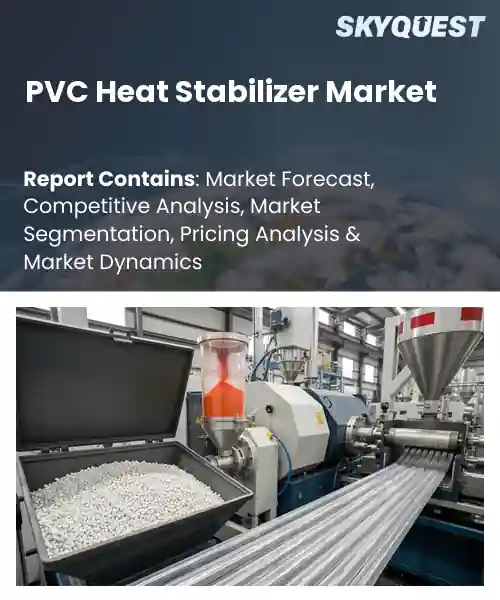
PVC Heat Stabilizer Market
Report ID: SQMIG15E3647
Report ID: SQMIG15E3647
[email protected]
USA +1 351-333-4748
Report ID:
SQMIG15E3647 |
Region:
Global |
Published Date: June, 2026
Pages:
157
|Tables:
145
|Figures:
78


Global PVC Heat Stabilizer Market size was valued at USD 3.32 Billion in 2024 and is poised to grow from USD 3.4 Billion in 2025 to USD 4.06 Billion by 2033, growing at a CAGR of 2.27% during the forecast period (2026-2033).
High demand for PVC products in construction and infrastructure, increasing investments in water and power distribution networks, rising adoption of environmentally compliant stabilizers, advancements in heat stabilization technologies, and expanding use of PVC in electrical applications are driving sales of PVC heat stabilizers.
Regulatory framework and the increasing consciousness among environmental issues have prompted manufacturers to develop advanced stabilizers that offer better performance and lower environmental impacts. Increasing usage of PVC products for infrastructure and electrical usage has also proved to be a significant driving force behind market growth. Infrastructure development due to expanding population in urban areas and investments in water supply, sewer system and power transmission are fueling the requirement of PVC pipes, fittings, wires, cables and profiles requiring efficient heat stabilization. In this pursuit, advanced calcium-zinc systems, multi-functional stabilizer packages and green alternatives with improved processing characteristics and durability are being introduced by market players. Applications like fire resistant electrical cable insulation, durable window profiles, etc. Are expected to provide further growth prospects to stabilizer suppliers. The market is also anticipated to see a rising trend toward development of bio-based stabilizers and circular economy-oriented business models due to growing trends toward recycling and environment-friendly products. Growing consumption of PVC across construction, electrical, and consumer goods industries is expected to primarily drive PVC heat stabilizer market growth.
However, stringent environmental regulations, volatility in raw material prices, higher costs associated with eco-friendly stabilizers, and increasing competition from alternative polymer materials are anticipated to slow down PVC heat stabilizer market penetration through 2033.
How is Automation Improving PVC Heat Stabilizer Production Efficiency?
Automation is helping to increase the productivity in the market for PVC heat stabilizers due to tighter process control, decrease of human interference and enhancement of consistent product quality. Examples are automatic dosing/blending processes and in-line quality control measures as well as digital process control to optimize temperatures and mixing parameters during the whole production process. Automated weighting, blending and closed-loop control systems provide formulation consistency, decrease variations, enhance independence on manual operations. The technologies increase output, reduce safety risks for workers and provide end users with a consistent and dependable supply of PVC heat stabilizers. Furthermore automation support quality assurance through earlier detection of deviations during the process and real time corrections.
Market snapshot - (2026-2033)
Global Market Size
USD 3.32 Billion
Largest Segment
Organophosphates
Fastest Growth
Bio-Insecticides & Botanicals
Growth Rate
2.27% CAGR
To get more insights on this market click here to Request a Free Sample Report
Global PVC heat stabilizer market is segmented by chemical composition type, processing formulation, application storage domain, distribution channel, and region. Based on chemical composition type, the market is segmented into organophosphates, pyrethroids, fumigants & metal phosphides, bio-insecticides & botanicals, and others. Based on processing formulation, the market is segmented into liquid concentrates, dusts & dry flowables, tablets & pellets, and aerosols & fogging agents. Based on application storage domain, the market is segmented into on-farm storage silos, off-farm commercial elevators, and export shipments & integrated logistics. Based on distribution channel, the market is segmented into direct and indirect. Based on region, the market is segmented into North America, Europe, Asia Pacific, Latin America, and Middle East & Africa.
The liquid concentrates segment is slated to lead the global PVC heat stabilizer market revenue generation across the study period. The free-flowing nature allows accurate dispensing and immediate dispersal in PVC melts for stable heat stabilization during compounding. Dusting losses are minimized, and uniform dispersion of the additive is achieved thereby avoiding local overheating/degradation. The ability to be incorporated into standard dosing equipment and broad compatibility with many polymer chemistries is what motivates processors to seek enhanced productivity.
However, dusts & dry flowables are the most rapidly expanding segment as per this PVC heat stabilizer industry analysis, since dry formulations suit multi additive blending, have reduced storage space and are easier on capital investment requirements for smaller processors. Improvements in carrier chemistry and flow aids now make them much more easily and accurately dosed encouraging formulators requiring variable, on demand, stabilizer blends and in PVC applications.
The Organophosphates segment is estimated to account for the highest global PVC heat stabilizer market share in the future. Their phosphate-based chemistries provide an effective HCl scavenging mechanism and also combine with metal soap systems to give good thermal stability to PVC at elevated processing temperatures. A wide range of chemical modifications is available allowing flexibility to target long term discoloration or to match up with other polymers. Easy compounding with plasticizers and heat-stable carriers provides processing balance with end-product resistance, making them well suited to combination stabilizers.
Conversely, bio-insecticides & botanicals are emerging as the fastest growing subsegment as demand for bio-based additives and the push from regulation will favor plant-based stabilizers. Better extraction and functionalization will produce bio based molecules that are getting close to traditional performance leading to investment in environmentally friendly PVC compounds and new green-based product opportunities.
To get detailed segments analysis, Request a Free Sample Report
Asia Pacific dominance reflects a combination of integrated manufacturing ecosystems, concentrated demand from construction and automotive sectors, and extensive raw material supply chains that support PVC processing at scale. Regional producers benefit from proximity to key resin and additive producers, which reduces lead times and supports collaborative product development. Investment in production capacity and technical expertise enhances formulation variety and thermal performance of stabilizers. Market participants leverage flexible supply networks and a strong downstream manufacturing base to adopt novel stabilizer chemistries. Regulatory landscapes in some markets encourage substitution toward more efficient additives, while customer emphasis on product durability and processing efficiency sustains adoption. Strategic partnerships between chemical producers and converters further reinforce region centrality in the global PVC heat stabilizer market.
PVC heat stabilizer demand in Japan is characterized by advanced formulation capabilities, strong technical support from material science institutions, and close collaboration between stabilizer makers and OEMs. Demand centers in building products and precision components drive a focus on high-performance stabilizers that ensure long service life and processing consistency. Established quality standards and an emphasis on material innovation sustain premium positioning and encourage tailored additive solutions across multiple end markets.
Adoption of PVC heat stabilizers in South Korea is driven by a competitive chemical manufacturing base and strong integration with electronics and automotive supply chains. Local producers focus on flexibility and speed of ramp-up to respond to changing converter demand, technological cooperation to help improve the thermal stability and processing performance. The overall development is supported by a strong innovation activity of upstream suppliers of additives with downstream fabricators seeking certain high-performance formulation for all segments.
Stringent product quality expectations, a strong chemicals industry with deep formulation expertise, and increasing demand from construction and specialized manufacturing segments are helping create a new business scope. Establishing compliance with regional environmental and performance standards has promoted the growth of new stabilizer chemistry to provide extended life and better reliability during processing. The collaboration of additive suppliers and converters has increased the pace at which developed / available new products can be modified to meet demanding applications. The mature distribution network in Europe, together with a focus on maintaining a circular economy associated with materials management, has further encouraged new and innovative methods of selecting and recycling stabilizers. Established market momentum has also been maintained through continued research & development investments, in addition to formal partnerships that link technological capabilities with end-user requirements. Integrated supply networks and specialist application support have further helped build the capacity needed for meeting changing regulatory and performance requirements associated with many different end-use applications.
PVC heat stabilizer demand in Germany is anchored by a sophisticated chemicals sector, strong industrial demand, and established standards that prioritize long-term performance and safety. Producers emphasize high-purity formulations and robust technical service to support demanding applications such as construction components and engineered systems. Close collaboration between additive manufacturers and converters drives consistent product quality and process reliability, underpinning adoption of premium stabilizer solutions across traditional and specialty markets nationally.
PVC heat stabilizer market in United Kingdom is characterized by dynamic converter demand and a strong focus on innovation, driving rapid adoption of novel stabilizer systems. Suppliers and processors collaborate in developing various end uses in modular construction and specialized industrial product constituents. Market players endeavor toward fast product iteration through more flexible service offerings and responsive technical support.
Sales of PVC heat stabilizers in France are emerging on the basis of growing attention to material performance in niche construction and specialty manufacturing applications. On the other hand, local suppliers are working with differentiated stabilizer packages that offer a compromise between processability and end product performance. Technical service is important for converter acceptance of the new stabilizer system. Cooperation with research institutes and application-oriented product trials will be useful for the introduction of new additive concepts for the wider industrial and consumer markets.
Supply chain optimization, advanced formulation expertise, and close alignment between additive manufacturers and large-scale converters drive steady sales of PVC heat stabilizers in the region. Additives suppliers are focused on product quality, reliability, and application support as they face increasing processing pressures for their products in the construction, infrastructure, and specialty/industrial market sectors. New investments in technical service, application testing, and collaborative development programmes are reducing the gaps between lab performance and production performance. Companies in North America are also focusing on the integration of sustainable practices and recyclability in stabilizers, meeting demand from their customers for circularity. Together with resilient distribution channels and responsive logistics, these initiatives support the enhanced competitiveness of suppliers and provide opportunities for continued incremental growth of market share across variant end-use applications. Cos-designing with testing organizations and strengthened application engineering groups facilitates rapid issue resolution and scale-up adoption, which create additional regional value for suppliers in the North American additives market.
PVC heat stabilizer demand in the United States is supported by large-scale converters, advanced process engineering capabilities, and a focus on application-driven product development. Suppliers provide extensive technical support and tailored formulation services to address diverse processing environments in construction, automotive, and industrial sectors. Emphasis on quality assurance and rapid application testing enables smooth scale up. Strong logistics networks and established distributor relationships help ensure consistent supply and responsive customer service.
Sales of PVC heat stabilizers in Canada are backed by a reliable supply and adaptable formulations suited to domestic manufacturing and export converters. Significant consideration is given to material traceability and compatibility to recycling streams when designing components. Communication and cooperation with distributors and application engineers is carefully managed to enable rapid uptake while supporting steady market development across a broad range of end markets. Local suppliers are geared toward service responsiveness and technical cooperation that help the processors design products, industrial components and applications.
To know more about the market opportunities by region and country, click here to
Buy The Complete Report
Increasing Construction Sector Demand
Shift Toward Ecofriendly Stabilizers
Raw Material Price Volatility
Regulatory Compliance Challenges
Request Free Customization of this report to help us to meet your business objectives.
The competitive landscape is shaped by consolidation and technology differentiation as regulatory pressure for low toxicity stabilizers forces concrete strategic moves. Recent joint ventures and capacity plays are visible, for example the Ingenia Polymers and IKA Group JV to commercialize PVC stabilizers in North America, and incumbent expansions and new lead free blends rolled out by major additives suppliers, driving partnerships, product innovation, and targeted M&A.
SkyQuest’s ABIRAW (Advanced Business Intelligence, Research & Analysis Wing) is our Business Information Services team that Collects, Collates, Correlates, and Analyses the Data collected by means of Primary Exploratory Research backed by robust Secondary Desk research.
As per SkyQuest analysis, high demand for PVC products in construction and infrastructure, increasing investments in water and power distribution networks, rising adoption of environmentally compliant stabilizers, advancements in heat stabilization technologies, and expanding use of PVC in electrical applications are anticipated to drive the demand for PVC heat stabilizers going forward. However, stringent environmental regulations, volatility in raw material prices, higher costs associated with eco-friendly stabilizers, and increasing competition from alternative polymer materials are slated to slow down the adoption of PVC heat stabilizers in the future. Asia Pacific is slated to spearhead the demand for PVC heat stabilizers owing to rapid urbanization, expanding infrastructure development activities, strong PVC production capacity, and growing investments in construction and electrical applications. Development of automated production lines, increasing adoption of calcium-zinc and other environmentally friendly stabilizers, and growing focus on sustainable and recyclable PVC formulations are anticipated to be key trends driving the PVC heat stabilizer market through 2033.
| Report Metric | Details |
|---|---|
| Market size value in 2024 | USD 3.32 Billion |
| Market size value in 2033 | USD 4.06 Billion |
| Growth Rate | 2.27% |
| Base year | 2024 |
| Forecast period | (2026-2033) |
| Forecast Unit (Value) | USD Billion |
| Segments covered |
|
| Regions covered | North America (US, Canada), Europe (Germany, France, United Kingdom, Italy, Spain, Rest of Europe), Asia Pacific (China, India, Japan, Rest of Asia-Pacific), Latin America (Brazil, Rest of Latin America), Middle East & Africa (South Africa, GCC Countries, Rest of MEA) |
| Companies covered |
|
| Customization scope | Free report customization with purchase. Customization includes:-
|
To get a free trial access to our platform which is a one stop solution for all your data requirements for quicker decision making. This platform allows you to compare markets, competitors who are prominent in the market, and mega trends that are influencing the dynamics in the market. Also, get access to detailed SkyQuest exclusive matrix.
Table Of Content
Executive Summary
Market overview
Parent Market Analysis
Market overview
Market size
KEY MARKET INSIGHTS
COVID IMPACT
MARKET DYNAMICS & OUTLOOK
Market Size by Region
KEY COMPANY PROFILES
Methodology
For the PVC Heat Stabilizer Market, our research methodology involved a mixture of primary and secondary data sources. Key steps involved in the research process are listed below:
1. Information Procurement: This stage involved the procurement of Market data or related information via primary and secondary sources. The various secondary sources used included various company websites, annual reports, trade databases, and paid databases such as Hoover's, Bloomberg Business, Factiva, and Avention. Our team did 45 primary interactions Globally which included several stakeholders such as manufacturers, customers, key opinion leaders, etc. Overall, information procurement was one of the most extensive stages in our research process.
2. Information Analysis: This step involved triangulation of data through bottom-up and top-down approaches to estimate and validate the total size and future estimate of the PVC Heat Stabilizer Market.
3. Report Formulation: The final step entailed the placement of data points in appropriate Market spaces in an attempt to deduce viable conclusions.
4. Validation & Publishing: Validation is the most important step in the process. Validation & re-validation via an intricately designed process helped us finalize data points to be used for final calculations. The final Market estimates and forecasts were then aligned and sent to our panel of industry experts for validation of data. Once the validation was done the report was sent to our Quality Assurance team to ensure adherence to style guides, consistency & design.
Analyst Support
Customization Options
With the given market data, our dedicated team of analysts can offer you the following customization options are available for the PVC Heat Stabilizer Market:
Product Analysis: Product matrix, which offers a detailed comparison of the product portfolio of companies.
Regional Analysis: Further analysis of the PVC Heat Stabilizer Market for additional countries.
Competitive Analysis: Detailed analysis and profiling of additional Market players & comparative analysis of competitive products.
Go to Market Strategy: Find the high-growth channels to invest your marketing efforts and increase your customer base.
Innovation Mapping: Identify racial solutions and innovation, connected to deep ecosystems of innovators, start-ups, academics, and strategic partners.
Category Intelligence: Customized intelligence that is relevant to their supply Markets will enable them to make smarter sourcing decisions and improve their category management.
Public Company Transcript Analysis: To improve the investment performance by generating new alpha and making better-informed decisions.
Social Media Listening: To analyze the conversations and trends happening not just around your brand, but around your industry as a whole, and use those insights to make better Marketing decisions.
REQUEST FOR SAMPLE
 REQUEST FREE CUSTOMIZATION
Global Pvc Heat Stabilizer Market size was valued at USD 3.32 Billion in 2024 and is poised to grow from USD 3.4 Billion in 2025 to USD 4.06 Billion by 2033, growing at a CAGR of 2.27% during the forecast period (2026-2033).
The competitive landscape is shaped by consolidation and technology differentiation as regulatory pressure for low toxicity stabilizers forces concrete strategic moves. Recent joint ventures and capacity plays are visible, for example the Ingenia Polymers and IKA Group JV to commercialize PVC stabilizers in North America, and incumbent expansions and new lead free blends rolled out by major additives suppliers, driving partnerships, product innovation, and targeted M&A. 'Baerlocher GmbH', 'Reagens SpA', 'Galata Chemicals', 'Valtris Specialty Chemicals', 'Songwon Industrial', 'Adeka Corporation', 'Sakai Chemical Industry', 'Nitto Kasei', 'Kisuma Chemicals', 'Sun Ace', 'Pau Tai Industrial', 'KD Chem', 'Chemson Group', 'Akcros Chemicals', 'Sadhana Nitro Chem', 'Goldstab Organics', 'Plastistab', 'Patcham FZCO', 'Sino-Chemical Holdings', 'Zhejiang Jiahua Energy Chemical'
The expansion of construction activities increases demand for durable PVC products, which in turn elevates the need for effective heat stabilizers to ensure product longevity and performance. Manufacturers prioritize stabilizers that maintain thermal stability during processing and extend service life in building applications, prompting procurement and formulation adjustments. This focus encourages investment in production capacity and innovation among stabilizer suppliers. Consequently, the construction-driven requirement for reliable PVC performance sustains market growth by creating steady downstream demand and incentivizing supply-side improvements and collaboration.
Sustainability Focused Formulations: Producers are reformulating PVC stabilizer portfolios to prioritize non-toxic, recyclable and bio-based chemistries that align with customer sustainability commitments. Demand from construction, medical, and consumer segments encourages suppliers to invest in greener R&D, lifecycle assessments, and transparent sourcing. This strategic shift reduces environmental footprint concerns, enhances end-product marketability and supports circularity initiatives. Partnerships across the value chain accelerate adoption through application testing, performance validation and communication of sustainability credentials to brand-conscious buyers while meeting evolving performance expectations and long-term reliability.
Why does Asia Pacific Dominate the Global PVC Heat Stabilizer Market? |@12


Want to customize this report? This report can be personalized according to your needs. Our analysts and industry experts will work directly with you to understand your requirements and provide you with customized data in a short amount of time. We offer $1000 worth of FREE customization at the time of purchase.
Feedback From Our Clients


 USA (+1) 351-333-4748

