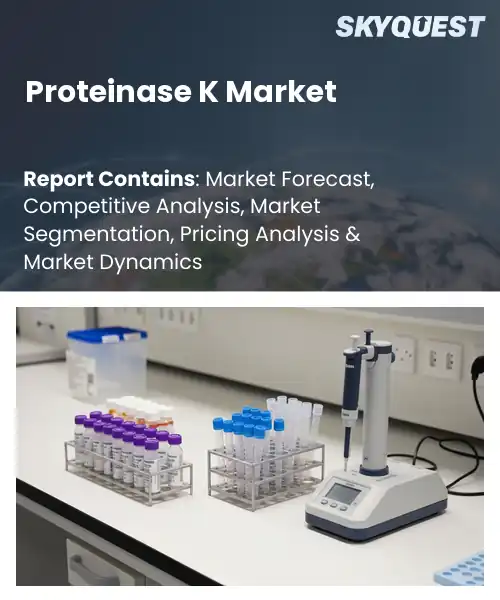
Proteinase K Market
Report ID: SQMIG35J2302
Report ID: SQMIG35J2302
[email protected]
USA +1 351-333-4748
Report ID:
SQMIG35J2302 |
Region:
Global |
Published Date: May, 2026
Pages:
157
|Tables:
178
|Figures:
79


Global Proteinase K Market size was valued at USD 5.2 Billion in 2024 and is poised to grow from USD 5.62 Billion in 2025 to USD 10.48 Billion by 2033, growing at a CAGR of 8.1% during the forecast period (2026-2033).
The proteinase K market is focused on proteolytic enzyme reagents used to digest proteins in molecular biology, diagnostics and bioprocessing workflows where the removal of contaminating proteins and nuclease inactivation are important. This is important because reliable DNA and RNA extraction is the basis for PCR, sequencing, and diagnostic tests and has become more important as genomics, clinical testing, and personalized medicine have expanded. Historically the sector has moved from simple lab purchased reagents to recombinant production and tailored formulations that improved purity, consistency and compatibility with automation, for example companies introducing heat stable recombinant proteinase K suitable for high throughput platforms and supporting broader clinical adoption globally.
Demand is driven by the increasing use of high throughput sequencing and the growth of point of care diagnostics, as higher sample throughput and more stringent purity requirements are driving laboratories to adopt premium proteinase K formulations that reduce processing time and eliminate inhibitors. This enables the scaling-up of recombinant production and the development of lyophilized ready-to-use formats that can improve the shelf life and can be deployed in the field for outbreak surveillance and decentralized clinical testing. Higher production volumes drive down costs per unit, making it easier for biopharma process developers and CMOs to integrate proteinase K into vaccine and biologic workflows, creating market pull for larger batches of enzyme and customized purity grades across the globe.
How is AI optimizing quality control in the Proteinase K market?
AI is revolutionizing quality control in the Proteinase K market by automating the analysis of assays and identifying subtle signs of impurity or activity drift. Key is machine vision for gel and plate reads, spectral pattern recognition for mass spectra and predictive models that flag processes before they cause failed batches. Today, many manufacturers and service labs are employing AI on automated workflows to accelerate lot release and minimize wasted material. We’re using these systems to help us prioritize human review of suspect lots and to combine environmental data with process data to make quality decisions, for a more reliable supply for diagnostics and bioprocessing.
Thermo Fisher (Jan 2026) partnered with NVIDIA to embed AI in lab instruments. This enables application of AI based analytics and automated monitoring in Proteinase K reagent testing to improve batch consistency, decrease manual assays and speed up reliable supply.
Market snapshot - (2026-2033)
Global Market Size
USD 5.2 Billion
Largest Segment
Powder Proteinase K
Fastest Growth
Liquid Proteinase K
Growth Rate
8.1% CAGR
To get more insights on this market click here to Request a Free Sample Report
Global proteinase k market is segmented by form, source, application, end user, grade, distribution channel and region. Based on form, the market is segmented into Powder Proteinase K, Liquid Proteinase K, Lyophilized Proteinase K and Others. Based on source, the market is segmented into Fungal-Derived Proteinase K, Recombinant Proteinase K and Others. Based on application, the market is segmented into DNA Extraction & Purification, RNA Isolation, Protein Digestion, In Situ Hybridization, Diagnostic Testing and Others. Based on end user, the market is segmented into Pharmaceutical & Biotechnology Companies, Academic & Research Institutes, Diagnostic Laboratories, Contract Research Organizations (CROs) and Others. Based on grade, the market is segmented into Molecular Biology Grade, Clinical Grade, Research Grade and Others. Based on distribution channel, the market is segmented into Direct Sales, Distributors & Suppliers and Online Sales. Based on region, the market is segmented into North America, Europe, Asia Pacific, Latin America and Middle East & Africa.
Diagnostic labs and production teams like the ready-to-use formulations because they are easier to handle and support higher throughput in routine workflows. Predictable activity patterns and suitability for automated platforms drive operational efficiencies and less variability supporting regulatory compliance and faster time to result. Its easy-to-use format reduces training burden, cuts integration costs and fuels consistent demand from high volume applications.
However Powder Proteinase K is the fastest growing segment as it is easy to ship and store and it is easy to customize formulation for niche assays. Uptake is being driven by research labs and custom manufacturers and improvements in stabilized powder chemistries are extending the range of applications and enabling new product formats. We also find opportunities for acceleration in decentralized and resource-constrained settings.
The Recombinant Proteinase K segment is expected to dominate the market as a result of scalable expression systems to provide consistent quality and supply of enzymes meeting stringent molecular biology and clinical requirements. Recombinant production for high sensitivity workflows, engineered purity, reduced host contaminants and bespoke activity profiles. It’s attractive for labs and manufacturers looking for reproducible performance and better fit into automated RNA isolation workflows as validation is facilitated for regulated users.
However, fungal derived Proteinase K is the fastest growing choice with improvements in sourcing and purification lowering variability and cost reigniting preference for naturally derived enzymes in research settings. Cost-conscious labs and the availability of new assay formats that can accommodate native preparations are driving demand for wider application and new product differentiation.
To get detailed segments analysis, Request a Free Sample Report
North America is the biggest market for global Proteinase K, thanks to a combination of solid research infrastructure, concentrated industry presence and established supply chains. The region has leading biotechnology and pharmaceutical companies and world class academic and clinical laboratories that are driving steady demand for high quality reagents. Proteinase K is extensively used in molecular testing and proteomic workflows with strong regulatory frameworks and clear standards for clinical and diagnostic products. Reliable availability and technical support from established reagent manufacturers and distributors, and active collaboration between industry and academia accelerate the development and application expansion of products. The existence of specialized service providers and large scale diagnostic testing networks further reinforce market leadership by enabling rapid adoption of innovations and consistent procurement among diverse end users.
The presence of a high concentration of biotechnology companies, large pharmaceutical firms, and state-of-the-art clinical laboratories that require high-quality enzymes for their complex workflows drive the United States proteinase K market. Strong supplier networks and well developed distribution channels support demand. Innovation in molecular diagnostics, genomics research and personalized medicine drive demand. Collaborative ecosystems linking academic centres with commercial developers accelerate the translation of new applications, while regulatory clarity and access to sophisticated analytical services facilitate adoption by research and diagnostic users.
The Proteinase K Market in Canada is driven by specialized research institutions, a supportive policy environment for life science innovation, and focused strengths in precision medicine and translational research. Procurement, in contrast, tends to focus on strict quality standards and traceability. There is a heavy reliance on networks of cooperation between academic laboratories and clinical testing laboratories. Local suppliers and distributors provide specialized technical support to niche users and cross border linkages with neighboring markets allow access to a wide range of reagent offerings and expertise.
Europe’s Proteinase K market is likely to witness rapid growth over the coming years, driven by a strong manufacturing base, coordinated research initiatives, and growing integration of advanced diagnostics in healthcare systems. Cross border collaborations and harmonization efforts that allow for wider market access for established and novel enzyme formulations offset fragmented national markets. Investment is being driven by increasing demand for proteomics, molecular diagnostics and contract research services, with established pharmaceutical and biotech clusters providing both end users and contract manufacturing services. Suppliers can improve their distribution reach and technical capabilities through strategic consolidation and partnerships, and public private initiatives can promote uptake in clinical settings. The differences in capabilities from one country to another create a complementary landscape where high quality production, translational research and rapid adoption of applications meet to accelerate market growth.
Germany Proteinase K Market is characterized by presence of sophisticated production capacities, strong industrial biotechnology know-how and extensive network of research institutes and diagnostic laboratories. Procurement priorities stress high purity and reproducibility. Local manufacturers provide enzyme formulations that are suitable for both academic research and regulated clinical applications. The collaboration between industrial companies and university centers promotes innovation in the use of enzymes. And solid logistics and quality systems ensure reliable delivery and compliance for a broad spectrum of users.
The Proteinase K Market United Kingdom is characterized by a fast growing biotechnology ecosystem, vibrant translational research activity and a cluster of specialized service providers and sequencing centers. The landscape favours rapid commercialisation of novel applications and close interaction between startups, contract research organisations and hospital laboratories. Funding mechanisms and clinical research networks speed up the evaluation of diagnostic workflows. Adaptive procurement strategies across institutions foster early implementation of advanced reagent technologies and tailored technical support.
With improving infrastructure in life sciences, fuelled by investment in public research institutions and regional biotech clusters, France’s Proteinase K market is coming up. The increasing clinical and academic adoption of molecular methods and a growing base of local suppliers and service providers offering application focused support are shaping the demand. The focus on quality control and links with national health programs promotes a steady rise in procurement for clinical laboratories. Cooperative programs allow for the transfer of technology and the scaling up of enzyme applications in research laboratories.
Asia Pacific is increasing its proteinase K market share through strategic investments in life science capacity, local manufacturing and increased adoption of molecular diagnostics in clinical and research use. Other priorities in the region include improving the supply chain resilience by strengthening in-country capacities for reagent production, strengthening the regulatory frameworks to promote diagnostic innovation and engaging with global suppliers to facilitate technology transfer and capacity building. The rising networks of contract research and diagnostics, together with the growing knowledge in genomics and proteomics, are driving the demand for reliable enzyme products. With an emphasis on quality assurance and scalable manufacturing techniques, regional players can meet domestic requirements as well as export markets. Cooperative research projects accelerate local development and commercialization pathways.
Japan Proteinase K Market characterized by advanced R&D, rigorous manufacturing guidelines, and stringent quality and regulatory adherence. Domestic suppliers with stringent quality controls are supporting the demand through the integration of enzyme reagents into high throughput sequencing, clinical diagnostics and biopharma research. Collaborative projects with international technology partners and well established laboratory networks extend the product portfolio and provide efficient adoption and technical support for academic and industrial users.
The South Korea biotech industry has fast technology adoption, strong diagnostics and sequencing capabilities, and a booming contract research industry. Proteinase K Market Local manufacturers and service providers are focused on innovation and speed to market and close ties between academia and industry make translational research a real possibility. The commercialization and simplification of regulatory processes are geared towards speeding up adoption by clinical labs and biopharma companies, building a strong regional competitive position for enzyme
To know more about the market opportunities by region and country, click here to
Buy The Complete Report
Rising Demand In Biotech Research
Expansion Of Diagnostic Applications
Stringent Regulatory Requirements
High Production And Purification Costs
Request Free Customization of this report to help us to meet your business objectives.
Consolidation, platform innovation and regional supply shifts are shaping competition in the global Proteinase K market. Big buyers of life sciences are making strategic deals to expand their toolset, such as Thermo Fisher’s 2024 acquisition of Olink. Startups are making a move on enzyme displacement through sample prep technology and local reagent production, with incumbents having to partner, differentiate and make targeted M&A moves.
SkyQuest’s ABIRAW (Advanced Business Intelligence, Research & Analysis Wing) is our Business Information Services team that Collects, Collates, Correlates, and Analyses the Data collected by means of Primary Exploratory Research backed by robust Secondary Desk research.
As per SkyQuest analysis, the global Proteinase K market is driven primarily by rising demand in biotech research, which fuels sustained purchases for reliable enzymatic digestion and nucleic acid workflows. A second driver is expanding diagnostic applications and high-throughput sequencing needs that push adoption of ready-to-use, automation-compatible formulations. The market faces a notable restraint in stringent regulatory requirements that increase validation burdens and raise costs for manufacturers. North America remains the dominating region due to concentrated industry, research infrastructure and established supply chains, while liquid Proteinase K leads as the dominating segment because ready-to-use formulations reduce handling, support automation and accelerate diagnostic throughput.
| Report Metric | Details |
|---|---|
| Market size value in 2024 | USD 5.2 Billion |
| Market size value in 2033 | USD 10.48 Billion |
| Growth Rate | 8.1% |
| Base year | 2024 |
| Forecast period | (2026-2033) |
| Forecast Unit (Value) | USD Billion |
| Segments covered |
|
| Regions covered | North America (US, Canada), Europe (Germany, France, United Kingdom, Italy, Spain, Rest of Europe), Asia Pacific (China, India, Japan, Rest of Asia-Pacific), Latin America (Brazil, Rest of Latin America), Middle East & Africa (South Africa, GCC Countries, Rest of MEA) |
| Companies covered |
|
| Customization scope | Free report customization with purchase. Customization includes:-
|
To get a free trial access to our platform which is a one stop solution for all your data requirements for quicker decision making. This platform allows you to compare markets, competitors who are prominent in the market, and mega trends that are influencing the dynamics in the market. Also, get access to detailed SkyQuest exclusive matrix.
Table Of Content
Executive Summary
Market overview
Parent Market Analysis
Market overview
Market size
KEY MARKET INSIGHTS
COVID IMPACT
MARKET DYNAMICS & OUTLOOK
Market Size by Region
KEY COMPANY PROFILES
Methodology
For the Proteinase K Market, our research methodology involved a mixture of primary and secondary data sources. Key steps involved in the research process are listed below:
1. Information Procurement: This stage involved the procurement of Market data or related information via primary and secondary sources. The various secondary sources used included various company websites, annual reports, trade databases, and paid databases such as Hoover's, Bloomberg Business, Factiva, and Avention. Our team did 45 primary interactions Globally which included several stakeholders such as manufacturers, customers, key opinion leaders, etc. Overall, information procurement was one of the most extensive stages in our research process.
2. Information Analysis: This step involved triangulation of data through bottom-up and top-down approaches to estimate and validate the total size and future estimate of the Proteinase K Market.
3. Report Formulation: The final step entailed the placement of data points in appropriate Market spaces in an attempt to deduce viable conclusions.
4. Validation & Publishing: Validation is the most important step in the process. Validation & re-validation via an intricately designed process helped us finalize data points to be used for final calculations. The final Market estimates and forecasts were then aligned and sent to our panel of industry experts for validation of data. Once the validation was done the report was sent to our Quality Assurance team to ensure adherence to style guides, consistency & design.
Analyst Support
Customization Options
With the given market data, our dedicated team of analysts can offer you the following customization options are available for the Proteinase K Market:
Product Analysis: Product matrix, which offers a detailed comparison of the product portfolio of companies.
Regional Analysis: Further analysis of the Proteinase K Market for additional countries.
Competitive Analysis: Detailed analysis and profiling of additional Market players & comparative analysis of competitive products.
Go to Market Strategy: Find the high-growth channels to invest your marketing efforts and increase your customer base.
Innovation Mapping: Identify racial solutions and innovation, connected to deep ecosystems of innovators, start-ups, academics, and strategic partners.
Category Intelligence: Customized intelligence that is relevant to their supply Markets will enable them to make smarter sourcing decisions and improve their category management.
Public Company Transcript Analysis: To improve the investment performance by generating new alpha and making better-informed decisions.
Social Media Listening: To analyze the conversations and trends happening not just around your brand, but around your industry as a whole, and use those insights to make better Marketing decisions.
REQUEST FOR SAMPLE
 REQUEST FREE CUSTOMIZATION
Global Proteinase K Market size was valued at USD 5.2 Billion in 2024 and is poised to grow from USD 5.62 Billion in 2025 to USD 10.48 Billion by 2033, growing at a CAGR of 8.1% during the forecast period (2026-2033).
Competition in the global Proteinase K market is shaped by consolidation, platform innovation and regional supply moves. Large life science acquirers execute strategic deals to broaden toolsets, for example Thermo Fisher’s 2024 acquisition of Olink. Startups push enzyme displacement through sample preparation technologies and local reagent manufacturing, forcing incumbents into partnerships, product differentiation and targeted M&A. 'Merck KGaA', 'Thermo Fisher Scientific Inc.', 'QIAGEN N.V.', 'F. Hoffmann-La Roche Ltd.', 'Agilent Technologies, Inc.', 'Promega Corporation', 'Takara Bio Inc.', 'New England Biolabs, Inc.', 'Bio-Rad Laboratories, Inc.', 'Abcam plc', 'Worthington Biochemical Corporation', 'MP Biomedicals, LLC', 'GenScript Biotech Corporation', 'Creative Enzymes', 'Bangalore Genei Pvt. Ltd.', 'Norgen Biotek Corp.', 'Canvax Biotech S.L.', 'Yeasen Biotechnology (Shanghai) Co., Ltd.', 'Bioline Reagents Limited', 'Sisco Research Laboratories Pvt. Ltd.'
The expanding use of Proteinase K in biotechnology and life science research drives market adoption by providing reliable enzymatic digestion for nucleic acid extraction and protein analysis, improving sample purification workflows and experimental reproducibility. Research laboratories and diagnostic developers increasingly prefer well-characterized enzymes to support assay sensitivity and downstream analytics, which enhances procurement of specialized reagents. As applications in genomics, proteomics, and clinical testing broaden, sustained demand for high-quality proteolytic enzymes supports suppliers in scaling production and diversifying formulations to meet varied laboratory requirements.
Recombinant Enzyme Innovation: Market demand is shifting toward recombinant and engineered Proteinase K variants that offer enhanced stability, reduced autolysis, and sourcing free of animal origin. Suppliers are prioritizing protein engineering and alternative expression systems to deliver consistent quality and traceability for research. Customization for kit manufacturers and integration with validated protocols significantly improves compatibility and reduces development timelines. Emphasis on lot to lot consistency and regulatory documentation fosters long term partnerships between enzyme producers and end users seeking reliable, scalable enzyme solutions.
Why does North America Dominate the Global Proteinase K Market? |@12


Want to customize this report? This report can be personalized according to your needs. Our analysts and industry experts will work directly with you to understand your requirements and provide you with customized data in a short amount of time. We offer $1000 worth of FREE customization at the time of purchase.
Feedback From Our Clients


 USA (+1) 351-333-4748

