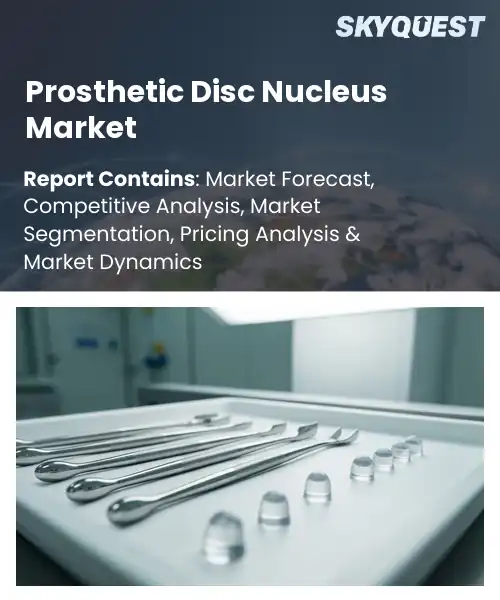
Prosthetic Disc Nucleus Market
Report ID: SQMIG20I2782
Report ID: SQMIG20I2782
[email protected]
USA +1 351-333-4748
Report ID:
SQMIG20I2782 |
Region:
Global |
Published Date: April, 2026
Pages:
157
|Tables:
117
|Figures:
77


Global Prosthetic Disc Nucleus Market size was valued at USD 284.5 Million in 2024 and is poised to grow from USD 302.71 Million in 2025 to USD 286.1 Million by 2033, growing at a CAGR of 6.4% during the forecast period (2026-2033).
Primary driver of the prosthetic disc nucleus market is the rising prevalence of degenerative disc disease as populations age and sedentary lifestyles increase. The market comprises implantable devices that replace or augment nucleus pulposus to preserve spinal motion, offering an alternative to fusion that can reduce adjacent segment degeneration and speed recovery. Interest has grown because motion preserving solutions address long term morbidity and quality of life, prompting evolution from experimental implants to prototypes. Examples such as DASCOR and NuCore demonstrated feasibility, while advances in biomaterials, surgical imaging, and minimally invasive delivery have steadily improved safety, durability, and clinical uptake.Building on improving outcomes, a pivotal growth factor is innovation in materials and delivery systems that lowers complication rates and shortens recovery. As elastomeric cores, hydrogels and polymer jackets better mimic biomechanics, surgeons gain confidence to treat earlier stage degeneration and payers expand reimbursement in response to demonstrated cost savings. This cause and effect cycle fuels adoption in ambulatory centers where reduced operative time and shorter hospital stays lead to real world cases such as same day nucleus replacement for working adults. Consequently, manufacturers access broader modular product lines, geographic expansion and bundled care agreements tied to better patient outcomes.
How is AI improving product development in the prosthetic disc nucleus market?
AI is improving product development in the prosthetic disc nucleus market by enabling faster design cycles and richer patient specific modeling. Key aspects include machine learning driven biomechanics simulation, generative design for elastomeric cores and AI enhanced imaging that personalizes implant shape and placement. The current state sees companies using algorithms to reduce prototyping and predict long term performance while maintaining clinical priorities. Market context shows growing interest in motion preserving solutions and minimally invasive approaches. Examples include AI optimized finite element models and clinical data analytics guiding iterative device refinement to make development more efficient and more clinically relevant.AxioMed January 2026, announced a peer reviewed study and a limited U.S. release that illustrate how AI driven simulation and embedded sensor software shortened testing cycles and supported faster iterative improvements for viscoelastic disc designs, helping translate lab advances into marketable, clinically focused products.
Market snapshot - (2026-2033)
Global Market Size
USD 284.5 Million
Largest Segment
Lumbar Disc Nucleus Prosthetics
Fastest Growth
Injectable/In-situ Forming Nucleus Replacements
Growth Rate
6.4% CAGR
To get more insights on this market click here to Request a Free Sample Report
Global prosthetic disc nucleus market is segmented by product configuration, material base, clinical application, end-user and region. Based on product configuration, the market is segmented into Lumbar Disc Nucleus Prosthetics, Cervical Disc Nucleus Prosthetics and Injectable/In-situ Forming Nucleus Replacements. Based on material base, the market is segmented into Hydrogel-based Nucleus Prosthetics, Metallic & Synthetic Polymer Composites and Specialized Elastomeric Materials. Based on clinical application, the market is segmented into Degenerative Disc Disease (DDD), Chronic Back Pain & Disc Herniation Management and Post-discectomy Spinal Stability. Based on end-user, the market is segmented into Hospitals & Specialized Spine Centers, Ambulatory Surgical Centers (ASCs) and Academic & Research Medical Institutions. Based on region, the market is segmented into North America, Europe, Asia Pacific, Latin America and Middle East & Africa.
Lumbar Disc Nucleus Prosthetics segment dominates because they address the largest clinical burden in the lower spine and integrate with established posterior surgical approaches, encouraging widespread clinician adoption. Their capacity to restore disc height and load sharing improves functional outcomes and reduces progression of degeneration, which in turn drives payer recognition and supplier investment, consolidating product development and commercialization efforts in the prosthetic disc nucleus market.
However, Injectable/In-situ Forming Nucleus Replacements are emerging as the fastest growing area owing to minimally invasive delivery, lower operative morbidity and adaptability to irregular defects, which appeal to surgeons and patients. Advances in biomaterials and regulatory clarity for percutaneous therapies are accelerating outpatient adoption and expanding indications, creating new opportunities across the prosthetic disc nucleus market.
Hydrogel-based Nucleus Prosthetics segment leads because hydrogels closely mimic the viscoelastic and hydration properties of the native nucleus, enabling restoration of disc biomechanics and pain relief with biocompatibility that eases clinical translation. Their tunable swelling and mechanical behavior allow designers to balance load sharing and mobility, which promotes surgeon confidence and payer consideration, fostering development pipelines and supplier ecosystems sustaining hydrogel prominence in the market.
Meanwhile, Specialized Elastomeric Materials are the fastest growing category due to improved fatigue resistance, molding versatility and long-term durability that support motion preservation. Their amenability to additive manufacturing and bespoke geometries attracts research investment and enables tailored implants for varied anatomies, broadening clinical indications and supplier innovation within the prosthetic disc nucleus market.
To get detailed segments analysis, Request a Free Sample Report
North America dominates due to a convergence of advanced clinical infrastructure, concentrated investment in spinal therapeutics, supportive reimbursement frameworks and high adoption of minimally invasive spinal interventions. Robust networks of specialized spine surgeons, comprehensive training programs and active clinical research ecosystems accelerate device refinement and acceptance. Strong collaboration between medical device manufacturers, academic centers and specialty hospitals fosters rapid translation of innovations into practice. Payer systems, while complex, facilitate access to novel spinal solutions for eligible patients, further encouraging commercial development. Market structure benefits from established distribution channels, experienced regulatory consultants and localized manufacturing capabilities that together reduce time to market and promote sustained leadership in prosthetic disc nucleus technologies. Patient awareness and referral patterns from multidisciplinary care teams also support steady clinical uptake across major treatment centers.
Prosthetic Disc Nucleus Market in the United States is characterized by early clinical adoption, concentration of specialist spine centers and alignment between manufacturers and leading surgeons. Regulatory and reimbursement environments, while demanding, are supported by experienced stakeholders who facilitate device evaluation and commercialization. Investment in surgeon training programs, device registries and market evidence generation strengthens clinician confidence and decision making, sustaining demand for innovative prosthetic solutions across spinal care pathways.
Prosthetic Disc Nucleus Market in Canada is shaped by public healthcare procurement practices, emphasis on clinical value and collaboration between academic hospitals and device developers. Adoption patterns reflect careful assessment of long term outcomes and cost effectiveness within provincial decision frameworks. Strong ties between specialized surgical centers and research institutions support clinical evaluation and guideline development. Manufacturers often engage health technology assessment bodies to align evidence generation with clinical priorities.
Rapid expansion in Europe is propelled by a combination of strong clinical expertise in spinal care, active research networks and a favorable industrial base for medical device development. Harmonized standards and collaborative initiatives across countries encourage cross border clinical trials and multicenter evaluations that build persuasive clinical evidence. Payers and hospital systems increasingly prioritize technologies that offer durable functional improvements and reduced recovery burdens, stimulating adoption in advanced centers. Growing surgeon specialization, investment in minimally invasive techniques and established relationships between regional distributors and manufacturers facilitate wider market penetration. Regulatory clarity and structured health technology assessment pathways help align evidence generation with reimbursement expectations, enabling smoother commercial roll out and uptake across diverse healthcare systems. Established centers of excellence and patient advocacy groups also accelerate clinician and payer engagement.
Prosthetic Disc Nucleus Market in Germany benefits from a strong medtech manufacturing ecosystem, a dense network of specialized spine centers and defined hospital procurement processes. Clinical research capacity and collaborative relationships between industry and academic hospitals support evidence generation and device refinement. Reimbursement pathways in hospitals favor adoption of technologies with clear functional benefits, while surgeon expertise and organized training initiatives aid integration of innovative spinal solutions across care networks.
Prosthetic Disc Nucleus Market in the United Kingdom is characterized by dynamic adoption driven by clinical research, centers of excellence and procurement evolution. Emphasis on efficiency and reduced recovery time resonates with hospital decisionmakers and specialist surgeons. Collaborative initiatives between academic hospitals and industry support multicenter evaluations and guideline development. Training programs and engagement with commissioners enhance awareness and facilitate integration of prosthetic disc nucleus solutions into spinal care pathways.
Prosthetic Disc Nucleus Market in France is emerging through introduction in specialized hospitals, pilot programs and studies with academic centers. Adoption is guided by rigorous clinical assessment and alignment with national health evaluation frameworks, encouraging evidence based decisions. Manufacturers engage clinician leaders to demonstrate clinical value and operational fit within hospital pathways. Growing interest among spinal specialists and supportive research collaborations signal potential for broader integration across regional care networks.
Asia Pacific is strengthening its position through concentrated investments in clinical capacity, targeted research collaborations and growing local manufacturing competence. Regional regulators are increasingly aligning with international standards, enabling smoother evaluation of novel spinal devices and facilitating market entry where clinical data meet local requirements. Strategic partnerships between global manufacturers and regional OEMs accelerate adaptation of designs to local clinical preferences and cost structures. Emphasis on surgeon training, centers of excellence and multicenter clinical studies furthers clinician confidence. Progressive hospital systems and growing stakeholder engagement across markets create fertile conditions for wider adoption of prosthetic disc nucleus technologies and for the region to play a more prominent role in device development and evidence generation. Local clinical leadership and patient advocacy also contribute to accelerated dissemination across tertiary care networks.
Prosthetic Disc Nucleus Market in Japan leverages strong medical device engineering, specialty hospitals and focused clinical research. Local manufacturers and international firms collaborate to adapt technologies to surgeon preferences and hospital workflows. Regulatory processes that emphasize clinical validation support careful introduction, while training programs and centers of excellence promote clinician familiarity. Coordinated engagement with payers and clinician leadership supports steady adoption of prosthetic disc nucleus solutions across advanced care settings.
Prosthetic Disc Nucleus Market in South Korea is advancing through integration of innovation, streamlined regulatory pathways and close collaboration between hospitals and device developers. Tertiary care centers and engaged surgical communities facilitate clinical evaluation and adoption. Local manufacturing agility and partnerships with global firms enable adaptation to clinical needs and rapid scaling. Emphasis on surgeon training, multicenter studies and export strategies strengthens the market role of prosthetic disc nucleus technologies.
To know more about the market opportunities by region and country, click here to
Buy The Complete Report
Advancements In Biomaterial Technology
Rising Prevalence Of Spinal Disorders
High Procedure And Device Costs
Regulatory Approval Complexity
Request Free Customization of this report to help us to meet your business objectives.
Competition in the global prosthetic disc nucleus market centers on rapid commercialization of minimally invasive motion preserving solutions, driving patent races and strategic consolidation. Competition is specifically fueled by demand for outpatient, nonfusion procedures that lower recovery time and preserve kinematics, so firms execute M&A to add implant portfolios, strike commercialization partnerships, and advance hydrogel and silicone innovations to reduce extrusion risk.
Top Player’s Company Profile
Recent Developments
SkyQuest’s ABIRAW (Advanced Business Intelligence, Research & Analysis Wing) is our Business Information Services team that Collects, Collates, Correlates, and Analyses the Data collected by means of Primary Exploratory Research backed by robust Secondary Desk research. As per SkyQuest analysis, the global prosthetic disc nucleus market is driven primarily by the rising prevalence of degenerative disc disease as populations age and sedentary lifestyles increase, which expands demand for motion-preserving spinal solutions. North America remains the dominating region due to advanced clinical infrastructure, reimbursement support and concentrated investment. The Lumbar Disc Nucleus Prosthetics segment dominates given its role in addressing lower spine burden. A secondary driver is rapid innovation in biomaterials, delivery systems and AI-enabled product development that improves durability and procedural efficiency. Growth is tempered by the high procedure and device costs that constrain payer coverage and broader hospital adoption, slowing widespread commercialization.
| Report Metric | Details |
|---|---|
| Market size value in 2024 | USD 284.5 Million |
| Market size value in 2033 | USD 286.1 Million |
| Growth Rate | 6.4% |
| Base year | 2024 |
| Forecast period | (2026-2033) |
| Forecast Unit (Value) | USD Million |
| Segments covered |
|
| Regions covered | North America (US, Canada), Europe (Germany, France, United Kingdom, Italy, Spain, Rest of Europe), Asia Pacific (China, India, Japan, Rest of Asia-Pacific), Latin America (Brazil, Rest of Latin America), Middle East & Africa (South Africa, GCC Countries, Rest of MEA) |
| Companies covered |
|
| Customization scope | Free report customization with purchase. Customization includes:-
|
To get a free trial access to our platform which is a one stop solution for all your data requirements for quicker decision making. This platform allows you to compare markets, competitors who are prominent in the market, and mega trends that are influencing the dynamics in the market. Also, get access to detailed SkyQuest exclusive matrix.
Table Of Content
Executive Summary
Market overview
Parent Market Analysis
Market overview
Market size
KEY MARKET INSIGHTS
COVID IMPACT
MARKET DYNAMICS & OUTLOOK
Market Size by Region
KEY COMPANY PROFILES
Methodology
For the Prosthetic Disc Nucleus Market, our research methodology involved a mixture of primary and secondary data sources. Key steps involved in the research process are listed below:
1. Information Procurement: This stage involved the procurement of Market data or related information via primary and secondary sources. The various secondary sources used included various company websites, annual reports, trade databases, and paid databases such as Hoover's, Bloomberg Business, Factiva, and Avention. Our team did 45 primary interactions Globally which included several stakeholders such as manufacturers, customers, key opinion leaders, etc. Overall, information procurement was one of the most extensive stages in our research process.
2. Information Analysis: This step involved triangulation of data through bottom-up and top-down approaches to estimate and validate the total size and future estimate of the Prosthetic Disc Nucleus Market.
3. Report Formulation: The final step entailed the placement of data points in appropriate Market spaces in an attempt to deduce viable conclusions.
4. Validation & Publishing: Validation is the most important step in the process. Validation & re-validation via an intricately designed process helped us finalize data points to be used for final calculations. The final Market estimates and forecasts were then aligned and sent to our panel of industry experts for validation of data. Once the validation was done the report was sent to our Quality Assurance team to ensure adherence to style guides, consistency & design.
Analyst Support
Customization Options
With the given market data, our dedicated team of analysts can offer you the following customization options are available for the Prosthetic Disc Nucleus Market:
Product Analysis: Product matrix, which offers a detailed comparison of the product portfolio of companies.
Regional Analysis: Further analysis of the Prosthetic Disc Nucleus Market for additional countries.
Competitive Analysis: Detailed analysis and profiling of additional Market players & comparative analysis of competitive products.
Go to Market Strategy: Find the high-growth channels to invest your marketing efforts and increase your customer base.
Innovation Mapping: Identify racial solutions and innovation, connected to deep ecosystems of innovators, start-ups, academics, and strategic partners.
Category Intelligence: Customized intelligence that is relevant to their supply Markets will enable them to make smarter sourcing decisions and improve their category management.
Public Company Transcript Analysis: To improve the investment performance by generating new alpha and making better-informed decisions.
Social Media Listening: To analyze the conversations and trends happening not just around your brand, but around your industry as a whole, and use those insights to make better Marketing decisions.
REQUEST FOR SAMPLE
 REQUEST FREE CUSTOMIZATION


Want to customize this report? This report can be personalized according to your needs. Our analysts and industry experts will work directly with you to understand your requirements and provide you with customized data in a short amount of time. We offer $1000 worth of FREE customization at the time of purchase.
Feedback From Our Clients


 USA (+1) 351-333-4748

