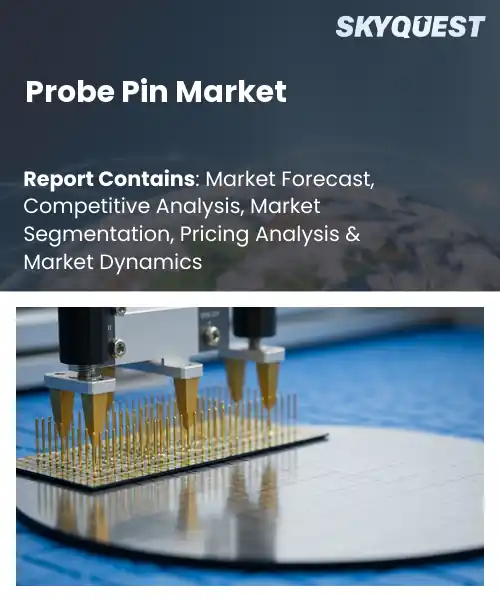
Probe Pin Market
Report ID: SQMIG45N2238
Report ID: SQMIG45N2238
[email protected]
USA +1 351-333-4748
Report ID:
SQMIG45N2238 |
Region:
Global |
Published Date: June, 2026
Pages:
157
|Tables:
144
|Figures:
78


Global Probe Pin Market size was valued at USD 670.0 Million in 2024 and is poised to grow from USD 726.95 Million in 2025 to USD 1396.18 Million by 2033, growing at a CAGR of 8.5% during the forecast period (2026-2033).
The steady decline in the physical size of semiconductors and the increase in complexity in the testing process is creating an ever-increasing demand for precision and reliability from equipment manufacturers. Probe Pins are the small, spring loaded contacts that allow Electrical Testing to be performed on Wafers and Packaged Devices. The performance of these probe pins is critical as poor electrical contact with the device can create false failures or escapes which will have an impact on the yield and downstream reliability. The evolution of the probe pin market over the past few decades has been from pogo-style pins that have simple contact designs; to high frequency, low inductance probe pins with specialty alloys and microfabricated parts; as is illustrated by the transition to WLT testing in memory Fabrication facilities, and with the use of RF Probe Cards in the testing of 5G Transceiver Qualification, where increased quality expectations have become the norm.
A key driver of global probe pin market growth is the rapid growth of the high frequency and high density packaging used in 5G Infrastructure, Automotive ADAS, and AI Accelerators, which has greatly increased the Signal Integrity and the Mechanical Endurance requirements placed on these products. The increased demand from Manufacturers and Test Houses for Probe Pins with lower inductance and controlled contact forces has prompted Suppliers to invest in new Alloy Materials, new Precision Machining processes, and new Coating Technologies in order to increase Throughput and Yield. This cascade yields use cases: wafer probers reduce retest cycles, RF stations secure high-speed measurements, and automotive suppliers meet tougher reliability screens, expanding aftermarket services and custom probe card opportunities across Asia effectively.
How is AI Improving Testing Accuracy In The Probe Pin Market?
By combining high-resolution imaging, electrical signals and sensor data into smarter decision-making, AI is improving testing accuracy within the probe pin market. Machine learning models are able to recognize subtle defects in the contact area and progressive wear that a human inspection may miss. Not only will adaptive test sequencing and predictive maintenance reduce the need for repeat tests and false failures, but they will also preserve the overall life of the probe. As the designs of chips continue to grow in density and complexity with increased pin counts, precise mapping of the actual connection and detection of anomalies will become critical to the test process; therefore, vendors and fabs are working together to integrate vision systems into probe workflows to increase the speed at which faults can be isolated and yield stability in this market, thus making the probe pin market more high-quality and competitive.
On April 2026, Advantest announced the Pin Scale 5000B Digital Test Solution which will be utilized for both AI and HPC devices and significantly increases the amount of vector memory for use within the digital testing of devices. The increase in timing fidelity offered by the Pin Scale 5000B will also allow for more detailed characterization of the probe; therefore, reducing misclassifications and speeding up the qualify time of probes will ultimately provide additional efficiency to the overall probe pin market and additionally provide for a scaled benefit to throughput in the market.
Market snapshot - (2026-2033)
Global Market Size
USD 670.0 Million
Largest Segment
Spring Probe Pins (Pogo Pins)
Fastest Growth
MEMS Probe Pins
Growth Rate
8.5% CAGR
To get more insights on this market click here to Request a Free Sample Report
Global probe pin market is segmented by product type, material, application, technology, end user and region. Based on product type, the market is segmented into Spring Probe Pins (Pogo Pins), Cantilever Probe Pins, Vertical Probe Pins and MEMS Probe Pins. Based on material, the market is segmented into Tungsten & Tungsten Alloys, Beryllium Copper and Palladium Alloys. Based on application, the market is segmented into Wafer Testing, Package Testing and PCB Testing. Based on technology, the market is segmented into Manual Testing and Automated Test Equipment (ATE). Based on end user, the market is segmented into Semiconductor Manufacturers, OSAT (Assembly & Test Providers) and Electronics Manufacturers. Based on region, the market is segmented into North America, Europe, Asia Pacific, Latin America and Middle East & Africa.
The segment of spring probe pins (pogo pins) is leading the way in terms of demand due to their ability to provide an electrically continuous connection across high density arrays and differing topographies of surfaces by means of a.spring-loaded mechanism. Additionally, they are very durable and easy to integrate into fully automated handling systems which reduces downtime for maintenance purposes; thus, testers are increasingly choosing to employ spring probes. Manufacturers therefore use them as their primary testing method in many cases which creates a strong level of demand that will encourage larger production runs, supply chain specialization and ongoing research and development.
As per probe pin market analysis, MEMS probe pins are currently experiencing the greatest growth because of the need for very precise micro-fabricated probes to check ultra-small device pitches, as well as meeting the needs for high frequency testing. Their ability to be scaled down to support extremely fine layouts, in addition to being compatible with emerging wafer probing technology, has opened new possibilities for increased investment and adoption that will spur further innovation in order to support a new generation of devices.
Due to its unique properties of elastic resilience and good electrical I conductivity along with its excellent wear resistance, the Beryllium copper segment is now the leading material for probe pin applications involving many microcontacts. The Beryllium copper’s unique spring characteristics enable consistent force across multiple applications and accept a wide variety of plating finishes, thus facilitating manufacturers’ processes and extending the life of probe pins. Beryllium copper also predominates in probes used throughout industries because test engineers are driven to use it across a broad range of applications, thus encouraging further standardisation, supplier specialisation, and economies that continue to reinforce Beryllium copper's position as the premier material for probe pins.
As per probe pin market forecast, the Palladium Alloy segment is currently growing rapidly as its low contact resistance and strong corrosion resistance allow for use without the expense associated with gold. As Palladium Alloys are well-suited for fine pitch contacts and will endure under repeated loads, they are becoming increasingly used in applications where high reliability is of critical importance. Thus, enhancing the ability to make investments into palladium plating and as such, allowing manufacturers a wider range of performance alternatives while also reducing the lifecycle cost associated with these applications.
To get detailed segments analysis, Request a Free Sample Report
The Asia-Pacific region dominates the probe pins market as a result of the region's high concentration of semiconductor manufacturing, integrated supply chains, and an abundant supplier base that allows for rapid iteration and customised solutions. The short distance between the manufacturers of the components and the testing laboratories allows for reduced lead times, as well as for close collaboration on quality control. The presence of local expertise in precision machining and advanced materials has further supported the increase in demand for consumer electronics and automotive testing applications. Many governments have implemented programs to support advanced manufacturing and infrastructure investments to help ensure continued manufacturing resilience and supplier continuity. In addition, many regional companies place a strong emphasis on product reliability, local engineering support, and flexible production batches, all of which enhance the regional manufacturers' competitiveness. The strong collaborative nature of original equipment manufacturers, test operators, and probe pin suppliers through strategic partnerships promotes innovation and speeds up the introduction of higher density and more durable contact solutions across various different device segments.
Probe Pin Market in Japan has a strong benefit from a long-standing precision engineering expertise, collaboration between test equipment manufacturers and component suppliers, as well as rigorous quality control. Local manufacturers put a large premium on these aspects when designing fine pitch probe pins; therefore, they maximize service life and rapidly develop prototypes. Additionally, numerous partnerships with university research centres allow for innovation in materials which further enhances the reliability of contact solutions that suppliers can provide for specialized applications in both the automotive and advanced electronics sectors.
The Probe Pin Market in South Korea benefits from close ties to the largest manufacturers in the memory and logic device markets as well as an active electronics sector, and the country's unique metalworking capabilities. Suppliers work closely together on reliability, compactness of contact geometries and provide prompt technical service to customers. This close collaboration between test engineers and component designers allows for accelerated development of customized solutions. Local manufacturers' agility in production and the concentration of engineering talent within the manufacturing facilities combine to improve the durability and performance of probe pins across multiple industries.
North America is experiencing rapid expansion in the probe pin market driven by a combination of technological innovation, strong demand from advanced electronics and automotive testing, and a robust network of test equipment manufacturers and service providers. Emphasis on local engineering support and after sales service enhances adoption of specialized contact solutions. Market participants invest in materials research and precision manufacturing to meet stringent reliability and throughput requirements. Collaborative programs between original equipment manufacturers and test labs accelerate customization cycles, while increasing emphasis on automated test platforms raises demand for durable, fine pitch contact systems. Regional supply chain diversification and focused quality assurance practices reinforce market resilience and enable suppliers to address complex testing needs across a wide set of device segments.
Probe Pin Market in United States benefits from proximity to semiconductor design hubs, leading research institutions, and a mature ecosystem of test equipment manufacturers. Demand for high reliability and compact contacts originates from automotive testing and data communications sectors. Suppliers offer responsive design cycles and technical support. Focus on automation and integration with advanced test platforms encourages deployment of robust, precision probe pin solutions tailored to complex device validation needs.
Probe Pin Market in Canada is supported by a services ecosystem, test houses, and collaboration between industry and academic centers on materials and manufacturing processes. Suppliers emphasize customizable contact designs and strong after sales support to meet diverse client needs. The market benefits from providers that balance precision machining with adaptable production runs, enabling tailored probe pin offerings for niche applications such as industrial electronics and specialized semiconductor testing environments.
Europe is strengthening its role in the probe pin sector through a combination of advanced manufacturing capabilities, rigorous quality standards, and close ties to established automotive and industrial electronics supply chains. Investment in materials research and precision engineering allows regional suppliers to offer robust, application specific contact solutions. Collaborative networks between component manufacturers, test equipment providers, and research centers support rapid prototyping and refinement. Emphasis on long term reliability and service support differentiates European offerings, while certification practices and supplier specialization enable firms to address demanding test requirements across automotive, aerospace, and specialized industrial segments. Strategic collaborations and aftermarket service networks enhance responsiveness to customer needs and reinforce regional competitiveness. Adoption of advanced machining techniques, precision tolerances, and tailored small batch production allows suppliers to meet niche specifications and collaborate closely with customers on iterative design improvements, supporting differentiated value propositions and stronger market positioning across varied European manufacturing ecosystems.
Probe Pin Market in Germany benefits from world class precision engineering, a dense automotive supply chain, and strong tooling expertise. Manufacturers emphasize durable contact materials, tight tolerance machining, and robust service networks that align with strict quality standards. Close collaboration with equipment makers and research institutes supports material innovation and customization. This environment enables suppliers to deliver reliable, high performance probe pin solutions for demanding industrial and automotive test regimes.
Probe Pin Market in United Kingdom benefits from a strong electronics design community and specialized testing services. Suppliers focus on flexible contact geometries, rapid prototyping, and close technical support for bespoke testing scenarios. Collaboration with equipment manufacturers and university research groups fosters materials development and process improvements. This mix of design driven demand and responsive supplier capabilities supports delivery of tailored probe pin solutions for communications and industrial electronics applications.
Probe Pin Market in France leverages strengths in precision manufacturing, research collaboration, and industrial equipment sectors. Suppliers emphasize materials expertise, corrosion resistant contacts, and adaptability to complex form factors. Close ties between test laboratories and component makers enable tailored engineering support and design validation. The market favors partners that combine quality assurance with flexible production capabilities, allowing delivery of reliable probe pin solutions suited to aerospace and defense testing requirements.
To know more about the market opportunities by region and country, click here to
Buy The Complete Report
Increasing Adoption Of Automated Testing
Growth In Advanced Semiconductor Nodes
High Replacement and Maintenance Costs
Stringent Regulatory and Compliance Requirements
Request Free Customization of this report to help us to meet your business objectives.
Competitive dynamics in the global probe pin market are driven by material and process differentiation, tighter ATE integration, and consolidation as test-equipment suppliers secure supply chains and exclusive capabilities. Recent tangible strategies include minority equity and partnership deals to lock probe card integration with ATE platforms, materials innovation for longer pin life, and micro3D printing for sub-20 micrometer probes, exemplified by Advantest strategic investments and Technoprobe collaborations, TANAKA rhodium material development, and Exaddon’s microprinted probes.
SkyQuest’s ABIRAW (Advanced Business Intelligence, Research & Analysis Wing) is our Business Information Services team that Collects, Collates, Correlates, and Analyses the Data collected by means of Primary Exploratory Research backed by robust Secondary Desk research.
As per SkyQuest analysis, the global probe pin market is being driven primarily by semiconductor miniaturization, which increases demand for high-precision contacts, while a second driver is the growing adoption of automated testing that boosts throughput and repeatability. A key restraint is the high replacement and maintenance costs that raise total ownership and can delay upgrades. Asia Pacific remains the dominant region due to concentrated semiconductor manufacturing and close supplier-test house ecosystems, and spring probe pins. Commonly known as pogo pins, lead the product mix because their spring-loaded design supports high density, reliable connections and ease of integration in automated workflows.
| Report Metric | Details |
|---|---|
| Market size value in 2024 | USD 670.0 Million |
| Market size value in 2033 | USD 1396.18 Million |
| Growth Rate | 8.5% |
| Base year | 2024 |
| Forecast period | (2026-2033) |
| Forecast Unit (Value) | USD Million |
| Segments covered |
|
| Regions covered | North America (US, Canada), Europe (Germany, France, United Kingdom, Italy, Spain, Rest of Europe), Asia Pacific (China, India, Japan, Rest of Asia-Pacific), Latin America (Brazil, Rest of Latin America), Middle East & Africa (South Africa, GCC Countries, Rest of MEA) |
| Companies covered |
|
| Customization scope | Free report customization with purchase. Customization includes:-
|
To get a free trial access to our platform which is a one stop solution for all your data requirements for quicker decision making. This platform allows you to compare markets, competitors who are prominent in the market, and mega trends that are influencing the dynamics in the market. Also, get access to detailed SkyQuest exclusive matrix.
Table Of Content
Executive Summary
Market overview
Parent Market Analysis
Market overview
Market size
KEY MARKET INSIGHTS
COVID IMPACT
MARKET DYNAMICS & OUTLOOK
Market Size by Region
KEY COMPANY PROFILES
Methodology
For the Probe Pin Market, our research methodology involved a mixture of primary and secondary data sources. Key steps involved in the research process are listed below:
1. Information Procurement: This stage involved the procurement of Market data or related information via primary and secondary sources. The various secondary sources used included various company websites, annual reports, trade databases, and paid databases such as Hoover's, Bloomberg Business, Factiva, and Avention. Our team did 45 primary interactions Globally which included several stakeholders such as manufacturers, customers, key opinion leaders, etc. Overall, information procurement was one of the most extensive stages in our research process.
2. Information Analysis: This step involved triangulation of data through bottom-up and top-down approaches to estimate and validate the total size and future estimate of the Probe Pin Market.
3. Report Formulation: The final step entailed the placement of data points in appropriate Market spaces in an attempt to deduce viable conclusions.
4. Validation & Publishing: Validation is the most important step in the process. Validation & re-validation via an intricately designed process helped us finalize data points to be used for final calculations. The final Market estimates and forecasts were then aligned and sent to our panel of industry experts for validation of data. Once the validation was done the report was sent to our Quality Assurance team to ensure adherence to style guides, consistency & design.
Analyst Support
Customization Options
With the given market data, our dedicated team of analysts can offer you the following customization options are available for the Probe Pin Market:
Product Analysis: Product matrix, which offers a detailed comparison of the product portfolio of companies.
Regional Analysis: Further analysis of the Probe Pin Market for additional countries.
Competitive Analysis: Detailed analysis and profiling of additional Market players & comparative analysis of competitive products.
Go to Market Strategy: Find the high-growth channels to invest your marketing efforts and increase your customer base.
Innovation Mapping: Identify racial solutions and innovation, connected to deep ecosystems of innovators, start-ups, academics, and strategic partners.
Category Intelligence: Customized intelligence that is relevant to their supply Markets will enable them to make smarter sourcing decisions and improve their category management.
Public Company Transcript Analysis: To improve the investment performance by generating new alpha and making better-informed decisions.
Social Media Listening: To analyze the conversations and trends happening not just around your brand, but around your industry as a whole, and use those insights to make better Marketing decisions.
REQUEST FOR SAMPLE
 REQUEST FREE CUSTOMIZATION
Global Probe Pin Market size was valued at USD 670.0 Million in 2024 and is poised to grow from USD 726.95 Million in 2025 to USD 1396.18 Million by 2033, growing at a CAGR of 8.5% during the forecast period (2026-2033).
Competitive dynamics in the global probe pin market are driven by material and process differentiation, tighter ATE integration, and consolidation as test-equipment suppliers secure supply chains and exclusive capabilities. Recent tangible strategies include minority equity and partnership deals to lock probe card integration with ATE platforms, materials innovation for longer pin life, and micro3D printing for sub-20 micrometer probes, exemplified by Advantest strategic investments and Technoprobe collaborations, TANAKA rhodium material development, and Exaddon’s microprinted probes. 'Technoprobe S.p.A.', 'FormFactor Inc.', 'Micronics Japan Co., Ltd.', 'Japan Electronic Materials Corporation', 'SV Probe Pte. Ltd.', 'LEENO Industrial Inc.', 'Smiths Interconnect', 'INGUN Prüfmittelbau GmbH', 'QA Technology Company Inc.', 'Harwin plc', 'Advantest Corporation', 'Teradyne Inc.', 'Cohu Inc.', 'Tokyo Seimitsu Co., Ltd.', 'MPI Corporation', 'Feinmetall GmbH', 'PTR HARTMANN GmbH', 'Seiken Co., Ltd.', 'Yokowo Co., Ltd.', 'Omron Corporation'
Rising use of automated wafer and package testing in semiconductor production has increased demand for high performance probe pins that deliver consistent contact, repeatability, and durability under rapid cycling. Automated test lines require probe solutions that minimize downtime, maintain electrical integrity across diverse device geometries, and ensure reliable signal transmission during high throughput operations. This drives suppliers to refine materials, tip geometries, and plating processes to meet strict equipment compatibility and maintenance expectations, thereby expanding uptake of advanced probe pins across production and burn in test applications.
Miniaturization And Fine Pitch: The shift toward smaller, denser electronic packages is driving demand for precision probe pins capable of reliable contact on fine pitch pads and tight geometries. Suppliers are focusing on material advances, tighter tolerances, and specialized tip designs to maintain signal integrity while reducing damage to sensitive surfaces. Close collaboration with semiconductor and PCB manufacturers is increasing to tailor probe solutions for new packaging formats, enabling design cycles and improved yields across assembly and test operations as device footprints continue contracting.
Why does Asia Pacific Dominate the Global Probe Pin Market? |@12


Want to customize this report? This report can be personalized according to your needs. Our analysts and industry experts will work directly with you to understand your requirements and provide you with customized data in a short amount of time. We offer $1000 worth of FREE customization at the time of purchase.
Feedback From Our Clients


 USA (+1) 351-333-4748

