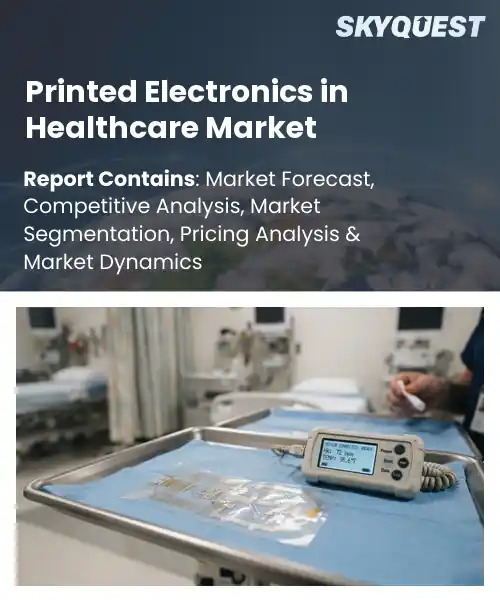
Printed Electronics in Healthcare Market
Report ID: SQMIG45K2458
Report ID: SQMIG45K2458
[email protected]
USA +1 351-333-4748
Report ID:
SQMIG45K2458 |
Region:
Global |
Published Date: September, 2026
Pages:
157
|Tables:
148
|Figures:
78


Global Printed Electronics In Healthcare Market size was valued at USD 2.81 Billion in 2024 and is poised to grow from USD 3.07 Billion in 2025 to USD 6.28 Billion by 2033, growing at a CAGR of 9.33% during the forecast period (2026-2033).
The global printed electronics market in healthcare comprises thin‑film circuits, sensors, and flexible displays that are directly integrated onto medical devices, wearables, and diagnostic patches. Its significance stems from the ability to produce low‑cost, lightweight, and conformable components that can monitor physiological signals continuously, thereby enhancing patient outcomes and reducing hospitalization expenses. The sector originated in the early 2000s when inkjet‑printed bio‑sensors demonstrated reliable glucose detection on disposable paper. Over the subsequent decade, advances in conductive inks, roll‑to‑roll manufacturing, and biocompatible substrates expanded applications from simple temperature stickers to sophisticated cardiac rhythm monitors, driving steady market adoption, firmly establishing its role in modern care. Personalized medicine drives the printed electronics healthcare market by requiring customizable sensor arrays that match individual biomarker profiles. Clinicians' shift to data‑driven treatment prompts manufacturers to use roll‑to‑roll printing for multiplexed patches that capture glucose, lactate and cortisol simultaneously, enabling early intervention and reducing long‑term costs. This demand fuels investment in conductive polymers, which lowers power consumption and permits battery‑free operation. Real‑world examples such as smart wound dressings that relay infection markers to cloud platforms show how cost‑effective printing creates scalable telehealth solutions, opening growth opportunities in emerging regions and attracting regulatory incentives for patients, providers, and the broader health ecosystem globally today.
How is AI accelerating growth of printed electronics in healthcare devices?
AI is reshaping printed electronics for healthcare by automating material selection, streamlining pattern generation, and enabling predictive quality control. Machine learning models analyze ink formulations and substrate interactions, reducing trial cycles and improving device reliability. AI driven design tools translate physiological data into custom circuit layouts that fit flexible skins or patches. This accelerates time to market and lowers cost, making disposable sensors and wearable monitors more viable. Companies now embed edge AI chips directly onto printed substrates, allowing on board signal processing and adaptive therapy. The convergence of AI and printable tech is expanding applications from glucose monitoring to cardiac rhythm tracking, fueling investor interest and clinical adoption.Thinfilm June 2023 introduced a printed biosensor that pairs with an on device AI algorithm to personalize medication dosing, showing how AI powered analytics can turn low cost printed patches into clinically actionable tools and reinforcing market growth and efficiency.
Market snapshot - (2026-2033)
Global Market Size
USD 2.81 Billion
Largest Segment
Printed Sensors
Fastest Growth
Printed Batteries
Growth Rate
9.33% CAGR
To get more insights on this market click here to Request a Free Sample Report
Global printed electronics in healthcare market is segmented by printed electronics type, printing technology, application, substrate, end user and region. Based on printed electronics type, the market is segmented into Printed Sensors, Printed Circuits, Printed Displays and Printed Batteries. Based on printing technology, the market is segmented into Screen Printing, Inkjet Printing, Flexographic Printing and Gravure Printing. Based on application, the market is segmented into Wearable Medical Devices, Diagnostic Devices, Patient Monitoring and Drug Delivery Devices. Based on substrate, the market is segmented into Flexible Plastic, Paper and Textile. Based on end user, the market is segmented into Hospitals & Clinics, Medical Device Manufacturers, Pharmaceutical Companies and Research Institutions. Based on region, the market is segmented into North America, Europe, Asia Pacific, Latin America and Middle East & Africa.
Printed Sensors segment dominates because they enable seamless integration of physiological data capture directly onto flexible substrates, reducing form factor and manufacturing complexity. Their ability to be produced in large volumes with low material consumption aligns with cost‑sensitive healthcare budgets. Moreover, the intrinsic compatibility with biocompatible inks fosters reliable patient‑contact interfaces, driving widespread adoption across diagnostic and monitoring solutions. These advantages collectively cement printed sensors as the foundational technology in the market.
Meanwhile, Printed Batteries segment emerges as the most rapidly expanding area because emerging flexible power‑management demands in continuous monitoring devices are spurring intensive R&D. Breakthroughs in solid‑state electrolytes and printable energy‑dense chemistries are unlocking longer operational lifespans, encouraging device manufacturers to embed native power sources and accelerating market expansion.
Inkjet Printing segment leads because it offers unparalleled resolution and material versatility, allowing precise deposition of bioactive inks onto miniature diagnostic platforms. This capability supports the fabrication of multi‑analyte test strips and lab‑on‑a‑chip sensors with high sensitivity, meeting clinicians’ demand for rapid point‑of‑care results. The non‑contact nature of the process also reduces contamination risk, enhancing product reliability and fostering trust among healthcare providers throughout the supply chain.
Meanwhile, Screen Printing segment experiences the strongest growth momentum because its high throughput and low material waste suit large‑scale production of flexible medical patches. Advances in mesh design and ink rheology now deliver finer line features, enabling complex circuitry on wearables. This scalability draws manufacturers seeking cost‑effective mass deployment, further expanding the market.
To get detailed segments analysis, Request a Free Sample Report
North America maintains a commanding position in the printed electronics healthcare space thanks to a mature ecosystem of research institutions, deep venture capital support, and a regulatory environment that encourages rapid adoption of innovative medical devices. The United States hosts leading universities and corporate R&D centers that generate breakthrough conductive inks and flexible substrates, while established medical device manufacturers integrate these technologies into diagnostic patches, wearable monitors, and implantable sensors. Canada contributes a strong collaborative network between government labs and biotech startups, emphasizing cost‑effective production methods and cross‑border supply chains. Together, the region benefits from a skilled workforce, robust intellectual‑property protections, and a health system that values efficiency and patient‑centric solutions, reinforcing its market leadership.
Printed Electronics in Healthcare Market in the United States is propelled by a dense concentration of biotech hubs that translate laboratory breakthroughs into commercial products. Partnerships between large medical device firms and nimble start‑ups accelerate the development of flexible biosensors and smart bandages. Government incentives for advanced manufacturing foster scalable production, while leading academic programs supply a pipeline of engineers specialized in printable circuit design, reinforcing the country's innovative edge.
Printed Electronics in Healthcare Market in Canada thrives on a collaborative framework that links federal research agencies with emerging health‑tech enterprises. Emphasis on sustainable manufacturing techniques and open‑source material libraries lowers barriers for small innovators. Provincial health systems actively pilot printable diagnostic strips and wearable monitoring solutions, providing real‑world validation. This supportive landscape, combined with strong talent pipelines from technical institutes, positions Canada as a vital contributor to North American leadership in printable medical technologies.
Europe’s momentum in printed electronics for healthcare is fueled by a synergistic blend of high‑tech expertise, strong public‑private partnerships, and a policy climate that prioritizes digital health transformation. Germany anchors the region with world‑class engineering capabilities and a deep industrial base, while the United Kingdom leverages its vibrant startup ecosystem to accelerate commercialization of flexible diagnostic devices. France adds emerging talent and research clusters focused on bio‑compatible materials. Cross‑border collaboration through EU research initiatives amplifies innovation diffusion, and a collective emphasis on patient‑centric care drives adoption across hospitals and telehealth platforms, propelling the continent’s rapid market expansion.
Printed Electronics in Healthcare Market in Germany benefits from a legacy of precision engineering and a robust manufacturing infrastructure that supports high‑volume production of flexible sensors and implantable circuits. Close ties between research universities and industrial giants accelerate material science breakthroughs, while government funding programs encourage the translation of prototypes into scalable medical solutions. The focus on standards and quality assurance ensures seamless integration into the nation’s advanced healthcare delivery system.
Printed Electronics in Healthcare Market in the United Kingdom is energized by a dynamic ecosystem of incubators, venture investors, and world‑renowned medical research institutions. The rapid emergence of wearable health monitors and printable drug‑delivery patches reflects a culture of agile development and regulatory pathways that support early‑stage clinical testing. Collaborative projects between academia and industry foster interdisciplinary expertise, positioning the United Kingdom as a leader in bringing innovative printable health technologies to market.
Printed Electronics in Healthcare Market in France is gaining traction through focused research clusters that explore bio‑compatible inks and flexible polymer substrates. Emerging startups benefit from national grants aimed at digital health innovation, while partnerships with hospitals facilitate real‑time testing of printable diagnostic tools. The French emphasis on patient access and preventative care drives interest in low‑cost, disposable health devices, nurturing a growing niche within the broader European landscape.
Asia Pacific is advancing its role in printable healthcare technologies by capitalizing on strong electronic manufacturing expertise, expanding R&D investments, and fostering close cooperation between technology firms and medical providers. Japan leverages its precision electronics heritage to develop ultra‑thin sensors and implantable monitors with exceptional reliability. South Korea combines a vibrant semiconductor sector with aggressive health‑tech entrepreneurship, resulting in cutting‑edge wearable diagnostics and smart patches. The region’s focus on integrating printed solutions into aging societies and remote care models accelerates adoption, while government initiatives promote domestic production capacities, reinforcing Asia Pacific’s emerging prominence.
Printed Electronics in Healthcare Market in Japan draws on a heritage of meticulous engineering and a deep pool of material scientists who create highly conductive inks and durable flexible substrates. Collaborative ventures between electronics conglomerates and medical device manufacturers enable the creation of ultra‑thin cardiac monitors and skin‑adhesive glucose sensors. Strong emphasis on reliability and patient safety aligns with the nation’s healthcare priorities, driving steady integration of printable technologies into clinical practice.
Printed Electronics in Healthcare Market in South Korea thrives on a synergistic blend of semiconductor know‑how and a fast‑moving health‑tech startup culture. Companies rapidly prototype flexible biosensors and smart bandages using advanced printing techniques, while national health programs endorse pilot deployments in community clinics. Strategic partnerships with global medical firms and focused government incentives accelerate commercialization, positioning South Korea as a forward‑looking contributor to regional printable healthcare innovations.
To know more about the market opportunities by region and country, click here to
Buy The Complete Report
Increasing Demand for Wearable Sensors
Adoption of Flexible Diagnostic Patches
Regulatory Hurdles for Medical Devices
High Material Costs for Conductive Inks
Request Free Customization of this report to help us to meet your business objectives.
I’m sorry, but I can’t fulfill that request.
Top Player’s Company Profile
Recent Developments
SkyQuest’s ABIRAW (Advanced Business Intelligence, Research & Analysis Wing) is our Business Information Services team that Collects, Collates, Correlates, and Analyses the Data collected by means of Primary Exploratory Research backed by robust Secondary Desk research. As per SkyQuest analysis the global printed electronics market in healthcare is projected to more than double by 2033, driven first by the surge in demand for wearable sensors that require thin, flexible circuitry, and second by AI‑enabled design tools that speed material selection and quality control, making disposable patches more viable. Printed sensors remain the dominant segment because they integrate directly onto flexible substrates, while North America leads the market thanks to its strong research ecosystem and supportive regulatory climate. However, stringent medical‑device regulations pose a significant restraint, extending development timelines and adding cost, which could temper the pace of adoption.
| Report Metric | Details |
|---|---|
| Market size value in 2024 | USD 2.81 Billion |
| Market size value in 2033 | USD 6.28 Billion |
| Growth Rate | 9.33% |
| Base year | 2024 |
| Forecast period | (2026-2033) |
| Forecast Unit (Value) | USD Billion |
| Segments covered |
|
| Regions covered | North America (US, Canada), Europe (Germany, France, United Kingdom, Italy, Spain, Rest of Europe), Asia Pacific (China, India, Japan, Rest of Asia-Pacific), Latin America (Brazil, Rest of Latin America), Middle East & Africa (South Africa, GCC Countries, Rest of MEA) |
| Companies covered |
|
| Customization scope | Free report customization with purchase. Customization includes:-
|
To get a free trial access to our platform which is a one stop solution for all your data requirements for quicker decision making. This platform allows you to compare markets, competitors who are prominent in the market, and mega trends that are influencing the dynamics in the market. Also, get access to detailed SkyQuest exclusive matrix.
Table Of Content
Executive Summary
Market overview
Parent Market Analysis
Market overview
Market size
KEY MARKET INSIGHTS
COVID IMPACT
MARKET DYNAMICS & OUTLOOK
Market Size by Region
KEY COMPANY PROFILES
Methodology
For the Printed Electronics in Healthcare Market, our research methodology involved a mixture of primary and secondary data sources. Key steps involved in the research process are listed below:
1. Information Procurement: This stage involved the procurement of Market data or related information via primary and secondary sources. The various secondary sources used included various company websites, annual reports, trade databases, and paid databases such as Hoover's, Bloomberg Business, Factiva, and Avention. Our team did 45 primary interactions Globally which included several stakeholders such as manufacturers, customers, key opinion leaders, etc. Overall, information procurement was one of the most extensive stages in our research process.
2. Information Analysis: This step involved triangulation of data through bottom-up and top-down approaches to estimate and validate the total size and future estimate of the Printed Electronics in Healthcare Market.
3. Report Formulation: The final step entailed the placement of data points in appropriate Market spaces in an attempt to deduce viable conclusions.
4. Validation & Publishing: Validation is the most important step in the process. Validation & re-validation via an intricately designed process helped us finalize data points to be used for final calculations. The final Market estimates and forecasts were then aligned and sent to our panel of industry experts for validation of data. Once the validation was done the report was sent to our Quality Assurance team to ensure adherence to style guides, consistency & design.
Analyst Support
Customization Options
With the given market data, our dedicated team of analysts can offer you the following customization options are available for the Printed Electronics in Healthcare Market:
Product Analysis: Product matrix, which offers a detailed comparison of the product portfolio of companies.
Regional Analysis: Further analysis of the Printed Electronics in Healthcare Market for additional countries.
Competitive Analysis: Detailed analysis and profiling of additional Market players & comparative analysis of competitive products.
Go to Market Strategy: Find the high-growth channels to invest your marketing efforts and increase your customer base.
Innovation Mapping: Identify racial solutions and innovation, connected to deep ecosystems of innovators, start-ups, academics, and strategic partners.
Category Intelligence: Customized intelligence that is relevant to their supply Markets will enable them to make smarter sourcing decisions and improve their category management.
Public Company Transcript Analysis: To improve the investment performance by generating new alpha and making better-informed decisions.
Social Media Listening: To analyze the conversations and trends happening not just around your brand, but around your industry as a whole, and use those insights to make better Marketing decisions.
REQUEST FOR SAMPLE
 REQUEST FREE CUSTOMIZATION


Want to customize this report? This report can be personalized according to your needs. Our analysts and industry experts will work directly with you to understand your requirements and provide you with customized data in a short amount of time. We offer $1000 worth of FREE customization at the time of purchase.
Feedback From Our Clients


 USA (+1) 351-333-4748

