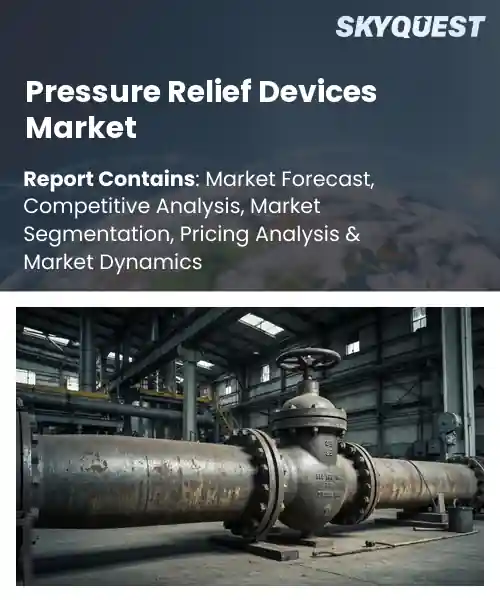
Pressure Relief Devices Market
Report ID: SQMIG35A3681
Report ID: SQMIG35A3681
[email protected]
USA +1 351-333-4748
Report ID:
SQMIG35A3681 |
Region:
Global |
Published Date: June, 2026
Pages:
157
|Tables:
153
|Figures:
78


Global Pressure Relief Devices Market size was valued at USD 4.2 Billion in 2024 and is poised to grow from USD 4.45 Billion in 2025 to USD 7.1 Billion by 2033, growing at a CAGR of 6.0% during the forecast period (2026-2033).
The primary driver of the pressure relief devices market is the intensifying regulatory and process safety environment that compels operators to prevent overpressure incidents and environmental releases. Pressure relief devices, which include safety valves and rupture discs, act as last line protection in chemical plants, oil and gas facilities and power stations because failures can cause catastrophic loss of life, asset damage and fines. Over decades the market has moved from basic mechanical relief solutions to engineered units with improved material resistance and formal certification programs, with incident driven regulation and insurer requirements accelerating upgrades and compliance across global regions.
Intensified regulation and asset modernisation pressures, the standout growth factor in the global pressure relief devices market is digitalisation. When operators equip safety valves with sensors and diagnostics they shift from calendar based maintenance to condition based intervention, thereby reducing unplanned shutdowns and extending equipment life. For example refineries fitted wireless valve monitors reported lower maintenance hours and avoided outages, which spurred adoption of smart valves integrated with cloud analytics. That cause and effect dynamic creates openings for retrofits, subscription monitoring and OEM software partnerships as industrialisation across Asia Pacific increases demand for digitally enabled protection and compliance.
How is IoT enhancing safety and monitoring in the pressure relief devices market?
IoT is transforming safety and monitoring for pressure relief devices by providing continuous sensing and real time telemetry that link field valves to central monitoring systems. Key aspects include smart sensors for valve position and pressure trends cloud analytics for anomaly detection and remote diagnostics that enable condition based maintenance. This shifts the market from scheduled manual checks to proactive risk management. Integration with control systems and digital twins gives operators richer context for incidents and clearer audit trails. In sectors such as oil and gas chemical processing and water utilities these capabilities improve reliability and make compliance and incident response faster and more transparent.
Emerson May 2026, launched the Synchros IIoT platform with wireless pressure sensing and asset health tools showing how connected valves and edge telemetry speed fault detection and guide prescriptive maintenance. This innovation helps operators reduce unplanned outages and supports wider adoption of smart pressure relief solutions.
Market snapshot - (2026-2033)
Global Market Size
USD 4.2 Billion
Largest Segment
Mattresses
Fastest Growth
Mattresses
Growth Rate
6.0% CAGR
To get more insights on this market click here to Request a Free Sample Report
Global pressure relief devices market is segmented by product type, technology, application, end user, distribution channel and region. Based on product type, the market is segmented into Mattresses, Cushions, Beds, Overlays and Others. Based on technology, the market is segmented into Low Air Loss Devices, Alternating Pressure Devices, Foam-Based Devices, Air Fluidized Devices and Others. Based on application, the market is segmented into Pressure Ulcer Prevention, Pressure Ulcer Treatment, Postoperative Care, Long-Term Care and Others. Based on end user, the market is segmented into Hospitals, Long-Term Care Centers, Home Healthcare, Rehabilitation Centers and Others. Based on distribution channel, the market is segmented into Direct Sales, Medical Distributors, Online Sales and Others. Based on region, the market is segmented into North America, Europe, Asia Pacific, Latin America and Middle East & Africa.
Mattresses segment dominates because they provide comprehensive pressure redistribution solutions that integrate easily into clinical workflows and span both prevention and treatment needs. Familiarity among clinicians and procurement teams, broad device compatibility, and the ability to incorporate advanced features like airflow and zonal support drive institutional adoption. Their versatility across care settings and perceived clinical efficacy leads to preferential purchasing, creating entrenched demand and manufacturer focus.
However, overlays are emerging as the most rapidly expanding product type, driven by portability, lower capital barriers and ease of retrofitting onto existing beds. Innovations in alternating pressure designs and lightweight materials broaden home and post-acute adoption, while payer and provider preference for cost-effective solutions accelerates demand and enables quicker market penetration.
Alternating Pressure Devices segment dominates because their cyclic redistribution of interface pressure aligns with established clinical protocols for pressure ulcer prevention and treatment, earning strong clinician trust. Reliability, compatibility with diverse patient conditions and the maturity of pump and mattress technologies simplify procurement and maintenance, driving adoption in institutional settings. Ongoing manufacturer investment in durability and service support further entrenches alternating pressure options as primary therapeutic choices across care pathways.
Meanwhile, low air loss devices are experiencing the strongest growth as advancements in microclimate control and patient comfort boost clinical adoption. Integration with sensor-driven pressure regulation and quieter, energy-efficient blowers expands use into long-term and home settings, driving investment, innovation, and creation of service models that open new commercial opportunities.
To get detailed segments analysis, Request a Free Sample Report
Asia Pacific dominates the global pressure relief devices market due to a combination of strong industrial demand, concentrated manufacturing capabilities and proactive regulatory engagement. Rapid expansion of process industries and energy infrastructures in key economies has created sustained need for safety and compliance solutions, while local manufacturers have scaled production and product portfolios to meet diverse applications. Regional supply chains enable competitive sourcing and export orientation, and strategic clustering of suppliers supports rapid innovation and customization. Governments and industry stakeholders emphasize risk management and equipment standardization, driving adoption of certified relief devices. Additionally, a growing service ecosystem for installation, testing and aftermarket support reinforces market resilience, enabling the region to lead in both volume and technological breadth within the global landscape.
Pressure Relief Devices Market in Japan benefits from engineering precision, strong manufacturing capabilities and alignment with industrial standards. High emphasis on reliability and operational certification encourages adoption of precision relief solutions across power, chemical and maritime sectors. Strong position in technology development and rigorous inspection regimes supports demand for high-specification devices, while established service networks provide robust testing, maintenance and customization for risk-averse industrial operators.
Pressure Relief Devices Market in South Korea is driven by a robust industrial base encompassing shipbuilding, petrochemical, power and high-tech manufacturing, creating diverse application requirements. Domestic suppliers emphasize compact, high-performance designs and integration with control systems to suit automated plants. Focused regulatory oversight and collaborative R&D with academia and global OEMs accelerate product refinement. Strong logistics and service capabilities support deployment, certification and aftermarket support, reinforcing adoption among industrial operators.
North America is experiencing rapid expansion in the pressure relief devices market driven by a convergence of stringent safety regulations, extensive industrial maintenance programs and a strong emphasis on operational integrity. Mature oil and gas, chemical processing and refining sectors demand reliable, certified relief solutions, while utilities and industrial manufacturers invest in modernization and risk reduction. Established aftermarket and engineering service networks facilitate retrofitting and testing, increasing penetration of advanced valve technologies and customized assemblies. Close collaboration between technology providers and end users accelerates adoption of condition monitoring and integrated safety architectures. Supply chain depth and a large base of experienced OEMs and service specialists enable responsive delivery and technical support, consolidating North America position as a key market for high-value relief device solutions.
Pressure Relief Devices Market in United States is characterized by demand from refining, petrochemical, power and manufacturing sectors that prioritize certified safety solutions and lifecycle management. Emphasis on compliance, regular inspection and retrofitting supports uptake of premium relief valves and skid-mounted assemblies. Strong presence of OEMs, integrators and specialized service providers enables rapid customization and testing, while investments in digital diagnostics and predictive maintenance enhance operational reliability for industrial assets.
Pressure Relief Devices Market in Canada reflects demand from oil and gas, mining and processing sectors where ruggedness and resilience are prioritized. Operators seek certified devices suited to cold climates and sites, prompting suppliers to offer reinforced designs and service support. Strong ties with regional OEMs and engineering firms facilitate tailored solutions and aftermarket testing. Emphasis on safety, inspection and maintenance drives uptake of reliable relief devices across diverse applications.
Europe is strengthening its position in the pressure relief devices market through a combination of regulatory harmonization, industry collaboration and technological specialization. Established manufacturers leverage deep engineering expertise to produce high-quality, standardized solutions that meet stringent safety and conformity requirements across multiple sectors, including chemical, energy and maritime. Emphasis on equipment reliability and traceable certification drives replacement and retrofitting activity, while service providers offer comprehensive testing, calibration and lifecycle management. Cross-border supply chains and strategic partnerships facilitate knowledge transfer and scalable production, and continued investment in valve design, materials and integration with monitoring systems enhances competitiveness. Active research clusters and cooperation with certification bodies further accelerate material innovation and lifecycle optimization across industry segments.
Pressure Relief Devices Market in Germany benefits from engineering precision, strong manufacturing capabilities and alignment with industrial standards. Demand from chemical processing, power generation and manufacturing sectors fosters development of high-integrity relief solutions and modular assemblies. Close collaboration among OEMs, inspection bodies and engineering firms underpins rigorous testing, certification and lifecycle services. Focus on quality and process integration enables suppliers to serve industrial users and international markets with advanced offerings.
Pressure Relief Devices Market in United Kingdom draws on expertise in offshore energy and maritime engineering, creating demand for robust, certified relief solutions. Integration with platform safety systems and modular plant designs encourages use of compact devices. Engineering consultancies and certification bodies play a pivotal role in specification and testing, while manufacturers focus on innovation in materials and control integration. Export orientation supports adoption of UK relief technologies and services.
Pressure Relief Devices Market in France is shaped by strong chemical, energy and manufacturing sectors that prioritize safety and conformity. Domestic manufacturers and engineering firms develop tailored relief solutions suited to refinery, processing and power applications, supported by rigorous inspection and certification services. Collaboration between research organizations and suppliers fosters material innovation. Established service networks provide installation, testing and maintenance, enabling consistent application of certified devices across diverse industrial operations.
To know more about the market opportunities by region and country, click here to
Buy The Complete Report
Rising Industrial Safety Requirements
Technological Innovation and Reliability
High Initial Capital Investment
Technical Complexity and Skilled Personnel
Request Free Customization of this report to help us to meet your business objectives.
Competition in the global pressure relief devices market is defined by incumbent consolidation and product differentiation. Incumbents pursue digital retrofit and aftermarket services to defend share. Recent vendor tactics include IoT-enabled pilot valves and targeted product launches by manufacturers to win brownfield upgrades. Market leaders also compete via regional acquisitions and specialist partnerships to add compliance and field-service capabilities.
Top Player’s Company Profile
Recent Developments
SkyQuest’s ABIRAW (Advanced Business Intelligence, Research & Analysis Wing) is our Business Information Services team that Collects, Collates, Correlates, and Analyses the Data collected by means of Primary Exploratory Research backed by robust Secondary Desk research. As per SkyQuest analysis, the global pressure relief devices market is being driven primarily by rising industrial safety requirements that push operators to upgrade protection and comply with stricter regulations, while a significant restraint remains the high initial capital investment needed for advanced devices and integrations. Asia Pacific emerges as the dominating region due to strong industrial expansion, concentrated manufacturing and service ecosystems, and mattresses are the dominating product segment given their broad clinical acceptance and versatility. A secondary driver is rapid digitalisation and IoT-enabled monitoring that enables condition based maintenance, lowers unplanned outages and opens retrofit and service revenue opportunities.
| Report Metric | Details |
|---|---|
| Market size value in 2024 | USD 4.2 Billion |
| Market size value in 2033 | USD 7.1 Billion |
| Growth Rate | 6.0% |
| Base year | 2024 |
| Forecast period | (2026-2033) |
| Forecast Unit (Value) | USD Billion |
| Segments covered |
|
| Regions covered | North America (US, Canada), Europe (Germany, France, United Kingdom, Italy, Spain, Rest of Europe), Asia Pacific (China, India, Japan, Rest of Asia-Pacific), Latin America (Brazil, Rest of Latin America), Middle East & Africa (South Africa, GCC Countries, Rest of MEA) |
| Companies covered |
|
| Customization scope | Free report customization with purchase. Customization includes:-
|
To get a free trial access to our platform which is a one stop solution for all your data requirements for quicker decision making. This platform allows you to compare markets, competitors who are prominent in the market, and mega trends that are influencing the dynamics in the market. Also, get access to detailed SkyQuest exclusive matrix.
Table Of Content
Executive Summary
Market overview
Parent Market Analysis
Market overview
Market size
KEY MARKET INSIGHTS
COVID IMPACT
MARKET DYNAMICS & OUTLOOK
Market Size by Region
KEY COMPANY PROFILES
Methodology
For the Pressure Relief Devices Market, our research methodology involved a mixture of primary and secondary data sources. Key steps involved in the research process are listed below:
1. Information Procurement: This stage involved the procurement of Market data or related information via primary and secondary sources. The various secondary sources used included various company websites, annual reports, trade databases, and paid databases such as Hoover's, Bloomberg Business, Factiva, and Avention. Our team did 45 primary interactions Globally which included several stakeholders such as manufacturers, customers, key opinion leaders, etc. Overall, information procurement was one of the most extensive stages in our research process.
2. Information Analysis: This step involved triangulation of data through bottom-up and top-down approaches to estimate and validate the total size and future estimate of the Pressure Relief Devices Market.
3. Report Formulation: The final step entailed the placement of data points in appropriate Market spaces in an attempt to deduce viable conclusions.
4. Validation & Publishing: Validation is the most important step in the process. Validation & re-validation via an intricately designed process helped us finalize data points to be used for final calculations. The final Market estimates and forecasts were then aligned and sent to our panel of industry experts for validation of data. Once the validation was done the report was sent to our Quality Assurance team to ensure adherence to style guides, consistency & design.
Analyst Support
Customization Options
With the given market data, our dedicated team of analysts can offer you the following customization options are available for the Pressure Relief Devices Market:
Product Analysis: Product matrix, which offers a detailed comparison of the product portfolio of companies.
Regional Analysis: Further analysis of the Pressure Relief Devices Market for additional countries.
Competitive Analysis: Detailed analysis and profiling of additional Market players & comparative analysis of competitive products.
Go to Market Strategy: Find the high-growth channels to invest your marketing efforts and increase your customer base.
Innovation Mapping: Identify racial solutions and innovation, connected to deep ecosystems of innovators, start-ups, academics, and strategic partners.
Category Intelligence: Customized intelligence that is relevant to their supply Markets will enable them to make smarter sourcing decisions and improve their category management.
Public Company Transcript Analysis: To improve the investment performance by generating new alpha and making better-informed decisions.
Social Media Listening: To analyze the conversations and trends happening not just around your brand, but around your industry as a whole, and use those insights to make better Marketing decisions.
REQUEST FOR SAMPLE
 REQUEST FREE CUSTOMIZATION
Global Pressure Relief Devices Market size was valued at USD 4.2 Billion in 2024 and is poised to grow from USD 4.45 Billion in 2025 to USD 7.1 Billion by 2033, growing at a CAGR of 6.0% during the forecast period (2026-2033).
Competition in the global pressure relief devices market is defined by incumbent consolidation and product differentiation. Incumbents pursue digital retrofit and aftermarket services to defend share. Recent vendor tactics include IoT-enabled pilot valves and targeted product launches by manufacturers to win brownfield upgrades. Market leaders also compete via regional acquisitions and specialist partnerships to add compliance and field-service capabilities. 'Arjo AB', 'Hill-Rom Holdings, Inc.', 'Stryker Corporation', 'Invacare Corporation', 'Drive DeVilbiss Healthcare', 'Medline Industries, LP', 'Paramount Bed Holdings Co., Ltd.', 'LINET Group SE', 'Joerns Healthcare LLC', 'GF Health Products, Inc.', 'Talley Group Ltd.', 'EHOB, Inc.', 'Direct Healthcare Group', 'Permobil AB', 'Span-America Medical Systems, Inc.', 'Mölnlycke Health Care AB', 'Savaria Corporation', 'Novis Healthcare Pty Ltd', 'ROHO, Inc.', 'Wellell Inc.'
Pressure relief devices are increasingly specified by industries to meet stricter safety regulations, to protect personnel and equipment from overpressure events and to ensure continuity of operations. The emphasis on process safety management and corporate risk governance motivates facility upgrades and retrofits, prompting procurement of modern relief valves, rupture discs, and venting systems. Manufacturers respond with product availability and compliance support, easing adoption. This regulatory and safety driven procurement cycle directly fuels market expansion by creating sustained demand across petrochemical, power, and manufacturing sectors.
Iot Enabled Safety Integration: Manufacturers and end users increasingly prioritize integration of pressure relief devices with IoT platforms and sensor networks to enable real time monitoring, remote diagnostics and predictive alerts. This connectivity supports proactive safety management, seamless asset visibility across distributed operations and faster incident response while facilitating compliance with evolving industry standards. Demand for interoperable interfaces and cloud enabled analytics is driving design changes toward smarter valves and rupture discs that can communicate operational status and lifecycle needs to centralized maintenance systems.
Why does Asia Pacific Dominate the Global Pressure Relief Devices Market? |@12


Want to customize this report? This report can be personalized according to your needs. Our analysts and industry experts will work directly with you to understand your requirements and provide you with customized data in a short amount of time. We offer $1000 worth of FREE customization at the time of purchase.
Feedback From Our Clients


 USA (+1) 351-333-4748

