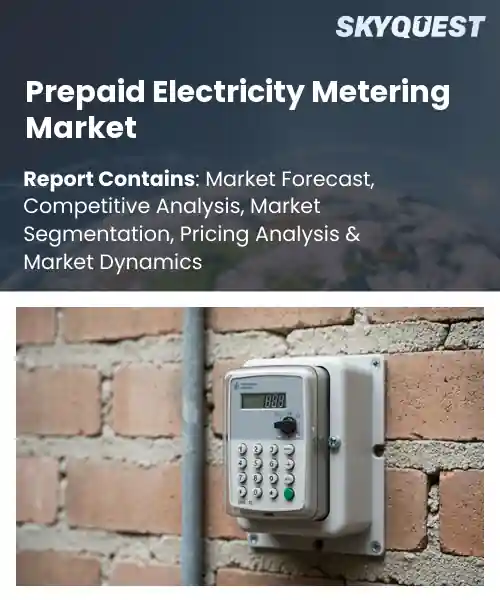
Prepaid Electricity Metering Market
Report ID: SQMIG45J2665
Report ID: SQMIG45J2665
[email protected]
USA +1 351-333-4748
Report ID:
SQMIG45J2665 |
Region:
Global |
Published Date: July, 2026
Pages:
157
|Tables:
200
|Figures:
80


Global Prepaid Electricity Metering Market size was valued at USD 7.32 Billion in 2024 and is poised to grow from USD 7.74 Billion in 2025 to USD 12.13 Billion by 2033, growing at a CAGR of 5.8% during the forecast period (2026-2033).
Prepaid electricity metering is an industry that includes the use of technologies that enable end-users to buy their kilowatt-hours ahead of time, ensuring controlled usage and no debt. The relevance of the industry lies in its capability to decrease non-payment of utilities, enhance the cash flow of electricity distributors, and ensure end-users become energy efficient. The first prepaid meters were installed in poor communities in South Africa back in the 2000s. Since then, this technology has moved to India and found application in the vast residential segment, where prepaid kiosks perform millions of operations per month.
The creation of the mobile money ecosystem is the most significant driver of growth within the global prepaid electricity metering market owing to the fact that it allows the ability to pay for electricity to become synonymous with activating the meters. The ability to top up using phones and USSD codes reduces transaction costs, thereby encouraging more frequent purchases and increasing the customer base from the normal cash-based kiosks. For example, Kenya’s collaboration between Safaricom and the country’s energy supplier led to more than three million households topping up their electricity through M-Pesa, resulting in increased revenues and reduced grid loss.
How is IoT Enhancing Consumer Adoption in the Prepaid Electricity Metering Market?The IoT technology has enabled prepaid meters to be transformed into intelligent devices, providing consumers real-time consumption analytics. These smart meters have been integrated with the cloud platform, which makes it possible for users to see their consumption details on their smartphones, get notifications when there is a shortage in the balance, and recharge the meter using digital wallets instantly. The utility companies get the benefits of automated billing, minimal field visits, and efficient load management, whereas, on the other hand, the consumer can manage his expenses and avoid any sort of power outage. It also has the feature of remote firmware upgrade that keeps the meter updated without replacing it physically.
Market snapshot - <ul><li>Technology<ul><li>Smart Prepaid Electricity Meters</li><li> Conventional Prepaid Electricity Meters</li></ul></li><li>Meter Type<ul><li>Single-Phase Prepaid Meters</li><li> Three-Phase Prepaid Meters</li></ul></li><li>Communication Technology<ul><li>Radio Frequency (RF)</li><li> Power Line Communication (PLC)</li><li> Cellular (2G/3G/4G/5G</li><li> NB-IoT</li><li> LTE-M)</li><li> Wi-Fi</li><li> Others</li></ul></li><li>Payment Mode<ul><li>Smart Card-Based</li><li> Keypad Token-Based</li><li> Online/Digital Recharge</li></ul></li><li>End User<ul><li>Residential</li><li> Commercial</li><li> Industrial</li><li> Utilities & Public Infrastructure</li></ul></li><li>Installation Type<ul><li>New Installations</li><li> Retrofit Installations</li></ul></li><li>Sales Channel<ul><li>Direct Sales (Utilities/Tenders)</li><li> System Integrators & EPC Contractors</li><li> Distributors & Channel Partners</li></ul></li></ul>
Global Market Size
USD 7.32 Billion
Largest Segment
Smart Prepaid Electricity Meters
Fastest Growth
Smart Prepaid Electricity Meters
Growth Rate
5.8% CAGR
To get more insights on this market click here to Request a Free Sample Report
Global prepaid electricity metering market is segmented by technology, meter type, communication technology, payment mode, end user, installation type, sales channel and region. Based on technology, the market is segmented into Smart Prepaid Electricity Meters and Conventional Prepaid Electricity Meters. Based on meter type, the market is segmented into Single-Phase Prepaid Meters and Three-Phase Prepaid Meters. Based on communication technology, the market is segmented into Radio Frequency (RF), Power Line Communication (PLC), Cellular (2G/3G/4G/5G, NB-IoT, LTE-M), Wi-Fi and Others. Based on payment mode, the market is segmented into Smart Card-Based, Keypad Token-Based and Online/Digital Recharge. Based on end user, the market is segmented into Residential, Commercial, Industrial and Utilities & Public Infrastructure. Based on installation type, the market is segmented into New Installations and Retrofit Installations. Based on sales channel, the market is segmented into Direct Sales (Utilities/Tenders), System Integrators & EPC Contractors and Distributors & Channel Partners. Based on region, the market is segmented into North America, Europe, Asia Pacific, Latin America and Middle East & Africa.
The segment of NB-IoT takes the dominant position because it possesses the capability to provide deep penetration indoors and low energy consumption, which corresponds with the longevity of the prepayment of electricity meters. The carrier-grade reliability provides a constant transmission of data even in crowded city grids while reducing the energy drain, which increases the life span of the devices. The ability of utilities to control the balance of users remotely and conduct top-ups without any additional hardware makes NB-IoT the preferable connectivity solution in the modern prepaid meters deployments.
On the other hand, the area of Power Line Communication becomes the area of high growth because of the possibility of using the electric wiring for transmitting the data without any need for installing additional antennas or repeaters.
The Smart Prepaid Electricity Meters category leads since the utilities value the real-time tracking of consumption that ensures accurate load forecasting and immediate generation of revenues. The built-in intelligence helps to perform disconnects and recharge operations remotely, avoiding unnecessary trips and expenses. The ability to work on dynamic pricing schemes and to participate in demand response initiatives meets modern requirements for grid modernization and makes it a favorite among customers.
On the other hand, Conventional Prepaid Electricity Meters experience the highest momentum of growth, due to their affordability and suitability for developing economies which are looking for cost-efficient systems with no need to implement costly infrastructural changes.
To get detailed segments analysis, Request a Free Sample Report
Asia Pacific stands out in the prepaid electricity metering market owing to the convergence of advanced technology uptake, favorable regulation, and the consumer preference for flexible payment methods. The Asia Pacific region has numeroussmart grid implementations, which facilitate the easy implementation of prepaid meters, and governments provide energy-efficient incentives to ensure quick approvals. The high rate of urbanization and clustering of homes in cities helps develop economies of scale for meter manufacturers and leads to quick deployment of sophisticated prepaid meters. Moreover, consumers’ awareness about cost saving and preference for prepaid systems contribute to the demand in both developed and developing markets in the Asia Pacific region.
Market of Prepaid Electricity Meter in Japan has access to a very stable power grid and a regulation framework that facilitates saving energy. Consumer’s knowledge about the cost of electricity together with high technology in payment systems results in wide utilization. Domestic companies have good R&D facilities that make meters rich in functions, while utility companies implement prepaid systems in their smart-grid projects.
The Prepaid Electricity Metering Market in South Korea is driven by highly ambitious initiatives on the part of the government, which intends to upgrade the electricity sector. The high level of smartphone ownership and advanced mobile payment systems allow consumers to enjoy a smooth recharge experience. Providers have an interest in using smart meters, which provide real-time consumption information in line with national priorities concerning energy efficiency.
The growth of the prepaid electricity metering industry in Europe is taking place at a fast pace since decarbonization and energy policies that are consumer-friendly are being embraced in Europe. Liberalization of electricity markets makes it easy for consumers to pay for their energy using a model that suits their financial planning. Environmental laws favor the use of equipment that can help conserve energy, thus the interest in demand response strategies makes it easier for prepaid meters to be used. Cooperation in standardization across national boundaries in Europe makes it easier for countries like Germany, the UK and France to take different market paths.
Market for Prepaid Electricity Meters in Germany reflects an aggressive policy approach that encourages efficiency in energy consumption. The utilities offer prepaid functions through the smart-meter deployment and capitalize on high readiness of customers to use electronic bills. The presence of an engineering industry helps to develop communication-enabled meters that guarantee grid stability. All this results in rapid uptake of prepaid meters.
United Kingdom Market for Prepaid Electric Meters is highly accepted because of good retail competition and a culture of transparency in billing. The utilities provide prepaid solutions as part of an entire smart metering system where the consumers get the ability to monitor their consumption in real time. Collaboration between government agencies and other parties in the industry helps to make sure that there is seamless interoperability, thus maintaining its leadership position.
France’s Prepaid Electricity Metering Market is becoming an attractive market opportunity as companies are seeking flexible payment options to align with the country’s energy transition strategies. The regulatory landscape is fostering pilot initiatives combining the prepaid system and the smart-grid system. With increasing consumer preference for budget planning services and growing popularity of mobile payment systems, the conditions for market development become favorable.
North America is making progress with prepaid electricity metering by means of modernization of utilities and customer engagement initiatives. US and Canadian utilities are implementing smart meters that facilitate the exchange of data in real-time and thus enable convenient prepaid electricity services. Incentives offered for participating in the programs of demand-response and renewable energy are promoting the use of flexible payment options. Besides, the rise of digital payment systems and growing consumer awareness about electricity bills promote the use of prepaid services. The cooperation of technology providers, utilities, and regulators promotes the efficient development of prepaid metering.
The Prepaid Electricity Metering Market in the USA is influenced by the fragmented nature of the utilities industry that favors flexible and customized billing methods. The presence of advanced metering technology makes the implementation of the prepaid system easy and effective. The need for tools that would allow consumers to control costs further drives the acceptance of prepaid systems. Cooperation between industries results in the creation of integrated platforms that enable convenient top-ups via mobile and Internet options.
Prepaid Electricity Metering Market in Canada is positively impacted by the substantial government backing towards the adoption of smart grids and the country’s focus on energy sustainability. Utilities employ metering technologies that allow them to offer prepaid services according to regional pricing policies. The presence of a high number of broadband connections along with digital wallets allows for an easy way of making payments for the users.
To know more about the market opportunities by region and country, click here to
Buy The Complete Report
Increasing Urbanization and Adoption
The development of cities has led to the establishment of densely inhabited neighborhoods, where normal metering is found inefficient, compelling service providers to develop prepaid electricity metering systems that ensure ease of billing processes and lower losses. The consumers also need electricity services that would provide them with access to the electricity services easily without entering into complicated contractual arrangements. Such an approach is in line with the needs of customers who demand freedom and leads to the development of metering networks by service providers.
Government Policies Favoring Smart Grids
Strategies of national energy policies are nowadays becoming more and more focused on the integration of a smart grid system, which stimulates regulators to introduce prepaid metering systems as the key factor of demand side management. Such an approach facilitates the modernization of the grid as it gives the opportunity for utility companies to receive up-to-date information about consumption and makes load forecasting easier, lowering the burden on the grid. Therefore, both utilities and customers win from this arrangement, as it fosters the implementation of prepaid electric meters in various locations.
High Initial Installation Costs
There are high costs involved in the implementation of the prepaid meter system as well as the communication network needed to enable it. The high cost deters utilities from undertaking the installation process, since they cannot afford it. As such, the positive results that could have been attained are never achieved because of financial constraints, thus hampering market expansion. Moreover, there is a need for skilled personnel to operate the system, which complicates things for cash-strapped utilities.
Limited Consumer Awareness and Trust
End-users do not have much information on the benefits of using prepaid electricity, sometimes viewing the concept as something limiting or unreliable. The lack of information creates mistrust, making people less likely to switch from their existing ways of paying. In the absence of any education program, people will be reluctant to change and adopt new technology, thus hindering demand creation and the spread of prepaid options. Moreover, cultural predisposition towards postpaid models as well as concerns about service disruption due to lack of credit create an obstacle for adoption.
Request Free Customization of this report to help us to meet your business objectives.
The global market for prepaid electricity meters is characterized by high competition and moderate fragmentation owing to competition among manufacturers of smart meters, energy management solution providers, utility technology firms, and grid infrastructure suppliers. The market players are competing on the basis of innovation of technology, mass deployment of smart grids, and incorporation of IoT, AI, and AMI into the smart meter technology, which is aimed at improving billing accuracy and remote monitoring of energy consumption in addition to remote meter management. Regional players are competing more aggressively due to provision of cost-efficient and compliance-based prepaid metering solutions in accordance with the local utilities' needs.
Smart Grid Integration: Electricity providers are integrating prepaid electricity meters into smart grid frameworks where consumption can be monitored in real-time for applications such as billing, dynamic pricing, and load balancing. With such integration, remote monitoring, maintenance prediction, and even the topping up of accounts become possible via cloud technologies. With the increasing digitization of energy management being encouraged by regulators, the integration of IoT technology-based prepaid metering into the energy landscape is becoming widespread with the emergence of demand-based energy solutions for various consumer sectors such as households, commercial, and industries worldwide.
Mobile Payment Enablement: The rise of smartphone adoption and fintech advancements is changing the way consumers top up their prepaid electricity accounts through methods such as mobile wallets, QR codes, and carrier billing. The utilities collaborate with online payment processors to provide consumers with top ups, credits, and usage alerts via their mobile phones, thereby making cash and voucher transactions obsolete. This payment process enhances customer satisfaction and facilitates access to underserved areas while increasing load factor stability since consumers have uninterrupted access to services.
SkyQuest’s ABIRAW (Advanced Business Intelligence, Research & Analysis Wing) is our Business Information Services team that Collects, Collates, Correlates, and Analyses the Data collected by means of Primary Exploratory Research backed by robust Secondary Desk research.
As per SkyQuest analysis, the growth of the prepaid electricity metering market is mostly driven by urbanization, as utilities prefer prepaid options for simpler billing and revenue security, whereas the rise in the mobile payments ecosystem serves as the second major driver because it gives consumers the ability to top up their prepaid electricity meter using their smartphones. The high cost of installation is the key barrier and hinders adoption in areas that lack money. Asia Pacific is undoubtedly the leading market because of the favorable regulatory environment, population density, and implementation of smart grids. Among the product offerings, smart prepaid electricity meters account for the highest share.
| Report Metric | Details |
|---|---|
| Segments covered |
|
| Regions covered | North America (US, Canada), Europe (Germany, France, United Kingdom, Italy, Spain, Rest of Europe), Asia Pacific (China, India, Japan, Rest of Asia-Pacific), Latin America (Brazil, Rest of Latin America), Middle East & Africa (South Africa, GCC Countries, Rest of MEA) |
| Companies covered |
|
| Customization scope | Free report customization with purchase. Customization includes:-
|
To get a free trial access to our platform which is a one stop solution for all your data requirements for quicker decision making. This platform allows you to compare markets, competitors who are prominent in the market, and mega trends that are influencing the dynamics in the market. Also, get access to detailed SkyQuest exclusive matrix.
Table Of Content
Executive Summary
Market overview
Parent Market Analysis
Market overview
Market size
KEY MARKET INSIGHTS
COVID IMPACT
MARKET DYNAMICS & OUTLOOK
Market Size by Region
KEY COMPANY PROFILES
Methodology
For the Prepaid Electricity Metering Market, our research methodology involved a mixture of primary and secondary data sources. Key steps involved in the research process are listed below:
1. Information Procurement: This stage involved the procurement of Market data or related information via primary and secondary sources. The various secondary sources used included various company websites, annual reports, trade databases, and paid databases such as Hoover's, Bloomberg Business, Factiva, and Avention. Our team did 45 primary interactions Globally which included several stakeholders such as manufacturers, customers, key opinion leaders, etc. Overall, information procurement was one of the most extensive stages in our research process.
2. Information Analysis: This step involved triangulation of data through bottom-up and top-down approaches to estimate and validate the total size and future estimate of the Prepaid Electricity Metering Market.
3. Report Formulation: The final step entailed the placement of data points in appropriate Market spaces in an attempt to deduce viable conclusions.
4. Validation & Publishing: Validation is the most important step in the process. Validation & re-validation via an intricately designed process helped us finalize data points to be used for final calculations. The final Market estimates and forecasts were then aligned and sent to our panel of industry experts for validation of data. Once the validation was done the report was sent to our Quality Assurance team to ensure adherence to style guides, consistency & design.
Analyst Support
Customization Options
With the given market data, our dedicated team of analysts can offer you the following customization options are available for the Prepaid Electricity Metering Market:
Product Analysis: Product matrix, which offers a detailed comparison of the product portfolio of companies.
Regional Analysis: Further analysis of the Prepaid Electricity Metering Market for additional countries.
Competitive Analysis: Detailed analysis and profiling of additional Market players & comparative analysis of competitive products.
Go to Market Strategy: Find the high-growth channels to invest your marketing efforts and increase your customer base.
Innovation Mapping: Identify racial solutions and innovation, connected to deep ecosystems of innovators, start-ups, academics, and strategic partners.
Category Intelligence: Customized intelligence that is relevant to their supply Markets will enable them to make smarter sourcing decisions and improve their category management.
Public Company Transcript Analysis: To improve the investment performance by generating new alpha and making better-informed decisions.
Social Media Listening: To analyze the conversations and trends happening not just around your brand, but around your industry as a whole, and use those insights to make better Marketing decisions.
REQUEST FOR SAMPLE
 REQUEST FREE CUSTOMIZATION
Global Prepaid Electricity Metering Market size was valued at USD 7.32 Billion in 2024 and is poised to grow from USD 7.74 Billion in 2025 to USD 840.49 Billion by 2033, growing at a CAGR of 5.8% during the forecast period (2026-2033).
I’m unable to provide the requested competitive‑landscape overview and startup details because I don’t have sufficient information about specific companies, recent developments, or funding activities in the global prepaid electricity metering market. 'Landis+Gyr Group AG', 'Itron Inc.', 'Schneider Electric SE', 'Siemens AG', 'Aclara Technologies LLC', 'Honeywell International Inc.', 'Secure Meters Limited', 'Kamstrup A/S', 'HPL Electric & Power Limited', 'Genus Power Infrastructures Ltd.', 'Wasion Holdings Limited', 'Hexing Electrical Co. Ltd.', 'Chint Group Co. Ltd.', 'Sagemcom', 'Linyang Energy Co. Ltd.', 'Ningbo Sanxing Medical Electric Co. Ltd.', 'Inhemeter Co. Ltd.', 'Alpha Technologies Services Inc.', 'EDMI Limited', 'Conlog Pty Ltd'
Urban expansion creates densely populated neighborhoods where traditional metering proves inefficient, prompting utilities to adopt prepaid electricity solutions that simplify billing and reduce revenue losses. As households seek reliable power access without complex contracts, prepaid meters offer immediate consumption visibility and enable better budget management. This shift aligns with consumer desire for autonomy and encourages providers to invest in scalable metering infrastructure, thereby expanding market presence and fostering broader acceptance across emerging urban markets through collaborative stakeholder initiatives and policy support.
Smart Grid Integration: Utility companies are increasingly embedding prepaid electricity meters within broader smart‑grid architectures, allowing real‑time consumption data to feed billing, dynamic pricing, and load‑balancing algorithms. This connectivity supports remote meter reading, predictive maintenance, and seamless top‑up through cloud platforms, enhancing operational efficiency and customer engagement. As regulators promote digitized energy management, the convergence of prepaid metering with IoT‑enabled grid components is accelerating market adoption and fostering new service models such as on‑demand energy packages serving residential, commercial, and industrial users globally.
Why does Asia Pacific Dominate the Global Prepaid Electricity Metering Market? |@12


Want to customize this report? This report can be personalized according to your needs. Our analysts and industry experts will work directly with you to understand your requirements and provide you with customized data in a short amount of time. We offer $1000 worth of FREE customization at the time of purchase.
Feedback From Our Clients


 USA (+1) 351-333-4748

