
Statcom Market
Report ID: SQMIG20E2148
Report ID: SQMIG20E2148
[email protected]
USA +1 351-333-4748
Report ID:
SQMIG20E2148 |
Region:
Global |
Published Date: August, 2025
Pages:
175
|Tables:
91
|Figures:
69


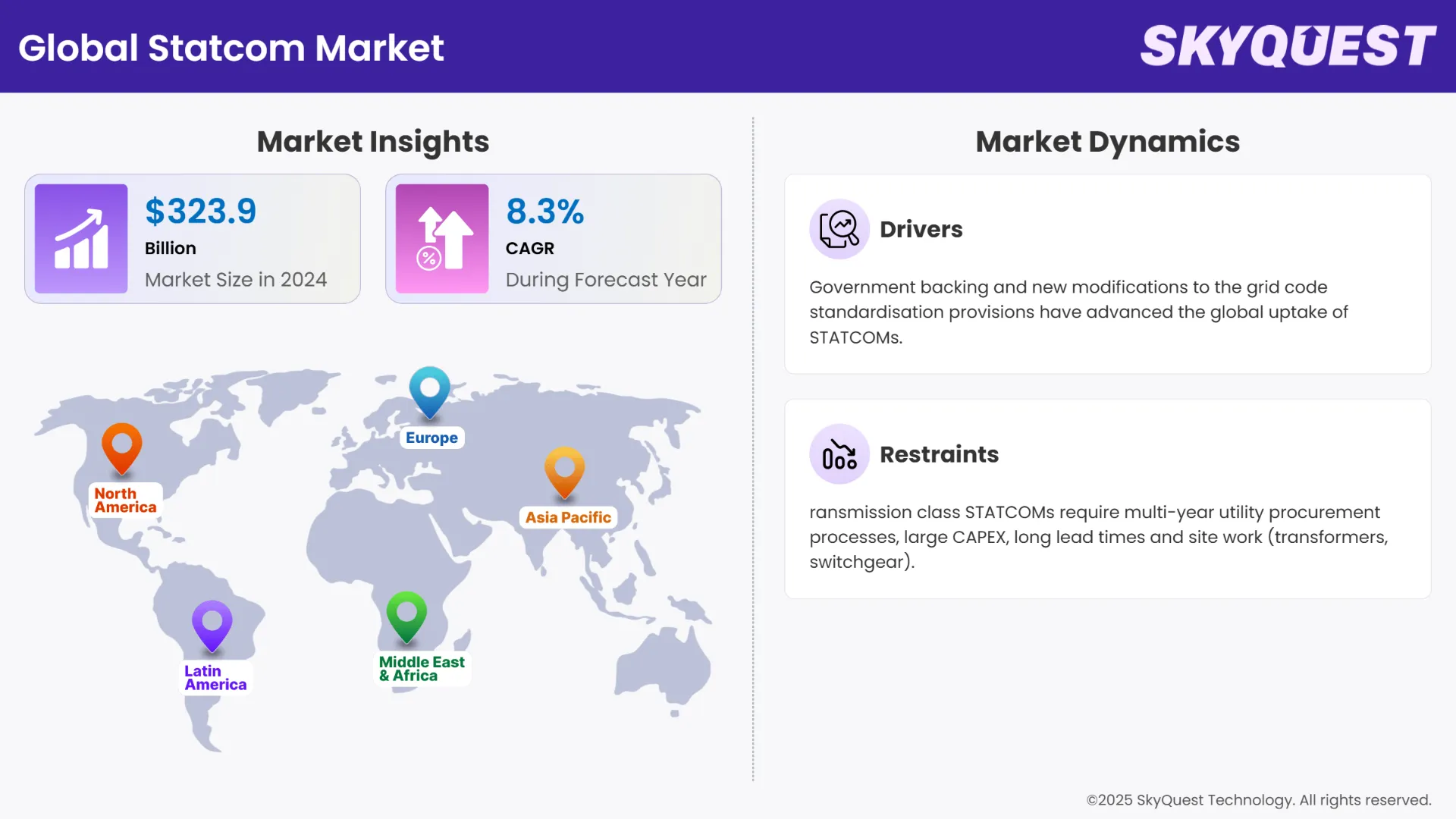
Global Statcom Market size was valued at USD 323.9 Billion in 2024 and is poised to grow from USD 350.78 Billion in 2025 to USD 663.85 Billion by 2033, growing at a CAGR of 8.3% in the forecast period (2026–2033).
The growing demand for STATCOM devices in high-voltage direct current systems for reactive current absorption and voltage regulation is driving the global statcom market growth. The product provides HVDC devices with the needed power stability and avoids commutation failures while connected to a weak AC system. Renewable energy adoption is predicted to skyrocket globally, creating new opportunities for industry players.
The two steady-state operating modes of traditional static synchronous compensator solutions, which are only useful at low frequencies, restrict the market. However, advancements in STATCOM technologies, like the introduction of hybrid STATCOMs to improve the stability of energy systems, will support the statcom industry growth.
Big data adoption is a major factor contributing in changing the global statcom market outlook in predictive maintenance, real-time control optimization, and advanced monitoring technologies. AI systems can predict equipment stress and create dynamic output changes in real time, based on measurements of voltage, frequency, and reactive power. For example, a GE STATCOM control system based on AI was introduced in 2025 and allowed for improvements in real-time optimization of the grid while providing the ability to compensate for dynamic reactive power returns that were faster than traditional systems. While this was still an experimental approach, this is a significant show of AI capabilities, and it demonstrates how integrating AI could minimize plant's downtime and lower disturbance on the grid while integrating renewable power sources. As AI development continues in the context of STATCOMs, it should continue to witness smarter and flexible grid support systems that enhance resiliency and operational efficiency globally.
To get more insights on this market click here to Request a Free Sample Report
The global statcom market is segmented into voltage, end user, application, and region. By voltage, the market is trifurcated into low, medium, and high. Depending on end user, it is divided into utility, steel manufacturing, renewable energy, mining, and hydrogen power plant. According to the application, the market is bifurcated into electricity networks and photovoltaic generation. Regionally, it is analyzed across North America, Europe, Asia-Pacific, Latin America, and the Middle East and Africa.
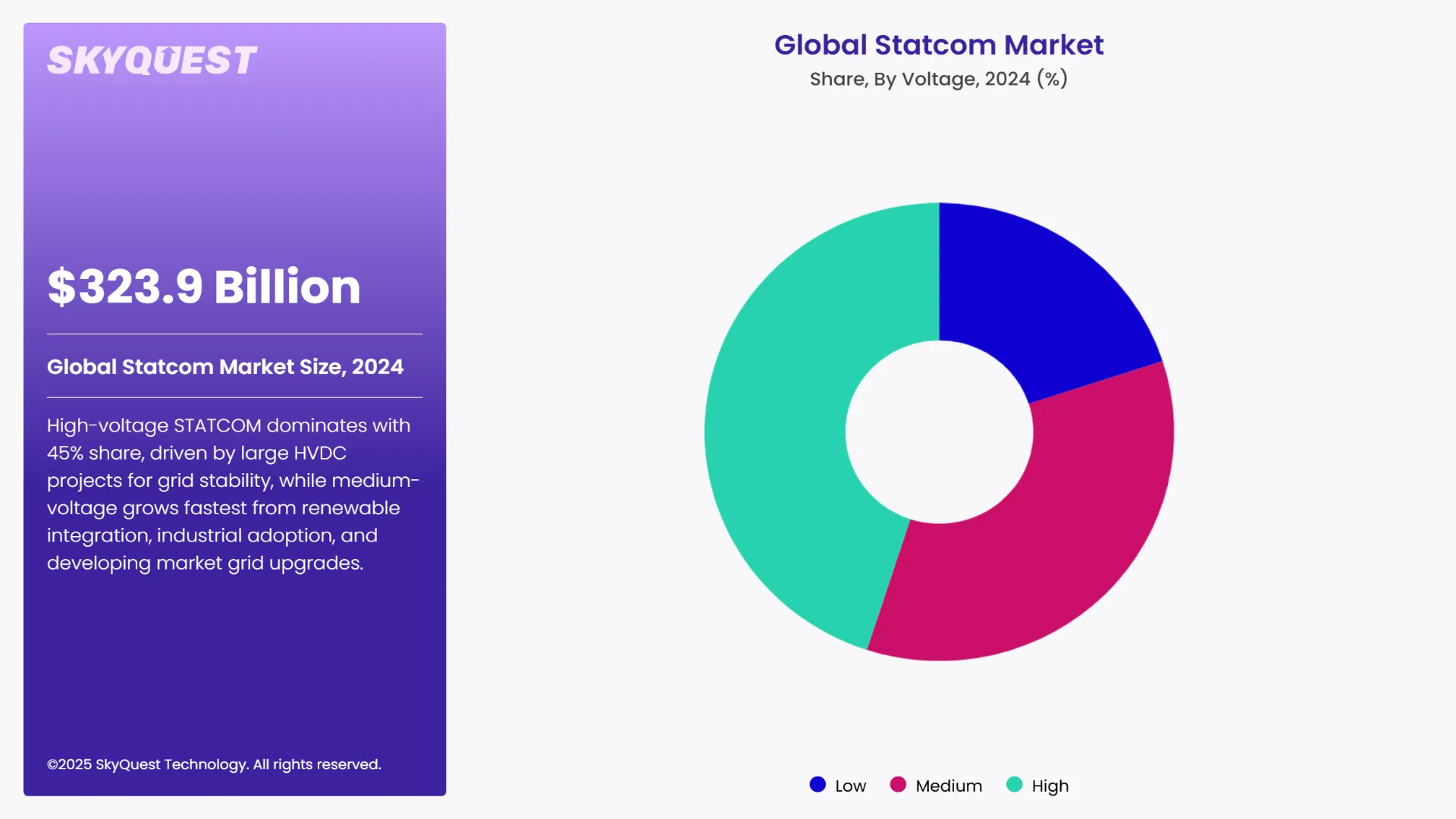
As per the 2024 statcom market analysis, in the coming years, it is anticipated that the high segment of the market will have a robust revenue share of 45%. This is due to grid stabilization solutions deployed in areas with high power demands. Several key players are working together to provide state-of-the-art high-voltage direct current. For instance, in April 2025, Adani Energy Solutions and Bharat Heavy Electricals Limited collaborated to construct a 6,000 MW +800 kV HVDC transmission line that would connect Bhadla, Rajasthan, and Fatehpur, Uttar Pradesh. By 2029, the nearly USD 3.0 billion investment is expected to be completed. The investment intends to improve grid stability in addition to promoting renewable energy from Rajasthan's Renewable Energy Zones.
The medium category of voltage is expected to experience substantial growth in the statcom sector. This increase can be partially attributed to the growing integration of renewable energy at the distribution level, which includes more industrial applications and the adoption of grid stabilization solutions in developing markets where medium-voltage systems are rapidly improving.
As per the 2024 statcom market forecast, the largest segment of the market is dominated by electrical networks that require compensated reactive power and voltage stability on large transmission systems. For example, India's Power Grid Corporation constructed several high capacity STATCOM units in northern transmission paths in 2024 in order to increase grid support and stability amid increasing demand for power. This segment of the market is structurally driven, owing to historic changes in grid modernization bringing the need for optimized demand response.
The photovoltaic generation industry is on the verge of unprecedented growth as solar capacity continues to deploy at new heights around the world. The benefits of STATCOMs for the grid integration process and as a means for managing voltage fluctuations from intermittent solar generation are discussed in detail. As evidence of a continuing and increasing integration of renewable energy into the electricity supply chain, Australia solar farms in Queensland commenced the installation of STATCOM systems in 2025 to facilitate more immediate integration and stabilize solar output.
To get detailed segments analysis, Request a Free Sample Report
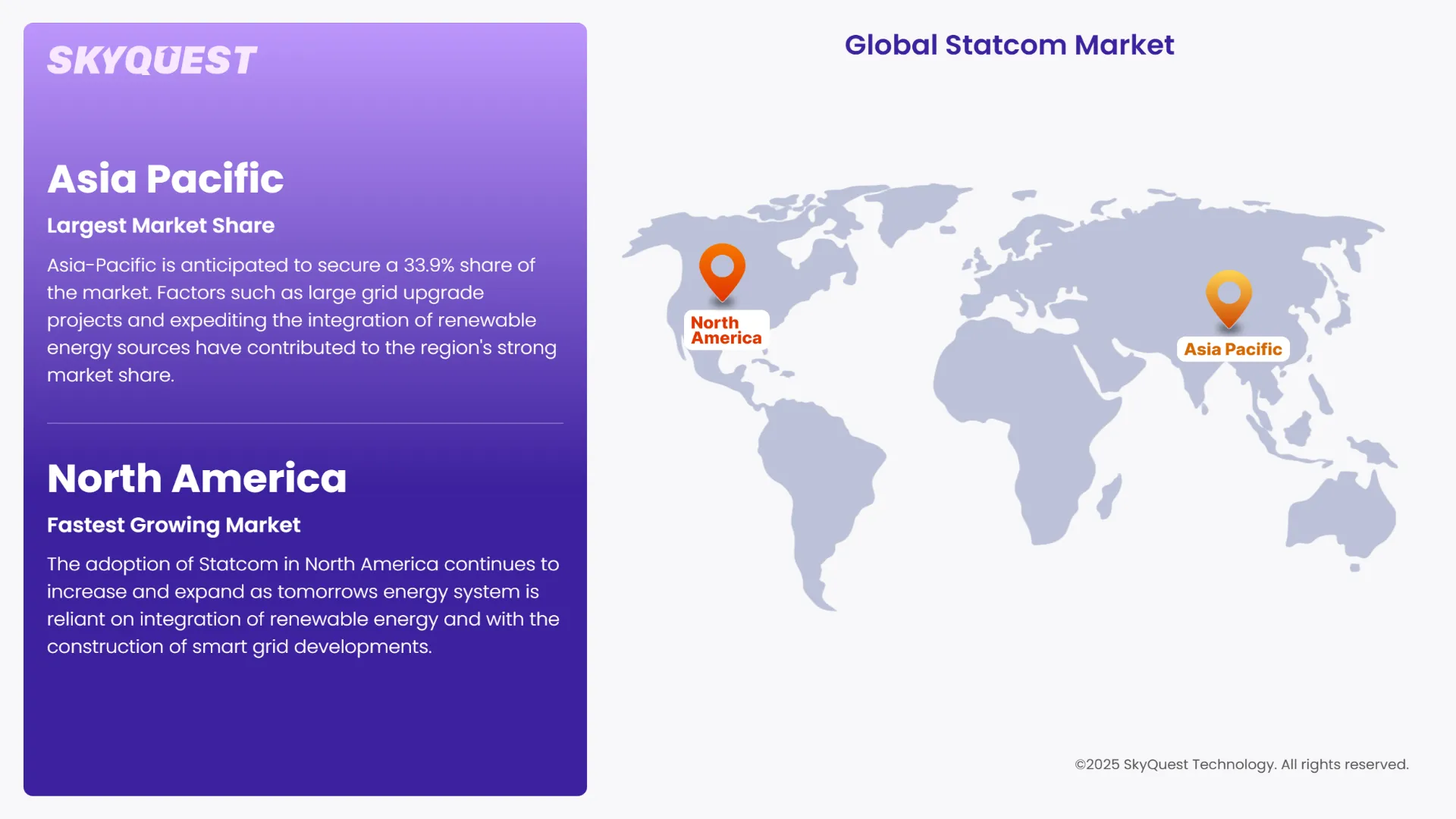
As per the statcom market regional analysis, in 2024, Asia-Pacific is anticipated to secure a 33.9% share of the market. Factors such as large grid upgrade projects and expediting the integration of renewable energy sources have contributed to the region's strong market share. Many countries in the Asia-Pacific (such as Australia, China and India) are making substantial advances in voltages stability. One example of India's commitment to improve its power system, and its aspiration to accommodate variable supply, was the planned deployment of 61 STATCOM units (from 220kV to 400kV) during 2024 to accommodate a greater renewable supply.
China Statcom Market
With more than 38% of the statcom market share in 2024, China is dominating the market. Moreover, reactive power support is in demand due to China's expansion of ultra-high-voltage transmission and rapid deployment of renewable energy resources, which includes 240 GW of solar in 2024 alone. In a situation where China has the fastest-growing renewable capacity in the world with over 1 TW of total solar installations globally, utilities are leveraging STATCOMs to stabilize voltage in wind-solar hybrid projects in order to keep the grid stable.
India Statcom Market
The statcom industry in India is growing rapidly with the explosion of renewable energy, and as regulations for grid stability become stricter. The government established 61 STATCOM units and related facilities in five states (under the Green Energy Corridor project) in 2024, with utilities deploying advanced STATCOM systems to control voltage swings of solar and wind integration as changes to the Indian Electricity Grid Code now require an improvement in reactive power control.
The adoption of Statcom in North America continues to increase and expand as tomorrows energy system is reliant on integration of renewable energy and with the construction of smart grid developments. In 2024, the Department of Energy supported 21 grid modernization pilot projects and STATCOMs were showed at a 37% installation rate in High Voltage substations across the United States. In an effort to address voltage stability problems in industrial and renewable-dominated utilities, found an increase in usage of medium-voltage STATCOM of approximately 18% by industrial sectors in the United States and in Canada.
U.S. Statcom Market
As part of its transition to sustainable energy, the US is still using statcom. In 2023, statcom systems will be incorporated into over 25 grid projects to control reactive electricity generated by 145 GW of solar and 143 GW of wind power. Department of Energy programs are encouraging adoption in high-voltage transmission corridors to boost stability and help achieve the goal of 100 percent renewable electricity by 2035.
Canada Statcom Market
Canada is enhancing grid reliability by integrating statcoms into HVDC transmission systems. Although provinces like British Columbia and Alberta are utilizing statcom devices as part of efforts to stabilize renewable-rich systems, Hydro-Québec is utilizing them in large HVDC systems to address reactive power issues. The expenditures illustrate Canada's commitment to support the industrial sectors with diverse energy demands and support voltage stability across vast, dispersed electrical power networks.
The demand for statcom is increasing in Europe due to stricter grid connection codes, and ambitions for greater renewable compatibility throughput. In 2023, more than 160 units were installed, aided by EU initiatives including the Green Deal and Horizon Europe. To maintain voltage stability and enable the offhauling of renewable generation flow across member states, transmission companies, including TenneT and National Grid, have begun to install statcoms on cross-border interconnectors.
UK Statcom Market
To monitor offshore wind capacity integration, the UK is exponentially increasing the deployment of statcom. After the National Grid upgraded 16 substations to ensure voltage stability, by 2023, 42 substations were in operation. Investments like these are necessary because the UK wants to increase its offshore wind capacity to 50 GW by 2030. Thus, grid balancing and reactive power management are more crucial.
France Statcom Market
In order to meet grid code requirements and EU renewable energy targets, France is increasing the use of statcom. To improve voltage regulation, about 35 units were added to transmission networks. French utilities are investing in cutting-edge STATCOM technologies as solar and wind integration rises in order to control reactive power flow and preserve grid stability in the face of changing energy transition requirements.
Germany Statcom Market
Germany will have the largest number of STATCOMs in Europe, with the expected addition of 58 new STATCOMs (mostly in high-voltage transmission corridors). In northern grid areas, where the added wind power supply often exceeds local(er) demand, these exist for grid stability. The increasing number of Statcom installations supports Germany's renewable energy policy by increasing the ability of large amounts of solar and wind power in addition to stabilizing grid voltage.
To know more about the market opportunities by region and country, click here to
Buy The Complete Report
Grid Codes and Assistance from Regulations
Increasing Distribution and Transmission Costs
Lengthy Procurement Cycles and Costly Capital Expenditures
Regulatory Uncertainties and Competition from Other Solutions
Request Free Customization of this report to help us to meet your business objectives.
Large power-electrics OEMs (Siemens, ABB/Hitachi, GE, Mitsubishi, and Hitachi Energy) control the majority of the market. They compete on the basis of scalability, MMC experience, and turnkey grid project delivery. Platform standardization, product modularization, joint venture/regional manufacturing, and integrating STATCOM with BESS and digital services (predictive maintenance and SCADA/controls) are some of the key statcom market strategies. Startups focus on distribution-level, software, or pole-mounted solutions, while mid-sized experts (Ingeteam, Merus, Hyosung) seek out specialized verticals (heavy industrial, mines, renewables) and quicker lead times.
Top Player’s Company Profile
Recent Developments in Statcom Market
SkyQuest’s ABIRAW (Advanced Business Intelligence, Research & Analysis Wing) is our Business Information Services team that Collects, Collates, Correlates, and Analyses the Data collected by means of Primary Exploratory Research backed by robust Secondary Desk research.
As per SkyQuest analysis, with world-class capabilities in voltage stability for inverter-rich grid applications, STATCOMs are shifting from specialized transmission-grade devices to more commonplace functions in transmission, distribution, and industrial grids of all sizes. Upgrades continue to be developed in subliminal pursuit of a modular MMC/IGBT technology, hybrid STATCOM+BESS business models, and factory manufactured systems with an all-in-one system offering to reduce implementation timelines and can get more financial outcomes. Adoption relies on multiple factors, including auxiliary service market regulations, utility procurement cycles, local finance availability for capital projects, which create probability frameworks. In the near-term, vendors positioned to deliver relatively low-cost "distribution" level STATCOM systems addressing rooftop PV voltage issues, bringing together reliable converter hardware with energy storage and digital services (controls/analytics) will win out. Expect demand to increase overall as grids electrify and decarbonize.
| Report Metric | Details |
|---|---|
| Market size value in 2024 | USD 323.9 Billion |
| Market size value in 2033 | USD 663.85 Billion |
| Growth Rate | 8.3% |
| Base year | 2024 |
| Forecast period | 2026–2033 |
| Forecast Unit (Value) | USD Billion |
| Segments covered |
|
| Regions covered | North America (US, Canada), Europe (Germany, France, United Kingdom, Italy, Spain, Rest of Europe), Asia Pacific (China, India, Japan, Rest of Asia-Pacific), Latin America (Brazil, Rest of Latin America), Middle East & Africa (South Africa, GCC Countries, Rest of MEA) |
| Companies covered |
|
| Customization scope | Free report customization with purchase. Customization includes:-
|
To get a free trial access to our platform which is a one stop solution for all your data requirements for quicker decision making. This platform allows you to compare markets, competitors who are prominent in the market, and mega trends that are influencing the dynamics in the market. Also, get access to detailed SkyQuest exclusive matrix.
Table Of Content
Executive Summary
Market overview
Parent Market Analysis
Market overview
Market size
KEY MARKET INSIGHTS
COVID IMPACT
MARKET DYNAMICS & OUTLOOK
Market Size by Region
KEY COMPANY PROFILES
Methodology
For the Statcom Market, our research methodology involved a mixture of primary and secondary data sources. Key steps involved in the research process are listed below:
1. Information Procurement: This stage involved the procurement of Market data or related information via primary and secondary sources. The various secondary sources used included various company websites, annual reports, trade databases, and paid databases such as Hoover's, Bloomberg Business, Factiva, and Avention. Our team did 45 primary interactions Globally which included several stakeholders such as manufacturers, customers, key opinion leaders, etc. Overall, information procurement was one of the most extensive stages in our research process.
2. Information Analysis: This step involved triangulation of data through bottom-up and top-down approaches to estimate and validate the total size and future estimate of the Statcom Market.
3. Report Formulation: The final step entailed the placement of data points in appropriate Market spaces in an attempt to deduce viable conclusions.
4. Validation & Publishing: Validation is the most important step in the process. Validation & re-validation via an intricately designed process helped us finalize data points to be used for final calculations. The final Market estimates and forecasts were then aligned and sent to our panel of industry experts for validation of data. Once the validation was done the report was sent to our Quality Assurance team to ensure adherence to style guides, consistency & design.
Analyst Support
Customization Options
With the given market data, our dedicated team of analysts can offer you the following customization options are available for the Statcom Market:
Product Analysis: Product matrix, which offers a detailed comparison of the product portfolio of companies.
Regional Analysis: Further analysis of the Statcom Market for additional countries.
Competitive Analysis: Detailed analysis and profiling of additional Market players & comparative analysis of competitive products.
Go to Market Strategy: Find the high-growth channels to invest your marketing efforts and increase your customer base.
Innovation Mapping: Identify racial solutions and innovation, connected to deep ecosystems of innovators, start-ups, academics, and strategic partners.
Category Intelligence: Customized intelligence that is relevant to their supply Markets will enable them to make smarter sourcing decisions and improve their category management.
Public Company Transcript Analysis: To improve the investment performance by generating new alpha and making better-informed decisions.
Social Media Listening: To analyze the conversations and trends happening not just around your brand, but around your industry as a whole, and use those insights to make better Marketing decisions.
REQUEST FOR SAMPLE
 REQUEST FREE CUSTOMIZATION
Global Statcom Market size was valued at USD 323.9 Billion in 2024 and is poised to grow from USD 350.78 Billion in 2025 to USD 663.85 Billion by 2033, growing at a CAGR of 8.3% in the forecast period (2026–2033).
Large power-electrics OEMs (Siemens, ABB/Hitachi, GE, Mitsubishi, and Hitachi Energy) control the majority of the market. They compete on the basis of scalability, MMC experience, and turnkey grid project delivery. Platform standardization, product modularization, joint venture/regional manufacturing, and integrating STATCOM with BESS and digital services (predictive maintenance and SCADA/controls) are some of the key statcom market strategies. Startups focus on distribution-level, software, or pole-mounted solutions, while mid-sized experts (Ingeteam, Merus, Hyosung) seek out specialized verticals (heavy industrial, mines, renewables) and quicker lead times. 'Siemens AG', 'ABB (Hitachi ABB Power Grids)', 'Hitachi Energy', 'General Electric (GE)', 'Mitsubishi Electric', 'NIDEC (including Nidec conversion)', 'Hyosung Heavy Industries', 'Ingeteam', 'American Superconductor (AMSC)', 'Rongxin / RXPE', 'Sieyuan Electric', 'NR Electric Co', 'Toshiba'
Government backing and new modifications to the grid code standardisation provisions have advanced the global uptake of STATCOMs. For example, Central Electricity Regulatory Commission made changes to the Indian Electricity Grid Code (IEGC) 2023 in October 2024 for the first time since its inception. This revision declared new firm operational standards for providing operational standards to improve grid stability. Furthermore, the new provisions set a maximum 45-day period in which infirm power can be supplied utilising renewable energy resources and storage systems, and the regulatory framework also has the potential for exemption. This amendment requires all generating stations to meet their requirements during off-peak hours and restricts the frequency of scheduling changes during daily and monthly periods.
Vendors are increasingly merging STATCOM converters with short-duration battery or supercapacitor storage for a new type of E-STATCOM systems that can supply both reactive and limited active power. With E-STATCOMS, grid resilience improves by offering faster frequency response, fault ride-through, and inertia emulation. Furthermore, E-STATCOMs, provide the ability to create additional revenue streams through ancillary service markets, and helps transition STATCOM customer applications from a single-purpose device to a multi-service grid asset.
As per the statcom market regional analysis, in 2024, Asia-Pacific is anticipated to secure a 33.9% share of the market. Factors such as large grid upgrade projects and expediting the integration of renewable energy sources have contributed to the region's strong market share. Many countries in the Asia-Pacific (such as Australia, China and India) are making substantial advances in voltages stability. One example of India's commitment to improve its power system, and its aspiration to accommodate variable supply, was the planned deployment of 61 STATCOM units (from 220kV to 400kV) during 2024 to accommodate a greater renewable supply.


Want to customize this report? This report can be personalized according to your needs. Our analysts and industry experts will work directly with you to understand your requirements and provide you with customized data in a short amount of time. We offer $1000 worth of FREE customization at the time of purchase.
Feedback From Our Clients


 USA (+1) 351-333-4748

