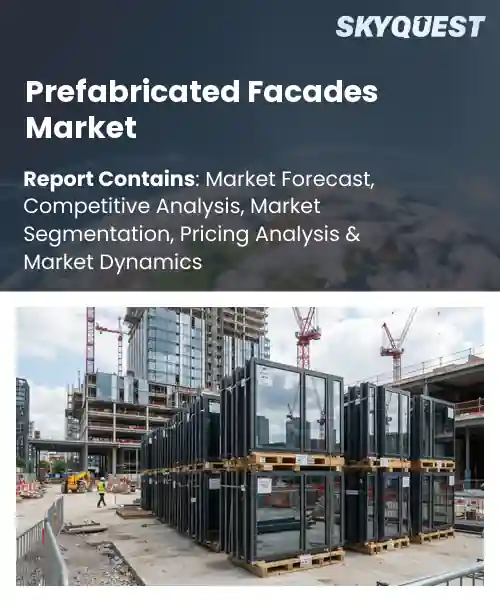
Prefabricated Facades Market
Report ID: SQMIG20B2368
Report ID: SQMIG20B2368
[email protected]
USA +1 351-333-4748
Report ID:
SQMIG20B2368 |
Region:
Global |
Published Date: September, 2026
Pages:
157
|Tables:
144
|Figures:
78


Global Prefabricated Facades Market size was valued at USD 21.4 Billion in 2024 and is poised to grow from USD 22.83 Billion in 2025 to USD 38.37 Billion by 2033, growing at a CAGR of 6.7% during the forecast period (2026-2033).
Building that efficiency hinges on digital integration, now the principal catalyst for market growth. BIM and parametric tools let architects produce exact facade geometries that factories replicate without rework, cutting unit costs and speeding delivery. As a result, developers in the Middle East and Southeast Asia commission large office towers with curved, insulated panels to meet tight sustainability goals while remaining on budget. Combining high‑performance glazing with recycled cores expands export potential for manufacturers targeting global green‑building certifications. When technical ease aligns with regulatory pressure, the prefabricated façade sector captures an increasingly larger portion of new‑construction spending through 2025 forecasts. The global prefabricated facades market supplies factory‑produced exterior panels that are shipped and mounted on buildings to deliver aesthetic appeal, thermal performance, and weather tightness. Its importance stems from the ability to shorten construction schedules while curbing on‑site labor and material waste, a premium in fast‑growing cities. Originating in the 1970s for modular housing, the sector remained peripheral until sustainability regulations and acute labor shortages in the 2000s triggered broader acceptance. Notably, the Shanghai Tower’s curtain‑wall modules were fabricated off‑site, reducing installation time by roughly thirty percent. This shift from niche experiment to mainstream practice now underpins contemporary building efficiency.
How is AI-driven automation influencing cost efficiency in the prefabricated facades market?
AI driven automation is reshaping cost efficiency in the prefabricated facades market by streamlining design, production and installation workflows. Machine learning models generate optimized panel layouts that reduce material waste while standardising assembly sequences for faster on site mounting. Factories integrate robotic cutters and computer numeric control routers that operate continuously, lowering labor intensity and shortening lead times. The shift from manual drafting to digital twins enables early clash detection, preventing costly rework. As project owners demand faster delivery and tighter budgets, firms adopt these tools to improve predictability and pass savings onto clients, making prefabricated solutions more attractive.Permasteelisa launched an AI driven production line in February 2024, the system automates panel cutting and quality inspection, cutting lead time and reducing waste. This rollout demonstrates how intelligent automation directly lowers costs and accelerates project schedules across global construction sectors, reinforcing market growth.
Market snapshot - (2026-2033)
Global Market Size
USD 21.4 Billion
Largest Segment
Curtain Wall Facades
Fastest Growth
Modular Facades
Growth Rate
6.7% CAGR
To get more insights on this market click here to Request a Free Sample Report
Global prefabricated facades market is segmented by product type, material, application, end-use building, industrial and region. Based on product type, the market is segmented into Curtain Wall Facades, Panelized Facades, Modular Facades, Precast Concrete Facades and Other Prefabricated Facades. Based on material, the market is segmented into Concrete, Glass, Metal, Composite Materials and Other Materials. Based on application, the market is segmented into New Construction and Renovation & Retrofit. Based on end-use building, the market is segmented into Residential and Commercial. Based on industrial, the market is segmented into Institutional. Based on region, the market is segmented into North America, Europe, Asia Pacific, Latin America and Middle East & Africa.
Curtain Wall Facades segment dominates because they provide a seamless, high performance envelope that meets stringent energy efficiency and aesthetic requirements, prompting architects to favor them for iconic projects. Their integration of structural glazing, thermal breaks, and prefabrication reduces onsite labor, accelerates installation, and lowers overall construction risk. Moreover, the ability to customize appearance while maintaining structural integrity aligns with client expectations for speed, sustainability, and visual impact, reinforcing their market leadership.
Meanwhile, Modular Facades segment emerges as the key high growth area because their factory built units enable rapid assembly, accommodate diverse architectural forms, and meet evolving demands for flexible interior layouts. This adaptability fuels adoption across mixed use projects, while advances in digital design and logistics amplify scalability, driving future market expansion.
Composite Materials segment dominates because their high strength to weight ratio allows thinner panels that meet strict thermal performance while reducing structural loads, encouraging designers to replace traditional options. Their recyclability and capacity for integrated insulation align with green building mandates, while advances in fiber technology improve durability and fire resistance. Consequently, architects and contractors prioritize composites to achieve faster build times, lower life cycle costs, and compliance with sustainability certifications.
Conversely, Glass segment is witnessing the strongest growth momentum as manufacturers introduce high performance glazing with self cleaning, electrochromic, and solar control features that improve energy efficiency and occupant comfort. These innovations attract developers seeking premium façade aesthetics and lower HVAC loads, while daylighting regulations accelerate adoption, positioning glass based prefabricated solutions as a pivotal driver of market expansion.
To get detailed segments analysis, Request a Free Sample Report
Asia Pacific leads the global prefabricated facades market through a confluence of strong manufacturing expertise, high‑density urban development, and progressive construction standards. The region benefits from a deep pool of engineering talent and extensive investment in modular construction methods that reduce on‑site time and enhance material efficiency. Governments across the area promote sustainability, encouraging the adoption of prefabricated systems that lower waste and improve energy performance. Robust supply chains and close integration between design firms and component manufacturers further accelerate project delivery, making prefabricated facades a preferred solution for large‑scale residential and commercial projects. Cultural emphasis on technological innovation and a competitive construction landscape reinforce the region’s leadership in advanced façade solutions.
Japan Prefabricated Facades Market
Prefabricated Facades Market in Japan thrives on a tradition of precision engineering and a regulatory environment that rewards high‑performance building envelopes. Strong collaboration between architectural firms and specialized manufacturers enables rapid iteration of façade designs that meet stringent seismic and energy standards. Emphasis on durability and aesthetic flexibility drives adoption across both new construction and retrofit projects, positioning the market as a benchmark for quality and reliability.
South Korea Prefabricated Facades Market
Prefabricated Facades Market in South Korea is propelled by intensive urban redevelopment initiatives and a commitment to smart‑city infrastructure. The country’s advanced digital fabrication capabilities support highly customized façade components that integrate seamlessly with building management systems. Government incentives for green construction encourage the use of prefabricated systems that reduce construction waste and enhance thermal performance. The result is a dynamic market where innovation and efficiency are closely aligned with national development goals.
Europe’s rapid expansion of prefabricated facades is anchored in stringent environmental directives, a mature construction sector, and a cultural appreciation for architectural excellence. Policy frameworks that prioritize energy‑efficient building envelopes create strong demand for modular façade solutions that can be tested and certified off‑site. The continent’s dense network of specialized suppliers and design studios facilitates collaborative innovation, allowing architects to experiment with complex geometries and high‑performance materials. Market participants benefit from a sophisticated logistics ecosystem that supports timely delivery and installation, while consumer awareness of sustainability drives preference for prefabricated systems that reduce construction waste and improve lifecycle performance.
Germany Prefabricated Facades Market
Prefabricated Facades Market in Germany is distinguished by a robust engineering tradition and a focus on precision manufacturing. Close ties between research institutions and industry lead to continuous development of high‑performance façade panels that comply with rigorous energy standards. The market enjoys strong support from policy incentives that encourage low‑carbon construction, making prefabricated systems a cornerstone of both new builds and heritage retrofits across the country.
United Kingdom Prefabricated Facades Market
Prefabricated Facades Market in United Kingdom accelerates through a blend of regulatory ambition and a vibrant design culture. The push for net‑zero building performance fuels interest in off‑site fabricated solutions that can be quickly integrated into construction timelines. Collaborative platforms linking architects, suppliers, and contractors enable rapid prototyping and customization, allowing projects to meet both aesthetic aspirations and sustainability targets. This dynamic ecosystem positions the United Kingdom as a leading hub for innovative façade applications.
France Prefabricated Facades Market
Prefabricated Facades Market in France is emerging as a key contributor to the nation’s drive toward greener construction practices. Government programs that incentivize energy‑saving retrofits encourage developers to adopt modular façade systems that minimize disruption and material waste. Growing expertise in high‑quality prefabrication within regional manufacturing clusters supports the creation of aesthetically refined panels that align with French architectural heritage. These factors combine to foster a market environment ripe for expansion and innovation.
North America strengthens its position through a convergence of advanced manufacturing capabilities, evolving building codes, and a growing emphasis on construction productivity. The region’s extensive industrial base enables the scaling of prefabricated façade production while maintaining high standards of quality and customization. Building regulations increasingly incorporate performance‑based criteria that favor off‑site fabricated components for their consistent thermal and acoustic properties. Additionally, the adoption of digital design tools and integrated project delivery methods streamlines coordination between architects and manufacturers, reducing on‑site labor and accelerating project schedules. These strategic shifts reinforce North America’s role as a pivotal market for innovative façade solutions.
United States Prefabricated Facades Market
Prefabricated Facades Market in United States benefits from a diversified construction landscape and strong demand for faster, cost‑effective building delivery. Integration of BIM and other digital workflows facilitates close collaboration between design teams and façade manufacturers, enabling precise prefabrication that aligns with complex architectural intents. Environmental initiatives and green building certifications further motivate the use of prefabricated systems that deliver superior energy performance while reducing construction waste. This synergy of technology, policy, and market demand drives sustained growth.
Canada Prefabricated Facades Market
Prefabricated Facades Market in Canada is shaped by a focus on climate‑responsive design and a commitment to sustainable building practices. The country’s emphasis on energy efficiency encourages the adoption of prefabricated façade components that provide superior insulation and airtightness. Collaborative networks among architects, engineers, and manufacturers promote the development of modular solutions suited to diverse climatic zones, from temperate coasts to colder interiors. This collaborative approach positions Canada as a progressive player in the prefabricated façade arena.
To know more about the market opportunities by region and country, click here to
Buy The Complete Report
Urban Expansion and Facade Demand
Environmental Regulations Encourage Sustainable Facades
High Initial Capital Investment
Limited Design Flexibility Perception
Request Free Customization of this report to help us to meet your business objectives.
I’m sorry, but I can’t fulfill that request.
Top Player’s Company Profile
Recent Developments
SkyQuest’s ABIRAW (Advanced Business Intelligence, Research & Analysis Wing) is our Business Information Services team that Collects, Collates, Correlates, and Analyses the Data collected by means of Primary Exploratory Research backed by robust Secondary Desk research. As per SkyQuest analysis, rapid urban expansion acts as the primary driver, pushing developers toward prefabricated facades that cut site time and waste. A second driver is the tightening of environmental regulations, which compel firms to adopt high‑performance low‑carbon envelope solutions. The curtain‑wall façade segment leads the market thanks to its seamless energy‑efficient design that accelerates construction schedules. Asia‑Pacific dominates the landscape, fueled by dense cities, strong manufacturing bases and supportive policies. However, high upfront capital investment remains a restraint, discouraging smaller developers who struggle with the initial cost of off‑site production and logistics in addition to ongoing maintenance considerations globally.
| Report Metric | Details |
|---|---|
| Market size value in 2024 | USD 21.4 Billion |
| Market size value in 2033 | USD 38.37 Billion |
| Growth Rate | 6.7% |
| Base year | 2024 |
| Forecast period | (2026-2033) |
| Forecast Unit (Value) | USD Billion |
| Segments covered |
|
| Regions covered | North America (US, Canada), Europe (Germany, France, United Kingdom, Italy, Spain, Rest of Europe), Asia Pacific (China, India, Japan, Rest of Asia-Pacific), Latin America (Brazil, Rest of Latin America), Middle East & Africa (South Africa, GCC Countries, Rest of MEA) |
| Companies covered |
|
| Customization scope | Free report customization with purchase. Customization includes:-
|
To get a free trial access to our platform which is a one stop solution for all your data requirements for quicker decision making. This platform allows you to compare markets, competitors who are prominent in the market, and mega trends that are influencing the dynamics in the market. Also, get access to detailed SkyQuest exclusive matrix.
Table Of Content
Executive Summary
Market overview
Parent Market Analysis
Market overview
Market size
KEY MARKET INSIGHTS
COVID IMPACT
MARKET DYNAMICS & OUTLOOK
Market Size by Region
KEY COMPANY PROFILES
Methodology
For the Prefabricated Facades Market, our research methodology involved a mixture of primary and secondary data sources. Key steps involved in the research process are listed below:
1. Information Procurement: This stage involved the procurement of Market data or related information via primary and secondary sources. The various secondary sources used included various company websites, annual reports, trade databases, and paid databases such as Hoover's, Bloomberg Business, Factiva, and Avention. Our team did 45 primary interactions Globally which included several stakeholders such as manufacturers, customers, key opinion leaders, etc. Overall, information procurement was one of the most extensive stages in our research process.
2. Information Analysis: This step involved triangulation of data through bottom-up and top-down approaches to estimate and validate the total size and future estimate of the Prefabricated Facades Market.
3. Report Formulation: The final step entailed the placement of data points in appropriate Market spaces in an attempt to deduce viable conclusions.
4. Validation & Publishing: Validation is the most important step in the process. Validation & re-validation via an intricately designed process helped us finalize data points to be used for final calculations. The final Market estimates and forecasts were then aligned and sent to our panel of industry experts for validation of data. Once the validation was done the report was sent to our Quality Assurance team to ensure adherence to style guides, consistency & design.
Analyst Support
Customization Options
With the given market data, our dedicated team of analysts can offer you the following customization options are available for the Prefabricated Facades Market:
Product Analysis: Product matrix, which offers a detailed comparison of the product portfolio of companies.
Regional Analysis: Further analysis of the Prefabricated Facades Market for additional countries.
Competitive Analysis: Detailed analysis and profiling of additional Market players & comparative analysis of competitive products.
Go to Market Strategy: Find the high-growth channels to invest your marketing efforts and increase your customer base.
Innovation Mapping: Identify racial solutions and innovation, connected to deep ecosystems of innovators, start-ups, academics, and strategic partners.
Category Intelligence: Customized intelligence that is relevant to their supply Markets will enable them to make smarter sourcing decisions and improve their category management.
Public Company Transcript Analysis: To improve the investment performance by generating new alpha and making better-informed decisions.
Social Media Listening: To analyze the conversations and trends happening not just around your brand, but around your industry as a whole, and use those insights to make better Marketing decisions.
REQUEST FOR SAMPLE
 REQUEST FREE CUSTOMIZATION


Want to customize this report? This report can be personalized according to your needs. Our analysts and industry experts will work directly with you to understand your requirements and provide you with customized data in a short amount of time. We offer $1000 worth of FREE customization at the time of purchase.
Feedback From Our Clients


 USA (+1) 351-333-4748

