
Precision Viticulture Market
Report ID: SQMIG45A2484
Report ID: SQMIG45A2484
[email protected]
USA +1 351-333-4748
Report ID:
SQMIG45A2484 |
Region:
Global |
Published Date: February, 2025
Pages:
192
|Tables:
59
|Figures:
70


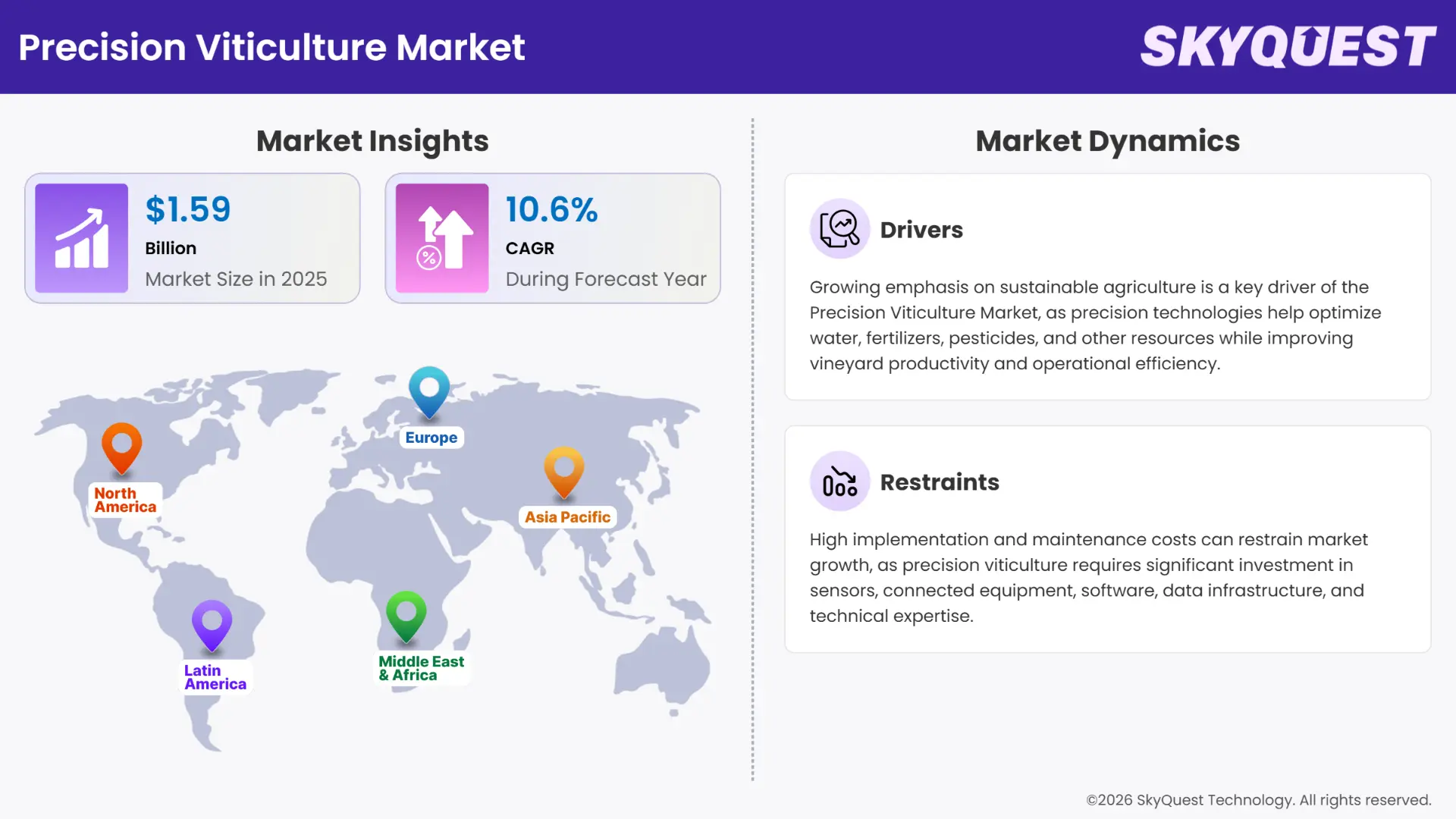
Global Precision Viticulture Market size was valued at USD 1.44 Billion in 2024 and is poised to grow from USD 1.59 Billion in 2025 to USD 3.56 Billion by 2033, growing at a CAGR of 10.6% during the forecast period (2026–2033).
Key Takeaways: Market Trends & Insights
Precision viticulture aids in increasing the output of the vineyard by providing enhanced monitoring and control of the area under cultivation. Precision viticulture involves several state-of-the-art devices and systems, including drones, application control devices, guidance systems, and driverless tractors. Farmers increasingly integrate these systems and devices into their vineyard production practices to increase grape productivity and yield quality. Devices such as sensors and drones provide vineyard owners with insights related to plant/crop health based on the collected data, which, in turn, helps owners take preventive steps for optimum production growth.
Various types of sensors, such as temperature sensors, humidity sensors, and soil sensors, among others, help vineyard owners collect data critical to the quality of the grapes. Thus, advancements in technology and growing awareness among growers regarding the benefits offered collectively drive the adoption of technologies for worldwide vineyard cultivation. Real-time monitoring of fields enables growers to undertake the steps necessary to reduce waste or crop failure. The quality of the grapes is of utmost importance for the vineyard owners, and therefore they prefer using advanced technologies for in-depth monitoring of grapes under cultivation/production. Moreover, using advanced technology in vineyards helps optimize fertilizer utilization using variable rate technology (VRT).
Precision technologies for farm applications require technical knowledge and a pre-requisite skill set. Using drones, driverless tractors, guidance systems, and other state-of-the-art technologies for farm practices requires a high understanding of the procedures. Although governments across several countries are undertaking steps to promote the adoption of precision technologies for farming practices, the need for more technical know-how among growers and the shortage of skilled labor collectively hinders market growth.
There is rising adoption of precision viticulture across North America and Europe due to a surging focus on sustainability and viticulture heritage, while Asia Pacific sees growth with modernization in agriculture. Latin America is expanding its wine industry, and the Middle East and Africa are adopting precision viticulture for arid climate challenges. The competitive landscape is marked by key players investing in research and development (R&D), strategic partnerships, and acquisitions to gain a technological edge. Established agri-tech companies and emerging startups compete, offering solutions that address the increasing demand for efficient vineyard management.
Challenges include initial implementation costs and the need for technological literacy among grape growers. However, supportive educational initiatives and the introduction of cost-effective, user-friendly solutions meeting the evolving needs of the viticulture industry are presenting lucrative market opportunities.
Market Key Attributes
To get more insights on this market click here to Request a Free Sample Report
Global Precision Viticulture Market is segmented by Component, Technology, Application and region. Based on Component, the market is segmented into Hardware, Software and Services. Based on Technology, the market is segmented into Guidance systems, Remote sensing and Variable rate technology. Based on Application, the market is segmented into Yield monitoring, Field mapping, Crop scouting, Weather tracking & forecasting, Irrigation management, Inventory management, Farm labor management, Financial management and Others. Based on region, the market is segmented into North America, Europe, Asia Pacific, Latin America and Middle East & Africa.
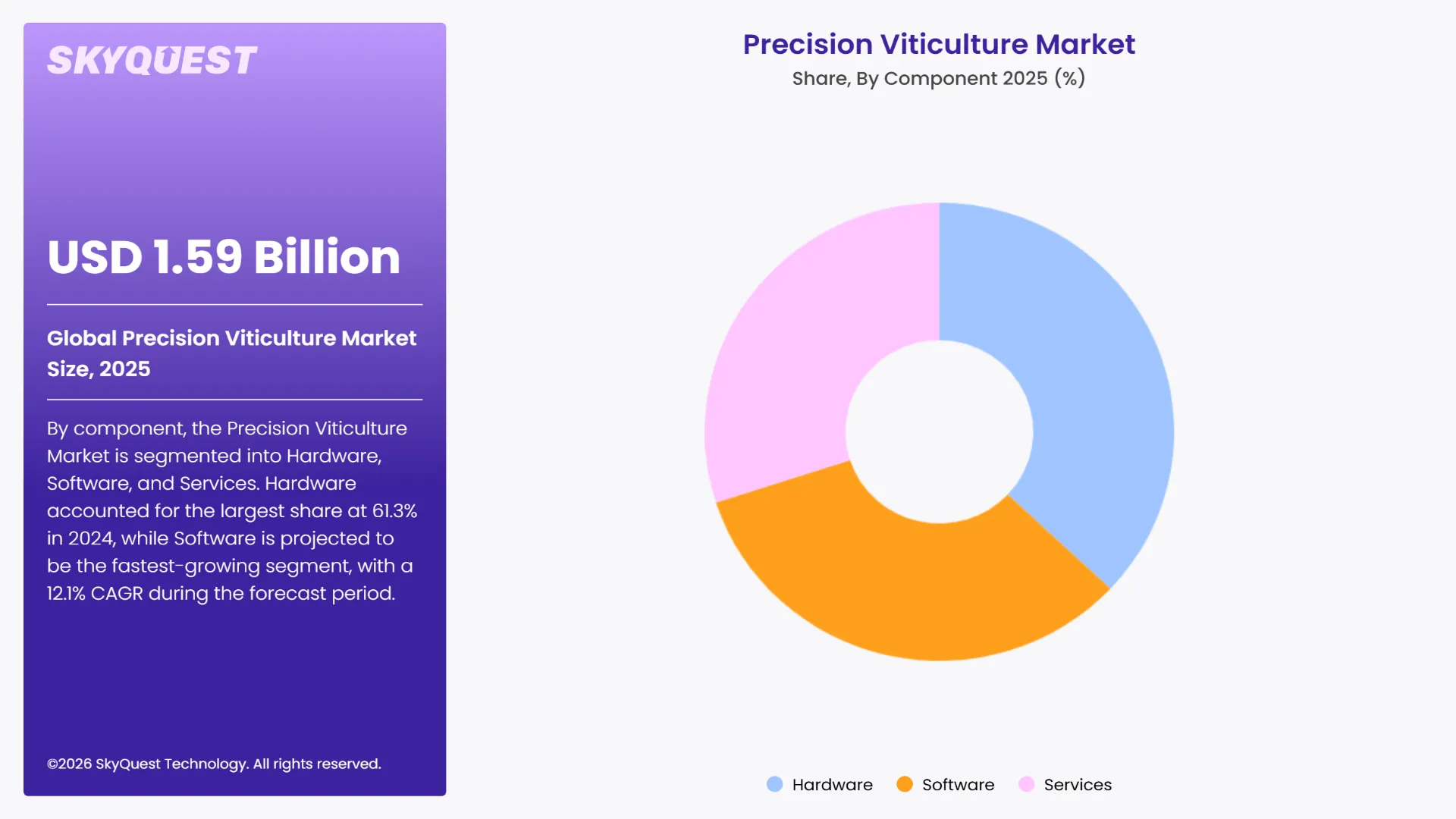
As per global precision viticulture market outlook, the hardware segment held the highest market share of 61.3% in 2024. Drones and VRT are gaining traction among grape growers, propelling growth. The hardware segment has been further segmented into devices and systems, such as mobile devices, remote sensing equipment, guidance systems, drones, and variable rate technology devices. The growers use these devices for constant monitoring and control of the vineyard. Besides, the increasing use of Geographic Information Systems (GIS) for visualizing and analysing the field, determining the appropriate location for the vineyard, and placing the crops in the field has positively affected the market demand.
As per global precision viticulture market analysis, the software segment is estimated to register the fastest CAGR of 12.1% during the forecast period. The software segment is bifurcated into cloud-based software and web-based software. Cloud-based software solutions help vineyard owners eliminate the costs of maintaining their IT infrastructure. The software powered by data analytics and AI, processes the vast amounts of collected data, providing actionable insights for optimizing grape cultivation, thereby impelling the market growth. In addition, software solutions facilitate spontaneous communication and coordination between different hardware components, ensuring a synergy.
As per global precision viticulture market forecast, the yield monitoring segment dominated the market with a revenue share of 39.6% in 2024, owing to the benefits offered in identifying the effects of internal and external forces on yields, such as weather, pesticides, soil properties and fertilizers. Yield monitoring can be done on-farm as well as off-farm. The on-farm yield monitoring provides the grape growers with real-time information during harvest. It also enables grape growers to generate yield maps for identifying areas of different crop yields. It further enables efficient planning and management of production using spatial yield trends, thereby improving overall crop productivity.
The weather tracking & forecasting segment is estimated to register the highest CAGR of 15.1% during the forecast period. Sensors are used for accurate weather tracking and forecasting. The imminent need for the safety of crop and to ensure crop quality is expected to be the driving factor for segment growth. Moreover, using advanced data analytics services helps winegrowers monitor the crops per the weather and respond quickly to weather changes. In addition, the integration of AI-powered forecasting models and advanced data analytics allows for real-time monitoring and proactive responses to sudden weather changes, reducing potential losses due to extreme weather events such as droughts, frosts, or storms.
To get detailed segments analysis, Request a Free Sample Report
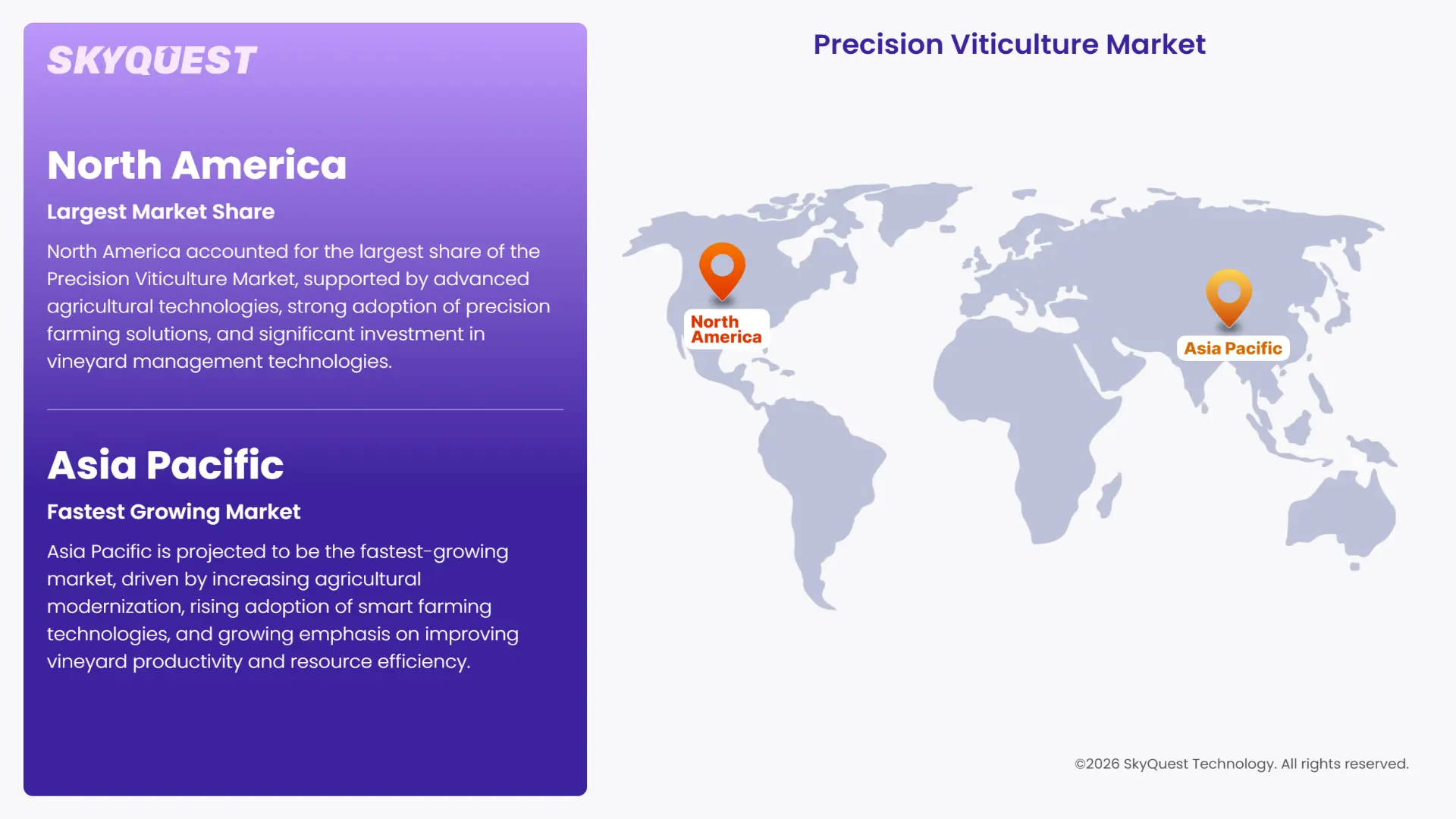
North America dominated the precision viticulture market in 2024. The United States stands as the key contributor to North America's dominance in the precision viticulture market in 2024. Precision viticulture is experiencing heightened demand across North America, propelled by a growing awareness of sustainable agriculture practices, coupled with the need for enhanced yield and grape quality.
In the Asia Pacific region, the precision viticulture market is expanding rapidly with China emerging as the fastest growing market. This is mostly due to China’s rising wine output and consumption combined with the government’s push for agricultural modernization. The first important driver of the precision viticulture market in Asia Pacific is the region’s expanding wine industry. According to the International Organization of Vine and Wine (OIV), China’s total vineyard area will reach 785,000 hectares in 2020, making it the world’s second largest after Spain.
Europe is anticipated to hold the largest share of the precision viticulture market during the forecast period. In Europe, industry has seen significant changes. The widespread use of industrialization, mechanization, and the creation of the Common Agricultural Policy (CAP) are credited with these developments. At 964,000 hectares, Spain now holds the record for the world's largest vineyard area.
Latin America, with its vast agricultural landscapes and vulnerability to climate change, is emerging as a significant market for weather tracking & forecasting solutions. Countries such as Brazil, Argentina, and Chile are leveraging advanced sensors, satellite imaging, and AI-driven weather analytics to optimize crop yields and mitigate climate-related risks. As one of the world’s largest agricultural producers. Brazil is adopting weather tracking technologies to manage the effects of droughts, floods, and unpredictable rainfall patterns on crops such as soybeans, coffee, and sugarcane.
The Middle East & Africa face harsh climatic conditions, including extreme heat, water scarcity, and desertification, making weather tracking & forecasting technologies vital for agriculture, water resource management, and disaster preparedness. Governments and private players are investing in early warning systems, AI-based climate monitoring, and sensor-driven weather stations. The UAE is investing heavily in AI-powered weather analytics and cloud seeding technologies to combat water scarcity and enhance agricultural productivity in desert climates.
To know more about the market opportunities by region and country, click here to
Buy The Complete Report
Growing Emphasis on Sustainable Agriculture
Data Analytics and AI
Data Correctness and Integration
High Cost of Technology Adoption
Request Free Customization of this report to help us to meet your business objectives.
The competitive landscape of the global precision viticulture industry is characterized by the presence of established agritech firms, precision agriculture solution providers, and emerging startups focusing on AI-driven analytics, remote sensing, and IoT-based vineyard management. Leading players such as John Deere, Trimble Inc., Topcon Corporation, and Deveron Corp. are actively integrating the GPS guidance systems, drones, and AI-powered weather forecasting tools to help winegrowers optimize yield and improve grape quality.
Increasing Adoption of IoT
Advancements in Technology
SkyQuest’s ABIRAW (Advanced Business Intelligence, Research & Analysis Wing) is our Business Information Services team that Collects, Collates, Co-relates, and Analyses the Data collected by means of Primary Exploratory Research backed by the robust Secondary Desk research.
According to SkyQuest analysis, the precision viticulture market is anticipated to experience significant growth in the coming years. Precision farming uses advanced technologies like Geographic Information Systems (GIS), Global Positioning Systems (GPS), and remote sensing to collect exact data about vineyard conditions. These tools allow vineyard managers to construct precise maps of vineyard heterogeneity in soil composition, geography, and microclimates.Key market drivers include increasing demand for high-quality wine, rising labor costs, and the need to minimize environmental impact. One of the most difficult aspects of precision viticulture is assuring the correctness and integration of data collected from several sources. Sensors, drones, satellites, and other technology are used in vineyards to collect information about soil moisture, temperature, humidity, plant vigor, and grape quality.
| Report Metric | Details |
|---|---|
| Market size value in 2024 | USD 1.44 Billion |
| Market size value in 2033 | USD 3.56 Billion |
| Growth Rate | 10.6% |
| Base year | 2024 |
| Forecast period | 2026–2033 |
| Forecast Unit (Value) | USD Billion |
| Segments covered |
|
| Regions covered | North America (US, Canada), Europe (Germany, France, United Kingdom, Italy, Spain, Rest of Europe), Asia Pacific (China, India, Japan, Rest of Asia-Pacific), Latin America (Brazil, Rest of Latin America), Middle East & Africa (South Africa, GCC Countries, Rest of MEA) |
| Companies covered |
|
| Customization scope | Free report customization with purchase. Customization includes:-
|
To get a free trial access to our platform which is a one stop solution for all your data requirements for quicker decision making. This platform allows you to compare markets, competitors who are prominent in the market, and mega trends that are influencing the dynamics in the market. Also, get access to detailed SkyQuest exclusive matrix.
Table Of Content
Executive Summary
Market overview
Parent Market Analysis
Market overview
Market size
KEY MARKET INSIGHTS
COVID IMPACT
MARKET DYNAMICS & OUTLOOK
Market Size by Region
KEY COMPANY PROFILES
Methodology
For the Precision Viticulture Market, our research methodology involved a mixture of primary and secondary data sources. Key steps involved in the research process are listed below:
1. Information Procurement: This stage involved the procurement of Market data or related information via primary and secondary sources. The various secondary sources used included various company websites, annual reports, trade databases, and paid databases such as Hoover's, Bloomberg Business, Factiva, and Avention. Our team did 45 primary interactions Globally which included several stakeholders such as manufacturers, customers, key opinion leaders, etc. Overall, information procurement was one of the most extensive stages in our research process.
2. Information Analysis: This step involved triangulation of data through bottom-up and top-down approaches to estimate and validate the total size and future estimate of the Precision Viticulture Market.
3. Report Formulation: The final step entailed the placement of data points in appropriate Market spaces in an attempt to deduce viable conclusions.
4. Validation & Publishing: Validation is the most important step in the process. Validation & re-validation via an intricately designed process helped us finalize data points to be used for final calculations. The final Market estimates and forecasts were then aligned and sent to our panel of industry experts for validation of data. Once the validation was done the report was sent to our Quality Assurance team to ensure adherence to style guides, consistency & design.
Analyst Support
Customization Options
With the given market data, our dedicated team of analysts can offer you the following customization options are available for the Precision Viticulture Market:
Product Analysis: Product matrix, which offers a detailed comparison of the product portfolio of companies.
Regional Analysis: Further analysis of the Precision Viticulture Market for additional countries.
Competitive Analysis: Detailed analysis and profiling of additional Market players & comparative analysis of competitive products.
Go to Market Strategy: Find the high-growth channels to invest your marketing efforts and increase your customer base.
Innovation Mapping: Identify racial solutions and innovation, connected to deep ecosystems of innovators, start-ups, academics, and strategic partners.
Category Intelligence: Customized intelligence that is relevant to their supply Markets will enable them to make smarter sourcing decisions and improve their category management.
Public Company Transcript Analysis: To improve the investment performance by generating new alpha and making better-informed decisions.
Social Media Listening: To analyze the conversations and trends happening not just around your brand, but around your industry as a whole, and use those insights to make better Marketing decisions.
REQUEST FOR SAMPLE
 REQUEST FREE CUSTOMIZATION
Global Precision Viticulture Market size was valued at USD 1.44 Billion in 2024 and is poised to grow from USD 1.59 Billion in 2025 to USD 3.56 Billion by 2033, growing at a CAGR of 10.6% during the forecast period (2026–2033).
The key vendors in the Precision Viticulture Market, according to SkyQuest, include John Deere, Trimble Inc., Topcon Corporation, AG Leader Technology, Raven Industries, Sentera, VitiBot, The Climate Corporation, PrecisionHawk, Deveron UAS, TeeJet Technologies, Groupe ICV, TracMap, QuantisLabs, and Terranis.
Growing emphasis on sustainable agriculture is the key driver of the Precision Viticulture Market. Precision technologies enable efficient use of water and chemicals, reduce waste and environmental impact, and support targeted pest and disease management in vineyards.
The key market trend in the Precision Viticulture Market is the increasing adoption of IoT. Connected soil sensors, weather stations, and automated machinery enable real-time vineyard monitoring, improve operational efficiency, optimize resources, and support proactive disease management.
North America accounted for the largest share of the Precision Viticulture Market, supported by advanced agricultural technologies, high adoption of precision farming solutions, strong R&D capabilities, and the presence of established technology providers.


Want to customize this report? This report can be personalized according to your needs. Our analysts and industry experts will work directly with you to understand your requirements and provide you with customized data in a short amount of time. We offer $1000 worth of FREE customization at the time of purchase.
Feedback From Our Clients


 USA (+1) 351-333-4748

