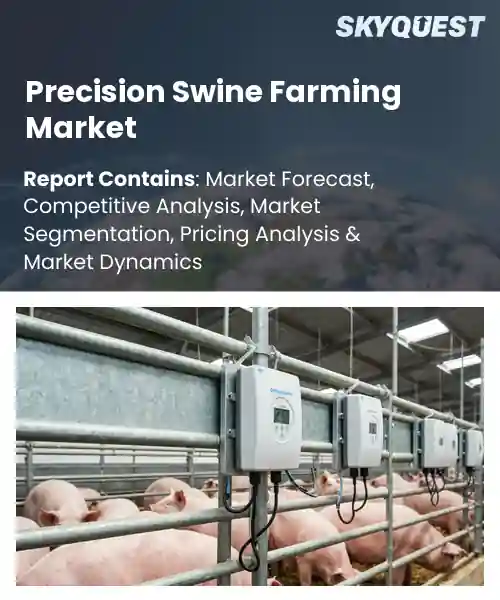
Precision Swine Farming Market
Report ID: SQMIG20F2069
Report ID: SQMIG20F2069
[email protected]
USA +1 351-333-4748
Report ID:
SQMIG20F2069 |
Region:
Global |
Published Date: June, 2026
Pages:
157
|Tables:
179
|Figures:
79


Global Precision Swine Farming Market size was valued at USD 1.50 Billion in 2024 and is poised to grow from USD 1.63 Billion in 2025 to USD 3.15 Billion by 2033, growing at a CAGR of 8.6% during the forecast period (2026-2033).
The main impetus for precision swine farming market growth is the need to improve productivity while maintaining herd health and meeting environmental and welfare regulations. The market encompasses sensors, automated feeders, climate control systems, RFID, camera-based monitoring and analytics that convert signals from the barn into management actions. Pork producers are dealing with volatile feed prices, labor shortages, and high biosecurity risk. Any technologies that can reduce mortality and improve feed conversion will have a direct impact on profitability. “Twenty years ago we were using paper records and siloed automation, now we have IoT and machine learning integrated,” he said. “We had farms using weight sensors and automated ventilation to stabilize growth and reduce energy costs.
The key growth driver is the accelerated deployment of IoT sensors and AI analytics, as the continuous data capture enables early disease detection, targeted interventions and efficiency gains. A sensor-driven monitoring system enables farms to spot fevers, respiratory patterns or refusals to feed more quickly, decreasing antibiotic use and mortality, and helping to reduce production costs and improve access to welfare-conscious buyers. The investment and farm management service models of the integrators create economies of scale that allow smaller producers to access tools and drive uptake. Use cases include cough-detection systems for PRRS alerts, automated estrus detection shortens breeding intervals and feed optimization cuts feed costs and improves gain.
How is AI Improving Operational Efficiency in the Precision Swine Farming Market?
AI improves operational efficiency in precision swine farming market trends by integrating continuous sensors, computer vision, acoustic monitoring and predictive analytics into practical decision support. Automated behavior and weight monitoring, targeted feeding and climate control, and early disease alerts are key elements. The market is moving from experimental pilots to wider commercial deployments, as models become more robust and easier to integrate with herd management systems. The technologies reduce routine labour, allow for earlier and more accurate intervention and optimize use of feed and space, which contributes to better welfare and less waste. Examples include cameras that flag lameness and sensors that trigger targeted treatments.
Virbac and MACSO, March 2026, announced an exclusive agreement to deploy AI driven acoustic and environmental monitoring that detects respiratory distress well before clinical signs appear. This innovation enables targeted intervention, reduces unnecessary treatments and labour, and helps scale precision health management across commercial swine operations.
Market snapshot - (2026-2033)
Global Market Size
USD 1.5 Billion
Largest Segment
Hardware
Fastest Growth
Software
Growth Rate
8.6% CAGR
To get more insights on this market click here to Request a Free Sample Report
Global precision swine farming market is segmented by component, application, farm type, deployment mode, technology, end user and region. Based on component, the market is segmented into hardware, software and services. Based on application, the market is segmented into Feeding management, breeding & reproduction management, health & disease monitoring, behavior & welfare monitoring, environmental monitoring, weight & growth monitoring and traceability & herd management. Based on farm type, the market is segmented into small-scale farms, medium-scale farms, large commercial farms and integrated swine production facilities. Based on deployment mode, the market is segmented into on-premises and cloud-based. Based on technology, the market is segmented into internet of things (IoT), artificial intelligence & machine learning, big data analytics, computer vision and robotics & automation. Based on end user, the market is segmented into swine breeding farms, farrow-to-finish farms, contract swine producers, veterinary & animal health organizations and research & academic institutions. Based on region, the market is segmented into North America, Europe, Asia Pacific, Latin America, and Middle East & Africa.
Hardware segment dominates because physical devices form the foundation of precision swine farming systems, delivering sensors, actuators, feeders and environmental controllers that collect and actuate critical animal and barn data. On-farm instruments that are reliable and accurate reduce uncertainty associated with feeding, climate and weighings - this enables downstream analytics and automation of responses to change. Vendors who emphasize durability, integration standards, and farm-friendly design will increasingly deploy their products, as farmers seek immediate improvement to their operation.
While software is growing the fastest among all categories in agriculture with advanced farm management platforms, analytics, and mobile apps that enable the efficient aggregation of data, remote monitoring and help producers make better decisions. The acceleration in adoption is driven by the ability to connect to the cloud, generate recurring revenue streams through SaaS business models, and increasing amounts of data that can provide valuable insights for farmers. These factors increase the number of integrations with services available to farmers, the development of predictive tools for farmers, and allow farmers to improve productivity.
The Internet of Things (IoT) is the leading segment of this, thanks to how the various sensors and edge devices used on farms can provide a general view of everything happening within a farm in real-time as compared to total reliance on physical observation alone. Ubiquitous arrays of sensors allow farms to utilize continuous monitoring and alerts to support their daily operational decisions, thus allowing farm managers better access to verifiable data on farm activities and using this data for permanent visibility (e.g. for feed schedules) on ventilator controls; in other words, improving the consistency and predictability of farm production workflow.
At the same time, Artificial Intelligence & machine learning are becoming the fastest growing area of technology within this industry as well due to increasing need for predictive alerts regarding animal health, as well as to automate the identification of anomalies, and receive prescriptive advice for feed recommendations. New models developed for usage within AI/ML, as well as growing acceptance of the use of data to support decision making for farm management, are both driving the increasing usage of data from sensors on farms. Because of the changes in how to develop models and limits in how sensor data can be used, farms are also benefiting from increased cost savings associated with the use of sensor data that is accompanied by additional offerings of service.
To get detailed segments analysis, Request a Free Sample Report
North America dominance stems from a mature agricultural technology ecosystem, concentrated commercial production systems and strong alignment between industry, research and service providers. The region benefits from advanced solution vendors that design, test and commercialise integrated platforms combining sensors, automation and data analytics tailored to swine operations. Producers prioritise biosecurity, traceability and productivity, creating demand for precision interventions. Close collaboration among universities, extension services, veterinary networks and private integrators accelerates technology transfer. Well developed supply chains, access to capital and experienced implementation partners enable rapid scaling of pilot projects into mainstream practice. Policy drivers around environmental compliance and animal welfare further incentivise adoption of precision tools, while a skilled workforce and local manufacturing capacity support customization and sustained innovation across the value chain.
Precision swine farming market share in United States is characterised by widespread adoption of sensor networks, automated feeding and health monitoring systems across intensive production systems. Producers are prioritizing biosecurity, traceability and performance optimization, which drives collaboration between technology vendors, integrators and veterinary advisors. Strong service ecosystems allow rapid deployment and scalability of solutions, and private and institutional investment supports innovation and commercialization of advanced precision livestock technologies and data driven decision making.
Precision swine farming market forecast shows realistic uptake by family as well as commercial herds throughout Canada, thanks to the contribution from collaborative research organisations and extension services. Producers focus on environmental stewardship, efficient resource usage and monitoring of animal health using remote sensing and precision feeding technologies. In addition, an integrated network of advisory services and supporting infrastructure in rural areas will allow support of deployments and improving scale. Vendors located in the area are able to adjust available technology to meet local climate and bio-security conditions, allowing for sustainable intensification as well as improved operational resilience.
The convergence of regulations and markets combined with technological developments throughout Europe, precision solutions are increasingly important as a result of rapidly growing interest in animal welfare, food safety and environmental performance; therefore, producers and processors are implementing technologies such as monitoring, traceability & emission management systems into their operations. Additionally, this is being driven by an abundance of agtech suppliers, engineering firms, and research centres that can provide regionally adapted systems to facilitate cooperation amongst producers and processors for quality schemes that are processor-led and to support wider diffusion across all sizes of farms. Furthermore, cooperation between private companies and academic institutions through public incentives will continue to support demonstration projects and transfer of knowledge through multiple avenues. Demand from consumers and retailers for provenance and verified welfare practices stimulates investment in digital platforms and sensor networks. The result is a dynamic environment where pilots can be rapidly validated and scaled, with Germany leading in technological depth, United Kingdom showing emerging adoption and France recording rapid uptake.
Precision swine farming market regional outlook in Germany is characterised by technologically advanced integration across large scale production. Producers leverage sophisticated automation, environmental control systems and sensor platforms developed by domestic equipment manufacturers. Collaboration among research institutes, feed companies and integrators drives tailored solutions for efficiency, welfare and emissions management. Established service networks and technical skills enable rapid implementation across varied production models, reinforcing Germany role as a regional technology leader internationally.
Precision swine farming market regional forecast in United Kingdom is showing emerging momentum due to increasing adoption of digital monitoring, herd health analytics and precision feeding across various farm structures. Quality assurance schemes and agritech startups help technology adoption. Pilots and rollouts encouraged by focus on traceability, welfare validation and supply chain transparency. Solutions are more and more being developed through collaboration between research centres, industry groups and end users that are tailored to meet biosecurity and productivity objectives.
Precision swine farming market analysis in France, producers of precision swine farming technologies are driven by the introduction of sensor networks, precision feeding, and health monitoring technologies into their operations to comply with changing sustainability and animal welfare trends. The presence of strong cooperative structures and close relationships between producers and processors help facilitate the diffusion of these new technologies throughout France. Research and advisory services also offer specialised support to producers with different farm sizes when implementing technologies into their operations.
The Asia Pacific region is evolving by combining adapting through a mix of changing technologies, mergers and acquisitions, and specific government or other organisation initiatives that will be 'tailored' to the regional realities of production of food. In countries that have very well-developed economies, many large agricultural companies are incorporating the use of automation and robotics and IoT to alleviate the challenges presented by labour shortages and to provide increased biosecurity. There is a great deal of collaboration between technology companies (and technology system developers) and local producers whereby they can create systems that take into account the high-density production areas as well as the diverse farm sizes. Institutionally, there are research centres and extension services supporting on-farm validation. Corporate and venture capital investments are providing funding for the development of analytics and precision feeding solutions. The focus on traceability and export quality as well as disease resilience within the primary industry will help to facilitate the adoption of the tools of technology along the entire value chain. Cross border technology transfer and strategic collaborations with global vendors accelerate capability building and practical deployments.
Precision swine farming market penetartion in Japan is advancing through adoption of robotics, automated feeding, environmental control and sophisticated monitoring platforms adapted for high efficiency and strict biosecurity. Industry manufacturers and systems integrators supply tailored hardware and analytics that align with food safety and traceability priorities. Collaboration between technology firms, universities and cooperative groups accelerates practical deployments, while focus on labour saving solutions and production consistency motivates ongoing investment and innovation.
Precision swine farming industry in South Korea is characterised by rapid integration of smart farm concepts, sensor arrays, automated feeders and real time analytics to optimise herd health and production efficiency. Strong collaboration among tech firms, feed companies and processors supports bespoke solutions for dense production systems. Government initiatives and venture activity foster pilot projects and scaling, while emphasis on biosecurity, traceability and product quality underpins adoption across commercial operations.
To know more about the market opportunities by region and country, click here to
Buy The Complete Report
Advanced Sensor and IoT Integration
Sustainability Goals and Labor Shortages
High Implementation and Capital Costs
Technical Skill Gaps and Privacy Concerns
Request Free Customization of this report to help us to meet your business objectives.
The alterations occurring in the global marketplace related to precision swine production due to the impact of competitive pressure through animal health companies looking for mergers (M&A) with strategic investment relationships and contrast with specialist start-ups using sensor technology/AI to differentiate themselves. Examples include Phibro's purchase of Zoetis' medicated feed business in April 2022 and Evonik/BASF's investments into SmartAHC while producers create partnerships with insurance companies to embed monitoring as part of risk transfer programs ultimately leading to increasing competition.
Top Player’s Company Profile
Recent Developments in the Precision Swine Farming Market
SkyQuest’s ABIRAW (Advanced Business Intelligence, Research & Analysis Wing) is our Business Information Services team that Collects, Collates, Correlates, and Analyses the Data collected by means of Primary Exploratory Research backed by robust Secondary Desk research. As per SkyQuest analysis, the precision swine farming market is propelled primarily by rapid adoption of IoT sensors and AI analytics that enable continuous monitoring and early disease detection, boosting productivity and reducing losses, and by mounting sustainability pressures and labor shortages that accelerate automation and resource-efficient practices. However, high upfront implementation and capital costs remain a significant restraint, slowing uptake among small and medium producers. North America currently dominates the market due to mature agtech ecosystems and concentrated commercial production, and the hardware segment remains dominant as sensors, feeders and environmental controllers form the practical foundation for on-farm systems even as software and analytics gain momentum.
| Report Metric | Details |
|---|---|
| Market size value in 2024 | USD 1.5 Billion |
| Market size value in 2033 | USD 3.15 Billion |
| Growth Rate | 8.6% |
| Base year | 2024 |
| Forecast period | (2026-2033) |
| Forecast Unit (Value) | USD Billion |
| Segments covered |
|
| Regions covered | North America (US, Canada), Europe (Germany, France, United Kingdom, Italy, Spain, Rest of Europe), Asia Pacific (China, India, Japan, Rest of Asia-Pacific), Latin America (Brazil, Rest of Latin America), Middle East & Africa (South Africa, GCC Countries, Rest of MEA) |
| Companies covered |
|
| Customization scope | Free report customization with purchase. Customization includes:-
|
To get a free trial access to our platform which is a one stop solution for all your data requirements for quicker decision making. This platform allows you to compare markets, competitors who are prominent in the market, and mega trends that are influencing the dynamics in the market. Also, get access to detailed SkyQuest exclusive matrix.
Table Of Content
Executive Summary
Market overview
Parent Market Analysis
Market overview
Market size
KEY MARKET INSIGHTS
COVID IMPACT
MARKET DYNAMICS & OUTLOOK
Market Size by Region
KEY COMPANY PROFILES
Methodology
For the Precision Swine Farming Market, our research methodology involved a mixture of primary and secondary data sources. Key steps involved in the research process are listed below:
1. Information Procurement: This stage involved the procurement of Market data or related information via primary and secondary sources. The various secondary sources used included various company websites, annual reports, trade databases, and paid databases such as Hoover's, Bloomberg Business, Factiva, and Avention. Our team did 45 primary interactions Globally which included several stakeholders such as manufacturers, customers, key opinion leaders, etc. Overall, information procurement was one of the most extensive stages in our research process.
2. Information Analysis: This step involved triangulation of data through bottom-up and top-down approaches to estimate and validate the total size and future estimate of the Precision Swine Farming Market.
3. Report Formulation: The final step entailed the placement of data points in appropriate Market spaces in an attempt to deduce viable conclusions.
4. Validation & Publishing: Validation is the most important step in the process. Validation & re-validation via an intricately designed process helped us finalize data points to be used for final calculations. The final Market estimates and forecasts were then aligned and sent to our panel of industry experts for validation of data. Once the validation was done the report was sent to our Quality Assurance team to ensure adherence to style guides, consistency & design.
Analyst Support
Customization Options
With the given market data, our dedicated team of analysts can offer you the following customization options are available for the Precision Swine Farming Market:
Product Analysis: Product matrix, which offers a detailed comparison of the product portfolio of companies.
Regional Analysis: Further analysis of the Precision Swine Farming Market for additional countries.
Competitive Analysis: Detailed analysis and profiling of additional Market players & comparative analysis of competitive products.
Go to Market Strategy: Find the high-growth channels to invest your marketing efforts and increase your customer base.
Innovation Mapping: Identify racial solutions and innovation, connected to deep ecosystems of innovators, start-ups, academics, and strategic partners.
Category Intelligence: Customized intelligence that is relevant to their supply Markets will enable them to make smarter sourcing decisions and improve their category management.
Public Company Transcript Analysis: To improve the investment performance by generating new alpha and making better-informed decisions.
Social Media Listening: To analyze the conversations and trends happening not just around your brand, but around your industry as a whole, and use those insights to make better Marketing decisions.
REQUEST FOR SAMPLE
 REQUEST FREE CUSTOMIZATION
Global Precision Swine Farming Market size was valued at USD 1.5 Billion in 2024 and is poised to grow from USD 1.63 Billion in 2025 to USD 3.15 Billion by 2033, growing at a CAGR of 8.6% during the forecast period (2026-2033).
Competitive dynamics in global precision swine farming are driven by incumbent animal-health firms pursuing acquisitions and strategic investments while specialist startups differentiate with sensor and AI innovation. Recent examples include Phibro’s April 2024 purchase of Zoetis medicated feed assets and Evonik and BASF investing in SmartAHC, and producers are partnering with insurers to embed monitoring into risk-transfer programs, intensifying competitive pressure. 'Big Dutchman', 'SKIOLD GROUP', 'Fancom B.V.', 'CTB, Inc.', 'Nedap N.V.', 'AGCO Corporation', 'Hotraco Agri', 'VDL Agrotech', 'Hog Slat, Inc.', 'Osborne Industries, Inc.', 'Rovibec Agrisolutions', 'Rotecna S.A.', 'Schauer Agrotronic GmbH', 'Farmweld, Inc.', 'Porcitec', 'Agrologic Ltd.', 'ACO FUNKI A/S', 'Maximus Systems', 'Luda.Farm AB', 'Merck & Co., Inc.'
Advanced sensor networks and Internet of Things platforms enable continuous monitoring of animal health, environmental parameters, and equipment performance, which enhances decision making and operational efficiency. By providing real time visibility into production processes, these technologies allow managers to detect deviations early, optimize feed and resource use, and reduce waste. The integration with analytics and automation supports targeted interventions that improve productivity and welfare outcomes, thereby making precision swine farming an attractive investment for operations seeking operational resilience and improved production consistency.
Data Driven Welfare Optimization: Precision swine farming increasingly leverages continuous sensor streams and machine learning to refine animal health and behavior monitoring. Farms are shifting from periodic checks to proactive welfare strategies informed by individualized data, enabling earlier identification of stress, illness, or suboptimal conditions and supporting targeted interventions. This emphasis on welfare is driving demand for interoperable platforms, standardized welfare metrics, and advisory services that translate insights into actionable management practices, enhancing compliance, market differentiation, and consumer trust in ethically produced pork.
Why does North America Dominate the Global Precision Swine Farming Market? |@12


Want to customize this report? This report can be personalized according to your needs. Our analysts and industry experts will work directly with you to understand your requirements and provide you with customized data in a short amount of time. We offer $1000 worth of FREE customization at the time of purchase.
Feedback From Our Clients


 USA (+1) 351-333-4748

