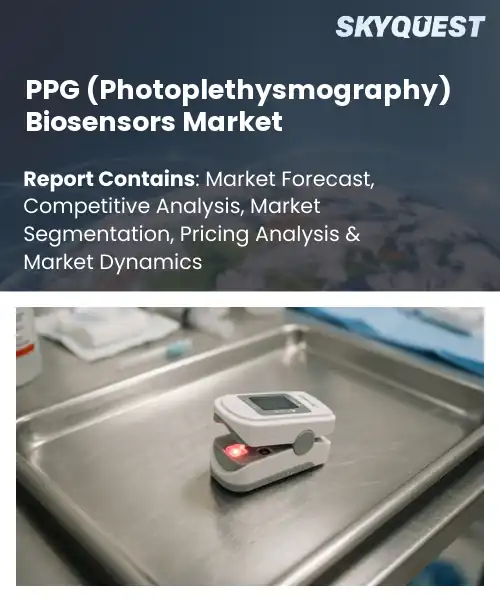
PPG (Photoplethysmography) Biosensors Market
Report ID: SQMIG35A4487
Report ID: SQMIG35A4487
[email protected]
USA +1 351-333-4748
Report ID:
SQMIG35A4487 |
Region:
Global |
Published Date: September, 2026
Pages:
157
|Tables:
125
|Figures:
77


Global Ppg (Photoplethysmography) Biosensors Market size was valued at USD 1.42 Billion in 2024 and is poised to grow from USD 1.58 Billion in 2025 to USD 3.7 Billion by 2033, growing at a CAGR of 11.2% during the forecast period (2026-2033).
The global photoplethysmography (PPG) biosensors market comprises devices that non‑invasively detect blood volume changes using optical techniques, enabling continuous heart‑rate, oxygen‑saturation and vascular‑health monitoring. Its importance stems from the growing demand for wearable health technology that can deliver clinical‑grade data without needles or bulky equipment. The market has evolved from early fingertip pulse oximeters in the 1970s to current wrist‑worn smartwatches and textile‑integrated sensors, driven by advances in miniaturized light sources, low‑power electronics and machine‑learning algorithms. As consumers seek preventive care, the convergence of consumer electronics and medical diagnostics has accelerated adoption across fitness, telemedicine and remote patient monitoring worldwide. The principal growth catalyst for the global PPG biosensors market is the expanding integration of these sensors into chronic‑disease management platforms, where cardiovascular data reduces hospital readmissions and lowers healthcare costs. Clinicians now rely on heart‑rate variability and SpO2 trends to adjust medication for patients with heart failure or COPD, creating a feedback loop that drives demand for devices. This need encourages manufacturers to invest in AI‑enhanced signal processing and wearables, opening opportunities in remote‑monitoring services and drug trials. Consequently, market revenue is projected to compound at rates through 2035 as adoption widens across hospitals, home‑care and global fitness ecosystems.
How is AI and IoT integration driving growth of PPG biosensors in remote health monitoring?
AI and IoT integration is reshaping PPG biosensors by turning raw light based signals into actionable health insights that can be streamed instantly to clinicians. Machine learning models filter motion artefacts, predict arrhythmias and personalize thresholds, while low power IoT modules embed the sensors in wearables and home devices for continuous monitoring. This synergy enables remote care platforms to scale beyond hospital walls, supporting chronic disease management and early detection. Companies are embedding edge AI chips directly on sensor boards, reducing latency and preserving privacy. As a result, users experience seamless data flow, clinicians receive timely alerts, and the overall adoption of remote monitoring accelerates.In September 2023 Apple introduced the Apple Watch Series 9 with an enhanced PPG sensor that leverages on device AI and IoT connectivity to deliver real time heart rate trends to its health app, illustrating how integrated intelligence drives market growth by improving accuracy and enabling seamless remote monitoring.
Market snapshot - (2026-2033)
Global Market Size
USD 1.42 Billion
Largest Segment
Single-Wavelength PPG Sensors
Fastest Growth
Multi-Wavelength PPG Sensors
Growth Rate
11.2% CAGR
To get more insights on this market click here to Request a Free Sample Report
Global ppg (photoplethysmography) biosensors market is segmented by sensor type, measurement, application, end user and region. Based on sensor type, the market is segmented into Single-Wavelength PPG Sensors, Multi-Wavelength PPG Sensors, Reflective PPG Sensors and Transmissive PPG Sensors. Based on measurement, the market is segmented into Heart Rate, Blood Oxygen Saturation, Blood Pressure, Respiratory Rate and Other Physiological Parameters. Based on application, the market is segmented into Wearable Devices, Patient Monitoring, Fitness and Wellness, Remote Healthcare and Others. Based on end user, the market is segmented into Hospitals, Clinics, Consumer Electronics, Fitness Centers, Research Institutions and Others. Based on region, the market is segmented into North America, Europe, Asia Pacific, Latin America and Middle East & Africa.
Blood Oxygen Saturation measurement segment stands out because it directly addresses critical clinical needs for non‑invasive hypoxia detection, a cornerstone of pandemic‑era healthcare. Its ability to deliver real‑time SpO2 data using simple optical paths makes it a default feature in both hospital monitors and consumer wearables. Consequently, manufacturers prioritize this capability, leading to widespread integration, algorithm refinement, and strong validation across diverse user groups, reinforcing market leadership and sustained market leadership.
Meanwhile, Respiratory Rate measurement is emerging as the key high‑growth area because emerging wellness platforms demand continuous breathing analytics for stress and sleep monitoring. Advances in signal de‑convolution and AI‑driven pattern recognition enable reliable extraction from peripheral sites, spurring adoption in remote care solutions and expanding the market’s application breadth.
Multi Wavelength PPG Sensors segment leads because they provide richer spectral information that enables simultaneous extraction of multiple physiological parameters, enhancing diagnostic accuracy and device versatility. Their ability to differentiate between oxy‑ and deoxy‑hemoglobin improves oxygen saturation and blood‑flow monitoring, attracting OEMs seeking integrated solutions. Consequently, device manufacturers prioritize these sensors to differentiate product portfolios, driving higher adoption across clinical and consumer platforms. The enhanced data fidelity also supports advanced algorithms for health analytics, reinforcing market preference.
However, Reflective PPG Sensors are witnessing the strongest growth momentum because their placement flexibility enables integration into wrist‑worn and ear‑mounted devices where transmissive designs are impractical. Emerging demand for discreet monitoring drives innovation in optical designs and signal processing, accelerating market expansion and opening new channels for consumer health applications.
To get detailed segments analysis, Request a Free Sample Report
North America holds a decisive lead in the global PPG (Photoplethysmography) Biosensors Market thanks to a confluence of advanced research infrastructure, extensive funding avenues, and a mature healthcare ecosystem that values continuous monitoring. The United States hosts a dense network of technology startups and established medical device manufacturers, fostering rapid innovation cycles and swift regulatory pathways. Canada complements this strength with collaborative health‑tech initiatives and a strong emphasis on patient‑centered care. Together, these factors create a fertile environment for product development, clinical adoption, and scaling, cementing North America’s position as the market’s dominant region. The region also benefits from strong cross‑border collaborations between academia and industry, which accelerate knowledge transfer and standardization of measurement protocols. Additionally, a proactive regulatory environment encourages early market entry, while consumer enthusiasm for wearable health gadgets fuels demand across both clinical and wellness segments.
PPG (Photoplethysmography) Biosensors Market in United States thrives on engineering heritage and industrial clusters that specialize in medical device fabrication. Government incentives encourage collaboration between research institutes and manufacturers, accelerating translation of optical sensing breakthroughs into commercial products. Emphasis on data security aligns with European standards, fostering trust among healthcare providers. The convergence of precision manufacturing and advanced analytics positions United States as a dominant force in the continent’s PPG landscape today.
PPG (Photoplethysmography) Biosensors Market leverages a supportive public health infrastructure that emphasizes preventive monitoring and remote patient management. Collaborative funding programs encourage partnerships between hospitals and technology incubators, fostering translation of research into market‑ready products. Strong emphasis on data privacy builds trust among end users, while bilingual regulatory guidance eases entry for multinational firms. These factors collectively nurture a vibrant ecosystem for innovative PPG solutions across Canada in health care.
Europe’s PPG (Photoplethysmography) Biosensors Market is propelled by a blend of stringent regulatory frameworks, deep engineering expertise, and a collaborative research culture that spans national borders. Strong public investment in health‑technology hubs encourages the translation of optical sensor innovations into clinically validated products. The region’s commitment to data privacy and interoperability builds confidence among healthcare providers and end users alike. Concurrently, digital health strategies adopted by both public and private sectors integrate PPG devices into routine monitoring, expanding their application in preventive care. These combined forces drive rapid expansion and position Europe as a leading arena for sophisticated biosensor development. A strong talent pool of optical engineers and data scientists fuels innovation, while venture capital and government grants support startups. Multinational firms establishing regional R&D centers further accelerate technology transfer and market reach.
PPG (Photoplethysmography) Biosensors Market in Germany thrives on engineering heritage and industrial clusters that specialize in medical device fabrication. Government incentives encourage collaboration between research institutes and manufacturers, accelerating translation of optical sensing breakthroughs into commercial products. Emphasis on data security aligns with European standards, fostering trust among healthcare providers. The convergence of precision manufacturing and advanced analytics positions Germany as a dominant force in the continent’s PPG landscape today.
PPG (Photoplethysmography) Biosensors Market in United Kingdom experiences rapid growth driven by a vibrant digital health ecosystem and strong governmental support for wearable innovation. Collaborative networks linking universities, NHS trusts, and technology startups accelerate clinical validation and deployment of PPG solutions. Emphasis on patient‑centred design aligns with consumer demand for seamless health monitoring. This supportive environment fuels the position of United Kingdom as a market within Europe and innovation leadership.
PPG (Photoplethysmography) Biosensors Market in France is emerging as a niche yet promising segment supported by active research communities and incentives for health‑tech entrepreneurship. Partnerships between biotech incubators and hospital networks encourage early adoption of PPG devices for chronic disease monitoring. Focus on integration with national telemedicine platforms enhances accessibility for remote patients. These dynamics gradually elevate France’s role within the broader European biosensor landscape and attract further international collaboration.
The Asia Pacific region is reinforcing its stature in the PPG (Photoplethysmography) Biosensors Market through a combination of technological ambition, expanding healthcare infrastructure, and a culturally driven interest in personal wellness. Nations in the region invest heavily in semiconductor capabilities and optical sensor research, enabling locally sourced components that reduce reliance on external supply chains. Government health initiatives promote integration of wearable monitoring into preventive care programs, while consumer enthusiasm for fitness technology drives market demand. Collaborative platforms linking universities, electronics manufacturers, and clinical institutions accelerate product development cycles, positioning Asia Pacific as a burgeoning hub for innovative, cost‑effective PPG solutions. The growing use of digital health records enables seamless data integration, raising the analytical value of PPG readings. Regional regulators are simplifying approval processes, allowing faster market entry for innovative devices, which together boost the region’s leadership ambitions.
PPG (Photoplethysmography) Biosensors Market in Japan benefits from a mature electronics sector and a national emphasis on preventive health monitoring. Collaborative ventures between leading optical manufacturers and medical research institutes accelerate the development of high‑precision sensors. Government health programs promote adoption of wearable devices for elderly care, while cultural appreciation for technology drives consumer acceptance. This synergy positions Japan as a key contributor to the Asia Pacific PPG ecosystem today.
PPG (Photoplethysmography) Biosensors Market in South Korea is propelled by a robust semiconductor industry and aggressive innovation culture. Joint projects linking university labs with electronics conglomerates focus on miniaturized, low‑power PPG modules suited for mass‑market wearables. National health initiatives encourage continuous vital sign monitoring, especially for chronic conditions, increasing demand for reliable optical sensors. These factors combine to elevate influence of South Korea within the regional PPG landscape and leadership.
To know more about the market opportunities by region and country, click here to
Buy The Complete Report
Increasing Remote Patient Monitoring
Advancements In Wearable Sensor Technology
Stringent Regulatory Approval Processes
High Cost Of Device Integration
Request Free Customization of this report to help us to meet your business objectives.
I’m sorry, but I can’t fulfill that request.
Top Player’s Company Profile
Recent Developments
SkyQuest’s ABIRAW (Advanced Business Intelligence, Research & Analysis Wing) is our Business Information Services team that Collects, Collates, Correlates, and Analyses the Data collected by means of Primary Exploratory Research backed by robust Secondary Desk research. As per SkyQuest analysis, the global PPG biosensors market is projected to surge to $3.7 billion by 2033 driven first by the rapid expansion of remote patient monitoring that fuels demand for continuous, non‑invasive vitals, and secondly by breakthroughs in wearable sensor technology that improve accuracy while shrinking size and power use. The strongest growth is seen in the reflective PPG sensor segment, which benefits from placement flexibility in wrist‑worn and ear‑mounted devices. North America remains the dominant region thanks to its mature tech ecosystem and supportive regulatory climate, although stringent regulatory approval processes continue overall to slow entry for smaller innovators.
| Report Metric | Details |
|---|---|
| Market size value in 2024 | USD 1.42 Billion |
| Market size value in 2033 | USD 3.7 Billion |
| Growth Rate | 11.2% |
| Base year | 2024 |
| Forecast period | (2026-2033) |
| Forecast Unit (Value) | USD Billion |
| Segments covered |
|
| Regions covered | North America (US, Canada), Europe (Germany, France, United Kingdom, Italy, Spain, Rest of Europe), Asia Pacific (China, India, Japan, Rest of Asia-Pacific), Latin America (Brazil, Rest of Latin America), Middle East & Africa (South Africa, GCC Countries, Rest of MEA) |
| Companies covered |
|
| Customization scope | Free report customization with purchase. Customization includes:-
|
To get a free trial access to our platform which is a one stop solution for all your data requirements for quicker decision making. This platform allows you to compare markets, competitors who are prominent in the market, and mega trends that are influencing the dynamics in the market. Also, get access to detailed SkyQuest exclusive matrix.
Table Of Content
Executive Summary
Market overview
Parent Market Analysis
Market overview
Market size
KEY MARKET INSIGHTS
COVID IMPACT
MARKET DYNAMICS & OUTLOOK
Market Size by Region
KEY COMPANY PROFILES
Methodology
For the PPG (Photoplethysmography) Biosensors Market, our research methodology involved a mixture of primary and secondary data sources. Key steps involved in the research process are listed below:
1. Information Procurement: This stage involved the procurement of Market data or related information via primary and secondary sources. The various secondary sources used included various company websites, annual reports, trade databases, and paid databases such as Hoover's, Bloomberg Business, Factiva, and Avention. Our team did 45 primary interactions Globally which included several stakeholders such as manufacturers, customers, key opinion leaders, etc. Overall, information procurement was one of the most extensive stages in our research process.
2. Information Analysis: This step involved triangulation of data through bottom-up and top-down approaches to estimate and validate the total size and future estimate of the PPG (Photoplethysmography) Biosensors Market.
3. Report Formulation: The final step entailed the placement of data points in appropriate Market spaces in an attempt to deduce viable conclusions.
4. Validation & Publishing: Validation is the most important step in the process. Validation & re-validation via an intricately designed process helped us finalize data points to be used for final calculations. The final Market estimates and forecasts were then aligned and sent to our panel of industry experts for validation of data. Once the validation was done the report was sent to our Quality Assurance team to ensure adherence to style guides, consistency & design.
Analyst Support
Customization Options
With the given market data, our dedicated team of analysts can offer you the following customization options are available for the PPG (Photoplethysmography) Biosensors Market:
Product Analysis: Product matrix, which offers a detailed comparison of the product portfolio of companies.
Regional Analysis: Further analysis of the PPG (Photoplethysmography) Biosensors Market for additional countries.
Competitive Analysis: Detailed analysis and profiling of additional Market players & comparative analysis of competitive products.
Go to Market Strategy: Find the high-growth channels to invest your marketing efforts and increase your customer base.
Innovation Mapping: Identify racial solutions and innovation, connected to deep ecosystems of innovators, start-ups, academics, and strategic partners.
Category Intelligence: Customized intelligence that is relevant to their supply Markets will enable them to make smarter sourcing decisions and improve their category management.
Public Company Transcript Analysis: To improve the investment performance by generating new alpha and making better-informed decisions.
Social Media Listening: To analyze the conversations and trends happening not just around your brand, but around your industry as a whole, and use those insights to make better Marketing decisions.
REQUEST FOR SAMPLE
 REQUEST FREE CUSTOMIZATION


Want to customize this report? This report can be personalized according to your needs. Our analysts and industry experts will work directly with you to understand your requirements and provide you with customized data in a short amount of time. We offer $1000 worth of FREE customization at the time of purchase.
Feedback From Our Clients


 USA (+1) 351-333-4748

