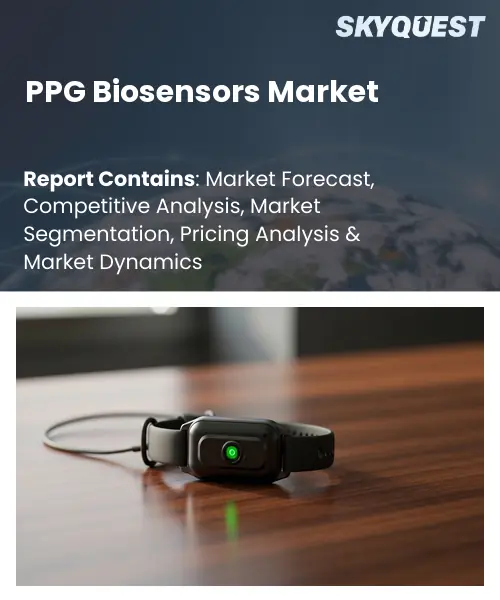
PPG Biosensors Market
Report ID: SQMIG35H2473
Report ID: SQMIG35H2473
[email protected]
USA +1 351-333-4748
Report ID:
SQMIG35H2473 |
Region:
Global |
Published Date: May, 2026
Pages:
157
|Tables:
154
|Figures:
78


Global PPG Biosensors Market size was valued at USD 689.2 Million in 2024 and is poised to grow from USD 791.89 Million in 2025 to USD 2405.61 Million by 2033, growing at a CAGR of 14.9% during the forecast period (2026-2033).
The increasing demand for continuous, non-invasive physiological monitoring both in the consumer market and clinical settings is the main driving force for the growth of the photoplethysmography PPG biosensors market. This accelerating demand has prompted a re-thinking of the device design and commercialization strategies by companies globally. Photoplethysmographic (PPG) sensors measure the volume of blood changes using light, allowing for monitoring of heart rate and oxygen saturation, which are critical to managing chronic diseases and for preventive care. They support the expansion of telehealth and reduce the number of hospital visits, therefore, the PPG biosensors market is of significant importance. In the last decade, PPG technology has evolved from bulky clinical oximeters to miniaturized wrist-based devices such as those manufactured by Apple and Fitbit that are now embedded in fitness trackers and smartwatches. In addition to the widespread acceptance of these consumer-based devices, advancements in algorithmic signal processing and machine learning that analyze raw optical data into measurable clinical metrics are a major driver of the continued growth of the PPG biosensors market. There has also been substantial improvement to the filtering of signal data through the use of artifact rejection algorithms that make PPB sensors more accurately able to measure vital signs like heart rate. There has been an increase in companies developing PPG devices that will allow continuous ambulatory monitoring of heart failure and sleep disorders, allowing clinicians to use long-term monitoring of patients instead of relying solely on snapshots of vital sign data. As companies are able to create economies of scale resulting in lower costs for PPG components, the PPG manufacturers are also beginning to concentrate on increasing their PPG biosensors market penetration in emerging economies and integrating PPG sensors into their telehealth platforms. This has led to the establishment of pilot remote monitoring projects by payers and hospitals to reduce readmission rates.
How is AI improving signal accuracy and reliability in the PPG biosensors market?
Photoplethysmography, PPG, biosensors record blood volume changes with light and contend with motion artifacts, skin tone variation and ambient interference. AI addresses these issues by learning to denoise signals, reject motion artifacts, adapt filter parameters and score signal quality so downstream metrics are more reliable. The market is shifting as wearables and medical devices pair compact optical hardware with on device or cloud machine learning, enabling cuffless blood pressure monitoring and continuous vital sign tracking. Real world pilots and studies show AI personalized models reduce false alarms and improve usable uptime in everyday conditions.
Biozen in May 2026, received FDA clearance for a calibration free cuffless blood pressure device that combines PPG with physiologically informed algorithms. That regulatory step shows how AI driven signal processing enhances measurement reliability, reduces calibration needs and helps speed clinical adoption and consumer uptake.
Market snapshot - (2026-2033)
Global Market Size
USD 689.2 Million
Largest Segment
Smart Watches
Fastest Growth
Smart Rings & Wearable Patches
Growth Rate
14.9% CAGR
To get more insights on this market click here to Request a Free Sample Report
Global ppg biosensors market is segmented by product type, device type, distribution channel, application, end user and region. Based on product type, the market is segmented into Smart Watches, Fitness Bands & Smart Wristbands, Pulse Oximeters, Smart Rings & Wearable Patches, Clinical & Hospital Monitoring Devices and Others. Based on device type, the market is segmented into Wearable PPG Biosensors and Non-Wearable / Clinical PPG Systems. Based on distribution channel, the market is segmented into OEM / Device Manufacturers, Direct Sales, Online Retail and Specialty Electronics & Medical Stores. Based on application, the market is segmented into Heart Rate Monitoring, Blood Oxygen Saturation (SpO2) Monitoring, Blood Pressure Monitoring, Respiratory Rate Monitoring, Sleep & Stress Monitoring, Arrhythmia & Cardiovascular Monitoring, Fitness & Activity Tracking and Others. Based on end user, the market is segmented into Consumer Electronics, Healthcare Providers & Hospitals, Home Healthcare & Remote Patient Monitoring, Sports & Fitness Industry and Research & Academic Institutes. Based on region, the market is segmented into North America, Europe, Asia Pacific, Latin America and Middle East & Africa.
The smart watches segment accounts for the majority of all PPG activity, as their continued incorporation into our daily wearables has resulted in high user engagement and therefore a widespread adoption of PPG sensors. Manufacturers are using more compact designs, multiple sensors combining to provide data from different sources, and large app ecosystems, to provide users with the ability to measure their heart rate or SpO2 around the clock, which leads to continuous software refinements and enhancement of the user’s data. With economies of scale, and increased consumer usage, manufacturers have increased their investment in improving PPG sensor accuracy and optimizing battery life, ensuring they remain market leaders in the consumer and lifestyle markets.
Fitness bands & smart wristbands are witnessing the strongest growth is largely due to because their integration into daily wearables creates constant user engagement and drives widespread adoption of PPG sensors. Fitness bands & smart wristbands are appealing to consumers and are therefore being purchased quickly due to the low price point and fitness-oriented design features. Improvements in optics and activity-specific algorithms have allowed for fitness bands and smart wristbands to be used in ways that go beyond mere activity tracking, and have consequently created partnerships and new product variations, facilitating further growth in this category.
Wearable PPG biosensors segment dominates because continuous, on body monitoring meets strong demand for real-time physiological data across consumer and clinical applications. Miniaturized optical modules, low power electronics and improved signal processing enable reliable heart rate and SpO2 capture during daily activities, prompting device makers to prioritize wearables. Integration with apps and telehealth platforms facilitates remote monitoring, driving sustained investment in wearable form factors and algorithm refinement.
However, non-wearable/clinical PPG systems are the most rapidly expanding segment because clinical validation and interoperability drive hospital procurement. Focused investment in high fidelity sensors and integrated monitoring platforms supports bedside and research applications, while regulatory momentum and EMR integration enable broader adoption and new clinical workflows that open substantial market opportunities.
To get detailed segments analysis, Request a Free Sample Report
The global PPG biosensors industry is primarily influenced by North America's advanced healthcare system, combined with the availability of innovative research and development, and many manufacturers located in the region. Established relationships among universities, hospitals, and manufacturing companies allow for quick clinical validation and refinement of products. A favorable regulatory environment along with reimbursement processes helps to accelerate product commercialization and product adoption, both medically and in consumer products.
The PPG biosensors market in the U.S. benefits from a large number of medical device manufacturing companies, research institutions, and clinical partners, which allow for quick clinical validation and adoption. The established commercialization processes and high levels of investment in the industry allow products to be developed and commercialized quickly. Digital health platforms and other forms of consumer wearable products commonly leverage PPG biosensors, while partnerships with healthcare systems allow for real-world testing and refinement of products. Mature supply chain systems, as well as extensive regulatory contact, provide a competitive advantage over manufacturers worldwide.
The PPG biosensors market in Canada is sustained due to the collaborative environment existing in the medtech industry, bridging both academic and industrial opportunities for research and development. Clinical research institutions and health networks can evaluate PPG devices during development, therefore, giving input on product design and validation. Close partnerships between manufacturers and solution providers, which are co-located with their U.S. counterparts, assist in supporting commercialization of PPG biosensors. There is an emphasis on product interoperability and user-centered design of PPG biosensors, which will help ensure that developed products will meet market needs.
The PPG biosensors industry in Asia Pacific is expected to grow substantially as a result of a number of trends including increased ownership of wearable devices by consumers to improve their health, continued strong electronics manufacturing ecosystems in the region, and rapidly expanding digitization of healthcare in each market globally. High levels of integration with mobile technologies as well as digital health service delivery help to increase the speed of adoption of products for both consumers and clinicians. Manufacturers of devices and system integrators in the region are focused on creating small, energy-efficient, and cost-effective designs to ensure that all market requirements are satisfied.
The Japan PPG biosensors market is being driven by leading-edge precision electronics manufacturing capabilities and a long-standing culture of clinical research collaboration. The focus on quality and strict validation processes is helping to drive adoption of PPG biosensors in healthcare monitoring applications. The presence of well-established industrial suppliers and system integrators provides the ability to achieve extremely precise sensor integration and miniaturization.
The South Korea PPG biosensors market is being driven by an electronics market that is providing a variety of products to such customers. The supply chain direction of each of these components is based on semiconductor and optical technologies, and strong supply chains exist that allow the ability of manufacturers to support the design of compact, low-power PPG biosensors. The collaboration among technology companies, healthcare providers, and research institutions is enabling the clinical validation and integration of the PPG biosensors into the mobile platforms of healthcare providers. Government and industry initiatives are pushing for the use of digital health solutions and will encourage both commercialisation of and regional expansion of PPG biosensors produced in South Korea.
Europe is strengthening its position in the PPG biosensors market through a combination of focused research ecosystems, established medical technology manufacturers, and coordinated regulatory frameworks that support device safety and market entry. By developing clinical validation and standardization across the 27 EU member states, national research centres and networks collaborate with the industry to demonstrate credibility of various PPG systems within the existing healthcare delivery systems. Interoperability between PPG devices and data security are being incorporated into wider digital health strategies. In addition, as a result of increased demand for PPG solutions from clinical pathways and specialist monitoring applications, there is a clear trend toward greater adoption of these devices.
Funds from both government and private sources are supporting the efforts of European companies to refine PPG sensor technology through the use of their engineering capabilities. Cross-border partnerships provide additional opportunities for European firms to leverage their engineering expertise into competitive international products through export efforts.
The PPG biosensors market in Germany has an established engineering and medical technology component dedicated to precision manufacturing. In addition, co-operation between manufacturers, research institutions, and clinical test has supported rigorous testing and validation efforts to develop PPG biosensors in Germany. There is an extensive supply chain of established medical device manufacturers as well as component manufacturers that provide reliable PPG sensors to end-users. The health system has established policies and procurement processes to encourage the adoption of validated products. Export-oriented firms leverage their engineering capabilities to create PPG biosensor products for the international market.
The UK PPG biosensors market has a benefit due to the availability of excellent clinical research networks across the country which enable real-world evaluations through collaboration with their National Health Service. Also, many start-ups and academic spin-offs collaborate with digital health platforms to develop sensors, with emphasis on designing the sensor itself and processing the signals. Manufacturer partners who are developing devices collaborate with emerging digital health platforms to help ensure that their products meet clinical demand by focusing on data governance.
The PPG biosensors market in France benefits from extensive clinical research networks and medical centres which are being used to provide test sites for innovative sensor technologies. In addition, emerging MedTech start-ups collaborate with existing manufacturers on device development, focusing on producing evidence in respect of the outcomes and how the devices align with the public health priorities allow for easier adoption into healthcare pathways.
To know more about the market opportunities by region and country, click here to
Buy The Complete Report
Rising Diabetes Prevalence
Advancements In Wearable Technology
Regulatory Approval Challenges
Signal Variability and Accuracy Concerns
Request Free Customization of this report to help us to meet your business objectives.
Competitive landscape of global PPG biosensors is defined by platform partnerships, regulatory driven product differentiation, and innovations in sensor technology through AI, resulting incumbents pursuing clinical integrations and acquisitions including niche new entrants providing cleared SDK for devices. Notable examples include Masimo with their wireless Radius PPG sensor, Biobeat using cuffless vital sign partnerships, and companies incorporating PPG derived algorithms into clinical workflows.
SkyQuest’s ABIRAW (Advanced Business Intelligence, Research & Analysis Wing) is our Business Information Services team that Collects, Collates, Correlates, and Analyses the Data collected by means of Primary Exploratory Research backed by robust Secondary Desk research.
As per SkyQuest analysis, the global PPG biosensors market is being propelled primarily by rising demand for continuous, noninvasive physiological monitoring across consumer and clinical settings, while regulatory approval challenges remain a key restraint that can slow clinical deployment. North America leads the market owing to mature healthcare infrastructure and strong device and R&D ecosystems, and smart watches represent the dominating product segment driven by daily wearability and integrated sensor platforms. A second important driver is rapid advancement in AI and signal processing that improves measurement accuracy and enables new clinical use cases. Together these forces support rapid growth but require clear regulatory pathways to unlock full clinical adoption.
| Report Metric | Details |
|---|---|
| Market size value in 2024 | USD 689.2 Million |
| Market size value in 2033 | USD 2405.61 Million |
| Growth Rate | 14.9% |
| Base year | 2024 |
| Forecast period | (2026-2033) |
| Forecast Unit (Value) | USD Million |
| Segments covered |
|
| Regions covered | North America (US, Canada), Europe (Germany, France, United Kingdom, Italy, Spain, Rest of Europe), Asia Pacific (China, India, Japan, Rest of Asia-Pacific), Latin America (Brazil, Rest of Latin America), Middle East & Africa (South Africa, GCC Countries, Rest of MEA) |
| Companies covered |
|
| Customization scope | Free report customization with purchase. Customization includes:-
|
To get a free trial access to our platform which is a one stop solution for all your data requirements for quicker decision making. This platform allows you to compare markets, competitors who are prominent in the market, and mega trends that are influencing the dynamics in the market. Also, get access to detailed SkyQuest exclusive matrix.
Table Of Content
Executive Summary
Market overview
Parent Market Analysis
Market overview
Market size
KEY MARKET INSIGHTS
COVID IMPACT
MARKET DYNAMICS & OUTLOOK
Market Size by Region
KEY COMPANY PROFILES
Methodology
For the PPG Biosensors Market, our research methodology involved a mixture of primary and secondary data sources. Key steps involved in the research process are listed below:
1. Information Procurement: This stage involved the procurement of Market data or related information via primary and secondary sources. The various secondary sources used included various company websites, annual reports, trade databases, and paid databases such as Hoover's, Bloomberg Business, Factiva, and Avention. Our team did 45 primary interactions Globally which included several stakeholders such as manufacturers, customers, key opinion leaders, etc. Overall, information procurement was one of the most extensive stages in our research process.
2. Information Analysis: This step involved triangulation of data through bottom-up and top-down approaches to estimate and validate the total size and future estimate of the PPG Biosensors Market.
3. Report Formulation: The final step entailed the placement of data points in appropriate Market spaces in an attempt to deduce viable conclusions.
4. Validation & Publishing: Validation is the most important step in the process. Validation & re-validation via an intricately designed process helped us finalize data points to be used for final calculations. The final Market estimates and forecasts were then aligned and sent to our panel of industry experts for validation of data. Once the validation was done the report was sent to our Quality Assurance team to ensure adherence to style guides, consistency & design.
Analyst Support
Customization Options
With the given market data, our dedicated team of analysts can offer you the following customization options are available for the PPG Biosensors Market:
Product Analysis: Product matrix, which offers a detailed comparison of the product portfolio of companies.
Regional Analysis: Further analysis of the PPG Biosensors Market for additional countries.
Competitive Analysis: Detailed analysis and profiling of additional Market players & comparative analysis of competitive products.
Go to Market Strategy: Find the high-growth channels to invest your marketing efforts and increase your customer base.
Innovation Mapping: Identify racial solutions and innovation, connected to deep ecosystems of innovators, start-ups, academics, and strategic partners.
Category Intelligence: Customized intelligence that is relevant to their supply Markets will enable them to make smarter sourcing decisions and improve their category management.
Public Company Transcript Analysis: To improve the investment performance by generating new alpha and making better-informed decisions.
Social Media Listening: To analyze the conversations and trends happening not just around your brand, but around your industry as a whole, and use those insights to make better Marketing decisions.
REQUEST FOR SAMPLE
 REQUEST FREE CUSTOMIZATION
Global Ppg Biosensors Market size was valued at USD 689.2 Million in 2024 and is poised to grow from USD 791.89 Million in 2025 to USD 2405.61 Million by 2033, growing at a CAGR of 14.9% during the forecast period (2026-2033).
Market competition in global PPG biosensors is defined by platform partnerships, regulatory driven product differentiation, and AI led sensor innovation; incumbents pursue clinical integrations and targeted acquisitions while niche entrants win SDK and device clearances. Examples include Masimo's Radius PPG tetherless sensor, Biobeat's cuffless vital sign partnerships, and firms adding PPG derived algorithms to clinical workflows. 'Apple Inc.', 'Samsung Electronics Co., Ltd.', 'Garmin Ltd.', 'Xiaomi Corporation', 'Omron Healthcare, Inc.', 'Masimo Corporation', 'Valencell, Inc.', 'Murata Manufacturing Co., Ltd.', 'Silicon Laboratories Inc.', 'MediaTek Inc.', 'Texas Instruments Incorporated', 'Nonin Medical, Inc.', 'Rockley Photonics Holdings Limited', 'Empatica Inc.', 'LifeQ Inc.', 'MedNet GmbH', 'BioTech Instruments, Inc.', 'Preventice Solutions, Inc.', 'CardiacSense Ltd.', 'Maxim Integrated Products, Inc.'
PPG biosensors benefit from the growing global burden of diabetes and related metabolic disorders, which increases demand for noninvasive and continuous glucose monitoring alternatives. Healthcare providers and patients are seeking less intrusive, easy-to-use devices that enable frequent measurement without blood sampling. This clinical need encourages investment in sensor development, integration into care pathways, and adoption by chronic disease management programs. As awareness of preventive monitoring rises, manufacturers prioritize PPG technology to meet user preferences for convenience and comfort, thereby expanding market opportunities.
Wearable Integration And Adoption: The integration of PPG biosensors into consumer and clinical wearables is driving adoption of continuous, noninvasive monitoring across care settings. Device makers emphasize ergonomic designs, energy efficient operation, and seamless connectivity to health ecosystems. Strategic partnerships among sensor developers, platform providers, and care organizations enable deployment and user engagement. Prioritizing comfort and long term adherence influences sensor placement and interface design, while commercial models highlight preventive health, remote chronic care management, and improved patient experience through unobtrusive, timely physiological insights.
Why does North America Dominate the Global PPG Biosensors Market? |@12


Want to customize this report? This report can be personalized according to your needs. Our analysts and industry experts will work directly with you to understand your requirements and provide you with customized data in a short amount of time. We offer $1000 worth of FREE customization at the time of purchase.
Feedback From Our Clients


 USA (+1) 351-333-4748

