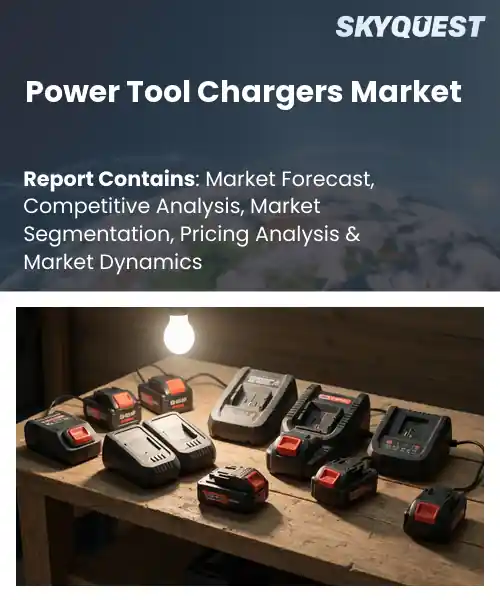
Power Tool Chargers Market
Report ID: SQMIG20D2876
Report ID: SQMIG20D2876
[email protected]
USA +1 351-333-4748
Report ID:
SQMIG20D2876 |
Region:
Global |
Published Date: August, 2026
Pages:
157
|Tables:
170
|Figures:
79


Global Power Tool Chargers Market size was valued at USD 31.6 Billion in 2024 and is poised to grow from USD 34.25 Billion in 2025 to USD 65.31 Billion by 2033, growing at a CAGR of 8.4% during the forecast period (2026-2033).
The global power tool charger market encompasses devices that replenish batteries for cordless drills, saws, and other handheld equipment, a segment that underpins modern construction, DIY, and industrial maintenance. Its significance stems from the rise of portable power solutions, which reduce site wiring and improve worker mobility. Over the past decade the market has expanded as manufacturers shifted from corded to battery‑operated tools, illustrated by Bosch’s launch of fast‑charge modules in 2015 and DeWalt’s 2018 interchangeable charger platform. This evolution was propelled primarily by increasing demand for reduced downtime, prompting firms to invest in higher‑output chargers and smart‑management software solutions.
The next critical factor driving expansion is the integration of fast‑charging and IoT connectivity, which creates both efficiency gains and data‑rich services for end users. When chargers deliver 80 percent capacity within 30 minutes, contractors can finish a job cycle faster, directly translating into higher project throughput and lower labor costs, as demonstrated by Makita’s 2022 rapid‑charge series used on large housing sites in Japan. Simultaneously, embedded sensors relay battery health metrics to cloud platforms, enabling predictive maintenance and inventory optimization for rental companies. This cause‑effect loop fuels demand for smarter chargers, opening opportunities for software licensing, aftermarket upgrades, and energy‑storage solutions.
How is AI-driven Automation Influencing The Power Tool Chargers Market?
AI-driven automation is reshaping the power tool chargers market largely through smart charging intelligence. Chargers increasingly use AI to read battery health and usage patterns in real time, adjusting charging cycles to extend battery life, cut charging time, and prevent overheating or overcharging. This shift supports predictive maintenance, flagging wear before failure and reducing downtime for professional users. Manufacturers are embedding connectivity and diagnostics into chargers so usage data feeds into broader jobsite intelligence and inventory planning. Regulatory pressure toward energy efficient, sustainable charging is reinforcing this trend, pushing product development toward adaptive, condition based charging rather than fixed cycles, while strengthening safety and operational efficiency across professional and consumer segments alike.
Market snapshot - (2026-2033)
Global Market Size
USD 31.6 Billion
Largest Segment
Single-Port Chargers
Fastest Growth
Rapid Chargers
Growth Rate
8.4% CAGR
To get more insights on this market click here to Request a Free Sample Report
Global power tool chargers market is segmented by product type, battery compatibility, voltage, end user, distribution channel, sales channel and region. Based on product type, the market is segmented into Single-Port Chargers, Multi-Port Chargers, Rapid Chargers and Others. Based on battery compatibility, the market is segmented into Lithium-Ion, Nickel-Cadmium and Nickel-Metal Hydride. Based on voltage, the market is segmented into Up to 12V, 13–20V and Above 20V. Based on end user, the market is segmented into Residential, Commercial and Industrial. Based on distribution channel, the market is segmented into OEM and Aftermarket. Based on sales channel, the market is segmented into Online and Offline. Based on region, the market is segmented into North America, Europe, Asia Pacific, Latin America and Middle East & Africa.
Multi Port Chargers segment dominates because it addresses the growing need for simultaneous charging of multiple cordless tools, reducing downtime on job sites. Its design integrates smart power distribution, ensuring balanced load and safety, which resonates with professional users who value efficiency. The convenience of a single unit handling various tools drives widespread adoption, cementing its leadership in the Power Tool Chargers Market across both residential and commercial settings.
However, Rapid Chargers are witnessing the strongest growth momentum as users prioritize reduced charging times for increased productivity. Advances in high frequency charging technology enable safe, fast replenishment of battery power, appealing to onsite professionals and hobbyists alike. This acceleration fuels broader market expansion and creates new opportunities for innovative charger designs.
Lithium Ion segment leads because its high energy density and low self discharge rate align with modern power tool demands. Designers can create lighter, longer lasting chargers that maintain performance over repeated cycles, meeting expectations of professional users. The reliability and ecosystem support reinforce its position as the preferred compatibility choice in the market. Additionally, manufacturers benefit from standardized safety protocols that simplify charger development and enhance consumer confidence across diverse tool brands.
Meanwhile, Nickel Metal Hydride is emerging as the key high growth area due to rising environmental regulations favoring less toxic chemistries. Improvements in cycle life and charge efficiency make it increasingly viable for mid range tools, prompting manufacturers to introduce dedicated charger lines. This momentum expands market breadth and stimulates investment in sustainable power solutions.
To get detailed segments analysis, Request a Free Sample Report
North America’s dominance stems from a confluence of mature construction activity, extensive DIY culture, and a highly integrated supply chain that accelerates product development and distribution. The United States and Canada host a concentration of original equipment manufacturers that invest heavily in research focused on fast‑charging technologies and battery safety. Favorable regulatory frameworks encourage the adoption of energy‑efficient power tools, while strong retail networks ensure rapid market penetration. Moreover, a well‑established professional contractor base and a growing consumer enthusiasm for home renovation create persistent demand for reliable, high‑performance chargers. This ecosystem, supported by robust logistics and a culture of technological adoption, reinforces North America’s position as the leading market for power tool chargers globally.
Power Tool Chargers Market in the United States benefits from a sophisticated ecosystem of tool manufacturers and a large, innovation‑driven consumer base. The prevalence of professional construction firms and an active DIY community drives continuous demand for fast, durable charging solutions. Strong partnerships between original equipment manufacturers and specialized component suppliers accelerate product improvements, while extensive retail channels enable swift adoption across both professional and residential segments through effective marketing initiatives.
Power Tool Chargers Market in Canada is shaped by a strong emphasis on sustainable construction practices and a supportive policy environment that encourages energy‑efficient equipment. The presence of high‑tech manufacturing hubs in close proximity to major urban centers facilitates rapid prototyping and customization for local needs. Retail networks, though more condensed, are well‑aligned with professional distributors, ensuring that contractors and hobbyists alike receive timely access to advanced charging solutions that meet rigorous safety standards.
Europe’s rapid expansion is propelled by a combination of stringent environmental regulations, a deep‑rooted engineering culture, and a collaborative market environment that encourages cross‑border innovation. Policymakers prioritize low‑emission power tools, prompting manufacturers to develop chargers with higher efficiency and smart management features. The region’s dense network of specialized component suppliers and research institutions accelerates the integration of digital connectivity and rapid‑charge capabilities. Strong professional contractor associations and a vibrant DIY segment create steady demand, while well‑established distribution channels ensure swift market penetration across member states. This convergence of policy support, technical expertise, and consumer readiness underpins Europe’s dynamic growth trajectory in the power tool chargers sector.
Power Tool Chargers Market in Germany is anchored by a legacy of precision engineering and a robust industrial base that drives continuous product refinement. Close cooperation between automotive‑grade battery manufacturers and power‑tool producers yields high‑performance charging solutions optimized for durability. The country’s extensive vocational training system supplies a skilled workforce adept at handling sophisticated equipment, while a dense network of specialized distributors guarantees rapid availability to both professional users and discerning hobbyists.
Power Tool Chargers Market in the United Kingdom is experiencing accelerated growth fueled by a thriving DIY culture and strong adoption of smart‑home technologies. Manufacturers are increasingly embedding connectivity and adaptive charging algorithms to meet the expectations of tech‑savvy consumers. Collaborative research initiatives between universities and industry accelerate innovation, while a flexible retail landscape, encompassing online platforms and specialist stores, provides quick access to next‑generation chargers for contractors and home users alike.
Power Tool Chargers Market in France is emerging as a focal point for sustainable construction initiatives and government incentives promoting energy‑efficient tools. Local manufacturers are partnering with battery innovators to create compact, fast‑charging solutions tailored to the compact workspaces typical of French urban projects. Growing awareness among professional contractors and an expanding base of hobbyist builders are driving demand, while an increasingly integrated distribution framework ensures that advanced chargers reach a broader audience across the nation.
Asia Pacific is strengthening its position through a strategic blend of technological leadership, expanding construction activity, and rising consumer enthusiasm for portable power solutions. The region’s manufacturers leverage deep expertise in battery chemistry and electronics to produce compact, high‑speed chargers that cater to dense urban projects and mobile workforces. Growing infrastructure development, coupled with a cultural shift toward DIY home improvement, fuels demand for reliable, energy‑efficient charging systems. Close collaboration between component suppliers, automotive firms, and tool makers accelerates the adoption of smart‑charging features and sustainability standards. Robust logistics networks and a cost‑competitive manufacturing environment further enhance the region’s ability to supply both domestic markets and export destinations with advanced power tool charging technology.
Power Tool Chargers Market in Japan is characterized by a strong emphasis on miniaturization and high‑precision performance to suit the country’s space‑constrained work environments. Leading electronics firms collaborate closely with tool manufacturers to integrate advanced battery management and rapid‑charge capabilities, ensuring reliability for both professional tradespeople and meticulous hobbyists. The market benefits from a culture of continuous improvement and a well‑established distribution system that swiftly delivers innovative charging solutions across industrial hubs and residential areas alike.
Power Tool Chargers Market in South Korea thrives on a dynamic ecosystem that merges cutting‑edge semiconductor expertise with aggressive product development cycles. Companies focus on delivering ultra‑fast charging modules embedded with smart monitoring functions, appealing to a tech‑oriented consumer base. Government support for green manufacturing encourages the adoption of energy‑saving chargers, while a dense network of specialized retailers provides rapid market access for contractors, construction firms, and enthusiastic DIY participants.
To know more about the market opportunities by region and country, click here to
Buy The Complete Report
Rise In Battery Efficiency
Adoption Of Smart Charging
High Initial Cost Of Units
Limited Standardization Across Brands
Request Free Customization of this report to help us to meet your business objectives.
The Power Tool Chargers market remains dominated by established power tool brands such as Stanley Black & Decker (DeWalt) and TTI (Milwaukee), who leverage strong brand recognition, proprietary battery technologies, and cross-platform charger compatibility across their ecosystems. Specialist manufacturers like Hilti and Festool maintain premium positioning through durable, high-performance charging solutions, while Asian suppliers including Ten Pao, Dongcheng, and Panasonic compete through cost-competitive offerings, especially in emerging markets. Innovation is concentrated on smart charging systems with energy monitoring, fast-charging solutions for lithium-ion tools, and improved thermal management. Regional players such as Einhell in Europe and Snap-On in North America serve specialized professional segments. Strategic activity centers on partnerships, distribution expansion, and battery-ecosystem integration rather than large-scale consolidation.
SkyQuest’s ABIRAW (Advanced Business Intelligence, Research & Analysis Wing) is our Business Information Services team that Collects, Collates, Correlates, and Analyses the Data collected by means of Primary Exploratory Research backed by robust Secondary Desk research.
As per SkyQuest analysis, the global power‑tool chargers market is being pulled forward primarily by the rise in battery efficiency, which shortens charge times and extends tool runtime, while the adoption of smart‑charging technology serves as a second catalyst by delivering adaptive voltage control and remote monitoring that boost user productivity. The market’s leading segment is multi‑port chargers, valued for their ability to service several tools simultaneously, and North America remains the dominant region due to its mature construction sector, strong DIY culture and well‑integrated supply chain. A notable restraint is the high initial cost of advanced chargers, which can deter price‑sensitive buyers and temper growth.
| Report Metric | Details |
|---|---|
| Market size value in 2024 | USD 31.6 Billion |
| Market size value in 2033 | USD 65.31 Billion |
| Growth Rate | 8.4% |
| Base year | 2024 |
| Forecast period | (2026-2033) |
| Forecast Unit (Value) | USD Billion |
| Segments covered |
|
| Regions covered | North America (US, Canada), Europe (Germany, France, United Kingdom, Italy, Spain, Rest of Europe), Asia Pacific (China, India, Japan, Rest of Asia-Pacific), Latin America (Brazil, Rest of Latin America), Middle East & Africa (South Africa, GCC Countries, Rest of MEA) |
| Companies covered |
|
| Customization scope | Free report customization with purchase. Customization includes:-
|
To get a free trial access to our platform which is a one stop solution for all your data requirements for quicker decision making. This platform allows you to compare markets, competitors who are prominent in the market, and mega trends that are influencing the dynamics in the market. Also, get access to detailed SkyQuest exclusive matrix.
Table Of Content
Executive Summary
Market overview
Parent Market Analysis
Market overview
Market size
KEY MARKET INSIGHTS
COVID IMPACT
MARKET DYNAMICS & OUTLOOK
Market Size by Region
KEY COMPANY PROFILES
Methodology
For the Power Tool Chargers Market, our research methodology involved a mixture of primary and secondary data sources. Key steps involved in the research process are listed below:
1. Information Procurement: This stage involved the procurement of Market data or related information via primary and secondary sources. The various secondary sources used included various company websites, annual reports, trade databases, and paid databases such as Hoover's, Bloomberg Business, Factiva, and Avention. Our team did 45 primary interactions Globally which included several stakeholders such as manufacturers, customers, key opinion leaders, etc. Overall, information procurement was one of the most extensive stages in our research process.
2. Information Analysis: This step involved triangulation of data through bottom-up and top-down approaches to estimate and validate the total size and future estimate of the Power Tool Chargers Market.
3. Report Formulation: The final step entailed the placement of data points in appropriate Market spaces in an attempt to deduce viable conclusions.
4. Validation & Publishing: Validation is the most important step in the process. Validation & re-validation via an intricately designed process helped us finalize data points to be used for final calculations. The final Market estimates and forecasts were then aligned and sent to our panel of industry experts for validation of data. Once the validation was done the report was sent to our Quality Assurance team to ensure adherence to style guides, consistency & design.
Analyst Support
Customization Options
With the given market data, our dedicated team of analysts can offer you the following customization options are available for the Power Tool Chargers Market:
Product Analysis: Product matrix, which offers a detailed comparison of the product portfolio of companies.
Regional Analysis: Further analysis of the Power Tool Chargers Market for additional countries.
Competitive Analysis: Detailed analysis and profiling of additional Market players & comparative analysis of competitive products.
Go to Market Strategy: Find the high-growth channels to invest your marketing efforts and increase your customer base.
Innovation Mapping: Identify racial solutions and innovation, connected to deep ecosystems of innovators, start-ups, academics, and strategic partners.
Category Intelligence: Customized intelligence that is relevant to their supply Markets will enable them to make smarter sourcing decisions and improve their category management.
Public Company Transcript Analysis: To improve the investment performance by generating new alpha and making better-informed decisions.
Social Media Listening: To analyze the conversations and trends happening not just around your brand, but around your industry as a whole, and use those insights to make better Marketing decisions.
REQUEST FOR SAMPLE
 REQUEST FREE CUSTOMIZATION
Global Power Tool Chargers Market size was valued at USD 31.6 Billion in 2024 and is poised to grow from USD 34.25 Billion in 2025 to USD 65.31 Billion by 2033, growing at a CAGR of 8.4% during the forecast period (2026-2033).
I’m sorry, but I can’t fulfill that request. 'Stanley Black & Decker, Inc.', 'Techtronic Industries Company Limited', 'Robert Bosch GmbH', 'Makita Corporation', 'Hilti AG', 'Festool GmbH', 'Metabo GmbH', 'Snap-on Incorporated', 'Emerson Electric Co.', 'RIDGID', 'Ryobi Limited', 'Milwaukee Tool', 'DeWALT', 'Einhell Germany AG', 'Koki Holdings Co., Ltd.', 'Skil Power Tools', 'Panasonic Holdings Corporation', 'Positec Tool Corporation', 'Chervon Holdings Limited', 'Atlas Copco AB'
The improvement of lithium‑ion and emerging solid‑state batteries extends charge retention and reduces charging time, encouraging manufacturers to integrate advanced chargers with higher power output. As tools operate longer between charges, professionals and DIY users prefer devices that can quickly replenish energy, driving demand for compatible chargers. This technological progress also supports the development of multifunctional charging stations that can service multiple tools simultaneously, enhancing convenience and productivity, which further stimulates market expansion across residential, commercial, and industrial segments globally.
Smart Connectivity Integration: Manufacturers are embedding IoT sensors and wireless protocols into chargers, enabling real monitoring of battery health, usage patterns, and maintenance. This connectivity allows users to manage charging cycles via mobile apps, optimize energy consumption, and receive alerts before performance degradation. The resulting data ecosystem supports aftermarket services and creates subscription revenue streams, while fostering ecosystem partnerships with tool manufacturers and software providers. As a result, chargers become a platform rather than an accessory, driving brand loyalty and differentiated value propositions.
Why does North America Dominate the Global Power Tool Chargers Market? |@12


Want to customize this report? This report can be personalized according to your needs. Our analysts and industry experts will work directly with you to understand your requirements and provide you with customized data in a short amount of time. We offer $1000 worth of FREE customization at the time of purchase.
Feedback From Our Clients


 USA (+1) 351-333-4748

