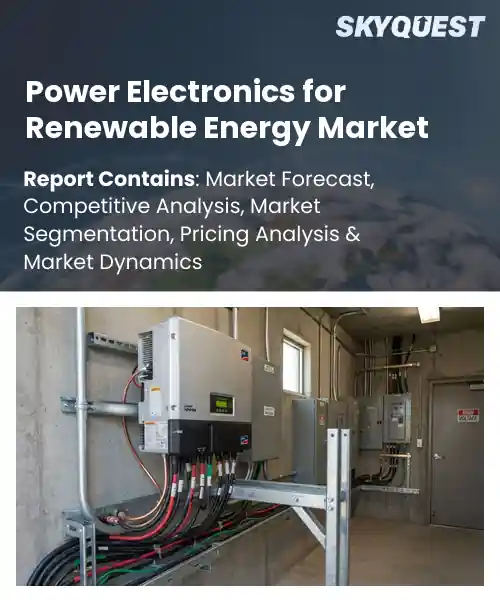
Power Electronics for Renewable Energy Market
Report ID: SQMIG20D2932
Report ID: SQMIG20D2932
[email protected]
USA +1 351-333-4748
Report ID:
SQMIG20D2932 |
Region:
Global |
Published Date: September, 2026
Pages:
157
|Tables:
149
|Figures:
78


Global Power Electronics For Renewable Energy Market size was valued at USD 9.85 Billion in 2024 and is poised to grow from USD 10.58 Billion in 2025 to USD 18.73 Billion by 2033, growing at a CAGR of 7.4% during the forecast period (2026-2033).
The power‑electronics market for renewable energy comprises converters, inverters and control systems that transform intermittent solar or wind output into grid‑compatible electricity. Its importance stems from the need to integrate larger shares of generation while preserving standards. Historically, the sector emerged in the 2000s when photovoltaic installations surpassed 1 GW, prompting manufacturers to develop string inverters that could handle variable irradiance. Incentives such as feed‑in tariffs in Europe and tax credits in the United States accelerated deployment and spurred efficiency improvements. Today, the market supports offshore wind farms and solar parks, illustrating its evolution from niche components to essential grid infrastructure. Building on that foundation, the principal growth driver is the decline in semiconductor costs combined with advances in silicon‑carbide (SiC) and gallium‑nitride (GaN) devices, which enable higher switching frequencies and lower losses. As converters become more efficient, developers can reduce system expenses, making offshore wind projects such as the 1.2 GW Hornsea II scheme viable. This efficiency also encourages storage integration, because inverters can manage power flow for battery farms like the 300 MW Moss Landing facility. Consequently, manufacturers expand production capacity and invest in firmware, creating a loop where lower prices spur adoption, which in turn drives technological refinement and market expansion.
How are AI and IoT driving efficiency in the power electronics for renewable energy market?
AI and IoT are reshaping power electronics for renewable energy by enabling real‑time monitoring, predictive maintenance and adaptive control of converters and inverters. Sensors collect voltage, current and temperature data, while AI algorithms analyze patterns to anticipate faults before they cause downtime. IoT connectivity allows distributed assets to share performance metrics, creating a coordinated grid that balances supply and demand more efficiently. These technologies reduce losses, extend component life and simplify integration of solar and wind sources, making renewable projects more reliable and cost‑effective. Industry players are embedding smart firmware into power modules, turning traditional hardware into data‑rich platforms that continuously optimize operation.A specific recent development is not available.
Market snapshot - (2026-2033)
Global Market Size
USD 9.85 Billion
Largest Segment
Power Semiconductors
Fastest Growth
Inverters
Growth Rate
7.4% CAGR
To get more insights on this market click here to Request a Free Sample Report
Global power electronics for renewable energy market is segmented by component, renewable energy source, application, voltage, end user and region. Based on component, the market is segmented into Power Semiconductors, Power Converters, Inverters, Power Modules and Other Power Electronic Components. Based on renewable energy source, the market is segmented into Solar Energy, Wind Energy, Hydropower and Other Renewable Energy Sources. Based on application, the market is segmented into Grid-Connected Systems, Energy Storage Systems, Microgrids, Off-Grid Systems and Electric Vehicle Charging. Based on voltage, the market is segmented into Low Voltage, Medium Voltage and High Voltage. Based on end user, the market is segmented into Utilities, Commercial & Industrial and Residential. Based on region, the market is segmented into North America, Europe, Asia Pacific, Latin America and Middle East & Africa.
Inverters segment dominates because they directly convert variable DC generated by renewable sources into grid compatible AC, a critical step for system integration. Their ability to support high efficiency, rapid response, and advanced control algorithms makes them indispensable for both utility scale farms and distributed installations. Design flexibility, reliability under harsh outdoor conditions, and continuous innovation in silicon and wide bandgap technologies reinforce their central position in the market.
However, Power modules segment is witnessing the strongest growth momentum as system designers embrace integrated solutions that combine semiconductor devices, driver circuits, and thermal management into compact packages. This integration reduces board space, simplifies assembly, and accelerates time to market, driving broader adoption across emerging applications and expanding market opportunity.
Energy storage systems segment leads because they provide buffering capacity that smooths intermittent generation, enabling stable power delivery and grid compliance. Their ability to store excess energy during peak production and release it during demand spikes enhances system efficiency and supports ancillary services, making them essential for renewable deployments and maintaining power quality. Coupled with falling battery prices and advanced management algorithms, these systems solidify their role as a cornerstone of modern renewable infrastructure.
Meanwhile, Microgrids segment emerges as the key high growth area as communities and commercial sites seek localized, resilient power networks that can operate independently of the main grid. The fusion of renewable generation, smart control, and plug and play power electronics accelerates deployment, creating new market opportunities and driving rapid expansion.
To get detailed segments analysis, Request a Free Sample Report
Asia Pacific enjoys a convergence of advanced manufacturing expertise, strong policy encouragement, and a deep commitment to renewable integration that collectively underpin its market leadership. The region’s industrial base excels in high‑efficiency semiconductor production, enabling cost‑effective inverter and converter solutions. Government frameworks consistently promote clean energy targets, stimulating demand for sophisticated power electronics across utility‑scale and distributed projects. Moreover, the presence of world‑class research institutions fuels continuous innovation, while strategic partnerships between manufacturers and grid operators accelerate technology adoption. This blend of technical prowess, supportive regulation, and collaborative ecosystems creates a resilient foundation that keeps Asia Pacific at the forefront of the global renewable power electronics landscape.
Japan Power Electronics for Renewable Energy Market
Power Electronics for Renewable Energy Market in Japan benefits from a longstanding tradition of precision engineering and a proactive approach to decarbonisation. Industry leaders invest heavily in research that enhances converter efficiency and durability, supporting a growing portfolio of offshore wind and solar installations. Close coordination between utilities, technology firms, and policy makers ensures that standards evolve in lockstep with emerging technologies, fostering a seamless integration of power electronics into the national grid. The focus on reliability and high performance positions Japan as a benchmark for sophisticated renewable power solutions.
South Korea Power Electronics for Renewable Energy Market
Power Electronics for Renewable Energy Market in South Korea is driven by a robust semiconductor sector that readily adapts its capabilities to renewable applications. Government incentives encourage the deployment of smart grid components, while corporate strategy emphasizes rapid scaling of inverter technologies for both utility and residential sectors. Collaborative ecosystems link academic research with manufacturing, accelerating the transition from prototype to commercial deployment. The emphasis on compact, high‑density designs enables extensive integration of renewable sources, reinforcing South Korea’s role as a key innovator in the regional market.
Europe’s rapid expansion is propelled by ambitious climate objectives, a mature renewable energy mix, and a strategic emphasis on grid flexibility. Policy frameworks across the continent prioritize renewable integration, prompting utilities to adopt advanced power electronic converters that balance variable generation with grid stability. Strong engineering talent pools and a tradition of collaborative standards development ensure interoperable solutions that meet stringent performance criteria. Investment in offshore wind, solar farms, and emerging storage projects creates continuous demand for high‑efficiency inverters and converters. This synergy of regulatory ambition, technical expertise, and cross‑border cooperation fuels Europe’s position as a dynamic hub for renewable power electronics innovation.
Germany Power Electronics for Renewable Energy Market
Power Electronics for Renewable Energy Market in Germany reflects its status as a leading industrial powerhouse with deep engineering roots. German firms specialise in high‑power converters that support extensive wind parks and large‑scale solar farms, emphasizing reliability and precision. Collaborative research institutes work closely with manufacturers to refine thermal management and power density, delivering solutions that align with the nation’s robust renewable targets. A clear focus on standardisation and quality assurance sustains confidence among utilities and project developers, reinforcing Germany’s dominant market role.
United Kingdom Power Electronics for Renewable Energy Market
Power Electronics for Renewable Energy Market in United Kingdom experiences swift growth thanks to ambitious offshore wind programmes and a supportive regulatory environment. The sector benefits from a vibrant ecosystem of start‑ups and established manufacturers that prioritise lightweight, high‑efficiency inverter designs suited to marine conditions. Policy incentives encourage the adoption of smart grid technologies, prompting utilities to integrate advanced converters that enhance system resilience. Collaborative pilots between academia and industry accelerate the rollout of next‑generation power electronics, positioning the United Kingdom as a rapid growth market.
France Power Electronics for Renewable Energy Market
Power Electronics for Renewable Energy Market in France is emerging as a focal point for innovative renewable integration. French technology providers concentrate on modular converter architectures that facilitate flexible deployment across diverse solar and wind projects. Governmental programmes champion eco‑innovation, providing a collaborative platform for research institutions to develop high‑performance power electronic solutions. The emphasis on clean energy transition drives utilities to adopt advanced grid‑forming inverters, fostering a supportive environment for market expansion and positioning France as an emerging leader.
North America advances its market position through a combination of extensive renewable capacity growth, a vibrant technology ecosystem, and strategic investments in grid modernization. The region’s emphasis on resilient, intelligent power conversion supports the integration of large‑scale solar and wind assets while enhancing grid reliability. Strong collaboration between leading semiconductor manufacturers, research universities, and utilities accelerates the development of high‑efficiency converters and smart inverter functionalities. Policy encouragement for clean energy adoption and a focus on domestic supply chains further reinforce the region’s ability to scale innovative power electronics solutions, solidifying its competitive edge.
United States Power Electronics for Renewable Energy Market
Power Electronics for Renewable Energy Market in United States benefits from a broad and diversified renewable portfolio that demands versatile conversion technologies. Industry leaders leverage extensive semiconductor capabilities to produce inverters that balance performance with cost efficiency for utility and distributed applications. Partnerships between research institutions and manufacturers accelerate advances in wide‑bandgap devices, enhancing power density and thermal management. Regulatory frameworks that promote grid flexibility encourage utilities to adopt advanced converters, reinforcing the United States’ role in shaping the future of renewable power electronics.
Canada Power Electronics for Renewable Energy Market
Power Electronics for Renewable Energy Market in Canada aligns with its expansive renewable resources and a strong commitment to clean energy transition. Canadian firms focus on robust converter solutions designed for cold‑climate operation, supporting wind farms and emerging solar installations across vast territories. Collaborative initiatives between academia, government, and industry foster innovation in high‑efficiency power electronic components that improve grid stability. Emphasis on indigenous technology development and sustainable practices positions Canada as an emerging contributor to the broader North American power electronics landscape.
To know more about the market opportunities by region and country, click here to
Buy The Complete Report
Growing Renewable Energy Capacity
Integration With Smart Grids
High Initial Capital Investment
Limited Supply Chain Localization
Request Free Customization of this report to help us to meet your business objectives.
Competitive pressure in the power‑electronics segment is driven by the race to improve inverter efficiency and reduce system cost, prompting aggressive M&A, partnerships, and technology roll‑outs. Infineon’s launch of CoolSiC modules, ABB’s collaboration with Tesla on megawatt‑scale battery inverters, and Siemens Energy’s joint venture with Envision Energy on offshore‑wind converters illustrate how incumbents are leveraging advanced semiconductor tech and strategic alliances to outpace rivals.
Top Player’s Company Profile
Recent Developments
SkyQuest’s ABIRAW (Advanced Business Intelligence, Research & Analysis Wing) is our Business Information Services team that Collects, Collates, Correlates, and Analyses the Data collected by means of Primary Exploratory Research backed by robust Secondary Desk research. As per SkyQuest analysis the global power electronics market for renewable energy is projected to rise at a 7.4% CAGR through 2033, driven primarily by falling semiconductor costs and the rapid adoption of silicon‑carbide and gallium‑nitride devices that boost conversion efficiency. A second major catalyst is the deepening integration of power electronics with smart‑grid architectures, which enables real‑time voltage regulation and flexible load management. The inverters segment remains the clear leader because it directly transforms variable DC into grid‑compatible AC, while Asia Pacific dominates the market thanks to its strong manufacturing base and supportive policies. However, high initial capital investment in advanced modules continues to temper growth.
| Report Metric | Details |
|---|---|
| Market size value in 2024 | USD 9.85 Billion |
| Market size value in 2033 | USD 18.73 Billion |
| Growth Rate | 7.4% |
| Base year | 2024 |
| Forecast period | (2026-2033) |
| Forecast Unit (Value) | USD Billion |
| Segments covered |
|
| Regions covered | North America (US, Canada), Europe (Germany, France, United Kingdom, Italy, Spain, Rest of Europe), Asia Pacific (China, India, Japan, Rest of Asia-Pacific), Latin America (Brazil, Rest of Latin America), Middle East & Africa (South Africa, GCC Countries, Rest of MEA) |
| Companies covered |
|
| Customization scope | Free report customization with purchase. Customization includes:-
|
To get a free trial access to our platform which is a one stop solution for all your data requirements for quicker decision making. This platform allows you to compare markets, competitors who are prominent in the market, and mega trends that are influencing the dynamics in the market. Also, get access to detailed SkyQuest exclusive matrix.
Table Of Content
Executive Summary
Market overview
Parent Market Analysis
Market overview
Market size
KEY MARKET INSIGHTS
COVID IMPACT
MARKET DYNAMICS & OUTLOOK
Market Size by Region
KEY COMPANY PROFILES
Methodology
For the Power Electronics for Renewable Energy Market, our research methodology involved a mixture of primary and secondary data sources. Key steps involved in the research process are listed below:
1. Information Procurement: This stage involved the procurement of Market data or related information via primary and secondary sources. The various secondary sources used included various company websites, annual reports, trade databases, and paid databases such as Hoover's, Bloomberg Business, Factiva, and Avention. Our team did 45 primary interactions Globally which included several stakeholders such as manufacturers, customers, key opinion leaders, etc. Overall, information procurement was one of the most extensive stages in our research process.
2. Information Analysis: This step involved triangulation of data through bottom-up and top-down approaches to estimate and validate the total size and future estimate of the Power Electronics for Renewable Energy Market.
3. Report Formulation: The final step entailed the placement of data points in appropriate Market spaces in an attempt to deduce viable conclusions.
4. Validation & Publishing: Validation is the most important step in the process. Validation & re-validation via an intricately designed process helped us finalize data points to be used for final calculations. The final Market estimates and forecasts were then aligned and sent to our panel of industry experts for validation of data. Once the validation was done the report was sent to our Quality Assurance team to ensure adherence to style guides, consistency & design.
Analyst Support
Customization Options
With the given market data, our dedicated team of analysts can offer you the following customization options are available for the Power Electronics for Renewable Energy Market:
Product Analysis: Product matrix, which offers a detailed comparison of the product portfolio of companies.
Regional Analysis: Further analysis of the Power Electronics for Renewable Energy Market for additional countries.
Competitive Analysis: Detailed analysis and profiling of additional Market players & comparative analysis of competitive products.
Go to Market Strategy: Find the high-growth channels to invest your marketing efforts and increase your customer base.
Innovation Mapping: Identify racial solutions and innovation, connected to deep ecosystems of innovators, start-ups, academics, and strategic partners.
Category Intelligence: Customized intelligence that is relevant to their supply Markets will enable them to make smarter sourcing decisions and improve their category management.
Public Company Transcript Analysis: To improve the investment performance by generating new alpha and making better-informed decisions.
Social Media Listening: To analyze the conversations and trends happening not just around your brand, but around your industry as a whole, and use those insights to make better Marketing decisions.
REQUEST FOR SAMPLE
 REQUEST FREE CUSTOMIZATION


Want to customize this report? This report can be personalized according to your needs. Our analysts and industry experts will work directly with you to understand your requirements and provide you with customized data in a short amount of time. We offer $1000 worth of FREE customization at the time of purchase.
Feedback From Our Clients


 USA (+1) 351-333-4748

