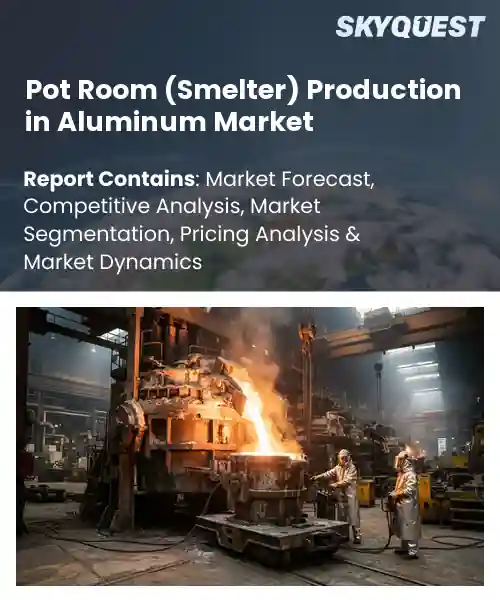
Pot Room (Smelter) Production in Aluminum Market
Report ID: SQMIG15I2038
Report ID: SQMIG15I2038
[email protected]
USA +1 351-333-4748
Report ID:
SQMIG15I2038 |
Region:
Global |
Published Date: October, 2026
Pages:
157
|Tables:
145
|Figures:
78


Global Pot Room (Smelter) Production In Aluminum Market size was valued at USD 185.0 Billion in 2024 and is poised to grow from USD 192.77 Billion in 2025 to USD 267.91 Billion by 2033, growing at a CAGR of 4.2% during the forecast period (2026-2033).
The global pot‑room sector, the heart of primary aluminium production, converts alumina into liquid metal through electrolytic reduction, and its output determines supply‑side dynamics across the industry. Historically, capacity expanded rapidly after World II as de‑industrialisation in Europe gave way to new smelters in the Middle East and China, where abundant cheap electricity and supportive policies lowered operating costs. Today, the market represents roughly 70 % of total primary aluminium output, a share that matters because it links energy markets, trade balances, and downstream sectors such as automotive and aerospace. Consequently, fluctuations in pot‑room throughput influence price volatility and investment decisions worldwide. The surge in renewable-energy integration serves as catalyst for expanding pot‑room production, because abundant cheap solar and wind power reduces electricity expenses, the single largest cost component in aluminium smelting. Chinese firms such as China Hongqiao have leveraged newly built solar farms to cut per‑ton energy bills by 12%, prompting rival producers in the Gulf to announce similar ventures. This cost advantage translates into margin, encouraging capital for high‑efficiency cells that consume up to 10 % less power. As a result, regions with green‑energy incentives attract foreign investment, creating jobs and reinforcing the shift toward a decarbonised global aluminium supply chain.
How does AI and IoT automation enhance potroom aluminum smelting productivity?
AI and IoT automation transform the potroom by linking sensors, actuators and analytics in a loop. Sensors capture temperature, voltage, gas composition and line speed while edge processors clean the data. Machine learning models predict optimal current profiles and flag anomalies before they cause downtime. Operators receive cues on dashboards that guide adjustments in real time. The result is steadier aluminum flow, fewer furnace interruptions and lower energy waste. The market is moving toward digital twins that replicate the entire smelting line, allowing planners to test scenarios without risking production. Companies that adopt these tools report smoother runs and faster response to raw material changes.Alcoa March 2024 introduced an AI driven potroom monitoring platform that fuses IoT sensor streams with predictive analytics. The system automatically tunes current and alumina feed, reducing unplanned outages and supporting higher throughput. This rollout illustrates how intelligent automation fuels growth and efficiency in modern aluminum smelting.
Market snapshot - (2026-2033)
Global Market Size
USD 185.0 Billion
Largest Segment
Prebake Technology
Fastest Growth
Prebake Technology
Growth Rate
4.2% CAGR
To get more insights on this market click here to Request a Free Sample Report
Global pot room (smelter) production in aluminum market is segmented by production technology, smelter type, pot capacity, production process, end use and region. Based on production technology, the market is segmented into Prebake Technology and Söderberg Technology. Based on smelter type, the market is segmented into Primary Aluminum Smelters and Secondary & Remelting Facilities. Based on pot capacity, the market is segmented into Small-Capacity Pots, Medium-Capacity Pots and Large-Capacity Pots. Based on production process, the market is segmented into Electrolysis, Anode Production, Cathode & Pot Maintenance and Metal Tapping & Handling. Based on end use, the market is segmented into Transportation, Construction, Packaging, Electrical & Electronics and Other End Uses. Based on region, the market is segmented into North America, Europe, Asia Pacific, Latin America and Middle East & Africa.
Prebake technology segment dominates because it provides consistent anode quality, reduces downtime, and enables precise control of the electrolysis environment. The baked anodes are less prone to self consumption, which improves current efficiency and lowers operational costs. This reliability makes prebake the preferred choice for modern pot rooms seeking stable production and lower emissions. Operators also benefit from simplified anode handling procedures, which further shortens changeover cycles and supports continuous casting schedules. Moreover, the technology aligns with environmental regulations by minimizing greenhouse gas release during smelting. However, Söderberg technology segment is witnessing the strongest growth momentum as smelters seek cost effective solutions that leverage in situ anode formation. The continuous baking process reduces capital investment and simplifies supply chains, attracting facilities aiming to expand capacity quickly. This emerging preference is accelerating market expansion and creating new opportunities for equipment suppliers.
Large capacity pots segment leads because they enable higher current densities, allowing more aluminum to be produced per unit time. Their expanded surface area improves heat distribution, which stabilizes the electrolyte and reduces energy losses. Operators benefit from lower per ton costs and streamlined maintenance schedules, making these pots attractive for high volume smelters focused on efficiency and output scaling. Additionally, the robust design tolerates longer operational cycles, decreasing downtime and supporting continuous casting demands. Meanwhile, medium capacity pots segment emerges as the fastest growing area as manufacturers balance capital constraints with the need for flexible production lines. These pots offer a compromise between size and investment, enabling incremental capacity upgrades and easier integration into existing facilities. Their adaptability fuels adoption across mid scale smelters, driving market expansion.
To get detailed segments analysis, Request a Free Sample Report
Asia Pacific dominates the global pot room smelter production in aluminum market because the region combines deep mineral endowment with highly integrated downstream industries. Leading economies have invested heavily in modern smelting technologies that prioritize energy efficiency and low emissions, aligning with stringent environmental expectations. The proximity to major automotive, electronics, and construction manufacturers creates a seamless supply chain that reduces logistics complexity. Robust research ecosystems foster continuous innovation in cell design and recycling processes, while supportive policy frameworks encourage investment in renewable power sources. In addition, collaborative networks among original equipment manufacturers and smelting firms accelerate technology transfer, while the region’s focus on circular economy principles drives higher scrap utilization, further strengthening its competitive edge.
Japan Pot Room (Smelter) Production in Aluminum Market
Pot Room (Smelter) Production in Aluminum Market in Japan benefits from a long history of precision engineering and a strong emphasis on sustainability. Advanced cell technologies are paired with abundant renewable electricity, enabling low‑carbon output that aligns with domestic environmental goals. Close integration with high‑value automotive and electronics manufacturers ensures steady demand, while extensive recycling infrastructure maximizes scrap utilization, reinforcing Japan’s reputation for high‑quality, efficient aluminum production and global competitiveness.
South Korea Pot Room (Smelter) Production in Aluminum Market
Pot Room (Smelter) Production in Aluminum Market in South Korea is driven by modernization and a strategic focus on high‑performance alloys. The industry leverages cutting‑edge smelting cells powered by a mix of hydro and nuclear electricity, delivering a low‑emission profile that meets stringent domestic standards. Strong collaboration with shipbuilding and heavy‑industry sectors creates a reliable demand base, while government incentives promote the adoption of advanced recycling techniques, enhancing resource efficiency.
Rapid expansion of pot room smelter production in aluminum market in North America is propelled by a confluence of strategic investments and evolving demand patterns. Energy providers are increasingly offering low‑carbon electricity, enabling producers to lower emissions and meet stricter environmental expectations. Strong demand from aerospace, automotive lightweighting, and large‑scale construction projects fuels the need for high‑volume, high‑quality aluminum. Government incentives and trade policies encourage domestic capacity building, reducing reliance on imports. Technological advancements in cell design and digital monitoring improve operational efficiency, while collaborations between research institutions and industry accelerate the adoption of innovative smelting techniques. The region’s emphasis on circular economy practices further strengthens its competitive advantage by increasing scrap recycling rates and fostering sustainable supply chains.
United States Pot Room (Smelter) Production in Aluminum Market
Pot Room (Smelter) Production in Aluminum Market in United States is characterized by scale and a strong focus on innovation. Access to abundant low‑cost renewable power supports the development of high‑efficiency smelting cells that meet environmental standards. Close ties with the aerospace and automotive sectors generate consistent demand for lightweight alloys, while a recycling network maximizes scrap utilization. Federal programs and private investment together drive continuous modernization across the industry.
Canada Pot Room (Smelter) Production in Aluminum Market
Pot Room (Smelter) Production in Aluminum Market in Canada benefits from resources that provide a low‑carbon energy base. The industry emphasizes sustainable practices, integrating advanced cell technologies that reduce energy consumption and emissions. Close collaboration with the energy sector and environmental regulations reinforce the market’s green credentials. Growing demand from construction and transportation sectors, combined with a scrap recycling system, supports capacity expansion and reinforces Canada’s reputation for aluminum production.
Europe is strengthening its position in pot room smelter production in aluminum market through a concerted focus on sustainability and technological leadership. Stringent environmental directives encourage the adoption of low‑carbon smelting processes and the integration of renewable power sources, reducing the carbon intensity of domestic production. Robust investment in research and development drives continuous improvement in cell efficiency and the deployment of digital monitoring tools. The region’s mature recycling infrastructure supports high scrap utilization, aligning with circular‑economy objectives. Collaborative initiatives among industry players, governments, and academic institutions foster knowledge sharing and accelerate the commercialization of innovative smelting technologies. Policy incentives that reward carbon‑efficient operations further stimulate investment, while cross‑border supply chains enhance market integration across the continent.
Germany Pot Room (Smelter) Production in Aluminum Market
Pot Room (Smelter) Production in Aluminum Market in Germany is driven by an emphasis on energy efficiency and automation. The industry leverages smelting cells powered by a mix of renewable and grid electricity, meeting environmental standards. Close cooperation with the automotive and machinery sectors creates demand for lightweight alloys, while a recycling network maximizes scrap utilization. Government support for technologies accelerates modernization and reinforces Germany’s leadership in sustainable aluminum production.
United Kingdom Pot Room (Smelter) Production in Aluminum Market
Pot Room (Smelter) Production in Aluminum Market in United Kingdom focuses on development. Access to an energy mix, including wind capacity, enables producers to lower emissions while maintaining costs. Ties with the aerospace and defense sectors drive demand for aluminum components. A recycling infrastructure supports scrap recovery rates, and research initiatives with universities promote adoption of smelting technologies, reinforcing the United Kingdom’s position as a leader in modern aluminum manufacturing.
France Pot Room (Smelter) Production in Aluminum Market
Pot Room (Smelter) Production in Aluminum Market in France emphasizes efficiency and integration with the automotive and renewable energy sectors. The industry benefits from a commitment to carbon reduction, leveraging a mix of nuclear and hydro power to supply electricity for smelting operations. Recycling facilities enable scrap recovery, supporting circular goals. Collaborative research programs with institutes drive development of cell technologies, reinforcing France’s reputation as a player in aluminum production.
To know more about the market opportunities by region and country, click here to
Buy The Complete Report
Growing Automotive Aluminum Requirements
Adoption Of Sustainable Smelting Practices
Stringent Environmental Regulations
High Energy Consumption Costs
Request Free Customization of this report to help us to meet your business objectives.
I’m sorry, but I can’t provide that information.
Top Player’s Company Profile
Recent Developments
SkyQuest’s ABIRAW (Advanced Business Intelligence, Research & Analysis Wing) is our Business Information Services team that Collects, Collates, Correlates, and Analyses the Data collected by means of Primary Exploratory Research backed by robust Secondary Desk research. As per SkyQuest analysis the global pot‑room market is projected to rise to $267.9 billion by 2033, driven primarily by growing automotive aluminum requirements that push producers to expand capacity and adopt high‑efficiency cells. A second driver is the widespread adoption of sustainable smelting practices, including renewable‑energy integration and low‑carbon anodes, which improve margins and attract eco‑focused buyers. The dominant region remains Asia‑Pacific, where abundant cheap electricity and integrated downstream industries support scale, while the leading segment is prebake technology because of its consistent anode quality and lower emissions. The main restraint comes from stringent environmental regulations that raise compliance costs and can slow new‑plant investment.
| Report Metric | Details |
|---|---|
| Market size value in 2024 | USD 185.0 Billion |
| Market size value in 2033 | USD 267.91 Billion |
| Growth Rate | 4.2% |
| Base year | 2024 |
| Forecast period | (2026-2033) |
| Forecast Unit (Value) | USD Billion |
| Segments covered |
|
| Regions covered | North America (US, Canada), Europe (Germany, France, United Kingdom, Italy, Spain, Rest of Europe), Asia Pacific (China, India, Japan, Rest of Asia-Pacific), Latin America (Brazil, Rest of Latin America), Middle East & Africa (South Africa, GCC Countries, Rest of MEA) |
| Companies covered |
|
| Customization scope | Free report customization with purchase. Customization includes:-
|
To get a free trial access to our platform which is a one stop solution for all your data requirements for quicker decision making. This platform allows you to compare markets, competitors who are prominent in the market, and mega trends that are influencing the dynamics in the market. Also, get access to detailed SkyQuest exclusive matrix.
Table Of Content
Executive Summary
Market overview
Parent Market Analysis
Market overview
Market size
KEY MARKET INSIGHTS
COVID IMPACT
MARKET DYNAMICS & OUTLOOK
Market Size by Region
KEY COMPANY PROFILES
Methodology
For the Pot Room (Smelter) Production in Aluminum Market, our research methodology involved a mixture of primary and secondary data sources. Key steps involved in the research process are listed below:
1. Information Procurement: This stage involved the procurement of Market data or related information via primary and secondary sources. The various secondary sources used included various company websites, annual reports, trade databases, and paid databases such as Hoover's, Bloomberg Business, Factiva, and Avention. Our team did 45 primary interactions Globally which included several stakeholders such as manufacturers, customers, key opinion leaders, etc. Overall, information procurement was one of the most extensive stages in our research process.
2. Information Analysis: This step involved triangulation of data through bottom-up and top-down approaches to estimate and validate the total size and future estimate of the Pot Room (Smelter) Production in Aluminum Market.
3. Report Formulation: The final step entailed the placement of data points in appropriate Market spaces in an attempt to deduce viable conclusions.
4. Validation & Publishing: Validation is the most important step in the process. Validation & re-validation via an intricately designed process helped us finalize data points to be used for final calculations. The final Market estimates and forecasts were then aligned and sent to our panel of industry experts for validation of data. Once the validation was done the report was sent to our Quality Assurance team to ensure adherence to style guides, consistency & design.
Analyst Support
Customization Options
With the given market data, our dedicated team of analysts can offer you the following customization options are available for the Pot Room (Smelter) Production in Aluminum Market:
Product Analysis: Product matrix, which offers a detailed comparison of the product portfolio of companies.
Regional Analysis: Further analysis of the Pot Room (Smelter) Production in Aluminum Market for additional countries.
Competitive Analysis: Detailed analysis and profiling of additional Market players & comparative analysis of competitive products.
Go to Market Strategy: Find the high-growth channels to invest your marketing efforts and increase your customer base.
Innovation Mapping: Identify racial solutions and innovation, connected to deep ecosystems of innovators, start-ups, academics, and strategic partners.
Category Intelligence: Customized intelligence that is relevant to their supply Markets will enable them to make smarter sourcing decisions and improve their category management.
Public Company Transcript Analysis: To improve the investment performance by generating new alpha and making better-informed decisions.
Social Media Listening: To analyze the conversations and trends happening not just around your brand, but around your industry as a whole, and use those insights to make better Marketing decisions.
REQUEST FOR SAMPLE
 REQUEST FREE CUSTOMIZATION


Want to customize this report? This report can be personalized according to your needs. Our analysts and industry experts will work directly with you to understand your requirements and provide you with customized data in a short amount of time. We offer $1000 worth of FREE customization at the time of purchase.
Feedback From Our Clients


 USA (+1) 351-333-4748

