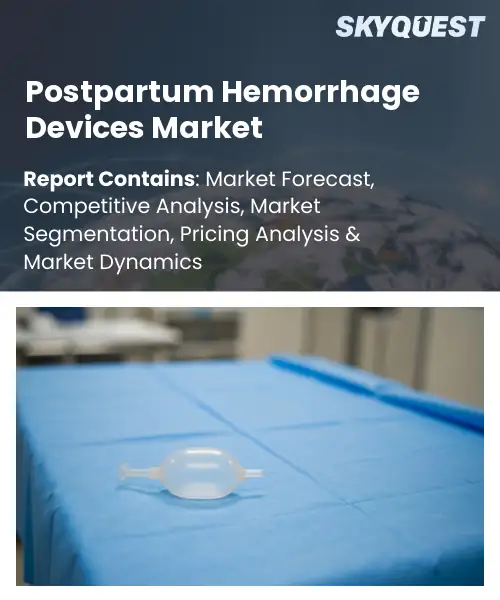
Postpartum Hemorrhage Devices Market
Report ID: SQMIG35A3956
Report ID: SQMIG35A3956
[email protected]
USA +1 351-333-4748
Report ID:
SQMIG35A3956 |
Region:
Global |
Published Date: June, 2026
Pages:
157
|Tables:
117
|Figures:
77


Global Postpartum Hemorrhage Devices Market size was valued at USD 682.50 Million in 2024 and is poised to grow from USD 731.84 Million in 2025 to USD 1285.4 Million by 2033, growing at a CAGR of 7.23% during the forecast period (2026-2033).
The global postpartum hemorrhage devices market trends consists of technologies used to stop excessive bleeding after childbirth, such as uterine balloon tamponade systems, surgical compression devices, and advanced hemostatic dressings. PPH is the leading cause of maternal death in low resource settings, making it very important for health organizations to prioritize rapid and cheap solutions. The market has grown in the past 10 years as governments and NGOs began including the procurement of PPH devices in their national maternal health programs, such as with the widespread adoption of Bakri balloons in sub-Saharan Africa.
This new evolution in the postpartum hemorrhage devices market growth represents a move away from predominantly pharmacologic approaches to predominant device based protocols that enable mothers worldwide to survive bleeding after childbirth. The primary growth driver for PPH devices is the increasing demand for point of care solutions that can be provided to clinics that do not have surgical infrastructure available to them. This is due to the fact that with the use of a uterine tamponade kit at a hospital, a clinician can begin treating a woman with PPH within minutes of entering the emergency room, thereby reducing the need for costly blood transfusions and operating room time.
Therefore, postpartum hemorrhage devices market share are cost-effective for budget-constrained health systems, encouraging them to purchase inventory of PPH devices. The real world experience of PPH device usage in India demonstrates that the distribution of ballot kits sponsored by the government resulted in a 15% reduction in maternal mortality over a five-year period. Investors are interested in manufacturers of PPH devices that provide reasonable returns on investment to them.
How is AI Integration Improving the Efficacy of Postpartum Hemorrhage Detection Devices?
The use of AI in postpartum hemorrhage identification is changing the landscape through predictive analysis that has been integrated directly into sensor platforms. Modern day devices integrate blood loss measurement and machine intelligence that can detect subtle patterns of bleeding as well as changes in vital signs. This, in turn, creates a more proactive alert system for clinical staff to be aware of increasing symptoms of crisis that may occur prior to an actual crisis developing.
In addition, it reduces the need for staff to rely on visual estimation, resulting in increased accuracy and consistency in care being provided in different locations. As a result of improved maternal safety, the desire for more intelligent, data‑rich technologies are driving rapid adoption and encouraging further research and development of wearable technologies that provide real-time data to AI-based engines.
Veranex in October 2024, developed a wearable monitoring device that employs AI technology to track uterine activity and blood flow, thereby improving early warning capabilities and enhancing the growth of the intelligent postpartum hemorrhage device market.
Market snapshot - (2026-2033)
Global Market Size
USD 682.5 Million
Largest Segment
Uterine Balloon Tamponade
Fastest Growth
Intrauterine Vacuum-Induced Hemorrhage Control
Growth Rate
7.23% CAGR
To get more insights on this market click here to Request a Free Sample Report
Global postpartum hemorrhage devices market is segmented by device type, application, end-user, distribution and region. Based on device type, the market is segmented into uterine balloon tamponade, uterine compression suture kits, non-pneumatic anti-shock garments and intrauterine vacuum-induced hemorrhage control. Based on application, the market is segmented into vaginal delivery PPH and cesarean section PPH. Based on end-user, the market is segmented into hospitals (labor & delivery), birthing centers and emergency care. Based on distribution, the market is segmented into direct to hospitals, medical distributors and NGO programs. Based on region, the market is segmented into North America, Europe, Asia Pacific, Latin America and Middle East & Africa.
Uterine balloon tamponade is a leading option because it is a simple, fast, and minimally invasive means of controlling bleeding, so it’s often utilized as a primary treatment within obstetric protocols. This technique’s ease of deployment, training time, and compatibility with currently used equipment have contributed to its widespread acceptance amongst clinicians. As such, it impacts purchasing decisions and constitutes a foundation of product lines/heavy bias to that category when looking for cost-effective alternatives within resource-limited settings whilst preserving clinical efficacy.
However, intrauterine vacuum-induced hemorrhage control has shown the most rapid growth trajectory due to growing evidence demonstrating its superior ability to remove blood and lower necessity for surgical intervention; the design enhancements of catheters and the incorporation of digital monitoring into the use of these devices are supporting the increased acceptance of this technique by clinicians, thus enabling the technique to be used in more than just emergency settings, opening up additional opportunities for growth within the healthcare marketplace.
The surgical nature of cesarean section deliveries, which cause them to be more prone to significant blood loss (i.e., hemorrhage), drives a lack of time for clinicians to use systematic approaches to stop blood loss during/after surgery. As a result, protocols to provide options for bleeding control must initially focus on developing immediate and highly effective hemostatic products. Clinicians are favoring bleeding control products that can be used in the surgical operating room without interfering with their normal workflow. Manufacturers are actively developing and marketing these surgical hemostatic products as kits designed for intra-operative use, contributing to the growth in demand for them. This clinical urgency combined with an abundance of ready-to-use hemostatic products will be extremely important in developing successful procurement strategies that will help shape the long-term decisions for the equipment budgets of all providers.
At the same time, vaginal delivery has the most promise to be the next high-growth area for developing portable, easy-to-use bleeding control products utilized at the community level. Tele-medicine support and continuing advancements in balloon technology are examples of products being used to bleed less from pregnancy. New ways of distributing these portable, easy-to-use bleeding control products through tele-medicine support and new sources of collectable data are expected to continue to drive the growth of this market.
To get detailed segments analysis, Request a Free Sample Report
The North American region is currently the leader in the market due to having an advanced healthcare infrastructure, rapidly implementing available advanced technology into its health care facilities, and an environment of clinical research that is continually innovating. Facilities in this region have robust reimbursement policies and established insurance structures, allowing them to purchase the most advanced diagnostic devices without financially prohibiting themselves. The growing number of multinational manufacturers and skilled clinical staff further enhances the rapid introduction and subsequent distribution of products into American hospitals and other healthcare facilities. Collaborative networks involving academic institutions, regulatory agencies, and industry partners have created an environment that quickly translates research discoveries into clinical practice, and helps maintain North America as the benchmark for quality and safety in maternal care.
Postpartum hemorrhage devices market growth in United States benefits from extensive hospital networks and leading academic medical centers that champion evidence‑based protocols. Payers provide comprehensive coverage that reduces barriers to adoption, while a proactive regulatory environment streamlines approval pathways for innovative solutions. The country also hosts a concentration of device innovators who leverage deep clinical insights to refine product portfolios, ensuring alignment with evolving obstetric standards.
Postpartum hemorrhage devices market forecast in Canada is supported by a publicly funded health system that emphasizes equitable access to high‑quality care across provinces. National health agencies promote clinical guidelines that encourage the use of proven technologies, while collaborative research initiatives between universities and industry accelerate product validation. Procurement processes favor cost‑effective yet reliable devices, reinforcing a balanced approach to innovation and sustainability.
The expansion of Europe is being driven by compatible regulations that allow for easier approval of devices across countries and a uniform market environment. The importance of maternal safety has resulted in countries placing a strong emphasis on public health initiatives, encouraging health services to introduce advanced methods of controlling bleeding during childbirth. Significant investments in collaborative research between educational institutions, hospitals, and technology companies are continuously developing new products. Along with this, the presence of comprehensive reimbursement mechanisms across European Union member states lower the financial barriers associated with purchasing newer technologies, thereby encouraging hospitals to adopt these devices. The focus on evidence-based practice and patient-centered care provides an excellent foundation for stimulating market development within the European Union.
Postpartum hemorrhage devices market outlook in Germany enjoys leadership through a robust manufacturing base and early clinical adoption. Health insurers provide reimbursement pathways that support integration of innovative technologies, while professional societies advocate for standardized guidelines. Collaborative clinical trials conducted in leading obstetric centers generate strong data, reinforcing confidence in emerging devices.
Postpartum hemorrhage devices market regional forecast in United Kingdom accelerates under the National Health Service’s strategic focus on cost‑effective interventions and patient outcomes. Clinical research institutions drive adoption by producing real‑world evidence, and procurement frameworks prioritize solutions that demonstrate clear clinical benefit. Policy initiatives encourage the swift uptake of technologies that align with national maternal health priorities.
Postpartum hemorrhage devices market analysis in France is emerging as healthcare authorities increase emphasis on improving maternal health indicators. Reimbursement policies evolve to accommodate newer devices, while academic hospitals serve as early adopters that showcase clinical value. Collaborative projects with European partners further stimulate market awareness and acceptance.
The Asia Pacific region is advancing its function by upgrading and expanding health infrastructure to accommodate sophisticated medical technologies and modernizing the obstetric care pathway through the development of government health programs aimed at establishing maternal safety, which has increased the demand for dependable postpartum hemorrhage control devices. With the assistance of global innovators through partnerships, domestic manufacturers are improving their ability to compete on the international market while enhancing their production capacity domestically. The formation of specialized training centers and growth of clinical expertise enables practitioners to be more confident in their practice and results in increased acceptance of such devices. The dynamic regulatory reforms within the region also facilitate quicker access to markets, making Asia Pacific an ideal location for growth as it rapidly develops as a center for managing postpartum hemorrhage.
Postpartum hemorrhage devices market regional outlook in Japan advances through a meticulous regulatory framework that ensures safety while encouraging innovation. Healthcare providers emphasize high‑precision devices that align with the country’s focus on quality of care. Collaborative research between leading universities and device firms generates robust clinical evidence, supporting wider hospital adoption.
Postpartum hemorrhage devices industry in South Korea benefits from strong governmental support for medical technology development and a rapidly expanding network of tertiary obstetric centers. The market’s growth is reinforced by strategic alliances with multinational manufacturers, facilitating technology transfer and localization of advanced
To know more about the market opportunities by region and country, click here to
Buy The Complete Report
Drivers
Rising Demand for Effective Solutions
Growing Emphasis on Early Intervention
Restraints
High Cost of Advanced Devices
Limited Availability in Rural Areas
Request Free Customization of this report to help us to meet your business objectives.
The competitive landscape is increasingly driven by technological innovation and strategic investments, with emerging healthcare technology companies securing significant funding to advance AI-enabled clinical solutions. In response, established manufacturers are focusing on strategic partnerships, product innovation, and digital integration to enhance the performance of uterine tamponade and compression devices. The incorporation of predictive analytics and data-driven monitoring capabilities is supporting product differentiation, improving clinical outcomes, and strengthening market competitiveness.
Top Player’s Company Profile
Recent Developments
SkyQuest’s ABIRAW (Advanced Business Intelligence, Research & Analysis Wing) is our Business Information Services team that Collects, Collates, Correlates, and Analyses the Data collected by means of Primary Exploratory Research backed by robust Secondary Desk research. As per SkyQuest analysis, the market is propelled primarily by the rising demand for point‑of‑care hemorrhage solutions that enable clinicians to intervene within minutes, while a second catalyst is the growing emphasis on early intervention supported by AI‑driven decision tools that improve detection and treatment speed. The high cost of advanced devices remains a notable restraint, limiting uptake in budget‑constrained facilities. North America dominates the market thanks to its sophisticated healthcare infrastructure, strong reimbursement pathways and intensive innovation activity. The uterine balloon tamponade segment leads overall because of its simplicity, minimal training requirements and proven efficacy across delivery settings, reinforcing its central role in procurement decisions.
| Report Metric | Details |
|---|---|
| Market size value in 2024 | USD 682.5 Million |
| Market size value in 2033 | USD 1285.4 Million |
| Growth Rate | 7.23% |
| Base year | 2024 |
| Forecast period | (2026-2033) |
| Forecast Unit (Value) | USD Million |
| Segments covered |
|
| Regions covered | North America (US, Canada), Europe (Germany, France, United Kingdom, Italy, Spain, Rest of Europe), Asia Pacific (China, India, Japan, Rest of Asia-Pacific), Latin America (Brazil, Rest of Latin America), Middle East & Africa (South Africa, GCC Countries, Rest of MEA) |
| Companies covered |
|
| Customization scope | Free report customization with purchase. Customization includes:-
|
To get a free trial access to our platform which is a one stop solution for all your data requirements for quicker decision making. This platform allows you to compare markets, competitors who are prominent in the market, and mega trends that are influencing the dynamics in the market. Also, get access to detailed SkyQuest exclusive matrix.
Table Of Content
Executive Summary
Market overview
Parent Market Analysis
Market overview
Market size
KEY MARKET INSIGHTS
COVID IMPACT
MARKET DYNAMICS & OUTLOOK
Market Size by Region
KEY COMPANY PROFILES
Methodology
For the Postpartum Hemorrhage Devices Market, our research methodology involved a mixture of primary and secondary data sources. Key steps involved in the research process are listed below:
1. Information Procurement: This stage involved the procurement of Market data or related information via primary and secondary sources. The various secondary sources used included various company websites, annual reports, trade databases, and paid databases such as Hoover's, Bloomberg Business, Factiva, and Avention. Our team did 45 primary interactions Globally which included several stakeholders such as manufacturers, customers, key opinion leaders, etc. Overall, information procurement was one of the most extensive stages in our research process.
2. Information Analysis: This step involved triangulation of data through bottom-up and top-down approaches to estimate and validate the total size and future estimate of the Postpartum Hemorrhage Devices Market.
3. Report Formulation: The final step entailed the placement of data points in appropriate Market spaces in an attempt to deduce viable conclusions.
4. Validation & Publishing: Validation is the most important step in the process. Validation & re-validation via an intricately designed process helped us finalize data points to be used for final calculations. The final Market estimates and forecasts were then aligned and sent to our panel of industry experts for validation of data. Once the validation was done the report was sent to our Quality Assurance team to ensure adherence to style guides, consistency & design.
Analyst Support
Customization Options
With the given market data, our dedicated team of analysts can offer you the following customization options are available for the Postpartum Hemorrhage Devices Market:
Product Analysis: Product matrix, which offers a detailed comparison of the product portfolio of companies.
Regional Analysis: Further analysis of the Postpartum Hemorrhage Devices Market for additional countries.
Competitive Analysis: Detailed analysis and profiling of additional Market players & comparative analysis of competitive products.
Go to Market Strategy: Find the high-growth channels to invest your marketing efforts and increase your customer base.
Innovation Mapping: Identify racial solutions and innovation, connected to deep ecosystems of innovators, start-ups, academics, and strategic partners.
Category Intelligence: Customized intelligence that is relevant to their supply Markets will enable them to make smarter sourcing decisions and improve their category management.
Public Company Transcript Analysis: To improve the investment performance by generating new alpha and making better-informed decisions.
Social Media Listening: To analyze the conversations and trends happening not just around your brand, but around your industry as a whole, and use those insights to make better Marketing decisions.
REQUEST FOR SAMPLE
 REQUEST FREE CUSTOMIZATION
Global Postpartum Hemorrhage Devices Market size was valued at USD 682.5 Million in 2024 and is poised to grow from USD 731.84 Million in 2025 to USD 1285.4 Million by 2033, growing at a CAGR of 7.23% during the forecast period (2026-2033).
The competitive landscape is shaped by rapid AI integration, as venture‑backed startups such as Hark, Frontier Labs and Mirus attract sizable Series A funding, prompting incumbent device manufacturers to pursue strategic alliances and potential acquisitions to embed predictive analytics into uterine tamponade and compression devices, thereby accelerating product differentiation and market penetration. 'Becton Dickinson (C-QUR)', 'Cook Medical (Bakri Balloon)', 'Teleflex Inc.', 'Jotec GmbH', 'I-STAT (Abbott)', 'Utah Medical Products', 'Alydia Health', 'Nihon Kohden Corporation', 'OB Scientific', 'Postpartum Plus', 'Laborie Medical Technologies', 'Hologic Inc.', 'GE Healthcare', 'Philips Healthcare', 'Masimo Corporation', 'Natus Medical', 'Covidien (Medtronic)', 'Invacare Corporation', 'Smiths Medical (ICU Medical)', 'Midmark Corporation'
Healthcare providers increasingly prioritize rapid management of postpartum hemorrhage, leading to greater adoption of specialized devices that can deliver precise hemostasis. The ability of these tools to reduce surgical time and lower the risk of complications enhances clinical confidence, encouraging hospitals to integrate them into standard obstetric protocols. Consequently, procurement budgets allocate more resources toward innovative solutions, fostering a supportive environment for manufacturers to expand product offerings and drive market expansion. This shift also supports training programs that further embed device utilization into routine care.
Enhanced Point‑Of‑Care Hemostasis: Healthcare providers are increasingly adopting compact, battery‑operated devices that deliver rapid uterine compression or targeted drug delivery at the bedside. These solutions eliminate the need for operating‑room resources, reduce response times, and align with hospital initiatives to improve patient flow and lower procedural costs. The convenience of point‑of‑care platforms also supports use in low‑resource settings, expanding market reach and driving manufacturers to prioritize ergonomics, intuitive interfaces, and minimal training requirements, while maintaining compliance with safety standards and clinical guidelines globally.
Why does North America Dominate the Global Postpartum Hemorrhage Devices Market? |@12


Want to customize this report? This report can be personalized according to your needs. Our analysts and industry experts will work directly with you to understand your requirements and provide you with customized data in a short amount of time. We offer $1000 worth of FREE customization at the time of purchase.
Feedback From Our Clients


 USA (+1) 351-333-4748

