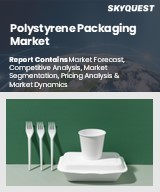
Polystyrene Packaging Market
Report ID: SQMIG15A2602
Report ID: SQMIG15A2602
[email protected]
USA +1 351-333-4748
Report ID:
SQMIG15A2602 |
Region:
Global |
Published Date: December, 2025
Pages:
190
|Tables:
92
|Figures:
71


Global Polystyrene Packaging Market size was valued at USD 10.27 Billion in 2024 and is poised to grow from USD 10.45 Billion in 2025 to USD 11.95 Billion by 2033, growing at a CAGR of 1.7% during the forecast period (2026–2033).
The global polystyrene packaging market analysis shows a market complicated by extreme pressure. Its primary constraint is the environmental concerns surrounding polystyrene. Polystyrene is not biodegradable and has very low recycling rates, which has raised an overwhelming plastic pollution problem. Consequently, numerous countries and many municipalities have placed outright bans and restrictions on polystyrene use, which is an extreme threat to the market.
However, the global polystyrene packaging market growth faces significant challenges. The growth of polystyrene packaging has historically been powered by its low cost, lightweight, and insulating properties. It remains popular for use in food service for cups and containers, and as a protective packager for electronics. Its wide availability and cost-effectiveness positions polystyrene packaging in a strong spot in the marketplace.
How Are Chemical Recycling and Automation Shaping the Polystyrene Packaging Market's Future?
The global polystyrene packaging market trends are developing under two competing catalysts: regulatory bans and technological solutions to those bans. In terms of technology, advancements in chemical recycling (like depolymerization) are in the works. These processes break down post-consumer polystyrene back to its original monomer, which can produce "new" virgin quality polymer. Additionally, automation in manufacturing is helping reduce waste and improve efficiencies.
In early 2025, INEOS Styrolution (a major chemical company) announced the completion of a pilot plant for the chemical recycling of polystyrene. They were able to demonstrate it was possible to convert post-consumer styrene food packaging back to pure styrene. This proved technically the possibility of a circular economy for the material, now the challenge is scaling the program to be economically feasible.
Market snapshot - 2026-2033
Global Market Size
USD 10.1 billion
Largest Segment
Expanded Polystyrene (EPS)
Fastest Growth
High Impact Polystyrene (HIPS)
Growth Rate
1.7% CAGR
To get more insights on this market click here to Request a Free Sample Report
Global Polystyrene Packaging Market is segmented by Product Type, Application, Manufacturing Process, End User Industry and region. Based on Product Type, the market is segmented into Expandable Polystyrene (EPS), Extruded Polystyrene (XPS), Polystyrene Sheet and Polystyrene Foam. Based on Application, the market is segmented into Consumer Electronics, Automotive, Food and Beverage, Pharmaceuticals and Industrial. Based on Manufacturing Process, the market is segmented into Injection Molding, Extrusion, Thermoforming and Blow Molding. Based on End User Industry, the market is segmented into Automotive, Construction, Electronics, Food and Beverages and Pharmaceuticals. Based on region, the market is segmented into North America, Europe, Asia Pacific, Latin America and Middle East & Africa.
The global polystyrene packaging market share is almost completely held by the Expanded Polystyrene (EPS) sector. This considers its excellent lightweight and cushioning properties and lower cost. EPS is the most common material for protective packaging inserts for electronics and appliances, and for disposable foam cups, containers and coolers. It is consumed in large quantity in both of those applications, thus allowing it to maintain market share.
The High Impact Polystyrene (HIPS) segment is experiencing the most consistent demand in the global polystyrene packaging market due to its use in rigid, thermoformed packaging such as yogurt cups and food service trays, which are not consistently experiencing bans like EPS foam products.
The global polystyrene packaging market size is heavily influenced by the thermoforming technology segment. This was strongly due to the acceptance of this technology to form high-volume low-cost rigid packaging items such as disposable cups, lids, plates, and clamshell containers made from HIPS and GPPS sheets. Tremendous speed and efficiency of the thermoforming process and its ability to combine a large quantity of thin-walled food service items makes it the leading manufacturing technology in the industry by a significant margin.
The injection molding technology segment is showing the most stabilized demand in the global polystyrene packaging market. This is primarily due to its application for making more complex and higher value items. Items like a reusable food container or various intricate parts of consumer goods packaging are less likely to be affected by any uncertainty around regulations surrounding single-use plastics.
To get detailed segments analysis, Request a Free Sample Report
Asia Pacific has the most prominent position in the global polystyrene packaging regional outlook. This is due to the massive manufacturing output of the region, especially in electronics and consumer goods, which require protective packaging for transit and retail. It also has a large food service industry, and, at least in many areas, less stringent environmental regulations than Europe and North America. As a result, polystyrene continues to be used in volume.
Japan is a notable market within the Asia Pacific polystyrene packaging market. This is due largely to their highly developed recycling systems, particularly for food trays. Expect its focus on resource recovery to remain, to an extent. More recent developing advancements includes acid and base recycling that aims to develop a circular economy around polystyrene.
South Korea is seeing notable activity in the Asia Pacific polystyrene packaging market. This is driven significantly by the size of their electronics export industry. A focus on high quality protective packaging for electronics is leading to innovation in polystyrene packaging more recently, including polystyrene with noticeably higher recycled content.
The North American market is a major player in the global polystyrene packaging regional forecast. Nevertheless, many segments are characterized by steep declines due to the proliferation of state and municipal bans on single-use foam items. The market is turning away from food service uses and has shifted more toward protective packaging for durable goods and some specialized uses where alternatives are not as available.
The United States is leading the North American polystyrene packaging market. This is due in a large part to the size of its consumer goods and electronics markets. The regulatory landscape in the US is a major factor as it is highly fragmented. Recently, there has been a big push by the industry associations to drive recycling rates and invest in chemical recycling to stem further bans.
Canada is experiencing a steep decline in the North American polystyrene packaging market. This is largely driven by a federal ban on many single-use plastic items including polystyrene foam food containers. Canada has also taken a stance of developing a zero-plastic-waste economy and is interested in issues surrounding consumption, recycling, and overconsumption. There are initiatives underway which involve companies quickly converting to alternative materials including paper, cardboard, and other plastics.
The European region is witnessing a significant decline in the global polystyrene packaging market revenue. This is a result of the EU's Single-Use Plastics Directive, which has banned many commonly used polystyrene packaging items, such as food containers and beverage cups. The polystyrene packaging market is now limited to uses where substitution to alternatives is not yet viable.
Germany is an important market in the European polystyrene packaging market. This is primarily due to its strong industrial sector, which continues to use polystyrene for protective packaging. Its orientation around engineering and exports is key. Also, there is a strong industry emphasis on product design for end-of-life recyclability.
The United Kingdom is experiencing a complementary steep decline in the European polystyrene packaging market. This is significantly driven by its own strong regulations, which are more stringent than the EU regulations, along with its emphasis on a circular economy. Recent examples include major retailers and food service companies publicly committing to eliminating polystyrene from their packaging.
France is experiencing one of the fastest declines in the European polystyrene packaging market, because of its strong national anti-waste regulatory framework, and its approach of supporting reusable packaging systems. The French government has recently recognized and announced financially support for startups that develop non-plastic alternatives.
To know more about the market opportunities by region and country, click here to
Buy The Complete Report
Low Cost and Performance
Inert Properties for Healthcare
Environmental Regulations and Bans
Negative Public Perception
Request Free Customization of this report to help us to meet your business objectives.
The global polystyrene packaging industry trends report reveals that the market is dominated by major chemical and packaging supermarket companies including Amcor, Sealed Air, and Berry Global. These companies build market share by utilizing scale, long-term contracts with consumer retail brands and broad lines of products. Increasingly, these companies are adapting their business and R&D practices to prioritize recycled PET, polypropylene, fibre-based substrates and other sustainable material in response to the declining market for polystyrene packaging.
New companies are developing direct and lasting substitutes for polystyrene packaging that is profoundly reshaping the competitive field. The companies in question are not focused on creating better alternatives to polystyrene. Rather, they are using polymetric process to examine and produce new materials derived from sustainable resource like seaweed, agricultural waste, and fungi. They are working towards developing a biodegradable or compostable alternative to polystyrene that can simply be inserted by consumers eliminating polystyrene's most problematic attributes.
SkyQuest’s ABIRAW (Advanced Business Intelligence, Research & Analysis Wing) is our Business Information Services team that Collects, Collates, Correlates, and Analyses the Data collected by means of Primary Exploratory Research backed by robust Secondary Desk research.
As per SkyQuest analysis, the global polystyrene packaging market is in a state of managed decline, under threat of regulation and public perception. The early advantages of low cost and performance cannot address the substantial environmental harm. The critical market dynamic remains the speed of new bans vs the industry's ability to create and scale a viable circular economy through chemical recycling. The clear direction remains substitution as brands search for less controversial materials.
European and North American regional markets are shrinking at a rapid pace due to regulatory change. The last stronghold for the market is currently Asia Pacific, but it is also applying increasing regulatory pressure. The Food & Beverage segment, formerly the largest application, now represents the most at-risk segment overall, while protective packaging for electronic goods remains a comparatively more stable application, though still under duress.
| Report Metric | Details |
|---|---|
| Market size value in 2024 | USD 10.27 Billion |
| Market size value in 2033 | USD 11.95 Billion |
| Growth Rate | 1.7% |
| Base year | 2024 |
| Forecast period | 2026-2033 |
| Forecast Unit (Value) | USD Billion |
| Segments covered |
|
| Regions covered | North America (US, Canada), Europe (Germany, France, United Kingdom, Italy, Spain, Rest of Europe), Asia Pacific (China, India, Japan, Rest of Asia-Pacific), Latin America (Brazil, Rest of Latin America), Middle East & Africa (South Africa, GCC Countries, Rest of MEA) |
| Companies covered |
|
| Customization scope | Free report customization with purchase. Customization includes:-
|
To get a free trial access to our platform which is a one stop solution for all your data requirements for quicker decision making. This platform allows you to compare markets, competitors who are prominent in the market, and mega trends that are influencing the dynamics in the market. Also, get access to detailed SkyQuest exclusive matrix.
Table Of Content
Executive Summary
Market overview
Parent Market Analysis
Market overview
Market size
KEY MARKET INSIGHTS
COVID IMPACT
MARKET DYNAMICS & OUTLOOK
Market Size by Region
KEY COMPANY PROFILES
Methodology
For the Polystyrene Packaging Market, our research methodology involved a mixture of primary and secondary data sources. Key steps involved in the research process are listed below:
1. Information Procurement: This stage involved the procurement of Market data or related information via primary and secondary sources. The various secondary sources used included various company websites, annual reports, trade databases, and paid databases such as Hoover's, Bloomberg Business, Factiva, and Avention. Our team did 45 primary interactions Globally which included several stakeholders such as manufacturers, customers, key opinion leaders, etc. Overall, information procurement was one of the most extensive stages in our research process.
2. Information Analysis: This step involved triangulation of data through bottom-up and top-down approaches to estimate and validate the total size and future estimate of the Polystyrene Packaging Market.
3. Report Formulation: The final step entailed the placement of data points in appropriate Market spaces in an attempt to deduce viable conclusions.
4. Validation & Publishing: Validation is the most important step in the process. Validation & re-validation via an intricately designed process helped us finalize data points to be used for final calculations. The final Market estimates and forecasts were then aligned and sent to our panel of industry experts for validation of data. Once the validation was done the report was sent to our Quality Assurance team to ensure adherence to style guides, consistency & design.
Analyst Support
Customization Options
With the given market data, our dedicated team of analysts can offer you the following customization options are available for the Polystyrene Packaging Market:
Product Analysis: Product matrix, which offers a detailed comparison of the product portfolio of companies.
Regional Analysis: Further analysis of the Polystyrene Packaging Market for additional countries.
Competitive Analysis: Detailed analysis and profiling of additional Market players & comparative analysis of competitive products.
Go to Market Strategy: Find the high-growth channels to invest your marketing efforts and increase your customer base.
Innovation Mapping: Identify racial solutions and innovation, connected to deep ecosystems of innovators, start-ups, academics, and strategic partners.
Category Intelligence: Customized intelligence that is relevant to their supply Markets will enable them to make smarter sourcing decisions and improve their category management.
Public Company Transcript Analysis: To improve the investment performance by generating new alpha and making better-informed decisions.
Social Media Listening: To analyze the conversations and trends happening not just around your brand, but around your industry as a whole, and use those insights to make better Marketing decisions.
REQUEST FOR SAMPLE
 REQUEST FREE CUSTOMIZATION


Want to customize this report? This report can be personalized according to your needs. Our analysts and industry experts will work directly with you to understand your requirements and provide you with customized data in a short amount of time. We offer $1000 worth of FREE customization at the time of purchase.
Feedback From Our Clients


 USA (+1) 351-333-4748

