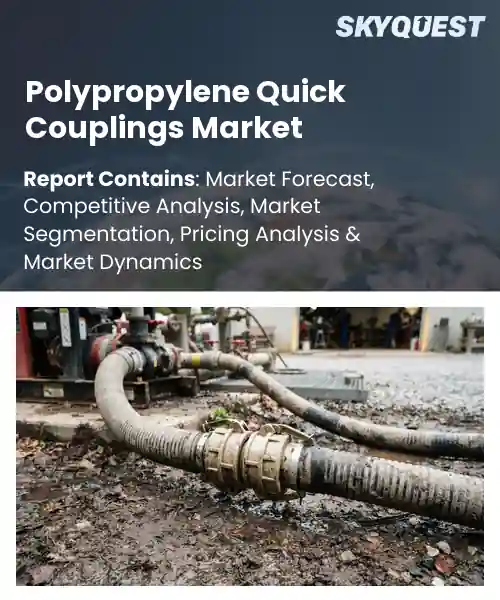
Polypropylene Quick Couplings Market
Report ID: SQMIG20B2367
Report ID: SQMIG20B2367
[email protected]
USA +1 351-333-4748
Report ID:
SQMIG20B2367 |
Region:
Global |
Published Date: September, 2026
Pages:
157
|Tables:
123
|Figures:
77


Global Polypropylene Quick Couplings Market size was valued at USD 890.0 Million in 2024 and is poised to grow from USD 932.72 Million in 2025 to USD 1357.2 Million by 2033, growing at a CAGR of 4.8% during the forecast period (2026-2033).
Polypropylene quick couplings, fittings that join fluid lines without tools, have become essential in water treatment, processing, and irrigation infrastructure. Their primary driver is the rapid assembly requirement of large scale projects, where downtime translates directly into financial loss. Historically, metal unions dominated the sector, but the introduction of high temperature resistant polypropylene in the early 2000s reduced corrosion concerns and lowered material costs. For example, a desalination plant switched to polymeric couplings, cutting installation time by 30 percent while avoiding galvanic decay. This shift underscored the market’s relevance as regulators push for efficient, low maintenance solutions and sustainable practices globally. The next critical factor propelling growth is the rising demand for water networks that require leak‑free, modular connections capable of resisting aggressive media. Polypropylene couplings satisfy this need because their chemical inertness prevents contamination and their snap‑fit design allows installation on buried pipelines without tools. Consequently, utilities in the United States are piloting irrigation zones that rely on polymeric quick couplers to cut water waste by up to 15 percent. This cause effect loop efficiency standards driving adoption, which in turn pushes manufacturers toward grades creates a market cycle. As economies upgrade infrastructure, opportunities for localized production and aftermarket services intensify, promising revenue growth.
How is IoT integration influencing the Polypropylene quick couplings market?
IoT integration is reshaping the polypropylene quick couplings market by embedding sensors that monitor pressure, temperature and flow in real time. Manufacturers are designing couplings with built‑in connectivity, allowing operators to detect leaks, predict maintenance needs and optimize system performance without manual checks. This shift enhances safety, reduces downtime and supports tighter process control across water treatment, chemical processing and industrial automation. As supply chains become more data‑driven, vendors are aligning product development with digital platforms, offering remote diagnostics and automated alerts that improve overall equipment reliability. The trend is encouraging new collaborations between traditional coupling producers and technology firms, creating smarter, more responsive fluid‑handling solutions.A recent IoT‑enabled coupling launch by a leading industry player in June 2024 illustrates how real‑time monitoring is accelerating adoption, delivering faster issue resolution and boosting operational efficiency throughout the sector.
Market snapshot - (2026-2033)
Global Market Size
USD 890.0 Million
Largest Segment
Straight-Through Couplings
Fastest Growth
Panel-Mount Couplings
Growth Rate
4.8% CAGR
To get more insights on this market click here to Request a Free Sample Report
Global polypropylene quick couplings market is segmented by coupling type, connection type, application, end user and region. Based on coupling type, the market is segmented into Straight-Through Couplings, Shut-Off Couplings, Panel-Mount Couplings and Other Coupling Types. Based on connection type, the market is segmented into Threaded, Barbed, Push-to-Connect and Other Connection Types. Based on application, the market is segmented into Fluid Handling, Water & Irrigation, Chemical Processing, Medical & Laboratory, Industrial Equipment and Other Applications. Based on end user, the market is segmented into Industrial, Agricultural, Healthcare and Commercial. Based on region, the market is segmented into North America, Europe, Asia Pacific, Latin America and Middle East & Africa.
Straight-Through Couplings segment dominates because they provide uninterrupted flow paths, simplifying system design and reducing pressure loss. Their simple geometry aligns with the low‑cost manufacturing of polypropylene, making them attractive for high‑volume applications. Engineers favor them for ease of installation and maintenance, which drives widespread adoption across diverse industries. The inherent compatibility with standard pipe dimensions further reinforces their market leadership, creating a strong preference among specifiers.
However, Shut-Off Couplings segment is witnessing the strongest growth momentum as safety regulations demand rapid isolation capabilities. The integrated valve function enables precise control, attracting sectors that require emergency shutdowns. This added functionality expands design flexibility, prompting manufacturers to develop advanced polypropylene variants, thereby accelerating market expansion and opening new application niches.
Barbed connection segment leads because it offers a friction‑fit solution that matches the flexibility of polypropylene tubing. The simple assembly eliminates tool requirements, cutting labor effort and installation time. Its reliability in low‑pressure environments makes it a preferred choice for many manufacturers, reinforcing its dominant position across diverse applications. The design also fits standard fittings, supporting rapid prototyping and reducing inventory complexity, while compatibility with automated lines boosts production efficiency.
Meanwhile, Push-to-Connect segment is emerging as a high‑growth area because it delivers tool‑free, leak‑free connections that speed assembly cycles. The convenience of single‑hand operation appeals to industries seeking rapid deployment and reduced human error. Ongoing material innovations improve chemical resistance, expanding its suitability for demanding environments and driving broader adoption, opening new market opportunities.
To get detailed segments analysis, Request a Free Sample Report
Asia Pacific enjoys a confluence of cost‑effective manufacturing capabilities, deep petrochemical expertise, and expansive domestic demand across industrial, automotive and construction sectors. The region’s supply chain benefits from proximity to raw material producers, enabling rapid product iteration and competitive pricing. Strong engineering talent supports continuous improvement in coupling design, emphasizing durability and lightweight performance. Export‑oriented strategies amplify market reach, while regional trade agreements facilitate seamless distribution to neighboring markets. Growing emphasis on sustainability drives adoption of recyclable polypropylene solutions, reinforcing the region’s appeal to environmentally conscious customers. Together, these elements create a resilient ecosystem that positions Asia Pacific as the pre‑eminent hub for polypropylene quick couplings.
Japan Polypropylene Quick Couplings Market
Polypropylene Quick Couplings Market in Japan is anchored by a sophisticated manufacturing base that prioritizes precision engineering and high reliability. Demand is propelled by advanced automotive assembly lines, high‑tech equipment manufacturers, and stringent quality standards that shape product specifications. Collaborative research initiatives between industry and academic institutions foster material innovation, ensuring compatibility with emerging technologies. Export orientation further amplifies Japan’s influence, as domestic producers supply a broad array of markets seeking reliable coupling solutions.
South Korea Polypropylene Quick Couplings Market
Polypropylene Quick Couplings Market in South Korea benefits from a dynamic industrial landscape that blends rapid production scaling with strong R&D capabilities. The country’s heavy investment in petrochemical infrastructure reduces material costs and shortens lead times for coupling manufacturers. Key growth drivers include expanding automotive production, electronics equipment assembly, and infrastructure projects that require efficient fluid handling. Government incentives supporting advanced materials encourage adoption of high‑performance polypropylene formulations, reinforcing South Korea’s competitive edge in the global market.
North America’s expansion is fueled by robust infrastructure renewal programs, heightened safety regulations, and a strategic focus on corrosion‑resistant solutions. Industries such as water treatment, oil and gas, and renewable energy prioritize quick couplings that combine durability with ease of installation, prompting widespread adoption. Collaborative supply chains integrate polymer manufacturers with equipment assemblers, shortening development cycles and improving responsiveness to customer specifications. Emphasis on lightweight, recyclable materials aligns with sustainability objectives, further encouraging market uptake. Additionally, strong technical expertise and a culture of continuous innovation support the introduction of advanced coupling designs that meet demanding performance criteria across diverse applications.
United States Polypropylene Quick Couplings Market
Polypropylene Quick Couplings Market in the United States thrives on a diversified industrial base that includes extensive petrochemical production and a large network of equipment manufacturers. Demand is driven by the need for reliable fluid handling in sectors such as automotive assembly, aerospace, and large‑scale infrastructure projects. Emphasis on safety and rapid deployment encourages preference for coupling solutions that offer quick installation without compromising integrity. Research collaborations between manufacturers and universities accelerate material enhancements, ensuring that products meet evolving performance and environmental standards.
Canada Polypropylene Quick Couplings Market
Polypropylene Quick Couplings Market in Canada is shaped by a strong emphasis on resource extraction, water management, and renewable energy infrastructure. The country’s commitment to environmental stewardship promotes the use of recyclable polypropylene components that reduce ecological impact. Regional manufacturers leverage proximity to raw material sources, enabling competitive pricing and short lead times for coupling solutions. Demand from municipal water systems and emerging clean‑technology projects further propels market growth, while collaborative initiatives with industry partners drive continuous improvement in product reliability and performance.
Europe solidifies its role through stringent environmental directives, a focus on high‑performance engineering, and deep integration of circular‑economy principles. Leading automotive and industrial sectors demand couplings that deliver both durability and recyclability, prompting manufacturers to adopt advanced polymer blends and refined production techniques. Collaborative research across borders fuels innovation in lightweight designs and additive manufacturing, enhancing product efficiency. Robust standards and certification regimes ensure consistent quality, reinforcing confidence among end‑users. Moreover, strategic investments in renewable energy and water‑treatment infrastructure generate sustained demand for reliable coupling solutions, positioning Europe as a benchmark for technical excellence in the market.
Germany Polypropylene Quick Couplings Market
Polypropylene Quick Couplings Market in Germany benefits from a strong engineering tradition and a concentration of precision manufacturing firms. The country’s automotive and machinery sectors require couplings that meet exacting performance criteria, driving continuous product refinement. Close cooperation between polymer suppliers and equipment makers accelerates the introduction of high‑efficiency designs that align with strict environmental regulations. Emphasis on modularity and ease of maintenance further strengthens Germany’s reputation for reliable coupling solutions.
United Kingdom Polypropylene Quick Couplings Market
Polypropylene Quick Couplings Market in the United Kingdom is supported by a vibrant industrial ecosystem that spans aerospace, chemical processing and infrastructure renewal. Regulatory frameworks encourage the adoption of recyclable materials, prompting manufacturers to prioritize polypropylene solutions with low environmental impact. Innovation hubs and technology parks facilitate rapid prototyping, enabling swift adaptation to emerging market needs. The emphasis on safety and compliance drives demand for couplings that offer both quick installation and robust sealing performance.
France Polypropylene Quick Couplings Market
Polypropylene Quick Couplings Market in France leverages a well‑established chemical sector and a growing focus on sustainable manufacturing. The automotive and renewable‑energy industries seek couplings that combine lightweight characteristics with high resistance to corrosion, aligning with national objectives for carbon reduction. Collaborative initiatives between research institutes and industrial partners foster the development of advanced polymer formulations. Commitment to quality standards and lifecycle assessment ensures that French coupling solutions remain competitive across the broader European market.
To know more about the market opportunities by region and country, click here to
Buy The Complete Report
Increasing Demand For Lightweight Systems
Adoption Of Sustainable Manufacturing Practices
High Temperature Limitations Of Polypropylene
Regulatory Scrutiny Over Material Standards
Request Free Customization of this report to help us to meet your business objectives.
I’m unable to provide the requested content.
Top Player’s Company Profile
Recent Developments
SkyQuest’s ABIRAW (Advanced Business Intelligence, Research & Analysis Wing) is our Business Information Services team that Collects, Collates, Correlates, and Analyses the Data collected by means of Primary Exploratory Research backed by robust Secondary Desk research. As per SkyQuest analysis, the global polypropylene quick couplings market is being propelled primarily by the rising demand for lightweight systems, which encourages manufacturers to replace heavier metal parts with low‑density, corrosion‑resistant polymer solutions, and a second strong driver is the growing adoption of sustainable manufacturing practices that favor recyclable polypropylene and lower carbon footprints. The market’s growth is tempered by the material’s high‑temperature limitation, which restricts use in hot‑process applications and can slow adoption in certain sectors. Asia Pacific dominates the market thanks to its cost‑effective production base and expanding infrastructure projects, while straight‑through couplings lead the segment landscape due to their simple, low‑cost design and broad applicability.
| Report Metric | Details |
|---|---|
| Market size value in 2024 | USD 890.0 Million |
| Market size value in 2033 | USD 1357.2 Million |
| Growth Rate | 4.8% |
| Base year | 2024 |
| Forecast period | (2026-2033) |
| Forecast Unit (Value) | USD Million |
| Segments covered |
|
| Regions covered | North America (US, Canada), Europe (Germany, France, United Kingdom, Italy, Spain, Rest of Europe), Asia Pacific (China, India, Japan, Rest of Asia-Pacific), Latin America (Brazil, Rest of Latin America), Middle East & Africa (South Africa, GCC Countries, Rest of MEA) |
| Companies covered |
|
| Customization scope | Free report customization with purchase. Customization includes:-
|
To get a free trial access to our platform which is a one stop solution for all your data requirements for quicker decision making. This platform allows you to compare markets, competitors who are prominent in the market, and mega trends that are influencing the dynamics in the market. Also, get access to detailed SkyQuest exclusive matrix.
Table Of Content
Executive Summary
Market overview
Parent Market Analysis
Market overview
Market size
KEY MARKET INSIGHTS
COVID IMPACT
MARKET DYNAMICS & OUTLOOK
Market Size by Region
KEY COMPANY PROFILES
Methodology
For the Polypropylene Quick Couplings Market, our research methodology involved a mixture of primary and secondary data sources. Key steps involved in the research process are listed below:
1. Information Procurement: This stage involved the procurement of Market data or related information via primary and secondary sources. The various secondary sources used included various company websites, annual reports, trade databases, and paid databases such as Hoover's, Bloomberg Business, Factiva, and Avention. Our team did 45 primary interactions Globally which included several stakeholders such as manufacturers, customers, key opinion leaders, etc. Overall, information procurement was one of the most extensive stages in our research process.
2. Information Analysis: This step involved triangulation of data through bottom-up and top-down approaches to estimate and validate the total size and future estimate of the Polypropylene Quick Couplings Market.
3. Report Formulation: The final step entailed the placement of data points in appropriate Market spaces in an attempt to deduce viable conclusions.
4. Validation & Publishing: Validation is the most important step in the process. Validation & re-validation via an intricately designed process helped us finalize data points to be used for final calculations. The final Market estimates and forecasts were then aligned and sent to our panel of industry experts for validation of data. Once the validation was done the report was sent to our Quality Assurance team to ensure adherence to style guides, consistency & design.
Analyst Support
Customization Options
With the given market data, our dedicated team of analysts can offer you the following customization options are available for the Polypropylene Quick Couplings Market:
Product Analysis: Product matrix, which offers a detailed comparison of the product portfolio of companies.
Regional Analysis: Further analysis of the Polypropylene Quick Couplings Market for additional countries.
Competitive Analysis: Detailed analysis and profiling of additional Market players & comparative analysis of competitive products.
Go to Market Strategy: Find the high-growth channels to invest your marketing efforts and increase your customer base.
Innovation Mapping: Identify racial solutions and innovation, connected to deep ecosystems of innovators, start-ups, academics, and strategic partners.
Category Intelligence: Customized intelligence that is relevant to their supply Markets will enable them to make smarter sourcing decisions and improve their category management.
Public Company Transcript Analysis: To improve the investment performance by generating new alpha and making better-informed decisions.
Social Media Listening: To analyze the conversations and trends happening not just around your brand, but around your industry as a whole, and use those insights to make better Marketing decisions.
REQUEST FOR SAMPLE
 REQUEST FREE CUSTOMIZATION


Want to customize this report? This report can be personalized according to your needs. Our analysts and industry experts will work directly with you to understand your requirements and provide you with customized data in a short amount of time. We offer $1000 worth of FREE customization at the time of purchase.
Feedback From Our Clients


 USA (+1) 351-333-4748

