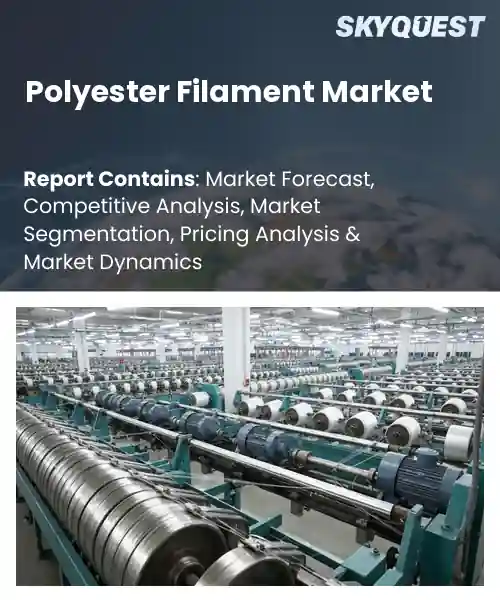
Polyester Filament Market
Report ID: SQMIG25M2119
Report ID: SQMIG25M2119
[email protected]
USA +1 351-333-4748
Report ID:
SQMIG25M2119 |
Region:
Global |
Published Date: June, 2026
Pages:
157
|Tables:
93
|Figures:
76


Global Polyester Filament Market size was valued at USD 59.50 Billion in 2024 and is poised to grow from USD 62.71 Billion in 2025 to USD 95.44 Billion by 2033, growing at a CAGR of 5.4% during the forecast period (2026-2033).
Synthetic fibers, primarily created from purified terephthalic acid and ethylene glycol, make up the global polyester filament market trends. Filaments are critical components of textiles and various industrial uses because of their strength, low moisture absorption rates, and overall affordability. Polyester fiber is extensively used in apparel and home furnishing as well as for making all types of fabrics. Increased use of fast-fashion and e-commerce has increased the need for large quantities of lightweight, durable clothing options that can be produced at competitive prices.
Since first being made commercially available in 1950, the polyester filament industry has evolved from producing only basic yarns to producing high-tenacity filaments capable of wicking moisture away from the skin, which has helped brands like Nike increase consumer comfort and performance with their products. The ongoing trend toward circularity is a major factor affecting the overall growth of the polyester filament market due to recent environmental regulations affecting all manufacturing industries and increasing demand from consumers for environmentally friendly products. As a result of this pressure, manufacturers are beginning to produce polyester filaments made from recycled PET feedstock, which has allowed them to reduce the cost of raw materials and decrease their greenhouse gas emissions by up to 30% compared to using virgin resin.
Examples of the impact of recycled polyester filament market growth include use in the automotive interior industry, where Ford has implemented the use of recycled filament for their seat covers, and in the medical textile industry, where hospitals are specifying sterilizable polyester blends in their fabrics for safety compliance. The reciprocal relationship between recycled filament and producing high-quality, environmentally friendly products is driving growth in the polyester filament industry.
How is AI-driven Automation Influencing the Polyester Filament Market's Production Efficiency?
By integrating AI into every step of polyester filament production (melt spinnning), AI based automation is changing how polyester filament is produced. Intelligent sensors, along with machine-learning algorithms, provide real-time (or near real-time) feedback for every step (process) in the melt-spinning process with respect to temperature, tension, and draw speed. The systems are able to predict changes (or faults/defects) that can potentially cause defects and provide the operating personnel (i.e., operators or maintenance personnel) with actionable insights (or suggestions) through a unified dashboard to reduce manual adjustment to machines and minimize cycle times. With this technology, dynamic changes to recipes allow new fibre product grades to be produced quickly. For the polyester manufacturer, the result is better production yields, reduced energy usage and a more agile response to changing market conditions.
In March of 2026, a major manufacturer of polyester filament implemented AI-based automation, improving the efficiency (or capacity) of the melt-spinning lines and reducing the time between product changes which will position the manaufacturer very well in the marketplace. The system was able to accommodate changes to production processes (melt-spinning lines) through real-time (or near real-time) analysis of data collected from the production process. Additionally, the system was able to make adjustments to temperature and tension in order to minimize wasted materials (defects).
Market snapshot - (2026-2033)
Global Market Size
USD 59.5 Billion
Largest Segment
Fully Drawn Yarn
Fastest Growth
Drawn Textured Yarn
Growth Rate
5.39% CAGR
To get more insights on this market click here to Request a Free Sample Report
Global polyester filament market is segmented by product typology, dyeing and coloration state, core application area and region. Based on product typology, the market is segmented into partially oriented yarn, fully drawn yarn, drawn textured yarn and high tenacity filament yarn. Based on dyeing and coloration state, the market is segmented into raw white filaments, semi-dull filaments, bright filaments and dope dyed filaments. Based on core application area, the market is segmented into apparel fabrics, home textiles, automotive textiles and industrial and technical textiles. Based on region, the market is segmented into North America, Europe, Asia Pacific, Latin America and Middle East & Africa.
Fully drawn yarn segment is leading due to its uniform linear properties and thus high tensile strength along with some dimensional stability that are critical for performance fabrics. Manufacturers prefer to use fully drawn yarn due to the predictable processing characteristics of the fully drawn yarn which helps to minimize waste and increase efficiency when knitting or weaving, and the ability of the fully drawn yarn to produce smoother surfaces helps meet both the aesthetic and functional demands of premium apparel and technical textiles, enhancing its position as the leading yarn in the market. This level of dependability attracts larger volume yarn producers looking for a long term supply of yarn.
In contrast to fully drawn yarn is the drawn textured yarn which represents one of the fastest growing segments of the polyester filament market. The bulk and resiliency of drawn textured yarn provides lightweight insulation and comfort which has resulted in increased usage of drawn textured yarn within the activewear and outerwear markets. As processing technology continues to advance, innovations are also being made in the stretch and durability of drawn textured yarn, which will further increase opportunities for use within newer performance categories.
The dope dyed filament segment has a clear lead due to the fact that by adding color during polymer extrusion rather than producing a finished product and then adding dye after it is made, both water as well as chemicals used in dyeing can be minimized. Since these colors are an inherent property of the material itself, they provide the ability to deliver consistent color fastness (i.e., how long do colors stay true) and stability (i.e., do colors fade) and allow for meeting high-level quality requirements for both apparel and home textiles. Manufacturers appreciate the streamlined workflow associated with this method, which reduces energy usage while also simplifying inventory management. Therefore, this contributes to the dominant position of dope dyed filament in high-volume production environments, as well as supporting its leadership position among the different filament options available.
Secondly, bright filaments are the highest growth category in the polyester filament industry trends. Their bright colors lend themselves easily to fashion-oriented consumers and, as a result, designers can use them in creative ways. As pigment technologies advance, bright filaments have increasingly greater levels of lightfastness (i.e., they resist losing their color when exposed to sunlight), thus enabling greater use of bright filaments in both premium apparel and home furnishings, leading to an increase in the polyester filament market as well as new creative opportunities.
To get detailed segments analysis, Request a Free Sample Report
With its strong manufacturing base and advanced textile engineering skills, the area has created a synergistic environment for producing polyester filament. Manufacturers of polymers and those who make fabric from the polymer work closely together, allowing for quick innovation and cost savings. The area also allows companies to invest in new technologies such as high-performance fiber and how to process them sustainably, thus enhancing the value of their output. Consumer demand for technical textiles used in automotive, clothing, and industrial applications is strong and can be full met by this region without sacrificing quality. This is driven as well by the presence of collaborative research centers and government incentives that, together, develop talent that keeps the area competitive with others, allowing the area to continue to lead all segments of the market for technical textiles.
Polyester filament market share in Japan benefits from a legacy of precision engineering and a robust ecosystem of specialty textile firms. Emphasis on high‑functionality fibers for medical and performance apparel drives continual product refinement. Collaborative initiatives between polymer producers and research institutions accelerate the adoption of bio‑based feedstocks, positioning Japan as a pioneer in sustainable filament solutions. Consumer preferences for durability and comfort further reinforce demand, while export channels expand the market reach of Japanese‑engineered products.
Polyester filament market outlook in South Korea is propelled by a dynamic blend of technological agility and a strong export orientation. The country’s focus on smart textile integration and electronic‑functional fibers creates differentiated offerings for emerging market niches. Government‑backed innovation programs foster advancements in melt‑spinning efficiency and waste‑reduction techniques, enhancing both competitiveness and environmental stewardship. Close ties between material suppliers and fashion manufacturers accelerate time‑to‑market, reinforcing South Korea’s reputation as a hub for cutting‑edge filament production.
A combination of sustainability requirements, applications for high-value textiles, and best-in-class supply chains fuels Europe’s growth. Strict environmental regulations are driving the development of recyclable and bio-based polyester fibers, as well as increasing investment in green manufacturing technologies. The region has a long-standing commitment to technical textiles (many of which are used in the aerospace, automotive, and protective apparel sectors); therefore, the demand for high-performance polyester filaments will continue to be significant. Collaborative relationships between research institutes, polymer manufacturers, and fashion brands in Europe accelerate the creation of innovative functional finishes and smart textile integration. Additionally, because of their premium market positioning and the consumer's appreciation of quality products, advanced polyester solutions are rapidly being adopted across both the industrial and fashion sectors in Europe, solidifying Europe's role as a growth leader within the filament industry.
Polyester filament market forecast in Germany leverages a well‑established engineering culture and a dense network of specialty chemical manufacturers. Emphasis on precision performance drives the development of high‑tenacity fibers for automotive and industrial applications. Strong collaboration between research universities and industry accelerates the rollout of recyclable filament technologies, aligning with the country’s sustainability agenda. Export‑oriented production capabilities also extend Germany’s influence across global supply chains, reinforcing its dominant role in the European market.
Polyester filament market penetration in United Kingdom experiences accelerated growth through a vibrant ecosystem of textile innovation hubs and fashion incubators. The emphasis on fast‑fashion cycles and sustainable sourcing creates fertile ground for new filament blends that balance performance with environmental credentials. Strategic partnerships between polymer producers and design studios foster rapid prototyping and market entry. Investment in digital manufacturing and smart textile platforms positions the United Kingdom as a leader in next‑generation filament solutions, driving its rapid expansion within Europe.
Polyester filament market analysis in France emerges as an evolving segment shaped by strong artistic heritage and a growing focus on eco‑friendly textile practices. Initiative to integrate bio‑based polymers into traditional weaving techniques encourages the launch of niche filament products for luxury and functional apparel. Collaboration between fashion houses and material scientists nurtures creative applications that emphasize comfort and sustainability. The market’s emerging status is further supported by policy incentives that promote circular economy principles, fostering a progressive environment for filament development.
By combining its strengths in technology, diverse use of its products, and the ability to be proactive about sustainable manufacturing/construction, North America continues to strengthen its standing as a leader in the global composite market. North America is enhancing its ability to produce fiber from melt spinning and texturing technologies through investment in the latest types of technology. The North American automotive/aerospace sectors are driving the demand for high performing filaments, while the comfort and durability of the apparel market is also driving the demand for these types of products. Collaborative research initiatives through universities and industry partners accelerate the development of advanced biodegradable and recycled polyester fibers. In addition, new technologies which combine the use of digital designs with the use of materials engineering allow for the development of sophisticated, quick turn-around products that allow North America to remain competitive in meeting type of evolving market requirements.
Polyester filament market regional outlook in United States is characterized by a strong emphasis on innovation and scale. Leading polymer producers invest heavily in research to develop high‑strength and low‑environmental‑impact fibers that serve automotive, medical, and fashion industries. Close alignment with technology start‑ups accelerates the adoption of smart textile functionalities, while extensive distribution networks ensure broad market penetration. Commitment to circular initiatives further enhances the United States’ role as a pivotal player in the global filament landscape.
Polyester filament market regional forecast in Canada benefits from a collaborative climate that merges resource efficiency with cutting‑edge material science. Emphasis on renewable feedstocks and low‑energy processing aligns with national sustainability goals, encouraging the production of eco‑conscious filament grades. Partnerships between academic research centers and industrial manufacturers foster innovation in high‑performance fibers for outdoor and technical apparel. The market’s growth is supported by a strong export orientation, positioning Canada as an emerging contributor to the North American filament ecosystem.
To know more about the market opportunities by region and country, click here to
Buy The Complete Report
Growing Demand for Lightweight Textiles
Adoption of Sustainable Manufacturing Processes
Fluctuating Crude Oil Prices
Stringent Environmental Regulations
Request Free Customization of this report to help us to meet your business objectives.
The competitive landscape is characterized by intense rivalry among global polymer manufacturers, driven by continuous technological innovation, expanding recycled polyester production capabilities, and strategic collaborations with apparel and industrial manufacturers to strengthen supply chains. Companies are increasingly focusing on sustainability, product differentiation, and operational efficiency to gain a competitive edge. Additionally, recent mergers, acquisitions, and joint ventures are enabling market participants to diversify their product portfolios, enhance production capacities, and meet the growing demand for high-performance filament yarns across various end-use industries.
Top Player’s Company Profile
Recent Developments in the Polyester Filament Market
SkyQuest’s ABIRAW (Advanced Business Intelligence, Research & Analysis Wing) is our Business Information Services team that Collects, Collates, Correlates, and Analyses the Data collected by means of Primary Exploratory Research backed by robust Secondary Desk research. As per SkyQuest analysis the global polyester filament market is being propelled primarily by the rising demand for lightweight textiles, which lets manufacturers deliver strong yet thin fabrics for apparel and automotive interiors, while a second strong catalyst comes from the shift toward sustainable manufacturing that incorporates recycled feedstock and energy‑efficient equipment to meet eco‑conscious buyer expectations. The market is currently led by Asia Pacific, where an extensive production base and advanced textile engineering give it a clear advantage, and the fully drawn yarn segment holds the largest share thanks to its uniform strength and dimensional stability. However, volatile crude‑oil prices remain a restraint, creating cost uncertainty for producers and tempering investment confidence.
| Report Metric | Details |
|---|---|
| Market size value in 2024 | USD 59.5 Billion |
| Market size value in 2033 | USD 95.44 Billion |
| Growth Rate | 5.39% |
| Base year | 2024 |
| Forecast period | (2026-2033) |
| Forecast Unit (Value) | USD Billion |
| Segments covered |
|
| Regions covered | North America (US, Canada), Europe (Germany, France, United Kingdom, Italy, Spain, Rest of Europe), Asia Pacific (China, India, Japan, Rest of Asia-Pacific), Latin America (Brazil, Rest of Latin America), Middle East & Africa (South Africa, GCC Countries, Rest of MEA) |
| Companies covered |
|
| Customization scope | Free report customization with purchase. Customization includes:-
|
To get a free trial access to our platform which is a one stop solution for all your data requirements for quicker decision making. This platform allows you to compare markets, competitors who are prominent in the market, and mega trends that are influencing the dynamics in the market. Also, get access to detailed SkyQuest exclusive matrix.
Table Of Content
Executive Summary
Market overview
Parent Market Analysis
Market overview
Market size
KEY MARKET INSIGHTS
COVID IMPACT
MARKET DYNAMICS & OUTLOOK
Market Size by Region
KEY COMPANY PROFILES
Methodology
For the Polyester Filament Market, our research methodology involved a mixture of primary and secondary data sources. Key steps involved in the research process are listed below:
1. Information Procurement: This stage involved the procurement of Market data or related information via primary and secondary sources. The various secondary sources used included various company websites, annual reports, trade databases, and paid databases such as Hoover's, Bloomberg Business, Factiva, and Avention. Our team did 45 primary interactions Globally which included several stakeholders such as manufacturers, customers, key opinion leaders, etc. Overall, information procurement was one of the most extensive stages in our research process.
2. Information Analysis: This step involved triangulation of data through bottom-up and top-down approaches to estimate and validate the total size and future estimate of the Polyester Filament Market.
3. Report Formulation: The final step entailed the placement of data points in appropriate Market spaces in an attempt to deduce viable conclusions.
4. Validation & Publishing: Validation is the most important step in the process. Validation & re-validation via an intricately designed process helped us finalize data points to be used for final calculations. The final Market estimates and forecasts were then aligned and sent to our panel of industry experts for validation of data. Once the validation was done the report was sent to our Quality Assurance team to ensure adherence to style guides, consistency & design.
Analyst Support
Customization Options
With the given market data, our dedicated team of analysts can offer you the following customization options are available for the Polyester Filament Market:
Product Analysis: Product matrix, which offers a detailed comparison of the product portfolio of companies.
Regional Analysis: Further analysis of the Polyester Filament Market for additional countries.
Competitive Analysis: Detailed analysis and profiling of additional Market players & comparative analysis of competitive products.
Go to Market Strategy: Find the high-growth channels to invest your marketing efforts and increase your customer base.
Innovation Mapping: Identify racial solutions and innovation, connected to deep ecosystems of innovators, start-ups, academics, and strategic partners.
Category Intelligence: Customized intelligence that is relevant to their supply Markets will enable them to make smarter sourcing decisions and improve their category management.
Public Company Transcript Analysis: To improve the investment performance by generating new alpha and making better-informed decisions.
Social Media Listening: To analyze the conversations and trends happening not just around your brand, but around your industry as a whole, and use those insights to make better Marketing decisions.
REQUEST FOR SAMPLE
 REQUEST FREE CUSTOMIZATION
Global Polyester Filament Market size was valued at USD 59.5 Billion in 2024 and is poised to grow from USD 62.71 Billion in 2025 to USD 95.44 Billion by 2033, growing at a CAGR of 5.39% during the forecast period (2026-2033).
The competitive landscape is shaped by intense rivalry among global polymer producers who are accelerating technology innovation, expanding recycled polyester capabilities, and forging strategic partnerships with apparel and industrial manufacturers to secure supply chains; recent M&A activity and joint ventures aim to broaden product portfolios and meet rising demand for high‑performance filament yarns. 'Tongkun Group Co. Ltd.', 'Reliance Industries Limited', 'Shenghong Holding Group Co. Ltd.', 'Hengli Group Co. Ltd.', 'Zhejiang Hengyi Group Co. Ltd.', 'Toray Industries Inc.', 'Indorama Ventures Public Company Limited', 'Teijin Limited', 'Alpek S.A.B. de C.V.', 'Xinfengming Group Co. Ltd.', 'Sinopec Yizheng Chemical Fibre Limited', 'Far Eastern New Century Corporation', 'Nan Ya Plastics Corporation', 'Nanya Plastics', 'William Barnet and Son LLC', 'Ganesha Ecosphere Ltd.', 'Filatex India Limited', 'JBF Industries Ltd.', 'SASA Polyester Sanayi A.S.', 'RadiciPartecipazioni S.p.A.'
The increasing preference for lightweight fabrics in apparel and automotive interiors fuels higher consumption of polyester filament. Manufacturers benefit from the material’s strength‑to‑weight ratio, enabling designers to create flexible yet durable products. This trend encourages producers to expand capacity and invest in advanced spinning technologies, thereby accelerating market growth. As consumers seek comfort and performance, the demand for such textiles sustains a steady rise in filament orders across multiple sectors. Retail brands also prioritize quick turnaround times, which polyester filament readily supports due to its efficient processing characteristics.
Circular Economy Integration: Manufacturers are redesigning polyester filament lines to enable recycling loops, embedding reclaimed PET into new yarns without compromising performance. This shift is driven by brand commitments to sustainable sourcing and consumer demand for traceable, low‑impact textiles. Closed‑loop initiatives reduce virgin polymer consumption, lower waste disposal costs, and open new revenue streams through up‑cycled product lines. As supply chains adopt standardized recovery protocols, the market gains resilience against raw material volatility while enhancing its environmental credibility among industry stakeholders worldwide today.
Why does Asia Pacific Dominate the Global Polyester Filament Market? |@12


Want to customize this report? This report can be personalized according to your needs. Our analysts and industry experts will work directly with you to understand your requirements and provide you with customized data in a short amount of time. We offer $1000 worth of FREE customization at the time of purchase.
Feedback From Our Clients


 USA (+1) 351-333-4748

