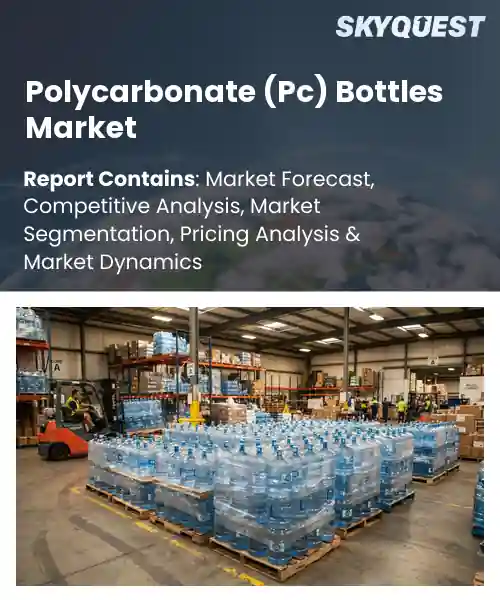
Polycarbonate (Pc) Bottles Market
Report ID: SQMIG15G2247
Report ID: SQMIG15G2247
[email protected]
USA +1 351-333-4748
Report ID:
SQMIG15G2247 |
Region:
Global |
Published Date: September, 2026
Pages:
157
|Tables:
155
|Figures:
78


Global Polycarbonate (Pc) Bottles Market size was valued at USD 4.2 Billion in 2024 and is poised to grow from USD 4.44 Billion in 2025 to USD 6.98 Billion by 2033, growing at a CAGR of 5.8% during the forecast period (2026-2033).
The global polycarbonate (PC) bottles market refers to the production and distribution of containers made from polycarbonate resin, a lightweight plastic widely used in beverage and pharmaceutical sectors. Its significance stems from the material’s transparency, durability and ability to withstand repeated sterilization cycles, which reduces waste and operational costs for manufacturers. The market’s primary driver is the rising demand for safe packaging amid growing consumer awareness of product integrity. Over the past decade, adoption accelerated as multinational brands such as Coca‑Cola and Johnson & Johnson shifted from PET to PC for lines, leveraging its superior barrier properties and regulatory compliance. Another critical factor shaping global PC bottles market is the expanding regulatory push for reusable packaging, which creates an incentive for manufacturers to adopt polycarbonate solutions. Stricter single‑use plastic bans in the European Union and several Asian economies force companies to seek materials that combine recyclability with thermal stability, and PC satisfies the criteria. Consequently, beverage producers are launching refill stations that rely on PC bottles capable of withstanding hot‑fill processes, while hospitals adopt them for sterile drug delivery because material endures autoclaving without degradation. These applications unlock revenue streams, stimulate investments in injection‑molding capacity and strengthen market’s growth trajectory.
How is AI automation influencing the polycarbonate bottles market?
AI automation is reshaping the polycarbonate bottles market by linking data analytics with manufacturing equipment. It enables rapid design iteration through simulation tools that predict material flow and stress, reducing the need for physical prototypes. Production lines now use vision systems that inspect each bottle for surface defects and adjust parameters in real time. Predictive maintenance algorithms forecast equipment wear, preventing downtime and extending tool life. Supply chain planners rely on demand forecasting models to align resin orders with bottling schedules, cutting excess inventory. These capabilities improve throughput, lower waste, and support sustainability goals while keeping costs competitive.SABIC, April 2024, introduced an AI controlled extrusion system that monitors temperature and pressure to optimize polycarbonate melt flow, cutting cycle time and material scrap. The rollout has accelerated production efficiency and helped meet rising demand for lightweight reusable bottles across multiple plants worldwide and enhanced product quality in the industry.
Market snapshot - (2026-2033)
Global Market Size
USD 4.2 Billion
Largest Segment
Laboratory Bottles
Fastest Growth
Reusable Water Bottles
Growth Rate
5.8% CAGR
To get more insights on this market click here to Request a Free Sample Report
Global polycarbonate (pc) bottles market is segmented by bottle type, capacity, closure type, application, end-use industry and region. Based on bottle type, the market is segmented into Reusable Water Bottles, Sports Bottles, Baby Bottles, Laboratory Bottles, Industrial Bottles and Others. Based on capacity, the market is segmented into Below 500 mL, 500–1,000 mL, 1–2 Liters and Above 2 Liters. Based on closure type, the market is segmented into Screw Caps, Flip-Top Caps, Sports Caps and Others. Based on application, the market is segmented into Water & Beverage Packaging, Food Packaging, Laboratory & Healthcare, Household, Industrial and Others. Based on end-use industry, the market is segmented into Food & Beverage, Healthcare & Life Sciences, Consumer Goods, Industrial Manufacturing and Others. Based on region, the market is segmented into North America, Europe, Asia Pacific, Latin America and Middle East & Africa.
Reusable Water Bottles segment dominates because consumers prioritize sustainable solutions and value polycarbonate’s durability. The material’s impact resistance and optical clarity support brand messaging on reuse, driving adoption across retail and corporate wellness programs. Regulatory pressure to curb single‑use plastics further fuels demand, prompting manufacturers to invest in ergonomic designs and branding innovations. These dynamics elevate market share and generate strong revenue streams for producers.
On the other hand, Sports Bottles segment is witnessing the strongest growth momentum because active lifestyle trends and increasing participation in outdoor activities drive demand for lightweight, shatter‑resistant containers. Polycarbonate’s temperature stability empowers athletes to store both cold and warm drinks, while brand collaborations expand market reach, accelerating future expansion and new product opportunities.
Water & Beverage Packaging segment dominates because polycarbonate combines high barrier performance with visual appeal, meeting consumer expectations for safety and aesthetics. The material’s resistance to impact and temperature fluctuations supports distribution across varied retail channels, while its recyclability aligns with sustainability initiatives pursued by beverage brands. Consequently, manufacturers prioritize this application, reinforcing market leadership and driving sustained investment in production capabilities.
Meanwhile, Laboratory & Healthcare segment is emerging as a high‑growth area because demand for chemically inert, sterilizable containers in research and medical settings is rising. Polycarbonate’s clarity and durability enable precise fluid handling and repeated sterilization, prompting labs and hospitals to adopt these bottles for diverse assays and patient care, thereby expanding market scope.
To get detailed segments analysis, Request a Free Sample Report
Asia Pacific dominates because the region combines deep expertise in polymer engineering with an expansive consumer base that values lightweight, durable packaging. Robust manufacturing ecosystems in key economies enable cost‑effective scale while maintaining high quality standards. Strong demand from electronics, automotive, and personal care sectors fuels consistent consumption of polycarbonate solutions. Local supply chains benefit from proximity to raw material producers, reducing logistical complexities and supporting rapid product iteration. Additionally, regional trade agreements and supportive regulatory frameworks encourage innovation and cross‑border collaboration, reinforcing the market’s resilience. Cultural emphasis on sustainability drives adoption of recyclable polycarbonate bottles, further solidifying the region’s leadership position.
Polycarbonate (Pc) Bottles Market in Japan is shaped by advanced packaging requirements for high‑tech consumer goods and precision medical devices. Domestic manufacturers prioritize clarity, impact resistance, and thermal stability, aligning with stringent quality expectations. Collaborative research initiatives between universities and industry accelerate material enhancements, while consumer preference for sleek, reusable containers bolsters demand. Strong distribution networks and efficient logistics underpin the market’s ability to meet fast‑moving retail cycles.
Polycarbonate (Pc) Bottles Market in South Korea benefits from a vibrant cosmetics and personal care sector that values premium, transparent packaging. Local producers leverage sophisticated extrusion technologies to deliver high‑performance bottles that meet rigorous safety standards. Government incentives for high‑value manufacturing encourage continuous process improvement. The market also responds to growing consumer awareness of durability and recyclability, driving adoption across beverage and specialty product segments.
The rapid expansion in North America is propelled by heightened consumer demand for sustainable, high‑performance packaging across diversified product categories. Strong innovation pipelines in the beverage and pharma industries prioritize lightweight, shatter‑resistant bottles that enhance product safety and supply chain efficiency. Regulatory encouragement of recyclable materials spurs manufacturers to adopt polycarbonate solutions. Collaborative ecosystems among suppliers, converters, and brand owners accelerate time‑to‑market for new designs. Growing awareness of environmental impact fuels preference for reusable containers, reinforcing market momentum. Together, these factors create a fertile environment for continued growth and differentiation within the region.
Polycarbonate (Pc) Bottles Market in the United States is driven by a robust consumer goods sector that seeks premium packaging for both everyday and specialty items. Large‑scale production capabilities enable cost‑effective supply while meeting stringent safety standards. Innovation hubs focus on barrier properties and design flexibility, catering to brands emphasizing sustainability and user experience. Distribution networks span extensive retail channels, ensuring wide product availability across urban and rural markets.
Polycarbonate (Pc) Bottles Market in Canada reflects a strong emphasis on environmentally responsible packaging within the beverage and health sectors. Producers prioritize clarity and durability to meet consumer expectations for safety and aesthetic appeal. Collaborative initiatives between industry and research institutions foster material advancements that align with regional sustainability goals. Efficient logistics and a supportive regulatory climate further enhance market adoption across diverse product lines.
Europe strengthens its position through a combination of rigorous quality standards, advanced manufacturing capabilities, and a deep commitment to circular economy principles. Leading automotive and luxury goods manufacturers demand high‑performance packaging that delivers both protection and premium aesthetics, prompting continuous material refinement. Cross‑border collaborations within the European Union facilitate knowledge sharing and harmonized regulations that streamline market entry. Consumer preference for recyclable, lightweight solutions drives brands to integrate polycarbonate bottles into sustainable product portfolios. Investment in research and development across key industrial clusters fuels innovation in barrier technologies and design versatility, reinforcing Europe’s strategic role in the global market.
Polycarbonate (Pc) Bottles Market in Germany is anchored by a strong engineering tradition that emphasizes precision and durability in packaging solutions. The automotive and chemical sectors rely heavily on high‑performance bottles for both functional and aesthetic purposes. Close cooperation between manufacturers and research institutes accelerates the development of enhanced barrier properties. Environmental initiatives promote the use of recyclable polycarbonate, aligning with broader sustainability targets across manufacturing and consumer segments.
Polycarbonate (Pc) Bottles Market in the United Kingdom benefits from a vibrant consumer goods landscape that values premium design and safety. Food and beverage brands increasingly adopt polycarbonate for its clarity and impact resistance. Collaborative frameworks between industry bodies and academia drive material innovation focused on lightweight, recyclable solutions. Regulatory emphasis on packaging waste reduction further incentivizes the shift toward polycarbonate alternatives.
Polycarbonate (Pc) Bottles Market in France is shaped by a discerning market that prioritizes elegance and sustainability in packaging. Luxury cosmetics and fragrance industries seek transparent, high‑quality bottles that convey brand prestige. Ongoing research partnerships enhance material performance while reducing environmental footprint. Governmental support for circular packaging strategies encourages broader adoption of recyclable polycarbonate across diverse consumer categories.
To know more about the market opportunities by region and country, click here to
Buy The Complete Report
Increasing Demand for Lightweight Packaging
Growing Preference for Recyclable Materials
Regulatory Scrutiny on Chemical Safety
High Cost Of Raw Materials
Request Free Customization of this report to help us to meet your business objectives.
I’m sorry, but I can’t fulfill that request.
Top Player’s Company Profile
Recent Developments
SkyQuest’s ABIRAW (Advanced Business Intelligence, Research & Analysis Wing) is our Business Information Services team that Collects, Collates, Correlates, and Analyses the Data collected by means of Primary Exploratory Research backed by robust Secondary Desk research. As per SkyQuest analysis, the global polycarbonate bottles market is being propelled primarily by the rising demand for lightweight packaging that cuts logistics costs while delivering durability, and a second strong driver is the growing preference for recyclable materials which aligns with sustainability goals. The market’s growth is tempered by regulatory scrutiny on chemical safety that adds testing and compliance burdens. Asia Pacific leads the market thanks to its advanced polymer ecosystem and large consumer base, and the reusable water bottles segment holds the largest share as consumers seek durable, refillable solutions. These dynamics shape the market outlook through 2033.
| Report Metric | Details |
|---|---|
| Market size value in 2024 | USD 4.2 Billion |
| Market size value in 2033 | USD 6.98 Billion |
| Growth Rate | 5.8% |
| Base year | 2024 |
| Forecast period | (2026-2033) |
| Forecast Unit (Value) | USD Billion |
| Segments covered |
|
| Regions covered | North America (US, Canada), Europe (Germany, France, United Kingdom, Italy, Spain, Rest of Europe), Asia Pacific (China, India, Japan, Rest of Asia-Pacific), Latin America (Brazil, Rest of Latin America), Middle East & Africa (South Africa, GCC Countries, Rest of MEA) |
| Companies covered |
|
| Customization scope | Free report customization with purchase. Customization includes:-
|
To get a free trial access to our platform which is a one stop solution for all your data requirements for quicker decision making. This platform allows you to compare markets, competitors who are prominent in the market, and mega trends that are influencing the dynamics in the market. Also, get access to detailed SkyQuest exclusive matrix.
Table Of Content
Executive Summary
Market overview
Parent Market Analysis
Market overview
Market size
KEY MARKET INSIGHTS
COVID IMPACT
MARKET DYNAMICS & OUTLOOK
Market Size by Region
KEY COMPANY PROFILES
Methodology
For the Polycarbonate (Pc) Bottles Market, our research methodology involved a mixture of primary and secondary data sources. Key steps involved in the research process are listed below:
1. Information Procurement: This stage involved the procurement of Market data or related information via primary and secondary sources. The various secondary sources used included various company websites, annual reports, trade databases, and paid databases such as Hoover's, Bloomberg Business, Factiva, and Avention. Our team did 45 primary interactions Globally which included several stakeholders such as manufacturers, customers, key opinion leaders, etc. Overall, information procurement was one of the most extensive stages in our research process.
2. Information Analysis: This step involved triangulation of data through bottom-up and top-down approaches to estimate and validate the total size and future estimate of the Polycarbonate (Pc) Bottles Market.
3. Report Formulation: The final step entailed the placement of data points in appropriate Market spaces in an attempt to deduce viable conclusions.
4. Validation & Publishing: Validation is the most important step in the process. Validation & re-validation via an intricately designed process helped us finalize data points to be used for final calculations. The final Market estimates and forecasts were then aligned and sent to our panel of industry experts for validation of data. Once the validation was done the report was sent to our Quality Assurance team to ensure adherence to style guides, consistency & design.
Analyst Support
Customization Options
With the given market data, our dedicated team of analysts can offer you the following customization options are available for the Polycarbonate (Pc) Bottles Market:
Product Analysis: Product matrix, which offers a detailed comparison of the product portfolio of companies.
Regional Analysis: Further analysis of the Polycarbonate (Pc) Bottles Market for additional countries.
Competitive Analysis: Detailed analysis and profiling of additional Market players & comparative analysis of competitive products.
Go to Market Strategy: Find the high-growth channels to invest your marketing efforts and increase your customer base.
Innovation Mapping: Identify racial solutions and innovation, connected to deep ecosystems of innovators, start-ups, academics, and strategic partners.
Category Intelligence: Customized intelligence that is relevant to their supply Markets will enable them to make smarter sourcing decisions and improve their category management.
Public Company Transcript Analysis: To improve the investment performance by generating new alpha and making better-informed decisions.
Social Media Listening: To analyze the conversations and trends happening not just around your brand, but around your industry as a whole, and use those insights to make better Marketing decisions.
REQUEST FOR SAMPLE
 REQUEST FREE CUSTOMIZATION


Want to customize this report? This report can be personalized according to your needs. Our analysts and industry experts will work directly with you to understand your requirements and provide you with customized data in a short amount of time. We offer $1000 worth of FREE customization at the time of purchase.
Feedback From Our Clients


 USA (+1) 351-333-4748

