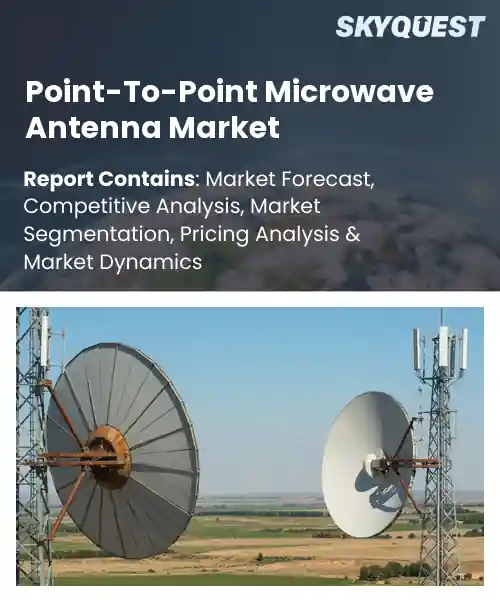
Point-To-Point Microwave Antenna Market
Report ID: SQMIG45H2238
Report ID: SQMIG45H2238
[email protected]
USA +1 351-333-4748
Report ID:
SQMIG45H2238 |
Region:
Global |
Published Date: July, 2026
Pages:
157
|Tables:
116
|Figures:
77


Global Point-To-Point Microwave Antenna Market size was valued at USD 4.80 Billion in 2024 and is poised to grow from USD 5.16 Billion in 2025 to USD 9.20 Billion by 2033, growing at a CAGR of 7.5% during the forecast period (2026-2033).
The major factor driving the global point-to-point microwave antenna market growth is the increasing demand for high capacity backhaul connectivity in mobile networks. With the rollout of 5G, carriers need low-latency, high-bandwidth links from cell sites to data centers and edge nodes. Microwave systems can be a cost-effective alternative to fiber where trenching costs are prohibitive. Historically, the market has evolved from early analog dishes used for voice transmission in the 1990s to today’s digital, adaptive arrays capable of gigabit speeds. Examples from the real world include rural broadband initiatives in India and emergency communications in disaster-prone regions of the Philippines, demonstrating the technology’s strategic relevance internationally.
Another crucial point-to-point microwave antenna market trends driver is the synergy between smart-city projects and the need for resilient links, pushing operators to deploy antennas on infrastructure. This creates an opportunity for manufacturers to embed ML beam-forming algorithms that dynamically adapt to fade and hence reduce downtime and operating cost. For example, Tokyo’s transit authority has deployed microwave backhaul to link CCTV and passenger-information systems in tunnels where fiber is not feasible, and a European utility uses the same technology to synchronize substations. Demand drives market adoption, which drives advanced antenna development, which drives densification of the cause-effect chain, which drives demand.
How is AI-driven Automation Influencing Performance and Cost Efficiency of Point-to-Point Microwave Antenna Deployments?
Artificial intelligence-driven automation is changing point-to-point microwave antenna market share deployments with real time beam alignment, predictive fault detection and self optimizing link configuration. These capabilities shorten manual tuning cycles, reduce labor costs, and keep link performance stable in the face of changing traffic patterns. Now operators rely on software agents that “ingest” telemetry, adjust tilt and power, and trigger maintenance before outages occur. The market for 5G backhaul is experiencing faster rollout cycles and higher capacity utilization due to demand. That means projects that once required weeks of field work can now be commissioned in days, on tighter budgets and with more dependable service.
CommScope Holding Company Inc. was featured in a February 2021 market analysis for its AI-enabled antenna management platform that automates the work of alignment and performance monitoring, reducing deployment time and operational costs. The launch highlights the way AI automation is helping to enable continued market growth and promote efficiency.
Market snapshot - (2026-2033)
Global Market Size
USD 4.8 Billion
Largest Segment
Parabolic Reflector Antennas
Fastest Growth
Flat Panel Directional Antennas
Growth Rate
7.5% CAGR
To get more insights on this market click here to Request a Free Sample Report
Global point-to-point microwave antenna market is segmented by antenna architecture type, frequency band spectrum, polarization mode, end-use application vertical and region. Based on antenna architecture type, the market is segmented into parabolic reflector antennas and flat panel directional antennas. Based on frequency band spectrum, the market is segmented into high frequency bands (6 GHz to 23 GHz), e-band v-band millimeter wave (above 24 GHz) and low frequency bands (under 6 GHz). Based on polarization mode, the market is segmented into single polarized antenna systems and dual polarized antenna systems. Based on end-use application vertical, the market is segmented into telecommunication network backhaul, enterprise private network infrastructure, government public safety communication and utility industrial remote monitoring. Based on region, the market is segmented into North America, Europe, Asia Pacific, Latin America and Middle East & Africa.
The parabolic reflector antennas segment is the leader, thanks to its proven high gain and narrow beamwidth that provide reliable long distance links that are essential for carrier backhaul and critical infrastructure. The proven installation expertise and developed manufacturing base along with cost effective performance in varying weather conditions gives confidence to the operators to prefer this architecture. Hence, network planners select parabolic solutions particularly to satisfy stringent availability requirements, which further strengthens its leading position in the point to point microwave antenna market.
Simultaneously, flat panel directional antennas are being developed as the fastest growing segment because their small form factor and ease of integration allow deployment in dense urban and enterprise environments. The progress in planar array technology enables better performance at higher frequencies, which is attractive for operators looking for agile and low-profile solutions to accelerate network densification and open market opportunities.
High frequency bands are used to split leads, as they are a compromise between coverage distance and bandwidth, so service providers can upgrade legacy links without the expense of fiber. The spectrum is sufficiently resistant to atmospheric attenuation and provides multi gigabit throughput to meet the growing data demand across metro and regional networks. Operators prefer equipment tuned to this range and this reinforces its leadership in the point to point microwave antenna market.
In contrast, the E Band V Band millimeter wave is the fastest growing domain, where its ultra wide spectrum enables a new level of unprecedented data rates for emerging ultra dense backhaul and edge computing links. Regulatory encouragement and continued progress in antenna miniaturization reduces the barriers to deployment, with operators embracing these bands as a catalyst for next generation network expansion.
To get detailed segments analysis, Request a Free Sample Report
It benefits from a mixture of sophisticated telecommunications infrastructure, high levels of broadband services deployment and robust government backing for digital connectivity initiatives. The region's premier manufacturers are known for their engineering prowess and fast innovation cycles, delivering compact, high-performance antenna solutions. Service providers tend to be early adopters of technology, so there is a demand for reliable point-to-point links, especially in dense urban corridors and emerging smart-city applications. The region’s leading position in the global market is also supported by strong supply chain networks and strategic proximity to key component suppliers, which boost cost efficiency.
Point-to-point microwave antenna market outlook in Japan is propelled by extensive fiber‑backhaul constraints in mountainous terrain, prompting operators to rely on wireless alternatives. The country’s emphasis on resilient communication networks for disaster preparedness fuels continuous investment in high‑capacity antenna systems. Domestic manufacturers leverage strong research capabilities to produce sophisticated, compact designs that meet rigorous performance standards, supporting widespread deployment across both urban and rural segments.
Point-to-point microwave antenna market forecast in South Korea thrives on aggressive rollout of next‑generation mobile services and a vibrant ecosystem of technology firms. The nation’s focus on ultra‑low latency connectivity for industrial automation and autonomous transportation creates persistent demand for robust microwave links. Local suppliers benefit from close collaboration with network operators, facilitating rapid customization and integration of antenna solutions that address dense metropolitan coverage challenges.
The market is being electrified by continued investment in high-speed connectivity to support growing data traffic and deployment of new advanced wireless services. Operators complementing fiber deployments are focusing on microwave backhaul, especially in remote and hard-to-reach locations where the cost of trenching is prohibitive. Strong regulatory structures help make spectrum available, and a mature ecosystem of technology providers means that products keep getting better. The focus on network resilience for critical communications coupled with the development of edge computing applications further intensifies the need for reliable point-to-point links across the continent.
Point-to-point microwave antenna market regional outlook in United States is shaped by large‑scale carrier initiatives to densify networks and improve rural broadband penetration. The extensive geographic diversity drives reliance on microwave solutions for bridging gaps in remote regions and for rapid deployment during infrastructure upgrades. Industry collaboration among equipment manufacturers, service providers, and standards bodies fuels innovation, delivering antenna systems that meet stringent performance and environmental criteria.
Point-to-point microwave antenna market regional forecast in Canada reflects the country’s focus on connecting sparsely populated northern communities and supporting vast resource extraction sites. The logistical challenges of extensive landmass encourage adoption of microwave technology as a cost‑effective alternative to fiber. Government incentives for broadband expansion and strong partnerships with indigenous operators promote the rollout of resilient, high‑capacity antenna networks that enhance connectivity across remote territories.
Europe is building its market position through coordinated investment in digital infrastructure and a common approach to spectrum harmonisation.” Policy frameworks enable the deployment of microwave backhaul as a complement to fibre, especially in cross-border corridors and environmentally sensitive areas where trenching is restricted. Leading companies and academic institutions collaborate on research projects to push antenna designs to greater efficiency and lower power consumption. The region’s commitment to sustainability and the integration of microwave solutions into emerging 5G and edge-computing ecosystems further cement its strategic importance.
Point-to-point microwave antenna market analysis in Germany benefits from a strong engineering tradition and a dense network of automotive and industrial manufacturers requiring reliable high‑speed links. The country’s emphasis on Industry 4.0 and smart‑factory deployments creates persistent demand for low‑latency microwave connections. Close cooperation between hardware providers and network operators facilitates rapid adaptation of antenna technologies to meet stringent performance standards across industrial zones.
Point-to-point microwave antenna market penetration in United Kingdom is driven by the need to augment fiber networks in historic urban centers and offshore installations. Regulatory support for spectrum sharing enables flexible deployment of microwave links for broadband expansion and public‑service communications. Collaborative efforts among telecom operators and technology firms foster the development of compact, weather‑resilient antenna solutions tailored to the country’s varied geographic and regulatory landscape.
Point-to-point microwave antenna industry in France reflects a strategic focus on bridging connectivity gaps in rural territories and enhancing mobile backhaul for urban densification. The nation’s commitment to digital sovereignty encourages investment in domestic antenna manufacturing capabilities. Partnerships between research institutions and industry accelerate the rollout of advanced microwave solutions that support high‑capacity, secure communications across both metropolitan and peripheral regions.
To know more about the market opportunities by region and country, click here to
Buy The Complete Report
Increasing Demand for High‑Speed Connectivity
Adoption Of 5G And Beyond
Regulatory Licensing And Spectrum Constraints
High Capital Expenditure For Deployment
Request Free Customization of this report to help us to meet your business objectives.
The competitive landscape of the microwave antenna market is characterized by established telecommunications equipment manufacturers competing through continuous product innovation, strategic collaborations with mobile network operators, and investments in next-generation wireless transport technologies. Leading companies including CommScope Holding Company, Huber+Suhner, Radio Frequency Systems, Ericsson, Nokia Corporation, Huawei Technologies, and NEC Corporation are expanding their microwave backhaul portfolios by introducing high-capacity E-band and multi-band antenna solutions that support 5G, private wireless networks, and mission-critical communications. Increasing demand for low-latency connectivity, rural broadband expansion, and network modernization is encouraging manufacturers to integrate advanced beamforming, improved spectral efficiency, and energy-efficient designs to strengthen their competitive positions.
Top Player’s Company Profile
Recent Developments in the Point-To-Point Microwave Antenna Market
SkyQuest’s ABIRAW (Advanced Business Intelligence, Research & Analysis Wing) is our Business Information Services team that Collects, Collates, Correlates, and Analyses the Data collected by means of Primary Exploratory Research backed by robust Secondary Desk research. As per SkyQuest analysis the global point‑to‑point microwave antenna market is being propelled primarily by the surging demand for high‑speed backhaul connectivity driven by 5G rollouts, while AI‑enabled automation offers a second driver by reducing deployment time and operational costs. The market is constrained by regulatory licensing and spectrum availability which can delay projects. Asia Pacific dominates the landscape thanks to strong telecom investment, early technology adoption and a robust manufacturing base. Parabolic reflector antennas remain the leading segment because of their proven high gain and reliability for long‑distance links. Together these forces shape a market expected to grow at a strong pace through 2033.
| Report Metric | Details |
|---|---|
| Market size value in 2024 | USD 4.8 Billion |
| Market size value in 2033 | USD 9.2 Billion |
| Growth Rate | 7.5% |
| Base year | 2024 |
| Forecast period | (2026-2033) |
| Forecast Unit (Value) | USD Billion |
| Segments covered |
|
| Regions covered | North America (US, Canada), Europe (Germany, France, United Kingdom, Italy, Spain, Rest of Europe), Asia Pacific (China, India, Japan, Rest of Asia-Pacific), Latin America (Brazil, Rest of Latin America), Middle East & Africa (South Africa, GCC Countries, Rest of MEA) |
| Companies covered |
|
| Customization scope | Free report customization with purchase. Customization includes:-
|
To get a free trial access to our platform which is a one stop solution for all your data requirements for quicker decision making. This platform allows you to compare markets, competitors who are prominent in the market, and mega trends that are influencing the dynamics in the market. Also, get access to detailed SkyQuest exclusive matrix.
Table Of Content
Executive Summary
Market overview
Parent Market Analysis
Market overview
Market size
KEY MARKET INSIGHTS
COVID IMPACT
MARKET DYNAMICS & OUTLOOK
Market Size by Region
KEY COMPANY PROFILES
Methodology
For the Point-To-Point Microwave Antenna Market, our research methodology involved a mixture of primary and secondary data sources. Key steps involved in the research process are listed below:
1. Information Procurement: This stage involved the procurement of Market data or related information via primary and secondary sources. The various secondary sources used included various company websites, annual reports, trade databases, and paid databases such as Hoover's, Bloomberg Business, Factiva, and Avention. Our team did 45 primary interactions Globally which included several stakeholders such as manufacturers, customers, key opinion leaders, etc. Overall, information procurement was one of the most extensive stages in our research process.
2. Information Analysis: This step involved triangulation of data through bottom-up and top-down approaches to estimate and validate the total size and future estimate of the Point-To-Point Microwave Antenna Market.
3. Report Formulation: The final step entailed the placement of data points in appropriate Market spaces in an attempt to deduce viable conclusions.
4. Validation & Publishing: Validation is the most important step in the process. Validation & re-validation via an intricately designed process helped us finalize data points to be used for final calculations. The final Market estimates and forecasts were then aligned and sent to our panel of industry experts for validation of data. Once the validation was done the report was sent to our Quality Assurance team to ensure adherence to style guides, consistency & design.
Analyst Support
Customization Options
With the given market data, our dedicated team of analysts can offer you the following customization options are available for the Point-To-Point Microwave Antenna Market:
Product Analysis: Product matrix, which offers a detailed comparison of the product portfolio of companies.
Regional Analysis: Further analysis of the Point-To-Point Microwave Antenna Market for additional countries.
Competitive Analysis: Detailed analysis and profiling of additional Market players & comparative analysis of competitive products.
Go to Market Strategy: Find the high-growth channels to invest your marketing efforts and increase your customer base.
Innovation Mapping: Identify racial solutions and innovation, connected to deep ecosystems of innovators, start-ups, academics, and strategic partners.
Category Intelligence: Customized intelligence that is relevant to their supply Markets will enable them to make smarter sourcing decisions and improve their category management.
Public Company Transcript Analysis: To improve the investment performance by generating new alpha and making better-informed decisions.
Social Media Listening: To analyze the conversations and trends happening not just around your brand, but around your industry as a whole, and use those insights to make better Marketing decisions.
REQUEST FOR SAMPLE
 REQUEST FREE CUSTOMIZATION
Global Point-To-Point Microwave Antenna Market size was valued at USD 4.8 Billion in 2024 and is poised to grow from USD 5.16 Billion in 2025 to USD 9.2 Billion by 2033, growing at a CAGR of 7.5% during the forecast period (2026-2033).
The competitive landscape is shaped by aggressive M&A activity, strategic partnerships with accelerator platforms and rapid tech innovation; for example, several telecom‑focused seed firms have aligned with Plug and Play Tech Center to accelerate market entry, while power‑grid software startups highlighted by New Market Pitch are integrating microwave link capabilities to enhance grid flexibility, intensifying rivalry among incumbent antenna manufacturers. 'CommScope Holding Company', 'Rosenberger Hochfrequenztechnik', 'Huber+Suhner', 'Radio Frequency Systems', 'Ericsson', 'Nokia Corporation', 'Huawei Technologies', 'ZTE Corporation', 'NEC Corporation', 'Fujitsu', 'Cisco Systems', 'Juniper Networks', 'Broadcom', 'Qualcomm', 'Texas Instruments', 'Analog Devices', 'NXP Semiconductors', 'STMicroelectronics', 'Infineon Technologies', 'TE Connectivity'
The proliferation of data‑intensive applications such as cloud gaming, video conferencing, and real‑time analytics drives enterprises and service providers to seek low‑latency, high‑capacity links. Point‑to‑point microwave antennas deliver reliable, line‑of‑sight connectivity that bypasses fiber constraints, enabling rapid network expansion in urban and remote areas. This capability supports the rollout of next‑generation services, reinforcing market momentum as operators prioritize flexible solutions that can be installed quickly and scaled to meet evolving bandwidth requirements.
5G Infrastructure Integration: The rollout of 5G networks is prompting telecom operators and equipment manufacturers to adopt point‑to‑point microwave antennas as a cost‑effective backhaul solution. These antennas provide high‑capacity links that complement fiber, especially in dense urban corridors and hard‑to‑reach suburban zones. By leveraging the millimeter‑wave spectrum, vendors can deliver low‑latency connections critical for real‑time services such as smart city platforms, edge computing, and industrial IoT, driving sustained demand for advanced antenna designs and enabling seamless integration with emerging cloud‑native architectures for operators.
Why does Asia Pacific Dominate the Global Point-To-Point Microwave Antenna Market? |@12


Want to customize this report? This report can be personalized according to your needs. Our analysts and industry experts will work directly with you to understand your requirements and provide you with customized data in a short amount of time. We offer $1000 worth of FREE customization at the time of purchase.
Feedback From Our Clients


 USA (+1) 351-333-4748

