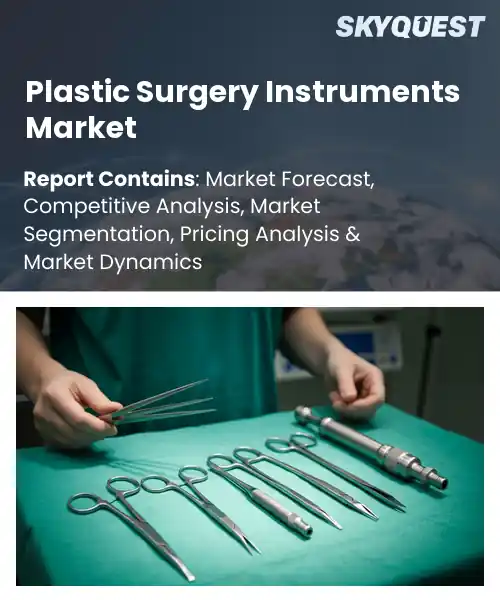
Plastic Surgery Instruments Market
Report ID: SQMIG35A3951
Report ID: SQMIG35A3951
[email protected]
USA +1 351-333-4748
Report ID:
SQMIG35A3951 |
Region:
Global |
Published Date: June, 2026
Pages:
157
|Tables:
153
|Figures:
78


Global Plastic Surgery Instruments Market size was valued at USD 1.65 Billion in 2024 and is poised to grow from USD 1.78 Billion in 2025 to USD 3.24 Billion by 2033, growing at a CAGR of 7.8% during the forecast period (2026-2033).
Plastic surgery instruments market also includes surgical instruments such as forceps, retractors, scissors, and electrosurgical instruments used in reconstructive and cosmetic surgeries. Increasing demand of elective aesthetic surgeries due to aging population and changing social norms is the key driver of this market. This market is important because precision instruments impact clinical outcomes, infection rates and procedural efficiency, which in turn impact patient satisfaction and healthcare costs. In the last two decades the field has evolved from basic stainless steel kits to specialized and ergonomically designed disposable kits with the advent of micro-instruments in minimally invasive rhinoplasty, and laser compatible forceps in dermatologic procedures.
Technology innovation in materials and design is a key driver for the global plastic surgery instruments market. Lighter alloys, titanium coatings and better sterilizable polymers reduce operative time and instrument fatigue, which is driving uptake by surgeons and purchase by hospitals. As instruments are adapted for use on endoscopic and robotic platforms, clinics are able to offer less invasive procedures, allowing for greater patient throughput and new revenue streams for ambulatory surgery centers. For instance, microdebriders paired with powered elevators allow for faster facelifts under local anesthesia, reducing costs and broadening access. This is why manufacturers are investing in modular systems and training partnerships to efficiently capture scaling opportunities around the world.
How is AI enhancing precision and outcomes in the plastic surgery instruments market?
AI is improving the precision and outcomes of the plastic surgery instruments market by enhancing imaging driven planning, intraoperative guidance and instrument control. Surgeons can more reliably plan incisions and predict the behavior of tissues by analyzing preoperative scans and real-time imaging with the help of AI. Operating room computer vision and navigation tools offer instrument tracking and scene awareness, which reduce unintended tissue handling and improve reconstruction consistency. At the instrument level, AI enables purpose built microsurgical tools and suture systems that match motion to clinical goals. These developments are driving demand for integrated smart instruments and collaborative surgical platforms with a focus on safety and reproducibility.
In April 2026 MMI unveiled a robotic microsurgical suture for reconstructive plastic surgery and showed how AI-based tool design and robotic platform integration can improve needle placement and reduce variation on delicate repairs. The real-world launch is positive for the growth of the market as it increases the adoption of advanced instruments in hospitals and clinics and shortens the learning curve for surgeons.
Market snapshot - (2026-2033)
Global Market Size
USD 1.65 Billion
Largest Segment
Handheld Instruments
Fastest Growth
Liposuction Instruments
Growth Rate
7.8% CAGR
To get more insights on this market click here to Request a Free Sample Report
Global plastic surgery instruments market is segmented by product type, procedure type, application, end user, material type and region. Based on product type, the market is segmented into Handheld Instruments, Electrosurgical Instruments, Liposuction Instruments, Microsurgical Instruments and Others. Based on procedure type, the market is segmented into Reconstructive Surgery, Cosmetic Surgery, Burn Repair Surgery, Craniofacial Surgery and Others. Based on application, the market is segmented into Facial Surgery, Breast Surgery, Body Contouring, Skin Grafting and Others. Based on end user, the market is segmented into Hospitals, Ambulatory Surgical Centers, Cosmetic Surgery Clinics, Specialty Clinics and Others. Based on material type, the market is segmented into Stainless Steel, Titanium, Disposable Plastic Instruments and Others. Based on region, the market is segmented into North America, Europe, Asia Pacific, Latin America and Middle East & Africa.
The Microsurgical Instruments segment is spearheading the growth with its ultra-fine instruments, which provide the precision required in complex reconstructive and aesthetic procedures, thereby reducing tissue trauma and improving functional outcomes. Procurement preference is driven by demand of surgeons for better visualization, miniaturization of instruments and integration with microscopes and micro sutures. Sustained by strong perceived clinical value, and ongoing use in complex craniofacial and vascularized tissue repairs, continues to be adopted across care settings and evolving training curricula.
However Liposuction Instruments are the fastest growing area, as the increasing demand for body contouring and minimally invasive fat removal drives innovation in powered cannulas and energy assisted systems. Safety improvements, faster recovery and streamlined procedures drive use in ambulatory centers and create new buying cycles and aftermarket opportunities that grow the market overall.
The Disposable Plastic Instruments segment is gaining traction as single use tools meet stringent infection control priorities and streamline workflow in high throughput cosmetic and ambulatory settings thereby reducing turnaround time for procedures. Regulatory push for reduction in cross contamination and increasing preference of clinics for cost effective consumables over disposable products will push procurement. Availability of custom kits, ease of inventory management and lower sterilization costs are driving widespread adoption and supplier investment in plastic instrument portfolios.
At the same time Titanium instruments are gaining the highest growth momentum in demand for lightweight, corrosion resistant and biocompatible tools for advanced reconstructive and microsurgeries. Material innovation and a premium positioning drive hospitals and specialty clinics to invest in titanium portfolios, opening doors to coated finishes, modular designs, and long term value propositions that elevate market sophistication.
To get detailed segments analysis, Request a Free Sample Report
North America leads due to a combination of structural and market factors that bolster leadership in plastic surgery instruments. Established Medical device manufacturers and a dense network of specialized clinical centers accelerate product development and adoption . Iterative improvements in instrument design are possible because of high level of clinical expertise, extensive training programs and a strong collaboration between surgeons and industry. A favorable reimbursement climate and large private investment in healthcare facilitate access to advanced tools. Regulatory frameworks and quality expectations are barriers to entry for lower tier suppliers and favour trusted brands. Furthermore, strong distribution channels and robust clinical research ecosystems cement the market strength, making the region a benchmark for innovation and quality in global instrument standards. Ambulatory surgery centers are well established, and there is a culture of elective aesthetic care, which maintains demand in urban and suburban markets.
Plastic Surgery Instruments Market in United States is characterized by concentration of specialized centers, high clinical expertise and frequent adoption of advanced instrument technology. Clinicians and manufacturers work closely together to facilitate iterative design improvements and rigorous quality standards. Aesthetic considerations, reconstructive requirements, and a robust training ecosystem that supports consistent procurement practices and personalized instrument portfolios designed to improve surgical outcomes across diverse practice settings are all factors that impact the demand for surgical instruments.
Plastic Surgery Instruments Market in Canada is a combination of stringent clinical standards, collaborative research initiatives and a patient-centric approach that emphasizes on safety and outcome transparency. Procurement is generally inclined towards high quality, multi-purpose instruments to suit multi-disciplinary practices. Regional centers facilitate clinician training and the adoption of minimally invasive technique, while distributors and manufacturers concentrate on service, instrument longevity, and regulatory compliance to preserve practitioner confidence and enhance consistency across care settings.
The Plastic Surgery Instruments Market in Germany is driven by a strong industrial base, advanced manufacturing capabilities and stringent clinical validation processes. Clusters in medical technology stimulate close cooperation between engineers and clinicians, and hence the invention of instruments that are tailored to the needs of surgery. Clinician preference for instruments of high quality and durability and well established hospital procurement procedures create a stable market environment. Local manufacturers and distributors emphasize precision, compliance and service models that establish trust.
The Plastic Surgery Instruments Market in United Kingdom is characterized by a dynamic private sector, growing clinic networks and strong medical technology innovation that accelerate instrument adoption. Clinicians and independent surgery centers want new, minimally invasive solutions supported by targeted training and localized service offerings. Close cooperation with manufacturers and flexible procurement models allow for the rapid introduction of differentiated instrument portfolios. The market rewards the ability to respond to patient preferences and efficiencies in clinical workflow.
Plastic Surgery Instruments Market in France is growing with a strong cultural focus on aesthetic refinement and clinician driven demand for precision instruments. Specialty clinics and multidisciplinary centers have procurement preferences that are more focused on the ergonomics and the finish of the instruments. Manufacturers and distributors who provide personalized service and training to clinicians are gaining traction. The market is a mix of aesthetics and clinical rigor, encouraging the selective adoption of instruments that marry functionality with user experience.
Asia Pacific is reinforcing its standing through sophisticated manufacturing, clinician skill building and market specific innovation. Regional manufacturers are investing in precision engineering and design to keep pace with changing surgical techniques and aesthetic preferences. “Surgeons are becoming more familiar with advanced instruments through centers of clinical excellence and focused training programs. Sustained clinical demand is supported by cross-border patient flows and a cultural emphasis on aesthetics. Technology transfer is accelerated by partnerships between local firms and global companies. To boost the region’s competitiveness on quality and value, manufacturers and distributors are focusing on product localization, ergonomic enhancement and responsive service models to serve a range of clinical workflows across markets. Better regulatory alignment and increasing clinical research collaborations are enabling enhanced credibility. Expansion of ambulatory facilities and specialized aesthetic centers is facilitating wider deployment of instruments and feedback driven refinement.
The Plastic Surgery Instruments Market in Japan is backed by precision manufacturing, strong research institutions and a disciplined regulatory environment that emphasizes safety and performance. Clinicians’ involvement in design teams results in instruments optimized for accuracy and usability. Hospitals and special centers focus on durable, high quality tools and systematic training to support reconstructive and aesthetic procedures. Locals have global partners and they work together to keep on tweaking instruments to meet local surgical techniques.
South Korea Plastic Surgery Instruments market is marked by a high concentration of aesthetic clinics, strong surgeon expertise and a market culture that favors innovative, minimally invasive solutions. Local manufacturers are renowned for their fast development cycles and tight cooperation with clinicians, resulting in instruments that are tailored to local procedural preferences. Training centers support clinical exposure informing iterative design. Design, affordability and service responsiveness are the focus to improve supplier relationships and increase export growth.
To know more about the market opportunities by region and country, click here to
Buy The Complete Report
Rising Demand For Cosmetic Procedures
Technological Advancements In Instruments
Stringent Regulatory Approval Processes
High Costs Of Advanced Instruments
Request Free Customization of this report to help us to meet your business objectives.
The competition landscape in the global plastic surgery instruments market is defined by consolidation and technology differentiation. Rivals are capitalizing on M&A tuck-ins for adding niche instrument lines, exclusive distribution agreements for gaining regional hospital accounts, and product innovation in ultrasound-guided tools and microsurgery robotics. Recent medtech tuck-ins, targeted distributor deals and startups commercializing CE-marked Sono-Instruments and funded microsurgery robot platforms are examples
SkyQuest’s ABIRAW (Advanced Business Intelligence, Research & Analysis Wing) is our Business Information Services team that Collects, Collates, Correlates, and Analyses the Data collected by means of Primary Exploratory Research backed by robust Secondary Desk research. As per SkyQuest analysis, the global plastic surgery instruments market is propelled by rising demand for elective aesthetic surgeries driven by aging populations and changing social norms, while technological and AI-enabled advancements in materials, ergonomics and imaging-guided instruments act as a second powerful growth driver. Stringent regulatory approval processes remain a major restraint, slowing time to market and raising costs. North America continues to dominate the market thanks to mature manufacturers, dense clinical networks and strong reimbursement support, and microsurgical instruments lead segmentally due to their critical role in precision reconstructive and aesthetic procedures, high clinical value and steady adoption across care settings.
| Report Metric | Details |
|---|---|
| Market size value in 2024 | USD 1.65 Billion |
| Market size value in 2033 | USD 3.24 Billion |
| Growth Rate | 7.8% |
| Base year | 2024 |
| Forecast period | (2026-2033) |
| Forecast Unit (Value) | USD Billion |
| Segments covered |
|
| Regions covered | North America (US, Canada), Europe (Germany, France, United Kingdom, Italy, Spain, Rest of Europe), Asia Pacific (China, India, Japan, Rest of Asia-Pacific), Latin America (Brazil, Rest of Latin America), Middle East & Africa (South Africa, GCC Countries, Rest of MEA) |
| Companies covered |
|
| Customization scope | Free report customization with purchase. Customization includes:-
|
To get a free trial access to our platform which is a one stop solution for all your data requirements for quicker decision making. This platform allows you to compare markets, competitors who are prominent in the market, and mega trends that are influencing the dynamics in the market. Also, get access to detailed SkyQuest exclusive matrix.
Table Of Content
Executive Summary
Market overview
Parent Market Analysis
Market overview
Market size
KEY MARKET INSIGHTS
COVID IMPACT
MARKET DYNAMICS & OUTLOOK
Market Size by Region
KEY COMPANY PROFILES
Methodology
For the Plastic Surgery Instruments Market, our research methodology involved a mixture of primary and secondary data sources. Key steps involved in the research process are listed below:
1. Information Procurement: This stage involved the procurement of Market data or related information via primary and secondary sources. The various secondary sources used included various company websites, annual reports, trade databases, and paid databases such as Hoover's, Bloomberg Business, Factiva, and Avention. Our team did 45 primary interactions Globally which included several stakeholders such as manufacturers, customers, key opinion leaders, etc. Overall, information procurement was one of the most extensive stages in our research process.
2. Information Analysis: This step involved triangulation of data through bottom-up and top-down approaches to estimate and validate the total size and future estimate of the Plastic Surgery Instruments Market.
3. Report Formulation: The final step entailed the placement of data points in appropriate Market spaces in an attempt to deduce viable conclusions.
4. Validation & Publishing: Validation is the most important step in the process. Validation & re-validation via an intricately designed process helped us finalize data points to be used for final calculations. The final Market estimates and forecasts were then aligned and sent to our panel of industry experts for validation of data. Once the validation was done the report was sent to our Quality Assurance team to ensure adherence to style guides, consistency & design.
Analyst Support
Customization Options
With the given market data, our dedicated team of analysts can offer you the following customization options are available for the Plastic Surgery Instruments Market:
Product Analysis: Product matrix, which offers a detailed comparison of the product portfolio of companies.
Regional Analysis: Further analysis of the Plastic Surgery Instruments Market for additional countries.
Competitive Analysis: Detailed analysis and profiling of additional Market players & comparative analysis of competitive products.
Go to Market Strategy: Find the high-growth channels to invest your marketing efforts and increase your customer base.
Innovation Mapping: Identify racial solutions and innovation, connected to deep ecosystems of innovators, start-ups, academics, and strategic partners.
Category Intelligence: Customized intelligence that is relevant to their supply Markets will enable them to make smarter sourcing decisions and improve their category management.
Public Company Transcript Analysis: To improve the investment performance by generating new alpha and making better-informed decisions.
Social Media Listening: To analyze the conversations and trends happening not just around your brand, but around your industry as a whole, and use those insights to make better Marketing decisions.
REQUEST FOR SAMPLE
 REQUEST FREE CUSTOMIZATION
Global Plastic Surgery Instruments Market size was valued at USD 1.65 Billion in 2024 and is poised to grow from USD 1.78 Billion in 2025 to USD 3.24 Billion by 2033, growing at a CAGR of 7.8% during the forecast period (2026-2033).
Competition in the global plastic surgery instruments market centers on consolidation and technology differentiation, with rivals using M&A tuck-ins to add niche instrument lines, exclusive distribution agreements to access regional hospital accounts, and product innovation in ultrasound-guided tools and microsurgery robotics. Examples include recent medtech tuck-ins, targeted distributor deals, and startups commercializing CE-marked Sono-Instruments and funded microsurgery robot platforms. 'B. Braun SE', 'Integra LifeSciences Holdings Corporation', 'Stryker Corporation', 'Johnson & Johnson MedTech', 'Medtronic plc', 'Zimmer Biomet Holdings, Inc.', 'Sklar Surgical Instruments', 'KLS Martin Group', 'Becton, Dickinson and Company', 'Olympus Corporation', 'Karl Storz SE & Co. KG', 'Conmed Corporation', 'Bausch Health Companies Inc.', 'Teleflex Incorporated', 'Novo Surgical Inc.', 'Hu-Friedy Mfg. Co., LLC', 'Scanlan International, Inc.', 'Black & Black Surgical, Inc.', 'Anthony Products Inc.', 'Delasco LLC'
Rising global consumer interest in aesthetic enhancement motivates healthcare providers to expand procedural offerings and invest in specialized surgical tools. As more patients elect cosmetic and reconstructive procedures, hospitals and clinics prioritize procurement of high quality instruments to improve outcomes and efficiency, prompting manufacturers to broaden product portfolios and innovate ergonomics and material selection. This heightened procurement activity stimulates supply chain scaling and encourages continued product development and service support, reinforcing market expansion through greater availability, clinician preference formation, and competitive differentiation among suppliers.
Minimally Invasive Preference Rise: Surge in patient and surgeon demand for less invasive procedures is driving adoption of specialized instruments designed for minimal tissue disruption, smaller incisions, and faster recovery. Manufacturers are prioritizing ergonomics, precision tips and disposable components to meet sterility and efficiency needs. Hospitals and clinics favor instrument sets that reduce operating time and support outpatient services, prompting suppliers to expand portfolios and training programs. This preference reshapes procurement criteria toward instruments that balance functionality, usability and patient-centered outcomes across diverse settings.
Why does North America Dominate the Global Plastic Surgery Instruments Market? |@12


Want to customize this report? This report can be personalized according to your needs. Our analysts and industry experts will work directly with you to understand your requirements and provide you with customized data in a short amount of time. We offer $1000 worth of FREE customization at the time of purchase.
Feedback From Our Clients


 USA (+1) 351-333-4748

