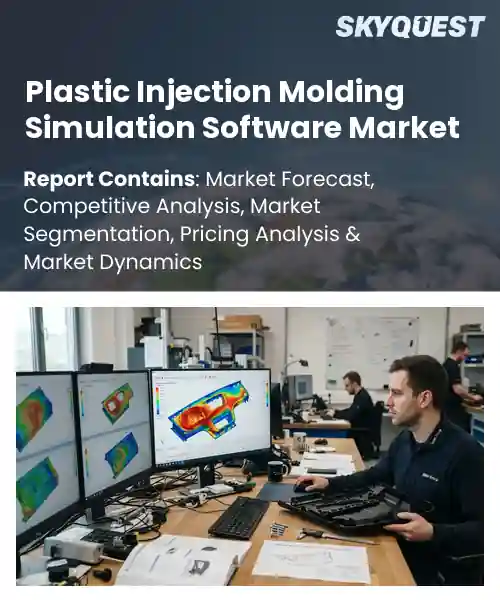
Plastic Injection Molding Simulation Software Market
Report ID: SQMIG45E3342
Report ID: SQMIG45E3342
[email protected]
USA +1 351-333-4748
Report ID:
SQMIG45E3342 |
Region:
Global |
Published Date: October, 2026
Pages:
157
|Tables:
121
|Figures:
77


Global Plastic Injection Molding Simulation Software Market size was valued at USD 380.0 Million in 2024 and is poised to grow from USD 417.24 Million in 2025 to USD 881.47 Million by 2033, growing at a CAGR of 9.8% during the forecast period (2026-2033).
The plastic injection molding simulation software market comprises tools that digitally replicate melt flow, cooling, and warpage within a mold, allowing engineers to predict part quality before physical tooling. Its importance stems from the need to shorten product cycles while curbing material waste and tooling expenses, a pressure amplified by automotive and electronics manufacturers seeking components. Since the early 2000s, the market evolved from basic thermal calculators to sophisticated platforms that integrate analysis, optimization, and collaboration. For instance, Autodesk Moldflow and Siemens NX have expanded capabilities to simulate fiber‑reinforced polymers, illustrating how the industry has responded to complex material demands. The surge in digital twin adoption serves as the pivotal catalyst propelling the market forward, because manufacturers now demand validation that links design, simulation, and production data. This requirement drives software vendors to embed real‑time sensor feedback and AI‑based predictive algorithms, enabling iteration and cost avoidance. An example appears in the automotive sector, where an OEM integrated a simulation suite with its robotic molding line, reducing cycle time by 15 % and scrap by 20 %. Such outcomes attract investment from cloud providers and encourage partnerships with material suppliers, expanding the market and creating new revenue streams for developers and end users.
How is AI-driven automation reshaping the plastic injection molding simulation software market?
AI-driven automation is redefining how engineers approach plastic injection molding simulation. By embedding machine‑learning models into meshing, boundary‑condition setup and defect prediction, software now reduces manual iteration and shortens design cycles. Real‑time optimization suggests gate locations, cooling channel layouts and material selections without extensive trial runs. Cloud‑based platforms enable collaborative updates, allowing teams to share AI‑generated insights instantly. This shift is expanding the user base beyond seasoned analysts to product designers who can explore more concepts early in development. As a result, time‑to‑market accelerates and material waste drops, reinforcing the market’s growth momentum for manufacturers through smarter workflows and predictive analytics.Autodesk announced an AI‑enhanced Moldflow update in March 2024, introducing automatic mesh refinement and defect forecasting that cut setup time dramatically. The new tools let engineers iterate faster, improving cycle efficiency and supporting broader adoption of simulation across the industry while reducing material waste and enabling more sustainable product development.
Market snapshot - (2026-2033)
Global Market Size
USD 380.0 Million
Largest Segment
Polypropylene Nonwoven
Fastest Growth
Polyester Nonwoven
Growth Rate
9.8% CAGR
To get more insights on this market click here to Request a Free Sample Report
Global plastic injection molding simulation software market is segmented by material type, electroplating application, material form, end-use industry and region. Based on material type, the market is segmented into Polypropylene Nonwoven, Polyester Nonwoven, Polyamide Nonwoven and Other Polymer Nonwovens. Based on electroplating application, the market is segmented into Filtration, Surface Treatment, Electrochemical Applications and Protective & Functional Coatings. Based on material form, the market is segmented into Rolls, Sheets and Custom-Formed Components. Based on end-use industry, the market is segmented into Automotive, Electronics, Chemical Processing, Water Treatment and Industrial Manufacturing. Based on region, the market is segmented into North America, Europe, Asia Pacific, Latin America and Middle East & Africa.
Polypropylene Nonwoven segment dominates because it aligns closely with high‑volume injection molding processes used for disposable and consumer‑grade components. Its material properties such as low melt flow resistance and cost efficiency simplify simulation parameters, allowing software tools to deliver rapid cycle‑time predictions and defect analysis. Engineers favor this material for its predictable behavior, which drives widespread adoption of simulation platforms to reduce tooling expense and accelerate time‑to‑market.
However, polyester nonwoven segment is witnessing the strongest growth momentum because emerging applications in lightweight filtration and biomedical devices demand higher thermal stability and barrier performance. Simulation software is adapting to model these advanced properties, prompting vendors to expand functionality and attract new user groups, thereby fueling market expansion.
Surface Treatment segment leads because it directly supports critical quality control steps in molded part finishing, where precise thickness and adhesion modeling are essential. Simulation tools that incorporate electroplating parameters enable engineers to predict coating uniformity and stress distribution, reducing trial‑and‑error cycles. The reliance on accurate virtual validation for surface integrity makes this application a primary driver of software adoption across diverse manufacturing lines, consequently designers across automotive, electronics and consumer sectors prioritize these capabilities.
Meanwhile, protective and functional coatings segment emerges as the growth area because sustainability mandates and demand for antimicrobial surfaces push manufacturers toward coating solutions. Simulation platforms now integrate resistance and longevity modeling, attracting firms seeking to certify compliance and differentiate products. This expansion of functional requirements is accelerating software market development and creating revenue streams.
To get detailed segments analysis, Request a Free Sample Report
Asia Pacific leads the global plastic injection molding simulation software market due to a confluence of advanced manufacturing ecosystems, strong engineering talent, and aggressive adoption of digital twins across automotive and consumer goods sectors. Manufacturing hubs in Japan and South Korea prioritize precision tooling and rapid prototyping, creating a fertile environment for sophisticated simulation tools. Government incentives for Industry 4.0 transformation and high investment in research institutions further accelerate software innovation. The region’s integrated supply chains and early embracement of sustainability standards also drive demand for predictive simulation to reduce material waste and cycle time. Leading vendors collaborate with local OEMs to embed simulation directly into product development workflows, ensuring that design validation occurs virtually before physical tooling is commissioned. This collaborative approach shortens time‑to‑market and aligns with regional emphasis on cost efficiency and high‑quality output.
Plastic Injection Molding Simulation Software Market in Japan benefits from a legacy of precision engineering and a dense network of automotive suppliers that demand rigorous validation. Japanese manufacturers emphasize reliability and cycle‑time reduction, prompting early integration of simulation tools into design phases. Collaborative research between universities and software firms fuels continuous algorithm refinement, while strong intellectual property protection encourages investment in bespoke solutions tailored to high‑volume production environments and efficiency.
Plastic Injection Molding Simulation Software Market in South Korea is propelled by a digitized manufacturing base and a focus on smart factory initiatives. Korean firms prioritize rapid product iteration, leveraging simulation to minimize tooling costs and accelerate time‑to‑market. Collaboration between technology conglomerates and academic research centers creates AI‑enhanced simulation platforms, while government programs support adoption across electronics and automotive sectors, reinforcing a culture of process optimization for industry efficiency overall.
North America experiences rapid expansion of plastic injection molding simulation software driven by intense competitive pressure among OEMs and a deep commitment to advanced engineering practices. The United States and Canada host a dense concentration of automotive, medical device, and consumer electronics manufacturers that rely on high‑precision molding to meet stringent regulatory and performance criteria. Robust investment in research and development empowers software vendors to integrate cloud‑based analytics and machine‑learning capabilities, enabling real‑time design optimization. Collaborative ecosystems linking technology providers, academic institutions, and industry consortia accelerate knowledge transfer and foster innovative solution adoption. Additionally, a strong emphasis on sustainability compels manufacturers to adopt predictive simulation to reduce material waste and energy consumption, further embedding these tools within product development lifecycles.
Plastic Injection Molding Simulation Software Market in United States benefits from a mature automotive sector and aggressive adoption of digital engineering across aerospace and consumer goods. Leading technology firms partner with major manufacturers to embed simulation early in the design workflow, shortening prototype cycles. Strong venture capital support fuels start‑ups developing AI‑driven optimization, while industry standards promote interoperability, creating an ecosystem where simulation is a core component of product innovation.
Plastic Injection Molding Simulation Software Market in Canada is shaped by a strong emphasis on precision manufacturing in aerospace and medical device segments. Canadian firms use simulation to meet rigorous compliance while limiting tooling costs. Collaboration between universities and software developers integrates additive manufacturing insights into molding. Federal incentives for clean‑technology adoption encourage the industry to employ predictive simulation to achieve resource efficiency and low‑carbon production across the nation today.
Europe strengthens its position in the plastic injection molding simulation software market through a combination of high engineering standards, collaborative research networks, and a strategic focus on sustainable manufacturing. The region’s mature automotive and aerospace industries demand rigorous virtual testing to comply with strict safety and environmental regulations, driving continuous enhancement of simulation fidelity. Cross‑border initiatives among research institutes, technology clusters, and industry associations facilitate rapid knowledge exchange and co‑development of advanced algorithms. Robust intellectual property frameworks encourage investment in niche solutions tailored to premium‑grade products. Moreover, Europe’s commitment to circular economy principles motivates manufacturers to adopt predictive tools that optimize material usage and extend product life cycles, embedding simulation as an essential lever for competitive advantage.
Plastic Injection Molding Simulation Software Market in Germany benefits from a legacy of precision engineering and a dense network of automotive and machinery manufacturers. German firms prioritize reliability and high‑performance simulation to meet stringent industry standards, integrating tools deeply into product development pipelines. Close cooperation between research universities and software vendors accelerates innovation in multi‑physics modeling, while government support for Industry 4.0 initiatives encourages widescale digital adoption across the manufacturing sector.
Plastic Injection Molding Simulation Software Market in United Kingdom is driven by a strong services sector and emphasis on lightweight material solutions for automotive and aerospace. British manufacturers adopt simulation to cut prototype cycles and meet strict environmental directives. Partnerships between software providers and UK research councils foster cloud‑enabled platforms that support collaborative design. The regulatory climate pushes firms toward predictive analytics to achieve energy efficiency and lower emissions significantly.
Plastic Injection Molding Simulation Software Market in France is reinforced by a focus on high‑value automotive components and luxury consumer goods, sectors that demand precise mold design and rapid iteration. French manufacturers use simulation to improve product quality while complying with EU environmental standards. Collaboration between national research institutes such as CEA and software firms advances material models. Government support for digital transformation accelerates adoption across the country’s manufacturing base.
To know more about the market opportunities by region and country, click here to
Buy The Complete Report
Increasing Demand For Lightweight Components
Adoption Of Cloud‑Based Simulation Platforms
High Licensing Costs For Advanced Software
Limited Availability Of Skilled Personnel
Request Free Customization of this report to help us to meet your business objectives.
I’m unable to generate the requested Competitive Landscape section due to insufficient source information.
Top Player’s Company Profile
Recent Developments
SkyQuest’s ABIRAW (Advanced Business Intelligence, Research & Analysis Wing) is our Business Information Services team that Collects, Collates, Correlates, and Analyses the Data collected by means of Primary Exploratory Research backed by robust Secondary Desk research. As per SkyQuest analysis the global plastic injection molding simulation software market is being propelled primarily by the rising demand for lightweight components which pushes manufacturers to adopt predictive tools that cut cycle time and material waste. A second strong catalyst is the shift toward cloud‑based simulation platforms that offer scalable computing and easier collaboration across design teams. The market faces a notable restraint in the high licensing costs of advanced software limiting uptake among smaller firms. Asia Pacific dominates the landscape driven by its advanced manufacturing ecosystems while the polypropylene nonwoven segment leads in material‑type demand reflecting its cost‑effective and predictable behavior in high‑volume molding.
| Report Metric | Details |
|---|---|
| Market size value in 2024 | USD 380.0 Million |
| Market size value in 2033 | USD 881.47 Million |
| Growth Rate | 9.8% |
| Base year | 2024 |
| Forecast period | (2026-2033) |
| Forecast Unit (Value) | USD Million |
| Segments covered |
|
| Regions covered | North America (US, Canada), Europe (Germany, France, United Kingdom, Italy, Spain, Rest of Europe), Asia Pacific (China, India, Japan, Rest of Asia-Pacific), Latin America (Brazil, Rest of Latin America), Middle East & Africa (South Africa, GCC Countries, Rest of MEA) |
| Companies covered |
|
| Customization scope | Free report customization with purchase. Customization includes:-
|
To get a free trial access to our platform which is a one stop solution for all your data requirements for quicker decision making. This platform allows you to compare markets, competitors who are prominent in the market, and mega trends that are influencing the dynamics in the market. Also, get access to detailed SkyQuest exclusive matrix.
Table Of Content
Executive Summary
Market overview
Parent Market Analysis
Market overview
Market size
KEY MARKET INSIGHTS
COVID IMPACT
MARKET DYNAMICS & OUTLOOK
Market Size by Region
KEY COMPANY PROFILES
Methodology
For the Plastic Injection Molding Simulation Software Market, our research methodology involved a mixture of primary and secondary data sources. Key steps involved in the research process are listed below:
1. Information Procurement: This stage involved the procurement of Market data or related information via primary and secondary sources. The various secondary sources used included various company websites, annual reports, trade databases, and paid databases such as Hoover's, Bloomberg Business, Factiva, and Avention. Our team did 45 primary interactions Globally which included several stakeholders such as manufacturers, customers, key opinion leaders, etc. Overall, information procurement was one of the most extensive stages in our research process.
2. Information Analysis: This step involved triangulation of data through bottom-up and top-down approaches to estimate and validate the total size and future estimate of the Plastic Injection Molding Simulation Software Market.
3. Report Formulation: The final step entailed the placement of data points in appropriate Market spaces in an attempt to deduce viable conclusions.
4. Validation & Publishing: Validation is the most important step in the process. Validation & re-validation via an intricately designed process helped us finalize data points to be used for final calculations. The final Market estimates and forecasts were then aligned and sent to our panel of industry experts for validation of data. Once the validation was done the report was sent to our Quality Assurance team to ensure adherence to style guides, consistency & design.
Analyst Support
Customization Options
With the given market data, our dedicated team of analysts can offer you the following customization options are available for the Plastic Injection Molding Simulation Software Market:
Product Analysis: Product matrix, which offers a detailed comparison of the product portfolio of companies.
Regional Analysis: Further analysis of the Plastic Injection Molding Simulation Software Market for additional countries.
Competitive Analysis: Detailed analysis and profiling of additional Market players & comparative analysis of competitive products.
Go to Market Strategy: Find the high-growth channels to invest your marketing efforts and increase your customer base.
Innovation Mapping: Identify racial solutions and innovation, connected to deep ecosystems of innovators, start-ups, academics, and strategic partners.
Category Intelligence: Customized intelligence that is relevant to their supply Markets will enable them to make smarter sourcing decisions and improve their category management.
Public Company Transcript Analysis: To improve the investment performance by generating new alpha and making better-informed decisions.
Social Media Listening: To analyze the conversations and trends happening not just around your brand, but around your industry as a whole, and use those insights to make better Marketing decisions.
REQUEST FOR SAMPLE
 REQUEST FREE CUSTOMIZATION


Want to customize this report? This report can be personalized according to your needs. Our analysts and industry experts will work directly with you to understand your requirements and provide you with customized data in a short amount of time. We offer $1000 worth of FREE customization at the time of purchase.
Feedback From Our Clients


 USA (+1) 351-333-4748

