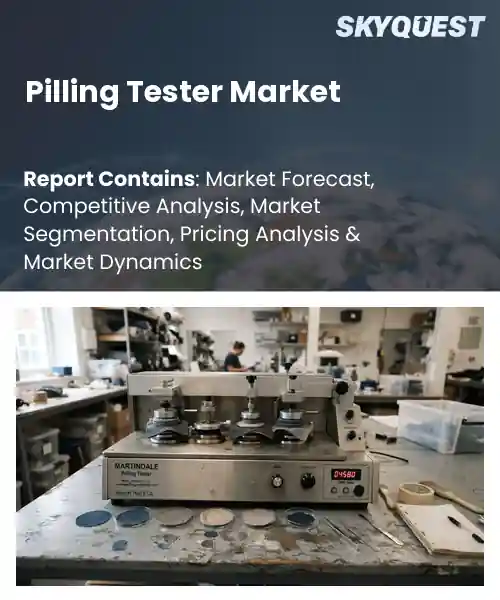
Pilling Tester Market
Report ID: SQMIG20I3770
Report ID: SQMIG20I3770
[email protected]
USA +1 351-333-4748
Report ID:
SQMIG20I3770 |
Region:
Global |
Published Date: August, 2026
Pages:
157
|Tables:
173
|Figures:
79


Global Pilling Tester Market size was valued at USD 184.6 Million in 2024 and is poised to grow from USD 195.31 Million in 2025 to USD 306.63 Million by 2033, growing at a CAGR of 5.8% during the forecast period (2026-2033).
The global pilling tester market centers on instruments that assess fabric surface degradation, a metric crucial for consumer satisfaction and brand reputation. Its primary driver is the heightened demand for durable, low‑maintenance textiles driven by fast‑fashion cycles and premium apparel brands seeking differentiation. Over the past decade, manufacturers have shifted from simple visual inspections to standardized machine‑based tests such as ISO 12945‑2, enabling objective comparison across fibers, blends, and finishes. For example, a leading denim producer integrated automated pilling analysis into its production line in 2018, reducing return rates by fifteen percent and illustrating how testing has become a competitive advantage. Building on this foundation, regulatory compliance emerges as a key factor propelling market expansion because governments and trade bodies increasingly mandate measurable durability standards for textile exports. When a European Union directive required documented pilling resistance for all labeled apparel in 2021, manufacturers rushed to acquire certified testers, driving a twelve‑percent annual rise in equipment purchases. This pressure creates opportunities for service firms offering calibration, data analytics, and predictive maintenance platforms, enabling brands to turn raw test results into actionable process improvements. Consequently, demand for hardware‑software solutions accelerates, positioning the pilling tester market as a hub within broader textile‑testing ecosystem.
How is AI integration reshaping product development in the pilling tester market?
AI is reshaping product development in the pilling tester market by embedding machine‑learning algorithms into instrument firmware, enabling real‑time defect detection and predictive maintenance. Manufacturers now integrate sensor data streams with cloud analytics, allowing engineers to iterate designs faster and tailor test cycles to specific fabric blends. This shift reduces manual calibration, shortens time‑to‑market, and supports higher consistency across global quality standards. As textile producers demand more precise and scalable testing, AI‑enabled platforms become a core differentiator, driving collaborative development between software specialists and equipment makers.Liebherr Group, January 2026, introduced AI‑enhanced diagnostic modules for its testing equipment, streamlining data capture and accelerating fault analysis, which bolsters efficiency and supports market growth.
Market snapshot - (2026-2033)
Global Market Size
USD 184.6 Million
Largest Segment
Martindale Pilling Testers
Fastest Growth
Random Tumble Pilling Testers
Growth Rate
5.8% CAGR
To get more insights on this market click here to Request a Free Sample Report
Global pilling tester market is segmented by product type, operation, application, end user, installation, sales channel and region. Based on product type, the market is segmented into Martindale Pilling Testers, Random Tumble Pilling Testers, ICI Pilling Testers and Others. Based on operation, the market is segmented into Manual, Semi-Automatic and Automatic. Based on application, the market is segmented into Textile Testing, Apparel Testing, Research Laboratories and Others. Based on end user, the market is segmented into Textile Manufacturers, Testing Laboratories, Academic & Research Institutes and Others. Based on installation, the market is segmented into Benchtop and Floor Standing. Based on sales channel, the market is segmented into Direct Sales, Laboratory Equipment Distributors and Others. Based on region, the market is segmented into North America, Europe, Asia Pacific, Latin America and Middle East & Africa.
Martindale Pilling Testers segment dominates because it has long been the industry benchmark for replicating real‑world wear, offering a standardized methodology that aligns with international textile specifications. Its mechanical simplicity and proven reliability give manufacturers confidence in product validation, while testing laboratories favor it for its ease of training and consistent results. This entrenched trust fuels continuous demand across textile and apparel quality assurance programs throughout the supply chain.
However, Random Tumble Pilling Testers segment emerges as the most rapidly expanding because its dynamic agitation better simulates consumer handling, attracting innovative fabric developers seeking differentiated performance metrics. Growing emphasis on fast fashion turnover and sustainability drives adoption, creating fresh opportunities for equipment suppliers and research collaborations.
Automatic operation segment leads because it integrates programmable cycles with real time data capture, eliminating manual intervention and reducing test variability. This high throughput aligns with manufacturers’ pressure to accelerate product development, while laboratories benefit from consistent repeatability and streamlined reporting. The synergy of robotics and software analytics enhances operator safety and lowers labor costs, making it the preferred choice for large scale quality control environments across global supply chains.
Meanwhile, Semi Automatic operation segment is witnessing the strongest growth momentum because it offers a cost effective bridge between manual flexibility and automated precision. Emerging textile startups favor this level of control while avoiding capital investment, and research labs appreciate the ability to customize test parameters. This appeal is expanding market reach and prompting new product development.
To get detailed segments analysis, Request a Free Sample Report
North America maintains a leading position through a combination of advanced research infrastructure, strong collaboration between textile manufacturers and testing equipment specialists, and a mature regulatory environment that emphasizes product durability and consumer satisfaction. The region benefits from deep-rooted expertise in textile engineering, robust funding for innovation, and a culture of early adoption of cutting‑edge testing solutions. These factors, together with comprehensive standards that drive rigorous quality assurance, create a fertile ecosystem where manufacturers prioritize pilling performance, reinforcing the market’s dominance in the global landscape.
Pilling Tester Market in the United States thrives on the presence of major textile research institutions and a high concentration of apparel brands that demand stringent quality metrics. Collaborative initiatives between academic labs and equipment manufacturers accelerate the development of sophisticated testing methodologies. Consumer expectations for long‑lasting garments and proactive regulatory guidance further propel investment in precise pilling assessment tools, cementing the United States as a pivotal hub for market activity.
Pilling Tester Market in Canada is shaped by a strong emphasis on sustainable textile production and a proactive approach to standardization. Close ties between industry associations and testing service providers foster the dissemination of best practices and the adoption of innovative instrumentation. The Canadian market’s focus on high‑quality textile outcomes, combined with supportive policy frameworks, encourages continuous refinement of pilling evaluation techniques across the sector.
Europe’s expansion is fueled by a sophisticated textile heritage, rigorous quality standards, and a competitive landscape that prizes product excellence. The region’s deep integration of research clusters, particularly in engineering and material science, nurtures the evolution of precise testing equipment. Stringent consumer protection regulations and a strong emphasis on sustainability compel manufacturers to adopt comprehensive pilling assessment practices. Collaborative networks among industry bodies, standards organizations, and technology providers further accelerate the diffusion of advanced testing solutions, positioning Europe as a dynamic growth engine for the market.
Pilling Tester Market in Germany benefits from a robust engineering culture and a dense network of textile manufacturers that prioritize precision testing. The country’s dedication to technical excellence and adherence to exacting standards drives continuous improvement of testing protocols. Partnerships between research institutes and equipment vendors stimulate innovation, ensuring that German apparel producers have access to state‑of‑the‑art pilling evaluation tools that align with the nation’s reputation for quality.
Pilling Tester Market in the United Kingdom is experiencing emerging momentum as fashion houses and technical textile firms seek to differentiate through durability credentials. A proactive regulatory climate coupled with active industry forums encourages the adoption of standardized pilling tests. Academic collaborations and a growing ecosystem of specialist service providers support the refinement of testing techniques, enabling UK manufacturers to meet heightened consumer expectations for long‑lasting fabrics.
Pilling Tester Market in France is advancing rapidly, propelled by a vibrant fashion sector that values both aesthetic appeal and functional performance. The French market’s commitment to premium quality drives investment in sophisticated pilling measurement solutions. Close cooperation between luxury apparel brands, research laboratories, and testing equipment manufacturers fosters the development of nuanced assessment methods, reinforcing France’s reputation for excellence in textile craftsmanship.
Asia Pacific is enhancing its role through vigorous industrial growth, expanding textile production capacities, and a strategic focus on technological upgradation. The region’s manufacturers are increasingly aligning with global quality benchmarks, prompting the integration of advanced pilling testing equipment into production lines. Government initiatives that promote innovation and skill development, alongside a rising consumer consciousness about garment longevity, encourage adoption of precise assessment tools. Collaborative platforms linking regional research centers with international equipment suppliers further accelerate the diffusion of best practices, solidifying Asia Pacific’s emerging influence in the market.
Pilling Tester Market in Japan is driven by a culture of meticulous craftsmanship and a strong orientation toward continuous improvement. Japanese textile firms invest heavily in high‑precision testing apparatus to guarantee consistent product performance. Collaborative efforts between engineering universities and equipment manufacturers foster the creation of sophisticated pilling analysis techniques, aligning with the nation’s reputation for technological finesse and reliability in apparel production.
Pilling Tester Market in South Korea reflects the country’s dynamic textile industry and its swift adoption of innovative testing solutions. A proactive regulatory framework and vibrant R&D ecosystem encourage manufacturers to embed comprehensive pilling assessments within their quality assurance processes. Partnerships between leading electronics firms and textile specialists enable the development of integrated testing platforms, positioning South Korea as a forward‑looking participant in the global pilling tester landscape.
To know more about the market opportunities by region and country, click here to
Buy The Complete Report
Increasing Regulatory Stringency
Adoption Of Automated Testing
High Initial Equipment Cost
Limited Skilled Operator Availability
Request Free Customization of this report to help us to meet your business objectives.
The Global Pilling Tester market is intensifying as firms vie for share in a segment projected to expand markedly, with China holding a 19.8% lead. Competitive pressure drives companies to broaden product lines, integrate advanced random‑tumble testing technology, and form cross‑regional collaborations that enhance testing accuracy and speed.
Top Player’s Company Profile
Recent Developments
SkyQuest’s ABIRAW (Advanced Business Intelligence, Research & Analysis Wing) is our Business Information Services team that Collects, Collates, Correlates, and Analyses the Data collected by means of Primary Exploratory Research backed by robust Secondary Desk research. As per SkyQuest analysis the global pilling tester market is projected to grow at a 5.8% CAGR to 306.6 million USD by 2033, driven first by tightening regulatory requirements that compel manufacturers to validate fabric durability through standardized tests, and second by the rapid uptake of automated testing systems which boost repeatability and reduce labour costs. High upfront equipment costs remain a restraint, limiting adoption among smaller producers. North America continues to dominate the market thanks to its advanced research infrastructure and early‑adopter culture, while the Martindale pilling tester segment holds the largest share owing to its long‑standing benchmark status in textile quality assessment.
| Report Metric | Details |
|---|---|
| Market size value in 2024 | USD 184.6 Million |
| Market size value in 2033 | USD 306.63 Million |
| Growth Rate | 5.8% |
| Base year | 2024 |
| Forecast period | (2026-2033) |
| Forecast Unit (Value) | USD Million |
| Segments covered |
|
| Regions covered | North America (US, Canada), Europe (Germany, France, United Kingdom, Italy, Spain, Rest of Europe), Asia Pacific (China, India, Japan, Rest of Asia-Pacific), Latin America (Brazil, Rest of Latin America), Middle East & Africa (South Africa, GCC Countries, Rest of MEA) |
| Companies covered |
|
| Customization scope | Free report customization with purchase. Customization includes:-
|
To get a free trial access to our platform which is a one stop solution for all your data requirements for quicker decision making. This platform allows you to compare markets, competitors who are prominent in the market, and mega trends that are influencing the dynamics in the market. Also, get access to detailed SkyQuest exclusive matrix.
Table Of Content
Executive Summary
Market overview
Parent Market Analysis
Market overview
Market size
KEY MARKET INSIGHTS
COVID IMPACT
MARKET DYNAMICS & OUTLOOK
Market Size by Region
KEY COMPANY PROFILES
Methodology
For the Pilling Tester Market, our research methodology involved a mixture of primary and secondary data sources. Key steps involved in the research process are listed below:
1. Information Procurement: This stage involved the procurement of Market data or related information via primary and secondary sources. The various secondary sources used included various company websites, annual reports, trade databases, and paid databases such as Hoover's, Bloomberg Business, Factiva, and Avention. Our team did 45 primary interactions Globally which included several stakeholders such as manufacturers, customers, key opinion leaders, etc. Overall, information procurement was one of the most extensive stages in our research process.
2. Information Analysis: This step involved triangulation of data through bottom-up and top-down approaches to estimate and validate the total size and future estimate of the Pilling Tester Market.
3. Report Formulation: The final step entailed the placement of data points in appropriate Market spaces in an attempt to deduce viable conclusions.
4. Validation & Publishing: Validation is the most important step in the process. Validation & re-validation via an intricately designed process helped us finalize data points to be used for final calculations. The final Market estimates and forecasts were then aligned and sent to our panel of industry experts for validation of data. Once the validation was done the report was sent to our Quality Assurance team to ensure adherence to style guides, consistency & design.
Analyst Support
Customization Options
With the given market data, our dedicated team of analysts can offer you the following customization options are available for the Pilling Tester Market:
Product Analysis: Product matrix, which offers a detailed comparison of the product portfolio of companies.
Regional Analysis: Further analysis of the Pilling Tester Market for additional countries.
Competitive Analysis: Detailed analysis and profiling of additional Market players & comparative analysis of competitive products.
Go to Market Strategy: Find the high-growth channels to invest your marketing efforts and increase your customer base.
Innovation Mapping: Identify racial solutions and innovation, connected to deep ecosystems of innovators, start-ups, academics, and strategic partners.
Category Intelligence: Customized intelligence that is relevant to their supply Markets will enable them to make smarter sourcing decisions and improve their category management.
Public Company Transcript Analysis: To improve the investment performance by generating new alpha and making better-informed decisions.
Social Media Listening: To analyze the conversations and trends happening not just around your brand, but around your industry as a whole, and use those insights to make better Marketing decisions.
REQUEST FOR SAMPLE
 REQUEST FREE CUSTOMIZATION


Want to customize this report? This report can be personalized according to your needs. Our analysts and industry experts will work directly with you to understand your requirements and provide you with customized data in a short amount of time. We offer $1000 worth of FREE customization at the time of purchase.
Feedback From Our Clients


 USA (+1) 351-333-4748

