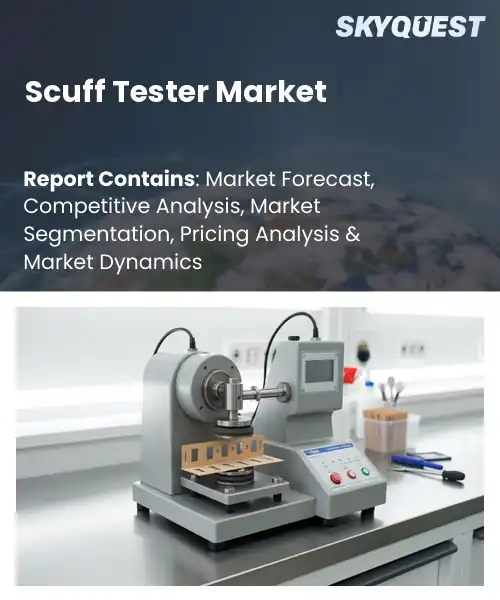
Scuff Tester Market
Report ID: SQMIG20I3137
Report ID: SQMIG20I3137
[email protected]
USA +1 351-333-4748
Report ID:
SQMIG20I3137 |
Region:
Global |
Published Date: June, 2026
Pages:
157
|Tables:
182
|Figures:
79


Global Scuff Tester Market size was valued at USD 1.21 Billion in 2024 and is poised to grow from USD 1.28 Billion in 2025 to USD 1.99 Billion by 2033, growing at a CAGR of 5.7% during the forecast period (2026-2033).
Regulatory pressure on product durability has become the pivotal catalyst shaping the scuff tester industry because compliance mandates compel firms to certify wear performance before launch. This pressure drives investment in advanced testing equipment, especially in aerospace and sectors where surface integrity influences safety and efficiency.
For instance, wind‑turbine blade manufacturers now employ scuff rigs to verify coating resistance against sand erosion, reducing maintenance downtime and extending service life. Consequently, vendors that integrate IoT connectivity and predictive analytics into their devices capture contracts, while markets in Southeast Asia experience significant adoption as automotive plants align with EU and US standards.
How is AI improving accuracy and efficiency in the Scuff Tester market?
AI is reshaping scuff testing by automating image capture, pattern recognition and data analytics. Machine‑learning models now compare wear patterns against vast reference libraries, reducing human bias and delivering repeatable results. Real‑time feedback lets operators adjust test parameters on the fly, cutting cycle time and material waste. Integration with cloud platforms enables centralized monitoring across multiple labs, fostering consistency and faster troubleshooting. These capabilities are raising confidence in test outcomes, encouraging broader adoption of scuff testers in quality‑control workflows and supporting the market’s expanding role in product durability assurance.
In April 2026 a leading scuff tester manufacturer launched an AI‑enhanced calibration system, streamlining setup and improving repeatability, which directly fuels market efficiency and growth.
Market snapshot - (2026-2033)
Global Market Size
USD 1.21 Billion
Largest Segment
Manual Scuff Testers
Fastest Growth
Fully Automatic Scuff Testers
Growth Rate
5.7% CAGR
To get more insights on this market click here to Request a Free Sample Report
Global scuff tester market is segmented by product type, test method, application, end user, testing standard, distribution channel and region. Based on product type, the market is segmented into Manual Scuff Testers, Semi-Automatic Scuff Testers, Fully Automatic Scuff Testers, Multi-Function Abrasion & Scuff Testers and Others. Based on test method, the market is segmented into Dry Scuff Testing, Wet Scuff Testing, Rub Resistance Testing, Abrasion Resistance Testing and Others. Based on application, the market is segmented into Packaging & Printing Materials Testing, Paints & Coatings Testing, Paper & Paperboard Testing, Textile & Fabric Testing, Plastic Film Testing and Others. Based on end user, the market is segmented into Packaging Manufacturers, Printing Companies, Testing Laboratories, Paint & Coating Manufacturers and Others. Based on testing standard, the market is segmented into ASTM Standards, ISO Standards, TAPPI Standards, DIN Standards and Others. Based on distribution channel, the market is segmented into Direct Sales, Testing Equipment Distributors and E-Commerce. Based on region, the market is segmented into North America, Europe, Asia Pacific, Latin America and Middle East & Africa.
Manual scuff tester segment dominates with large global scuff tester market share because it offers the simplest, most cost effective solution for basic surface integrity verification, making it the preferred choice for manufacturers seeking quick, repeatable assessments without extensive training. Its ease of operation, low maintenance, and compatibility with diverse material types foster widespread adoption, reinforcing its central position in the market and ensuring consistent demand across multiple industry verticals and supporting continuous product development cycles through globally recognized quality standards.
As per global scuff tester market outlook, semi automatic scuff tester segment is witnessing the strongest growth momentum because emerging automation technologies enable higher throughput and data integration, aligning with Industry 4.0 initiatives. Its ability to combine ease of use with advanced repeatability attracts sectors requiring precise wear profiling, thereby expanding market reach and creating new opportunities for sophisticated testing workflows.
As per global scuff tester market forecast, dry scuff testing segment dominates because it delivers rapid, reproducible results without the need for specialized liquids, simplifying the testing workflow for a broad range of substrates. This method reduces preparation time and eliminates contamination risks, making it especially attractive for high volume production environments. Its straightforward protocol aligns with lean manufacturing principles, fostering broad acceptance and anchoring its role as the foundational technique across diverse material categories.
Meanwhile, wet scuff testing segment is experiencing rapid expansion because it captures real world abrasion behavior under realistic moisture conditions, meeting the rising demand for durability verification in humid or outdoor applications. This approach enables more accurate performance predictions, prompting manufacturers to adopt it for premium products, thereby driving market diversification and opening new avenues for specialized testing services.
To get detailed segments analysis, Request a Free Sample Report
As per global scuff tester market regional outlook, North America leads the market due to a mature manufacturing base, extensive research and development infrastructure, and strong regulatory frameworks that prioritize product durability and consumer safety. Companies benefit from close collaboration with automotive and consumer goods manufacturers, fostering rapid adoption of advanced testing protocols. The region’s emphasis on innovation, combined with a highly skilled engineering workforce, drives continuous improvement of testing equipment and methodologies. Furthermore, robust supply chains and strategic investments in automation reinforce the competitive advantage, allowing North American firms to set industry standards that are adopted globally.
As per global scuff tester market regional forecast, United States is characterized by high adoption across automotive, aerospace, and consumer electronics sectors, where rigorous surface integrity standards are critical. Industry leaders leverage sophisticated testing rigs and integrate digital analytics to enhance product validation processes. Collaborative networks between universities and private firms accelerate technology transfer, while a strong emphasis on sustainability encourages the development of eco‑friendly testing solutions. These dynamics create a resilient ecosystem that continuously pushes the boundaries of performance and reliability.
As per global scuff tester industry analysis, Canada benefits from close proximity to U.S. innovation hubs and a supportive governmental framework that encourages research partnerships. The sector focuses on niche applications such as renewable energy components and high‑performance flooring, where surface durability is paramount. Canadian firms prioritize cost‑effective solutions without compromising precision, often tailoring equipment to meet specific regulatory requirements. This strategic focus on specialization and cross‑border collaboration sustains a vibrant market presence within the broader North American landscape.
Europe’s expansion is fueled by stringent environmental and safety regulations that demand superior material performance across automotive, construction, and consumer goods industries. Strong engineering traditions and a dense network of research institutions empower the development of cutting‑edge testing technologies. Collaboration among multinational corporations and specialized suppliers accelerates the diffusion of innovative solutions. Additionally, growing consumer awareness of product longevity drives manufacturers to invest in advanced scuff testing to differentiate their offerings. The region’s commitment to sustainability further encourages the adoption of testing methods that reduce waste and improve lifecycle assessment, positioning Europe as a hub of progressive market growth.
Germany stands out for its precision engineering heritage and deep integration with the automotive sector. Leading firms combine high‑resolution instrumentation with robust data analytics to meet exacting quality standards. Close ties between manufacturers and technical universities foster rapid prototyping and iterative improvement cycles. The market emphasizes reliability and long‑term performance, supporting Germany’s reputation as a benchmark for high‑quality testing solutions across Europe.
United Kingdom is experiencing swift growth driven by a vibrant start‑up ecosystem and strong investment in advanced materials research. Companies focus on digitalization, incorporating IoT connectivity and real‑time monitoring to enhance testing efficiency. Collaborative initiatives between industry bodies and academic institutions accelerate knowledge transfer, positioning the UK as a fast‑adopting leader in novel testing methodologies. This dynamic environment fuels rapid market expansion and diversification.
France is emerging through targeted support for sustainable manufacturing and luxury goods sectors where surface quality is paramount. French firms prioritize adaptable testing platforms that can accommodate diverse material palettes, from high‑end textiles to automotive composites. Government incentives for green technology promote the integration of low‑impact testing processes. This emerging focus nurtures a growing market presence aligned with France’s broader commitment to innovation and environmental stewardship.
Asia Pacific is bolstering its role by leveraging rapid industrialization, expanding consumer electronics production, and a burgeoning automotive market that demands rigorous surface durability assessment. The region benefits from cost‑effective manufacturing capabilities combined with a rising emphasis on technological sophistication, leading to the development of compact, high‑precision testing devices. Strategic partnerships between local OEMs and global technology providers facilitate knowledge exchange and accelerate adoption of advanced testing protocols. Increasing focus on quality assurance and export competitiveness drives companies to invest in state‑of‑the‑art scuff testing solutions, thereby enhancing the region’s market influence.
Japan integrates meticulous quality culture with advanced automation to deliver highly reliable testing equipment. The market serves a wide array of sectors, including automotive, electronics, and high‑performance materials, where precise surface evaluation is essential. Collaboration between leading manufacturers and research institutes yields continuous innovation, particularly in miniaturized sensors and AI‑driven analysis. This blend of tradition and cutting‑edge technology sustains Japan’s prominent position in the regional landscape.
South Korea is distinguished by its rapid adoption of smart manufacturing and emphasis on speed‑to‑market for new consumer products. Companies leverage strong electronics expertise to embed sophisticated data acquisition systems within testing rigs. Close cooperation with major automotive and smartphone manufacturers ensures that testing solutions align with fast‑paced product development cycles. This proactive approach enhances South Korea’s capacity to deliver high‑quality, responsive testing services across the Asia Pacific region.
To know more about the market opportunities by region and country, click here to
Buy The Complete Report
Growing Demand for Product Longevity
Adoption of Automated Quality Inspection
High Initial Capital Investment
Regulatory Compliance Complexity
Request Free Customization of this report to help us to meet your business objectives.
The global scale is moderately competitive, and the top competitors are working on product innovations, testing accuracy, automation capabilities and global distribution networks to increase their market position. The key players in the market include Presto Group, Testing Machines Inc., TQC Sheen, Labthink Instruments Co. Ltd., Thwing-Albert Instrument Company, Industrial Physics, Amade-Tech Test Instruments and Smithers. The companies compete on the basis of technology innovations such as digital controls, automated test functions, touch screen displays, and better data processing.
SkyQuest’s ABIRAW (Advanced Business Intelligence, Research & Analysis Wing) is our Business Information Services team that Collects, Collates, Correlates, and Analyses the Data collected by means of Primary Exploratory Research backed by robust Secondary Desk research.
As per SkyQuest analysis, the global scuff tester market growth is being propelled primarily by the growing demand for product longevity, which pushes manufacturers to invest in precise wear‑assessment tools, and a second strong catalyst comes from the adoption of automated quality inspection that embeds scuff testing into robotic cells for faster, repeatable results. However, high initial capital investment remains a notable restraint, limiting uptake among smaller firms. North America continues to dominate the market due to its mature manufacturing base and strict durability standards, while manual scuff testers hold the largest share due to their cost‑effectiveness and ease of use across diverse applications. The global scuff tester market trend driven by increasing quality control requirements in the packaging, printing, coatings, paper and consumer goods industries.
| Report Metric | Details |
|---|---|
| Market size value in 2024 | USD 1.21 Billion |
| Market size value in 2033 | USD 1.99 Billion |
| Growth Rate | 5.7% |
| Base year | 2024 |
| Forecast period | (2026-2033) |
| Forecast Unit (Value) | USD Billion |
| Segments covered |
|
| Regions covered | North America (US, Canada), Europe (Germany, France, United Kingdom, Italy, Spain, Rest of Europe), Asia Pacific (China, India, Japan, Rest of Asia-Pacific), Latin America (Brazil, Rest of Latin America), Middle East & Africa (South Africa, GCC Countries, Rest of MEA) |
| Companies covered |
|
| Customization scope | Free report customization with purchase. Customization includes:-
|
To get a free trial access to our platform which is a one stop solution for all your data requirements for quicker decision making. This platform allows you to compare markets, competitors who are prominent in the market, and mega trends that are influencing the dynamics in the market. Also, get access to detailed SkyQuest exclusive matrix.
Table Of Content
Executive Summary
Market overview
Parent Market Analysis
Market overview
Market size
KEY MARKET INSIGHTS
COVID IMPACT
MARKET DYNAMICS & OUTLOOK
Market Size by Region
KEY COMPANY PROFILES
Methodology
For the Scuff Tester Market, our research methodology involved a mixture of primary and secondary data sources. Key steps involved in the research process are listed below:
1. Information Procurement: This stage involved the procurement of Market data or related information via primary and secondary sources. The various secondary sources used included various company websites, annual reports, trade databases, and paid databases such as Hoover's, Bloomberg Business, Factiva, and Avention. Our team did 45 primary interactions Globally which included several stakeholders such as manufacturers, customers, key opinion leaders, etc. Overall, information procurement was one of the most extensive stages in our research process.
2. Information Analysis: This step involved triangulation of data through bottom-up and top-down approaches to estimate and validate the total size and future estimate of the Scuff Tester Market.
3. Report Formulation: The final step entailed the placement of data points in appropriate Market spaces in an attempt to deduce viable conclusions.
4. Validation & Publishing: Validation is the most important step in the process. Validation & re-validation via an intricately designed process helped us finalize data points to be used for final calculations. The final Market estimates and forecasts were then aligned and sent to our panel of industry experts for validation of data. Once the validation was done the report was sent to our Quality Assurance team to ensure adherence to style guides, consistency & design.
Analyst Support
Customization Options
With the given market data, our dedicated team of analysts can offer you the following customization options are available for the Scuff Tester Market:
Product Analysis: Product matrix, which offers a detailed comparison of the product portfolio of companies.
Regional Analysis: Further analysis of the Scuff Tester Market for additional countries.
Competitive Analysis: Detailed analysis and profiling of additional Market players & comparative analysis of competitive products.
Go to Market Strategy: Find the high-growth channels to invest your marketing efforts and increase your customer base.
Innovation Mapping: Identify racial solutions and innovation, connected to deep ecosystems of innovators, start-ups, academics, and strategic partners.
Category Intelligence: Customized intelligence that is relevant to their supply Markets will enable them to make smarter sourcing decisions and improve their category management.
Public Company Transcript Analysis: To improve the investment performance by generating new alpha and making better-informed decisions.
Social Media Listening: To analyze the conversations and trends happening not just around your brand, but around your industry as a whole, and use those insights to make better Marketing decisions.
REQUEST FOR SAMPLE
 REQUEST FREE CUSTOMIZATION
Global Scuff Tester Market size was valued at USD 1.21 Billion in 2024 and is poised to grow from USD 1.28 Billion in 2025 to USD 1.99 Billion by 2033, growing at a CAGR of 5.7% during the forecast period (2026-2033).
Top Player’s Company Profile 'TMI (Testing Machines Inc.)', 'Thwing-Albert Instrument Company', 'Presto Group', 'Industrial Physics', 'Testing Machines Australia', 'Labthink Instruments Co., Ltd.', 'Smithers Group', 'PTI Packaging Technologies & Inspection', 'Messmer Büchel (Industrial Physics)', 'Imal S.r.l.', 'SDL Atlas LLC', 'Qualitest International Inc.', 'Torontech Group International', 'Amittari Instruments', 'Hanatek Instruments Ltd.', 'Gester International Co., Ltd.', 'Pacorr Testing Instruments Pvt. Ltd.', 'Asian Test Equipments', 'Labotronics Scientific Ltd.', 'U-Therm International (H.K.) Limited'
Sustainable Material Testing Integration: Manufacturers are shifting toward eco‑friendly polymers and bio‑based composites, creating a need for scuff testers that reliably assess wear on sustainable surfaces. Testing laboratories are updating protocols to align with green certification schemes, and equipment providers are launching fixtures constructed from recycled components and actuation systems that cut the carbon impact of each test. This sustainability drive satisfies regulatory expectations and resonates with eco‑conscious consumers, prompting OEMs to embed ecological performance criteria into product development and widening demand for advanced scuff testing capabilities.
Why does North America Dominate the Global Scuff Tester Market? |@12


Want to customize this report? This report can be personalized according to your needs. Our analysts and industry experts will work directly with you to understand your requirements and provide you with customized data in a short amount of time. We offer $1000 worth of FREE customization at the time of purchase.
Feedback From Our Clients


 USA (+1) 351-333-4748

