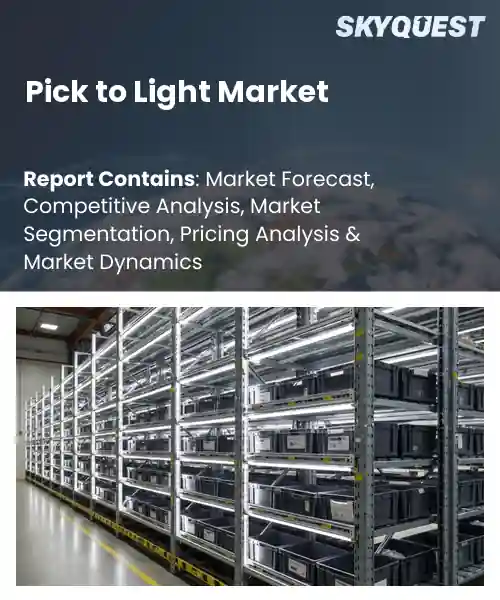
Pick to Light Market
Report ID: SQMIG45J2520
Report ID: SQMIG45J2520
[email protected]
USA +1 351-333-4748
Report ID:
SQMIG45J2520 |
Region:
Global |
Published Date: June, 2026
Pages:
157
|Tables:
175
|Figures:
79


Global Pick To Light Market size was valued at USD 501.1 Million in 2024 and is poised to grow from USD 557.27 Million in 2025 to USD 1303.82 Million by 2033, growing at a CAGR of 11.21% during the forecast period (2026-2033).
The pick‑to‑light system is a visual guidance technology that illuminates specific storage locations to direct operators toward the exact item required for an order. The connection around the use of LED indicators in warehouse is mainly due to pressure on distribution centers to manage processing times efficiently while maintaining accuracy, this is therefore compounded by the surge in e-commerce volume seen over the last 10 years. E.g. Amazon and DHL both were early adopters integrating LED indicators with their small-item aisles and they were able to achieve on the measurement of pick error reductions as well as 20% increase in throughput.
The dominant growth catalyst for the pick‑to‑light market is the rising demand for order fulfillment driven by omnichannel retail strategies. When retailers promise same‑day delivery, warehouses must synchronize picking speed with inventory accuracy; implementing illuminated guidance reduces mispicks, which in turn shortens cycle time and lowers labor overtime costs. Companies such as Zebra Technologies report that clients achieve up to a thirty percent reduction in labor hours after retrofitting lines with pick‑to‑light modules. The increased efficiency that is created by investing in a modular system encourages investments in new modular solutions as well, thus creating a continuous cycle of investment whereby the cost savings from investing in modular systems can be reinvested back into acquiring additional modular products.
How is AI-Driven Automation Enhancing Efficiency in the Pick-to-Light Market?
Pick-to-light systems are being redefined by technology using AI and real-time analytics combined with visual identification. Sensors now capture every picking event while using machine learning to anticipate spikes in orders as well as recommending the best light sequence. With the introduction of this technology, the rate of manual error is reduced, the speed of fulfillment increased, and workers are freed up to perform exception handling. Warehouse managers will also have a smoother overall operation as this technology can flex up or down based on the inventory levels, increasing overall throughput and week-to-week accuracy to meet the growing demands of the e-commerce marketplace.
In March 2025, Honeywell International Inc. enhanced its warehouse automation portfolio with AI-driven fulfillment optimization software. The solution uses machine learning to analyze picking patterns, optimize workflows, and improve pick-to-light system performance. The development helps warehouses increase order accuracy, reduce labor costs, and accelerate fulfillment operations in high-volume distribution environments.
Market snapshot - (2026-2033)
Global Market Size
USD 501.1 Million
Largest Segment
Solutions
Fastest Growth
Services
Growth Rate
11.21% CAGR
To get more insights on this market click here to Request a Free Sample Report
Global pick to light market is segmented by offering, component, application, end user, deployment mode, organization size and region. Based on offering, the market is segmented into solutions and services. Based on component, the market is segmented into light modules, displays & indicators, controllers, software and others. Based on application, the market is segmented into order picking, order sorting, assembly operations, inventory replenishment and others. Based on end user, the market is segmented into e-commerce & retail, manufacturing, logistics & warehousing providers, healthcare & pharmaceutical facilities and others. Based on deployment mode, the market is segmented into cloud, on-premises and hybrid. Based on organization size, the market is segmented into small & medium enterprises (SMEs) and large enterprises. Based on region, the market is segmented into North America, Europe, Asia Pacific, Latin America and Middle East & Africa.
Light modules segment dominates because they provide the visual cue that drives operator actions, linking digital order data to physical locations. When it comes to speed, error reduction and quick deployment these devices provide an easy to install, reliable and low maintenance solution for all your applications. Manufacturers are focusing on manufacturing products quickly and reducing errors; the tactile clarity of illuminated indicators makes the light module the basis for pick to light across many different types of products and types of warehouse configurations.
However, software segment is witnessing the strongest growth momentum as advanced analytics and integration capabilities unlock new value. Real time data exchange, AI driven task optimization, and cloud connectivity enable dynamic lighting adjustments and predictive maintenance, expanding pick to light relevance beyond traditional order fulfillment and driving broader system adoption across multiple industry verticals.
Order picking segment dominates because it directly addresses the core objective of pick to light systems: accelerating item retrieval while minimizing errors. Its simple process combines with the lighting direction to provide both measurable time savings and labor productivity. The use of visual prompts at the pick location allows businesses to have quicker throughput and greater accuracy in their order picking, making order picking the foundational application used for wide deployment across fulfillment centers and also supporting scalability during peak seasons of demand.
On the other hand, order sorting segment is emerging as the key high growth area as facilities seek to automate downstream processes. Using lighting cues allow you to direct items to nearby bays with less effort, decrease time taken on work cycles and connect with conveyor network in a seamless fashion; thereby increasing productivity and expanding your market.
To get detailed segments analysis, Request a Free Sample Report
Asia Pacific dominates due to extensive manufacturing output, advanced automation adoption, and a strategic focus on operational efficiency. Smart factory implementation is encouraged through government incentives and leading technology companies creating innovations in visual guided solutions. Early adoption of digital tools is enhanced through a culture of continuous improvement and seamless integration through solid logistics networks across supply chains. Research and development investment lead to highly sophisticated Pick to Light systems designed for highly complex operations with collaborative partnerships between equipment manufacturers and system integrators accelerating the deployment of these solutions. A skilled workforce, supportive government policies, and the close integration of IoT and AI within the region strengthen the region’s leadership position worldwide.
Pick to light market in Japan is propelled by a longstanding commitment to precision manufacturing and lean production principles. Automotive companies, and companies in other industries such as electronics, want to provide customers with error-free orders, so they have invested dramatically into systems integration. Technology providers at the local level are integrating their own systems with the technology provider's systems, which allows global technology providers and local providers to work together to create solutions that meet high-quality standards.
Pick to light market in South Korea benefits from rapid digitization of its manufacturing base and strong government backing for smart factory initiatives. Leading electronics and semiconductor producers seek high‑speed picking accuracy, driving adoption of light‑based guidance systems. Implementing an advanced pick-to-light technology system in conjunction with Robotics Technology will provide local supply chain entities the operational agility needed throughout the entire region.
Europe has a mature manufacturing landscape combined with a regulatory emphasis on sustainability and worker safety, which fuels interest in Pick to Light technologies. Automotive, consumer products, and pharmaceutical businesses are focused on improving energy efficiency while decreasing picking errors and resulting in a larger scale of adopting different types of systems. Strong cross-border logistics networks create an environment with a common set of standards for easier integration of multinational businesses. Established research institutions and a culture of collaboration create many advanced visual-guided solutions specifically designed for a variety of marketplace applications. Policy incentives promoting Industry 4.0 transformation and digital skill development further accelerate deployment. Together these factors create an environment where Pick to Light is viewed as essential for competitive resilience and operational excellence throughout Europe.
Pick to light market in Germany is anchored by the country’s engineering excellence and its extensive network of automotive and machinery manufacturers. To ensure that orders are filled at a high level of accuracy, companies are continually investing in visual picking systems and working with partners to develop sophisticated arrangements that integrate into their current ERP systems. In addition, Germany continues to be a leading centre for the Pick-to-Light systems due to an increasing focus on minimizing waste and increasing labour productivity.
Pick to light market in United Kingdom experiences swift growth as retailers and e‑commerce operators modernize fulfillment centers to meet rising consumer expectations. The focus on quick completion of orders and avoiding errors has enabled the growth of user-friendly illuminated guide systems. The vibrant start-up tech ecosystem collaborates with established distribution companies, creating innovative uses for both Pick to Light and real-time analytics. The emphasis on digital transformation and upskilling workers helps to increase the use of these systems across many types of distribution.
Pick to light market in France is emerging alongside a broader push for smart logistics within the country’s diversified manufacturing and retail sectors. Businesses are looking to improve their level of accuracy in picking products but also looking to support the need for more sustainable warehousing operations through initiatives put into place by their company. The increasing awareness of the advantages of visual aids for both high-skilled and low-skilled workers is leading to the gradual implementation of visual aids as a solution, with France emerging as a key player in the European Pick to Light industry.
North America strengthens its position through a convergence of strong e‑commerce growth, advanced supply chain analytics, and a culture of operational innovation. In order to improve speed-to-market, the leading distribution centers in North America are utilizing Pick to Light systems. By integrating Pick-to-Light with advanced warehouse management systems (WMS) & robotics technology; creating value through significant investment in workforce development for employees' ability to use visual guidance tool directly affects productivity levels; enhancing solutions development in the form of collaborative ecosystems that promote fast & flexible customization through partnerships between technology suppliers & logistics providers; businesses across all sizes can benefit from making use of the latest trends associated with this technology.
Pick to light market in United States is propelled by massive e‑commerce fulfillment networks that demand high‑speed, accurate picking processes. Larger logistics companies are implementing light based systems together with AI software to allow for quicker decisions about what to ship out. Keeping an updated workforce through continuously trained employees will increase the accuracy of the use of visual aids by operators, which will allow the distribution centers to maintain the productivity increases that occurred as part of the distribution center's work process.
Pick to light market in Canada benefits from a focus on modernizing supply chains within a geographically dispersed market. There are collaborative partnerships between Canadian automation firms and international providers of logistics solutions, which develop and deploy systems that are customized to meet local code and safety criteria. Therefore, the increase in investment in digital logistics, and the emphasis on sustainable practices, create financial incentives for companies to adopt light-guided picking.
To know more about the market opportunities by region and country, click here to
Buy The Complete Report
Rising Demand For Efficient Logistics
Integration With Industry 4.0 Technologies
High Initial Capital Expenditure
Complex Integration With Legacy Systems
Request Free Customization of this report to help us to meet your business objectives.
The global pick-to-light market is characterized by intense competition among automation and warehouse technology providers, including Daifuku Co., Ltd., SSI SCHAEFER, Dematic, Honeywell International Inc., and Kardex Group. Companies focus on integrating pick-to-light systems with warehouse management software, IoT, and automation platforms. Dematic focuses on full service fulfillment throughout their supply chain, while SSI SCHAEFER is focused on smart storage technologies to enhance the customer’s experience. Through the use of data and digitalization, Honeywell strives to provide storage solutions that increase the accuracy of service and efficiency in operations.
Top Player’s Company Profile
Recent Developments
SkyQuest’s ABIRAW (Advanced Business Intelligence, Research & Analysis Wing) is our Business Information Services team that Collects, Collates, Correlates, and Analyses the Data collected by means of Primary Exploratory Research backed by robust Secondary Desk research.
As per SkyQuest analysis the global pick‑to‑light market is projected to more than double by 2033, driven primarily by rising demand for efficient logistics that push warehouses toward faster, error‑free picking, while a second powerful catalyst is the integration with Industry 4.0 technologies such as IoT, AI and robotics that turn visual cues into a connected decision‑making hub. The main restraint comes from the high initial capital expenditure required to outfit facilities with hardware and integration services. Asia Pacific leads the market thanks to its strong manufacturing base and supportive policies, and the light‑module component segment remains the dominant share because it provides the core visual prompt that fuels system performance.
| Report Metric | Details |
|---|---|
| Market size value in 2024 | USD 501.1 Million |
| Market size value in 2033 | USD 1303.82 Million |
| Growth Rate | 11.21% |
| Base year | 2024 |
| Forecast period | (2026-2033) |
| Forecast Unit (Value) | USD Million |
| Segments covered |
|
| Regions covered | North America (US, Canada), Europe (Germany, France, United Kingdom, Italy, Spain, Rest of Europe), Asia Pacific (China, India, Japan, Rest of Asia-Pacific), Latin America (Brazil, Rest of Latin America), Middle East & Africa (South Africa, GCC Countries, Rest of MEA) |
| Companies covered |
|
| Customization scope | Free report customization with purchase. Customization includes:-
|
To get a free trial access to our platform which is a one stop solution for all your data requirements for quicker decision making. This platform allows you to compare markets, competitors who are prominent in the market, and mega trends that are influencing the dynamics in the market. Also, get access to detailed SkyQuest exclusive matrix.
Table Of Content
Executive Summary
Market overview
Parent Market Analysis
Market overview
Market size
KEY MARKET INSIGHTS
COVID IMPACT
MARKET DYNAMICS & OUTLOOK
Market Size by Region
KEY COMPANY PROFILES
Methodology
For the Pick to Light Market, our research methodology involved a mixture of primary and secondary data sources. Key steps involved in the research process are listed below:
1. Information Procurement: This stage involved the procurement of Market data or related information via primary and secondary sources. The various secondary sources used included various company websites, annual reports, trade databases, and paid databases such as Hoover's, Bloomberg Business, Factiva, and Avention. Our team did 45 primary interactions Globally which included several stakeholders such as manufacturers, customers, key opinion leaders, etc. Overall, information procurement was one of the most extensive stages in our research process.
2. Information Analysis: This step involved triangulation of data through bottom-up and top-down approaches to estimate and validate the total size and future estimate of the Pick to Light Market.
3. Report Formulation: The final step entailed the placement of data points in appropriate Market spaces in an attempt to deduce viable conclusions.
4. Validation & Publishing: Validation is the most important step in the process. Validation & re-validation via an intricately designed process helped us finalize data points to be used for final calculations. The final Market estimates and forecasts were then aligned and sent to our panel of industry experts for validation of data. Once the validation was done the report was sent to our Quality Assurance team to ensure adherence to style guides, consistency & design.
Analyst Support
Customization Options
With the given market data, our dedicated team of analysts can offer you the following customization options are available for the Pick to Light Market:
Product Analysis: Product matrix, which offers a detailed comparison of the product portfolio of companies.
Regional Analysis: Further analysis of the Pick to Light Market for additional countries.
Competitive Analysis: Detailed analysis and profiling of additional Market players & comparative analysis of competitive products.
Go to Market Strategy: Find the high-growth channels to invest your marketing efforts and increase your customer base.
Innovation Mapping: Identify racial solutions and innovation, connected to deep ecosystems of innovators, start-ups, academics, and strategic partners.
Category Intelligence: Customized intelligence that is relevant to their supply Markets will enable them to make smarter sourcing decisions and improve their category management.
Public Company Transcript Analysis: To improve the investment performance by generating new alpha and making better-informed decisions.
Social Media Listening: To analyze the conversations and trends happening not just around your brand, but around your industry as a whole, and use those insights to make better Marketing decisions.
REQUEST FOR SAMPLE
 REQUEST FREE CUSTOMIZATION
Global Pick To Light Market size was valued at USD 501.1 Million in 2024 and is poised to grow from USD 557.27 Million in 2025 to USD 1303.82 Million by 2033, growing at a CAGR of 11.21% during the forecast period (2026-2033).
I’m unable to provide the requested Competitive Landscape section because the necessary company-specific information for the Pick to Light market is not available in the provided sources. 'Daifuku Co., Ltd.', 'SSI SCHAEFER Group', 'Dematic Corporation', 'Honeywell International Inc.', 'Kardex Group', 'KNAPP AG', 'Vanderlande Industries B.V.', 'Murata Machinery, Ltd.', 'Bastian Solutions, LLC', 'Lightning Pick Technologies', 'Pick-to-Light Systems Ltd.', 'AIOI·SYSTEMS Co., Ltd.', 'Turck Holding GmbH', 'Banner Engineering Corp.', 'Viscon Group', 'Softeon Inc.', 'Cimcorp Group', 'Fives Group', 'SICK AG', 'Opticon Sensors Europe B.V.'
Companies seeking to reduce order picking errors and labor costs are increasingly adopting pick‑to‑light systems, which provide visual cues that guide operators directly to the correct items. This technology simplifies the picking process, shortens cycle times, and enhances overall warehouse productivity, thereby supporting higher throughput and customer satisfaction. As manufacturers aim to improve operational efficiency, the perceived benefits of reduced waste and improved accuracy drive broader implementation across various distribution centers. The streamlined workflow also enables faster training of new staff, further reducing onboarding time and associated expenses.
Ai-Driven Adaptive Guidance: Manufacturers are embedding AI algorithms into pick‑to‑light systems to dynamically adjust illumination intensity, sequence, and visual cues based on real‑time order volatility and worker performance. This adaptive guidance reduces cognitive load, shortens training periods, and improves placement accuracy across fluctuating demand cycles. By learning from historical picking patterns, the technology anticipates bottlenecks and proactively reallocates light signals, fostering a more responsive warehouse environment that aligns with lean operational philosophies and enhances overall labor productivity and supports continuous improvement initiatives worldwide.
Why does Asia Pacific Dominate the Global Pick to Light Market? |@12


Want to customize this report? This report can be personalized according to your needs. Our analysts and industry experts will work directly with you to understand your requirements and provide you with customized data in a short amount of time. We offer $1000 worth of FREE customization at the time of purchase.
Feedback From Our Clients


 USA (+1) 351-333-4748

