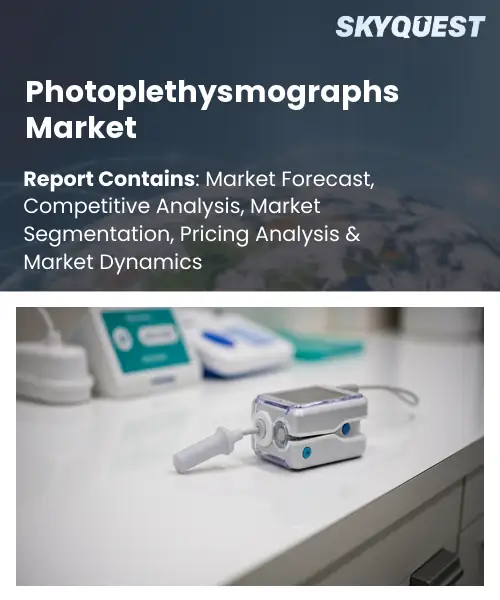
Photoplethysmographs Market
Report ID: SQMIG35B2300
Report ID: SQMIG35B2300
[email protected]
USA +1 351-333-4748
Report ID:
SQMIG35B2300 |
Region:
Global |
Published Date: March, 2026
Pages:
157
|Tables:
117
|Figures:
77


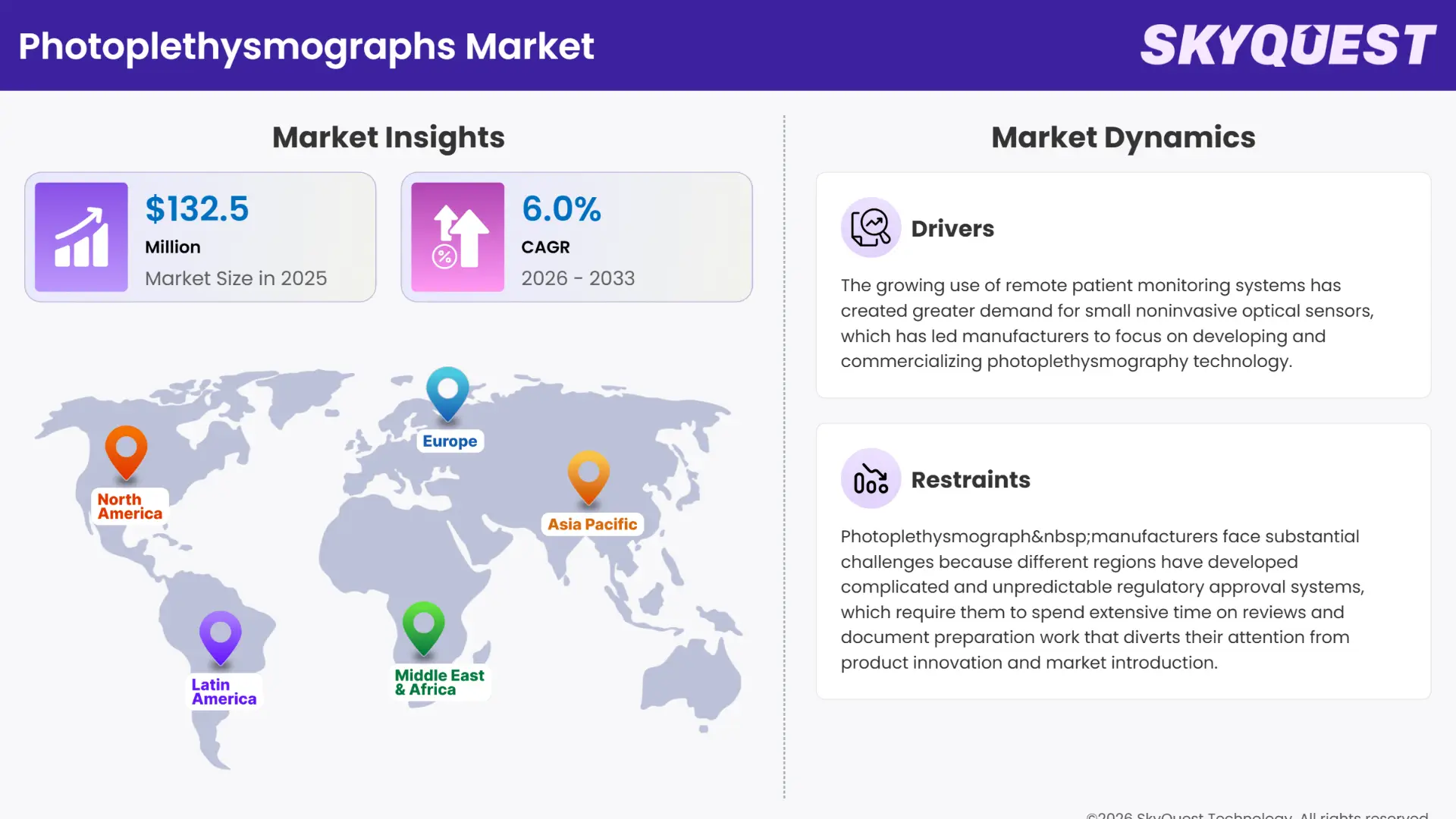
Global Photoplethysmographs Market size was valued at USD 125.0 Million in 2024 and is poised to grow from USD 132.5 Million in 2025 to USD 211.18 Million by 2033, growing at a CAGR of 6.0% during the forecast period (2026-2033).
Key Takeaways: Market Trends & Insights
The global photoplethysmographs market growth is driven because there is increasing need for noninvasive and continuous physiological monitoring which results from the growing elderly demographic and increasing instances of chronic health conditions. The photoplethysmography technology allows healthcare professionals and patients to obtain vital sign information when they need it because it uses optical sensors to measure blood volume changes and produces vital signs from heart rate and oxygen saturation and peripheral vascular signals.
The technological evolution began with hospital pulse oximeter systems and progressed to create portable devices which include the Apple Watch and portable oximeters. As PPG has migrated into consumer wearables and clinical workflows, a key growth factor is integration with advanced signal processing and machine learning, which improves accuracy and enables new applications in chronic disease management.
Clinicians use remote heart failure monitoring and hypertension screening programs which require validated sensors and interoperable data platforms because algorithms successfully eliminate motion artifacts to derive reliable blood pressure and arrhythmia indicators. The market grows when medical device manufacturers team up with healthcare systems while telemedicine companies integrate continuous vital signs into treatment protocols and developing countries implement affordable newborn and community health assessment programs.
How is AI Enhancing Accuracy and Adoption in the Photoplethysmographs Market?
AI transforms the global photoplethysmographs market outlook through its ability to transform raw optical signals into accurate physiological measurements which users can trust. The main advancements consist of machine learning technology which uses noise reduction and adaptive algorithms that can handle motion and different skin characteristics. The tools increase confidence in clinical settings while being used by consumers who wear devices and use vital sign applications on their smartphones. AI enables researchers to conduct multimodal studies where PPG data combines with other sensors to produce comprehensive insights which reflect contextual information. Vendors can show their product value through special channels which direct users to direct their focus on different product aspects, which will lead to increased usage to build remote monitoring systems.
To get more insights on this market click here to Request a Free Sample Report
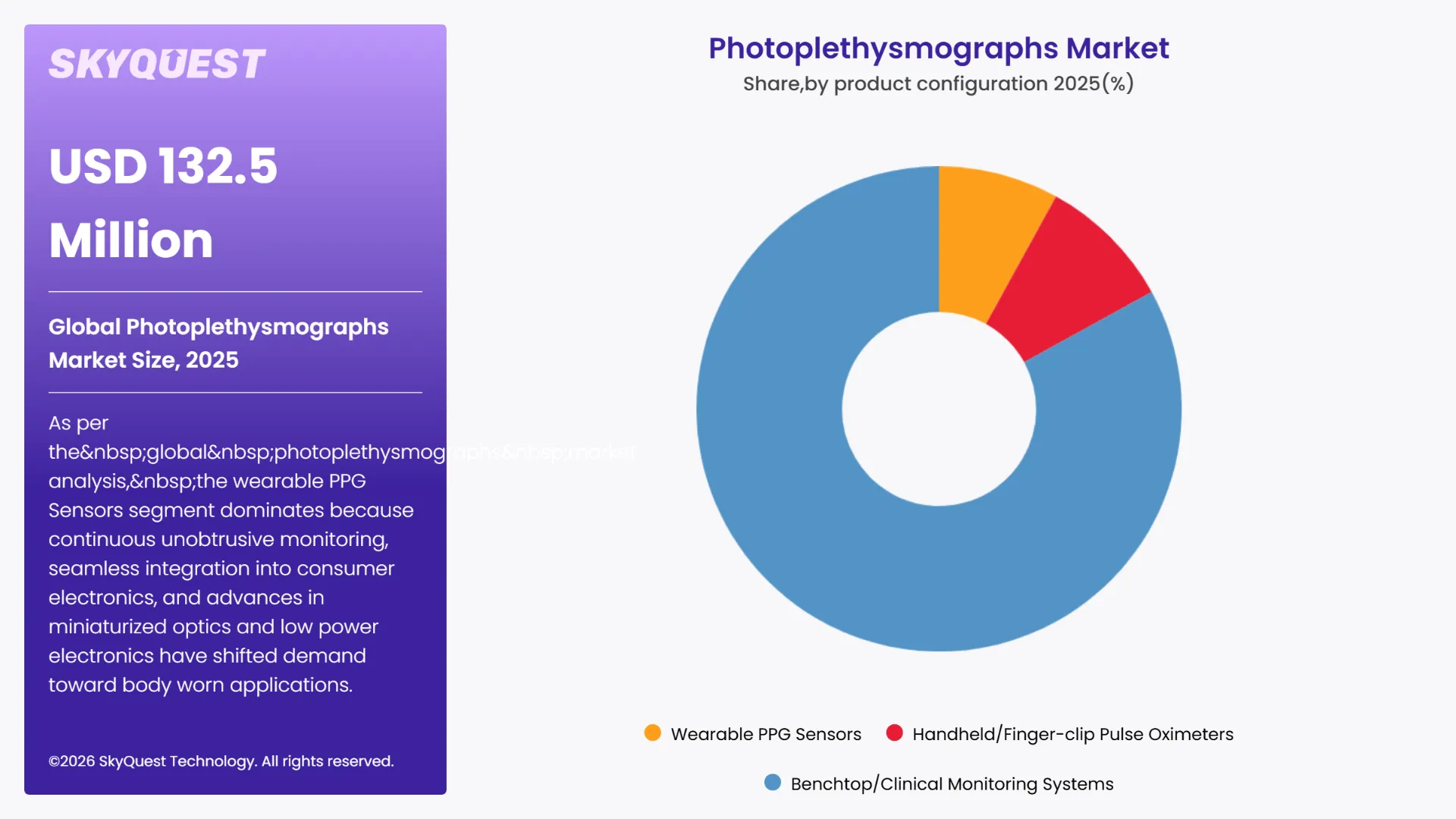
The global photoplethysmographs (PPG) market is segmented based on product configuration, measurement technology, application area, end user, and region. By product configuration, the market includes wearable PPG biosensors, handheld or finger-clip pulse oximeters, and benchtop or clinical monitoring systems. In terms of measurement technology, it is categorized into transmission mode PPG and reflectance mode PPG. Based on application area, the market covers heart rate and variability (HRV) monitoring, oxygen saturation (SpO₂) detection, blood pressure estimation, and sleep apnea screening. Depending on end users, the market is divided into consumer health and fitness devices, hospitals and diagnostic centers, and research and sleep labs. Regionally, the market is analyzed across North America, Europe, Asia Pacific, Latin America, and the Middle East & Africa.
As per the global photoplethysmographs market analysis, the wearable PPG Sensors segment dominates because continuous unobtrusive monitoring, seamless integration into consumer electronics, and advances in miniaturized optics and low power electronics have shifted demand toward body worn applications. The industry now favors wrist and patch designs for health monitoring and fitness because these choices produce systems which use software to analyze data and transmission technologies to enable remote care of patients.
However, the handheld finger clip Pulse Oximeters currently shows the fastest growth in the market because users value their portable design and simple operation which delivers accurate SpO2 readings for home and point of care situations. Clinicians and consumers can use the improved sensor systems because their user interfaces have become simpler,which enables the devices to be distributed through multiple channels in the upcoming future.
According to the global photoplethysmographs market forecast, the Transmission Mode PPG segment leads the market because its optical pathway produces precise signal transmission which enables accurate pulse and oxygen saturation measurements at finger and earlobe locations. Medical device buyers develop trust in products because they understand regulatory requirements and trust validated algorithms which allow hospitals to buy medical equipment and diagnostic systems. The extensive clinical applications of transmission-based systems lead hospitals to continue investing in these systems while maintaining their market dominance in traditional monitoring solutions.
Whereas the Reflectance Mode PPG category is anticipated to have the largest photoplethysmographs market share because its sensor designs allow users to monitor their data from their wrist and forehead-placed devices. Machine learning-enabled signal recovery technology and new solutions for handling ambient light have created business opportunities which drive vendor spending.
To get detailed segments analysis, Request a Free Sample Report
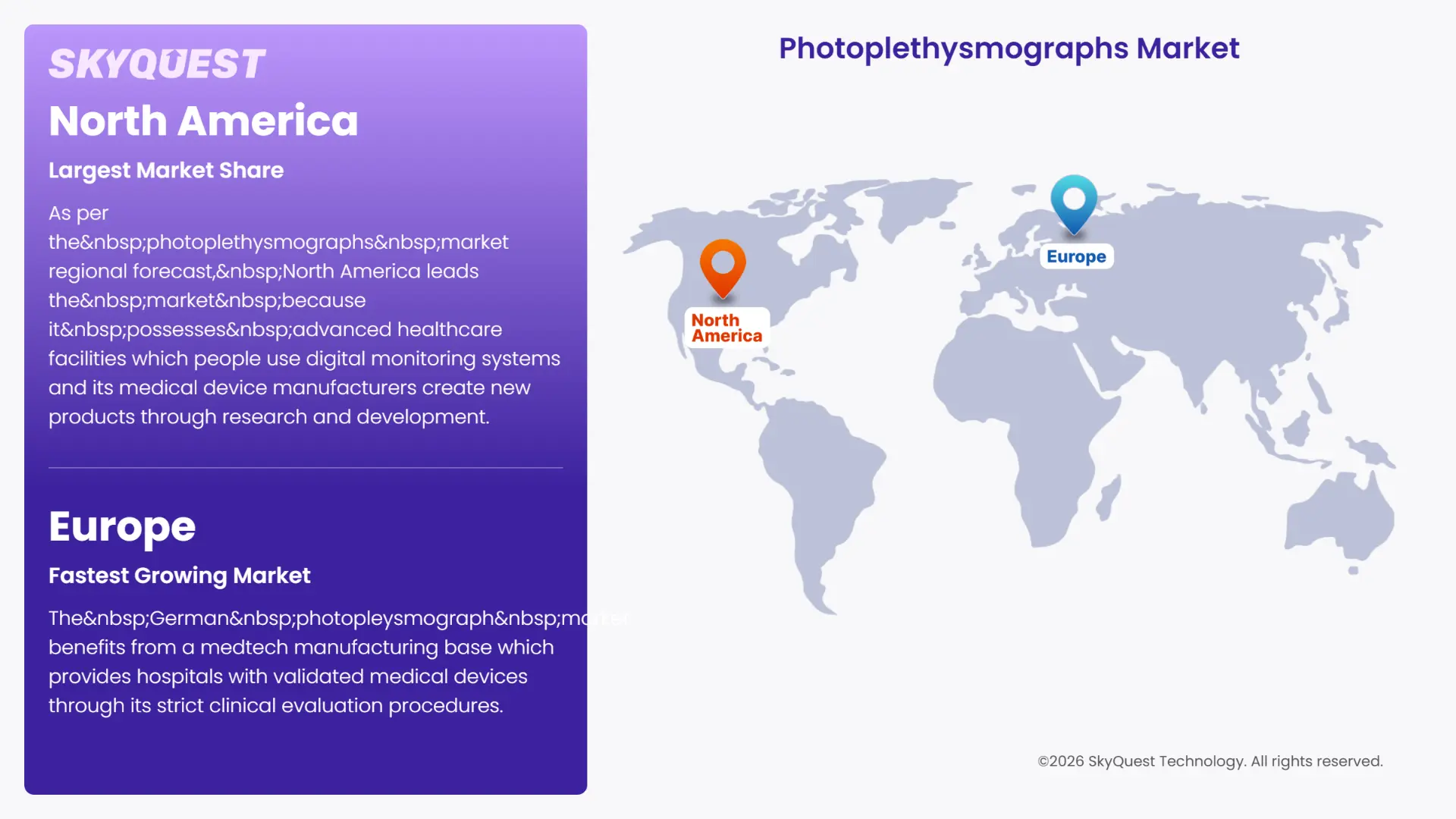
As per the photoplethysmographs market regional forecast, North America leads the market because it possesses advanced healthcare facilities which people use digital monitoring systems and its medical device manufacturers create new products through research and development. The combination of reimbursement policies and provider knowledge about clinical applications leads to complete photoplethysmography implementation in medical settings. The research activities of both private and public organizations together with their partnerships between technology companies and healthcare organizations lead to faster product development and testing processes. Established distribution networks together with active regulatory participation work to improve market position. The system provides quick routes from initial product testing to final market introduction while it attracts investment to sensor and signal processing technology companies which helps the region establish market dominance and international market expansion.
The United States Photopleysmographs sector displays a complete adoption environment which enables hospitals and outpatient clinics to utilize photopleysmographs throughout their operations. The presence of strong clinical validation pathways together with manufacturer-academic partnerships enables the fast development of next-generation sensors and analytical systems. The clinical uptake of noninvasive monitoring systems receives payer recognition while pilot programs together with technology partnerships enable the development of new form factors and interoperability capabilities which maintain demand between clinical and remote monitoring settings.
The Canadian photopleysmograph industry develops through its emphasis on collaborative care delivery which unites all provincial health systems with technological partners. The need for remote patient monitoring together with improved access to rural areas promotes the use of photoplethysmographs which people can wear and use at their bedsides. Research institutions enhance signal processing technology while pilot testing results guide procurement choices. The hospital networks and community health programs use regulatory pathways together with procurement frameworks to drive device adoption particularly for clinically validated products.
The European photoplethysmographs market penetration is driven because preventive care improvement together with public healthcare systems which emphasize remote care and enhanced device manufacturer-research organization partnerships between clinical studies and research networks. The German medical technology market sector together with its clinical evaluation system supports market entry through European regulatory standardization. The growing telehealth provider of interest, together with its application in chronic disease management procedures, has expanded use cases beyond emergency medical situations. The regional monitoring systems which hospitals use while community health systems need sensor platforms will see faster implementation because the region invests in digital health infrastructure and data standardization projects. The strong reimbursement systems which operate in multiple markets together with payer involvement in pilot programs validate the clinical benefits of products which leads to their purchase. The combination of localized innovation hubs and increasing private sector participation leads to solution provider diversity which improves market competition.
The German photopleysmograph market benefits from a medtech manufacturing base which provides hospitals with validated medical devices through its strict clinical evaluation procedures. The industrial sector together with university hospitals and certification bodies work together to achieve both product improvement and complete performance testing. The existing hospital procurement systems, together with clinical evidence requirements, drive the demand for advanced sensor technology and signal analysis capabilities. Local innovation clusters drive commercialization processes.
The United Kingdom photopleysmograph market grows rapidly through digital health startups who actively participate in integrated care programs. The National Health Service innovation bodies together with regional pilot programs provide essential testing environments for wearable photoplethysmograph technology which will be used in various care environments. The system focuses on data interoperability, which leads to development of solutions that work with both electronic health record systems and telemedicine platforms. The combination of venture funding and clinician partnerships enables rapid technology creation and deployment.
The French photopleysmograph market develops through clinical research investments which create strong hospital channels for procurement of clinically validated products. The regional innovation centers together with medical institute collaborations with small manufacturers enable the development of photoplethysmograph technologies which meet the requirements of local clinical pathways. The need to manage chronic diseases along with home care programs creates a market for devices which people can operate easily while they work with other medical devices. Public hospitals and community care networks will adopt the technology more because of the regulatory clarity and reimbursement trials which support their implementation.
The photoplethysmographs market in Asia Pacific experiences growth due to its strategic investments in manufacturing and its development of clinical research capabilities and its rising use of digital health platforms. Regional technology companies develop sensor design and signal processing capabilities to fulfill various clinical requirements while healthcare organizations establish remote monitoring services to address the increasing need for chronic illness treatment. The combination of cross-border partnerships and global device partnerships results in knowledge transfer which enables localized product development. Telemedicine infrastructure together with pilot projects receives priority from governments who support its wider implementation in healthcare systems. The region transforms its manufacturing base into an innovation center through its ability to produce at scale and its focus on developing affordable products and its dynamic startup environment. Local regulatory authorities start to work more with industry partners who help them create faster approval processes and support clinical validation work which builds trust with both buyers and medical professionals.
The photopleysmograph market in Japan focuses on two main areas, which include developing precise engineering methods and creating systems that work smoothly with existing healthcare IT infrastructure. Medical device manufacturers and research institutions work together to improve clinical sensor accuracy and enhance clinical reliability through better signal processing algorithms. Home and institutional monitoring solutions receive increasing adoption because health systems want to provide better care for their aging populations. The regulatory pathways enable complete clinical assessment to take place. Companies from both domestic and international markets create partnerships which help them commercialize their products faster.
The South Korean photoplethysmogram market benefits from its quick electronics production capabilities and its close relationships between semiconductor manufacturers and medical device companies. The development of advanced signal processing together with miniaturization technology enables the creation of highly compact wearable medical devices which users can wear for both medical and personal purposes. The collaborative testbeds between hospitals and technology incubators work together to perform product testing through multiple cycles of product assessment. The government-supported digital health programs together with export-oriented industrial policies promote the development of photoplethysmograph technologies for regional market expansion.
To know more about the market opportunities by region and country, click here to
Buy The Complete Report
Rising Demand for Remote Monitoring
The growing use of remote patient monitoring systems has created greater demand for small noninvasive optical sensors, which has led manufacturers to focus on developing and commercializing photoplethysmography technology. Healthcare providers require simple methods to gather vital signs continuously from patients who are not in their facilities, which leads to product innovation through research on smaller devices and wearables that can be developed. The development of user-friendly home monitoring systems creates opportunities for medical device companies to work with technology firms who design products that meet three essential requirements which include accurate performance and efficient battery usage and compatibility with various data systems, which creates new market prospects and speeds up product adoption across different care environments.
Growing Wearable Health Device Adoption
Consumers increasingly wear health devices, which create better conditions for using photoplethysmograph sensors, so manufacturers need to develop better signal processing and ergonomic systems that match user requirements. Wearable technology has become the primary way people monitor their health, so the need for dependable heart rate monitoring and blood oxygen testing has led different industries to work together in developing better products. The combination of consumer interests and product design approaches together with technological capabilities works to create broader distribution networks which include aftercare services, enabling vendors to develop new products while driving continuous market growth through user-centered device updates.
Regulatory Approval Complexity
Photoplethysmograph manufacturers face substantial challenges because different regions have developed complicated and unpredictable regulatory approval systems, which require them to spend extensive time on reviews and document preparation work that diverts their attention from product innovation and market introduction. Companies need to create unique products and compliance processes for every operational area because different safety regulations and certification standards exist, which extends product development duration and creates operational challenges. The product launch process gets delayed because multiple regulatory systems exist, which prevents companies from entering new markets and stops small businesses from entering the market, thus preventing the entire industry from advancing despite technological progress.
Signal Quality Limitations in Specific Populations
Certain user groups experience unstable signal quality, which affects people who have darker skin tones and those who have low peripheral perfusion or who move their bodies during physical activity, which results in unreliable photoplethysmograph measurements that physicians cannot use for clinical purposes. Manufacturers need to conduct extensive testing which requires them to develop algorithms that will function properly with multiple user groups, which will result in higher expenses and longer development periods.Healthcare providers and end users handle technical uncertainty with caution, which prevents sensors from being widely used in vital applications and stops market growth until sensors demonstrate reliable and inclusive performance capacity.
Request Free Customization of this report to help us to meet your business objectives.
The global photoplethysmographs market experiences competition because of two forces which are advancements in remote photoplethysmography technology and new regulatory achievements and the formation of strategic business mergers. Vendors pursue regulatory clearances SDK licensing and channel partnerships to secure healthcare and retail distribution, exemplified by PanopticAI obtaining FDA 510k clearance and rolling into hospital and pharmacy integrations, and strategic acquirers buying camera PPG SDKs to bolster product stacks. The business environment sees competitive activities organized through three main methods which are mergers and acquisitions, SDK licensing, and the combination of devices with software products.
AI-enhanced Signal Interpretation: Machine learning advances enable better photoplethysmography performance because they decrease background noise while they correct movement errors, which enables users to create unique features from their patterns. The device algorithms deliver immediate results while the cloud analytics function delivers long-term user pattern insights, which integrate with clinical systems to deliver medical decision support. The combination of transparent systems with privacy-preserving federated training and validation procedures helps boost telemedicine and chronic disease monitoring and wellness application adoption, which creates new pathways for organizations to obtain physiological insights and technical alliances between device manufacturers and software platform developers.
SkyQuest’s ABIRAW (Advanced Business Intelligence, Research & Analysis Wing) is our Business Information Services team that Collects, Collates, Correlates, and Analyses the Data collected by means of Primary Exploratory Research backed by robust Secondary Desk research.
As per SkyQuest analysis, the global demand for noninvasive continuous physiologic monitoring drives the photoplethysmographs market forward, but wearable PPG sensors hold the top market position in North America, which serves as the most important regional market. The adoption of AI-enabled signal processing together with machine learning technologies leads to improvements in accuracy, which enables the development of new clinical and consumer applications. The development of new products takes longer and costs more due to the complicated and disjointed regulatory approval process that manufacturers must follow. Remote patient monitoring and chronic disease management and consumer health channel growth and telehealth program scalability will generate the most market opportunities for companies which combine validated wearable hardware with robust analytics and clear regulatory strategies.
| Report Metric | Details |
|---|---|
| Market size value in 2024 | USD 125.0 Million |
| Market size value in 2033 | USD 211.18 Million |
| Growth Rate | 6.0% |
| Base year | 2024 |
| Forecast period | 2026-2033 |
| Forecast Unit (Value) | USD Million |
| Segments covered |
|
| Regions covered | North America (US, Canada), Europe (Germany, France, United Kingdom, Italy, Spain, Rest of Europe), Asia Pacific (China, India, Japan, Rest of Asia-Pacific), Latin America (Brazil, Rest of Latin America), Middle East & Africa (South Africa, GCC Countries, Rest of MEA) |
| Companies covered |
|
| Customization scope | Free report customization with purchase. Customization includes:-
|
To get a free trial access to our platform which is a one stop solution for all your data requirements for quicker decision making. This platform allows you to compare markets, competitors who are prominent in the market, and mega trends that are influencing the dynamics in the market. Also, get access to detailed SkyQuest exclusive matrix.
Table Of Content
Executive Summary
Market overview
Parent Market Analysis
Market overview
Market size
KEY MARKET INSIGHTS
COVID IMPACT
MARKET DYNAMICS & OUTLOOK
Market Size by Region
KEY COMPANY PROFILES
Methodology
For the Photoplethysmographs Market, our research methodology involved a mixture of primary and secondary data sources. Key steps involved in the research process are listed below:
1. Information Procurement: This stage involved the procurement of Market data or related information via primary and secondary sources. The various secondary sources used included various company websites, annual reports, trade databases, and paid databases such as Hoover's, Bloomberg Business, Factiva, and Avention. Our team did 45 primary interactions Globally which included several stakeholders such as manufacturers, customers, key opinion leaders, etc. Overall, information procurement was one of the most extensive stages in our research process.
2. Information Analysis: This step involved triangulation of data through bottom-up and top-down approaches to estimate and validate the total size and future estimate of the Photoplethysmographs Market.
3. Report Formulation: The final step entailed the placement of data points in appropriate Market spaces in an attempt to deduce viable conclusions.
4. Validation & Publishing: Validation is the most important step in the process. Validation & re-validation via an intricately designed process helped us finalize data points to be used for final calculations. The final Market estimates and forecasts were then aligned and sent to our panel of industry experts for validation of data. Once the validation was done the report was sent to our Quality Assurance team to ensure adherence to style guides, consistency & design.
Analyst Support
Customization Options
With the given market data, our dedicated team of analysts can offer you the following customization options are available for the Photoplethysmographs Market:
Product Analysis: Product matrix, which offers a detailed comparison of the product portfolio of companies.
Regional Analysis: Further analysis of the Photoplethysmographs Market for additional countries.
Competitive Analysis: Detailed analysis and profiling of additional Market players & comparative analysis of competitive products.
Go to Market Strategy: Find the high-growth channels to invest your marketing efforts and increase your customer base.
Innovation Mapping: Identify racial solutions and innovation, connected to deep ecosystems of innovators, start-ups, academics, and strategic partners.
Category Intelligence: Customized intelligence that is relevant to their supply Markets will enable them to make smarter sourcing decisions and improve their category management.
Public Company Transcript Analysis: To improve the investment performance by generating new alpha and making better-informed decisions.
Social Media Listening: To analyze the conversations and trends happening not just around your brand, but around your industry as a whole, and use those insights to make better Marketing decisions.
REQUEST FOR SAMPLE
 REQUEST FREE CUSTOMIZATION
Global Photoplethysmographs Market size was valued at USD 125.0 Million in 2024 and is poised to grow from USD 132.5 Million in 2025 to USD 211.18 Million by 2033, growing at a CAGR of 6.0% during the forecast period (2026-2033).
Competition in the global photoplethysmographs market is driven by rapid remote photoplethysmography innovation, regulatory milestones and strategic consolidation. Vendors pursue regulatory clearances, SDK licensing and channel partnerships to secure healthcare and retail distribution, exemplified by PanopticAI obtaining FDA 510k clearance and rolling into hospital and pharmacy integrations, and strategic acquirers buying camera PPG SDKs to bolster product stacks. M&A, SDK licensing and device plus software bundling define competitive moves. 'Masimo Corporation', 'Philips Healthcare', 'Nonin Medical, Inc.', 'GE Healthcare', 'Nihon Kohden Corporation', 'Bio-Beat Technologies', 'Getinge AB', 'Medtronic PLC', 'Huma Therapeutics Ltd.', 'SPO Medical, Inc.', 'Tactile Medical', 'Shimmer Research', 'OptoMedic Technologies', 'Cnoga Medical', 'iHealth Labs Inc.', 'Everist Health', 'LightLab Imaging', 'Dilon Technologies', 'Biobeat', 'Heartbeat Health'
The growing preference for remote patient monitoring has intensified demand for compact, noninvasive optical sensors, encouraging manufacturers to invest in photoplethysmograph development and commercialization. Healthcare providers seek convenient solutions for continuous vital sign collection outside clinical settings, which drives product innovation, miniaturization, and integration into wearables. This emphasis on user-friendly, at-home monitoring fosters partnerships among medical device firms and technology companies, guiding design priorities toward accuracy, battery efficiency, and data compatibility, thereby expanding market opportunities and accelerating adoption across care settings.
Wearable Integration Growth: Manufacturers and healthcare providers increasingly prioritize seamless integration of photoplethysmography into consumer wearables and clinical devices, enabling continuous, noninvasive monitoring outside traditional settings. Emphasis on lightweight form factors, power efficiency, and interoperable software ecosystems supports broader adoption in remote patient management and preventive care. Strategic partnerships with platform providers and electronic health record vendors accelerate clinical workflows and data sharing, while user centered design and sensor performance foster patient engagement and clinician trust in longitudinal health assessments toward better outcomes.
North America Dominate the Global Photoplethysmographs Market?
Photoplethysmographs (PPG) are non-invasive optical sensing devices used to monitor blood volume changes in the microvascular bed of tissue. They play a critical role in wearable health devices, enabling continuous monitoring of heart rate, blood oxygen levels, and cardiovascular health.
Smartwatches, fitness trackers, remote patient monitoring systems, and other connected healthcare devices are expanding the use of photoplethysmography technology across healthcare and consumer wellness applications.


Want to customize this report? This report can be personalized according to your needs. Our analysts and industry experts will work directly with you to understand your requirements and provide you with customized data in a short amount of time. We offer $1000 worth of FREE customization at the time of purchase.
Feedback From Our Clients


 USA (+1) 351-333-4748

