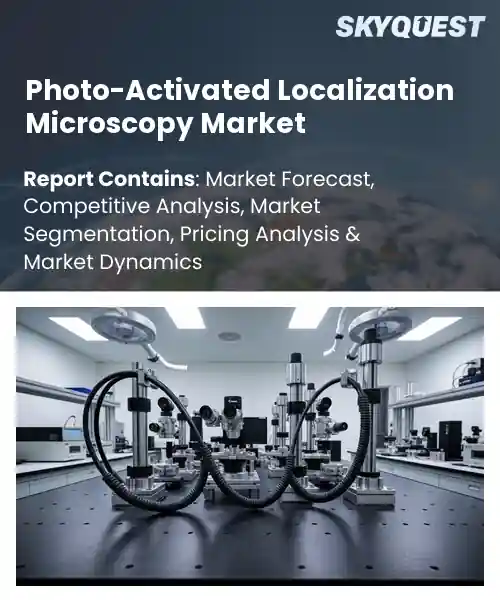
Photo-Activated Localization Microscopy Market
Report ID: SQMIG35J2252
Report ID: SQMIG35J2252
[email protected]
USA +1 351-333-4748
Report ID:
SQMIG35J2252 |
Region:
Global |
Published Date: April, 2026
Pages:
157
|Tables:
152
|Figures:
78


Global Photo-Activated Localization Microscopy Market size was valued at USD 0.6 Million in 2024 and is poised to grow from USD 0.66 Million in 2025 to USD 1.41 Million by 2033, growing at a CAGR of 10.0% during the forecast period (2026-2033).
Photo-activated localization microscopy (PALM) market centers on advanced super-resolution imaging systems that enable single-molecule localization beyond the diffraction limit, and this capability has redefined cell biology and molecular research. The market matters because researchers and pharmaceutical developers require nanoscale spatial resolution to visualize protein dynamics, viral entry, and synaptic architecture, which traditional microscopy cannot resolve. Over the past decade commercial PALM platforms evolved from niche academic prototypes into integrated instruments offered by established life science vendors, and open-source hardware and software projects contributed to broader adoption. For example, PALM imaging mapped membrane protein clusters in immune cells, demonstrating translational potential.An essential growth factor for the global PALM market is expanding demand for drug discovery and precision diagnostics, because when pharmaceutical teams require accurate localization of targets it drives instrument purchases and service contracts. As gene therapies and biologics target increasingly complex intracellular pathways, firms invest in PALM to validate mechanisms and to quantify target engagement at the nanoscale, which accelerates candidate selection and reduces late-stage failures. Clinical research centers adopting PALM for biomarker validation generate datasets that attract collaborations with instrument manufacturers and software developers, therefore fostering ecosystem innovation and creating recurring revenue from consumables and training services globally.
How is AI enhancing data analysis in the Photo-activated Localization Microscopy market?
Photo activated Localization Microscopy is a single molecule localization approach that reconstructs super resolution images from many blinking events. AI complements the technique by using deep learning for more precise spot detection and denoising, by automating drift correction and frame linking, and by extracting features for downstream analysis. The current market shows growing adoption of ML driven analysis because it reduces manual parameter tuning and makes workflows more reproducible. Vendors and academic groups are packaging AI into turnkey tools for applications such as nanoparticle characterization and long sequence localization benchmarking, which helps labs scale experiments and interpret complex spatial data.Bruker February 2026, announced AI ready AtoMx analysis and 3D AI cell segmentation that prepare image first data for conversational models and automate cell boundary definition, improving throughput and consistency for spatial single molecule workflows. This development helps convert dense localization datasets into actionable biological insights faster.
Market snapshot - (2026-2033)
Global Market Size
USD 0.6 Million
Largest Segment
Microscope Systems
Fastest Growth
Fluorescent Probes
Growth Rate
10.0% CAGR
To get more insights on this market click here to Request a Free Sample Report
Global photo-activated localization microscopy market is segmented by product type, technology, application, end user, deployment and region. Based on product type, the market is segmented into Microscope Systems, Imaging Software, Fluorescent Probes, Accessories and Consumables. Based on technology, the market is segmented into STORM (Stochastic Optical Reconstruction Microscopy), PALM (Photoactivated Localization Microscopy), fPALM (Fluorescence Photoactivation Localization Microscopy), dSTORM (Direct STORM) and Other Super-Resolution Techniques. Based on application, the market is segmented into Cell Biology, Neuroscience, Molecular Biology, Drug Discovery and Clinical Research. Based on end user, the market is segmented into Academic and Research Institutes, Pharmaceutical and Biotechnology Companies, Hospitals and Diagnostic Centers, Contract Research Organizations (CROs) and Government and Regulatory Bodies. Based on deployment, the market is segmented into On-Premise, Cloud-Based and Hybrid. Based on region, the market is segmented into North America, Europe, Asia Pacific, Latin America and Middle East & Africa.
Microscope Systems segment dominates because it provides the indispensable instrumentation that enables photo-activated localization experiments, combining optical design, precise stage control, and detector sensitivity to deliver nanometer localization. Purchase decisions center on system capability, reliability, and vendor support, driving large capital commitments and long purchasing cycles. Integrated turnkey systems simplify complex workflows for end users, creating high barriers to entry for alternatives and anchoring vendor relationships across research programs.
However, Imaging Software is witnessing the strongest growth momentum as advances in localization algorithms, machine learning, and user-friendly visualization lower technical barriers and unlock new applications. Growing demand for high throughput analysis, interoperability with diverse hardware, and cloud-enabled processing accelerates adoption among labs seeking to extract meaningful insights from dense single-molecule datasets and extend PALM and STORM applicability.
STORM segment dominates because its established localization framework delivers consistently high spatial resolution and mature experimental protocols that researchers rely on for complex molecular mapping. Broad community adoption has generated extensive methodological expertise, validated probe chemistries, and vendor support for optimized hardware, reinforcing trust in results. The technique’s proven versatility across diverse biological targets and its compatibility with multi-color experiments drive sustained demand from advanced research programs and instrument purchasers.
Meanwhile, dSTORM is emerging as the fastest growing approach due to its use of conventional fluorescent labels and simpler switching buffers, lowering experimental complexity and cost. This accessibility drives uptake in labs seeking super resolution without specialized probes, boosting demand for analysis software and consumables and enabling broader translational and high throughput workflows.
To get detailed segments analysis, Request a Free Sample Report
North America retains leadership in the global Photo-Activated Localization Microscopy market due to a dense concentration of academic and clinical research institutions, leading instrument manufacturers, and an ecosystem that supports rapid translation of imaging technologies into applications. Robust collaboration between universities, biotech and pharmaceutical companies, and specialized service providers accelerates development and commercialization. Access to a deep pool of skilled researchers, established core facilities, and venture and industry funding supports continuous innovation. Regulatory and reimbursement frameworks in major markets facilitate clinical development and adoption. Proximity of end users and suppliers encourages iterative product improvement and tailored services, reinforcing market dominance and sustaining a strong competitive advantage in high-resolution microscopy solutions. Extensive professional training programs, active industry consortia, and frequent scientific conferences foster knowledge exchange and standards development, enabling rapid uptake of advanced methodologies across laboratories.
Photo-Activated Localization Microscopy Market in United States benefits from a dense network of leading universities, translational research centers, and instrument manufacturers that drive adoption and innovation. Strong industry partnerships, availability of specialized imaging cores, and a mature service provider landscape facilitate commercialization of new modalities. Emphasis on interdisciplinary collaborations and robust technical support accelerates deployment in both basic research and applied biomedical development and strengthens commercial pathways for clinical application.
Photo-Activated Localization Microscopy Market in Canada is characterized by collaborative research networks linking universities, healthcare institutions, and technology firms to advance imaging capabilities. National research infrastructures and core facilities provide access to advanced systems and training, supporting method development and translational studies. Close cooperation with international partners and responsive commercialization initiatives help move innovations from laboratory settings to practical research and clinical uses, fostering a resilient and innovation-oriented domestic ecosystem.
Europe is experiencing rapid expansion in the Photo-Activated Localization Microscopy market driven by a dense network of research institutions, well coordinated collaborative frameworks, and strong industry linkages that support technology transfer. Investment in centralized imaging facilities and translational research hubs enables broad access to advanced microscopy across academic and clinical settings. National champions in instrument development and a growing community of specialized service providers accelerate commercialization. Regulatory harmonization and concerted public research initiatives foster cross-border partnerships that scale adoption. Active interactions between life science clusters and medtech companies promote tailored solutions for regional needs, while frequent scientific exchanges and standardized protocols improve reproducibility and uptake across laboratories. Comprehensive training programs, industry consortia, and a vibrant conference ecosystem further stimulate knowledge transfer and innovation, strengthening the region's position in high-resolution imaging technologies.
Photo-Activated Localization Microscopy Market in Germany benefits from a strong engineering and instrument manufacturing base and prominent research institutes that support advanced microscopy development. Close collaboration between industry suppliers, service providers, and academic imaging centers fosters high quality instrument design and validation. Export oriented manufacturing and partnerships with medtech firms enhance commercialization. Emphasis on precision engineering and rigorous quality control underpins Germany role as a dominant regional hub and innovation.
Photo-Activated Localization Microscopy Market in United Kingdom is propelled by a dynamic ecosystem of leading academic centers, innovative startups, and translational programs that accelerate adoption. Rich networks of imaging cores and specialized service providers support method dissemination and training. Strong links between university research, healthcare institutions, and biotech companies enable commercialization and clinical translation. Active commercialization channels and scientific exchanges stimulate market momentum and foster development of tailored imaging solutions.
Photo-Activated Localization Microscopy Market in France is emerging through expanded national imaging infrastructures, public research institutes, and growing partnerships with industry that encourage method development. Investment in core facilities and collaborative translational programs increases researcher access to advanced microscopy. A developing community of specialized service providers and academic spinouts supports local commercialization pathways. Emphasis on interdisciplinary collaboration and quality training programs fosters adoption in fundamental research and applied biomedical projects.
Asia Pacific is strengthening its position in the Photo-Activated Localization Microscopy market through concerted efforts to build domestic research capabilities, enhance manufacturing of precision optics, and foster partnerships with global technology leaders. Governments and academic institutions are supporting the development of centralized imaging facilities and training programs that expand access and expertise. Rapid improvements in local supply chains and integration with advanced electronics industries enable cost competitive production and customized solutions. Strategic collaborations between universities, industry, and international research centers accelerate technology transfer and application development. Growing demand from regional life science and pharmaceutical sectors further motivates commercialization, while a rising community of service providers and start up ventures supports scalable deployment across research and applied settings. Enhanced participation in international conferences and focus on methodological standardization improve credibility and cross border adoption.
Photo-Activated Localization Microscopy Market in Japan is supported by advanced optics and precision manufacturing sectors that supply high quality instrumentation and components. Strong collaboration between industrial engineering groups and academic life science laboratories drives integration of imaging modalities into practical workflows. National research centers and specialized imaging facilities provide training and method development resources. Emphasis on rigorous quality assurance and partnerships with global technology firms enhances adoption of domestic solutions.
Photo-Activated Localization Microscopy Market in South Korea is advancing through strong capabilities in electronics, optics, and systems integration that enable compact high performance instruments. Collaboration between universities, technology companies, and venture teams fosters prototyping and application development. Public research programs and biotech clusters increase access to imaging facilities and training. Focus on agile manufacturing and close industry academic partnerships supports regional adoption and commercialization of imaging solutions across international markets.
To know more about the market opportunities by region and country, click here to
Buy The Complete Report
Technological Advancements In Imaging
Rising Demand From Biomedical Research
High Instrumentation And Maintenance Costs
Limited Technical Expertise And Training
Request Free Customization of this report to help us to meet your business objectives.
Competition in the Global Photo-Activated Localization Microscopy market is intensifying as incumbents pursue technology integration, targeted acquisitions, and platform partnerships. Examples include Leica's integration of Viventis light-sheet technology and ZEISS's detector acquisitions, while Eikon's heavy private financing and ONI's recent single-molecule instrument launch illustrate how funding and product innovation are driving competitive positioning and faster commercialization.
Top Player’s Company Profile
Recent Developments
SkyQuest’s ABIRAW (Advanced Business Intelligence, Research & Analysis Wing) is our Business Information Services team that Collects, Collates, Correlates, and Analyses the Data collected by means of Primary Exploratory Research backed by robust Secondary Desk research. As per SkyQuest analysis, the global photo-activated localization microscopy market is driven primarily by expanding demand from drug discovery and precision diagnostics, supported by technological advancements in imaging that improve localization precision and throughput. High instrumentation and maintenance costs remain a major restraint, limiting adoption among smaller labs and healthcare providers. North America continues to dominate the market thanks to concentrated research institutions, vendor presence, and strong translational ecosystems. Microscope systems represent the leading segment because integrated turnkey instruments deliver the necessary optical performance and vendor support for complex single-molecule workflows. Continued AI-enabled software improvements and growing clinical research applications should sustain market growth through the forecast period.
| Report Metric | Details |
|---|---|
| Market size value in 2024 | USD 0.6 Million |
| Market size value in 2033 | USD 1.41 Million |
| Growth Rate | 10.0% |
| Base year | 2024 |
| Forecast period | (2026-2033) |
| Forecast Unit (Value) | USD Million |
| Segments covered |
|
| Regions covered | North America (US, Canada), Europe (Germany, France, United Kingdom, Italy, Spain, Rest of Europe), Asia Pacific (China, India, Japan, Rest of Asia-Pacific), Latin America (Brazil, Rest of Latin America), Middle East & Africa (South Africa, GCC Countries, Rest of MEA) |
| Companies covered |
|
| Customization scope | Free report customization with purchase. Customization includes:-
|
To get a free trial access to our platform which is a one stop solution for all your data requirements for quicker decision making. This platform allows you to compare markets, competitors who are prominent in the market, and mega trends that are influencing the dynamics in the market. Also, get access to detailed SkyQuest exclusive matrix.
Table Of Content
Executive Summary
Market overview
Parent Market Analysis
Market overview
Market size
KEY MARKET INSIGHTS
COVID IMPACT
MARKET DYNAMICS & OUTLOOK
Market Size by Region
KEY COMPANY PROFILES
Methodology
For the Photo-Activated Localization Microscopy Market, our research methodology involved a mixture of primary and secondary data sources. Key steps involved in the research process are listed below:
1. Information Procurement: This stage involved the procurement of Market data or related information via primary and secondary sources. The various secondary sources used included various company websites, annual reports, trade databases, and paid databases such as Hoover's, Bloomberg Business, Factiva, and Avention. Our team did 45 primary interactions Globally which included several stakeholders such as manufacturers, customers, key opinion leaders, etc. Overall, information procurement was one of the most extensive stages in our research process.
2. Information Analysis: This step involved triangulation of data through bottom-up and top-down approaches to estimate and validate the total size and future estimate of the Photo-Activated Localization Microscopy Market.
3. Report Formulation: The final step entailed the placement of data points in appropriate Market spaces in an attempt to deduce viable conclusions.
4. Validation & Publishing: Validation is the most important step in the process. Validation & re-validation via an intricately designed process helped us finalize data points to be used for final calculations. The final Market estimates and forecasts were then aligned and sent to our panel of industry experts for validation of data. Once the validation was done the report was sent to our Quality Assurance team to ensure adherence to style guides, consistency & design.
Analyst Support
Customization Options
With the given market data, our dedicated team of analysts can offer you the following customization options are available for the Photo-Activated Localization Microscopy Market:
Product Analysis: Product matrix, which offers a detailed comparison of the product portfolio of companies.
Regional Analysis: Further analysis of the Photo-Activated Localization Microscopy Market for additional countries.
Competitive Analysis: Detailed analysis and profiling of additional Market players & comparative analysis of competitive products.
Go to Market Strategy: Find the high-growth channels to invest your marketing efforts and increase your customer base.
Innovation Mapping: Identify racial solutions and innovation, connected to deep ecosystems of innovators, start-ups, academics, and strategic partners.
Category Intelligence: Customized intelligence that is relevant to their supply Markets will enable them to make smarter sourcing decisions and improve their category management.
Public Company Transcript Analysis: To improve the investment performance by generating new alpha and making better-informed decisions.
Social Media Listening: To analyze the conversations and trends happening not just around your brand, but around your industry as a whole, and use those insights to make better Marketing decisions.
REQUEST FOR SAMPLE
 REQUEST FREE CUSTOMIZATION


Want to customize this report? This report can be personalized according to your needs. Our analysts and industry experts will work directly with you to understand your requirements and provide you with customized data in a short amount of time. We offer $1000 worth of FREE customization at the time of purchase.
Feedback From Our Clients


 USA (+1) 351-333-4748

