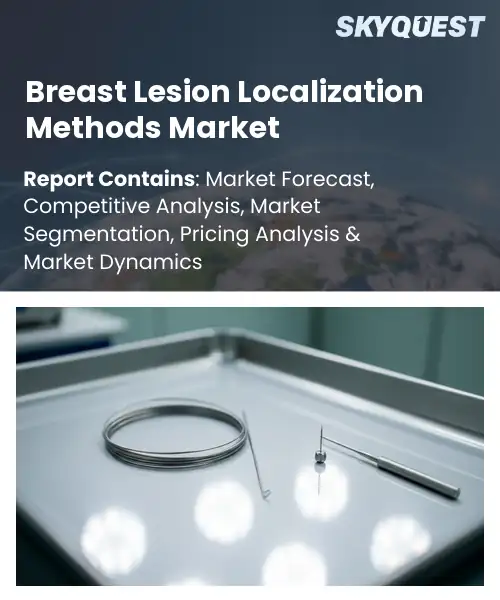
Breast Lesion Localization Methods Market
Report ID: SQMIG35A3649
Report ID: SQMIG35A3649
[email protected]
USA +1 351-333-4748
Report ID:
SQMIG35A3649 |
Region:
Global |
Published Date: June, 2026
Pages:
157
|Tables:
175
|Figures:
79


Global Breast Lesion Localization Methods Market size was valued at USD 950.00 Million in 2024 and is poised to grow from USD 1030.00 Million in 2025 to USD 1960.00 Million by 2033, growing at a CAGR of 8.4% during the forecast period (2026-2033).
The breast lesion localization methods market growth is mainly driven by the growing number of nonpalpable breast lesions detected by imaging that require accurate intraoperative targeting. This market covers wire localization, radioactive seeds, magnetic seed and reflector systems, ultrasound guidance and tracer free technologies used to localize tumours before breast conserving surgery. Accurate localization means fewer positive margins and repeat procedures, which leads to better patient outcomes and lower per case costs for hospitals. Clinicians have moved away from cumbersome wires to wireless platforms that simplify logistics and improve patient comfort over the years, driving adoption of seed and reflector devices in cancer centers globally and improving operating room efficiency.
Rapid device innovation, coupled with growing clinical evidence and better reimbursement that together speed hospital adoption and supplier investment, are a key driver of global market expansion. Regulatory approval and comparable or better margin results for magnetic seeds and radar reflectors allow surgeons to more flexibly schedule procedures and patients to avoid pre-operative wire placement, which results in fewer cancellations on the day of surgery and downstream costs. Hospitals that have implemented wireless localization are experiencing faster turnover times and increased throughput in operating suites, driving the acquisition of newer platforms and commercial opportunities through strategic partnerships and tiered pricing in emerging markets globally.
How is AI Enhancing Diagnostic Accuracy in the Breast Lesion Localization Methods Market?
AI combines advanced image analysis and clinical workflows to improve the diagnostic accuracy of breast lesion localization. Key components include detection of lesions on screening images and accurate margin determination at surgery. Current tools provide decision support to radiologists and surgeons and reduce uncertainty concerning subtle findings. The market is moving toward solutions that include mammography, ultrasound, and intraoperative imaging to increase the reliability and decrease the invasiveness of localizations. AI can detect lesions that are difficult to see and highlight areas for targeted localization, which not only improves adoption but also streamlines care, according to real-world deployments and clinical studies.
Perimeter Medical Imaging AI Inc received FDA premarket approval in March 2026 for Claire, an AI-enabled OCT device for intraoperative margin assessment, which improves market efficiency by improving real-time margin detection and reducing repeat surgeries.
Market snapshot - (2026-2033)
Global Market Size
USD 0.95 Billion
Largest Segment
Wire-Guided Localization
Fastest Growth
Magnetic Seed Localization
Growth Rate
8.4% CAGR
To get more insights on this market click here to Request a Free Sample Report
Global breast lesion localization methods market is segmented by localization method, product type, application, imaging modality, end user, procedure type and region. Based on localization method, the market is segmented into wire-guided localization, radioactive seed localization, magnetic seed localization, radar localization, radiofrequency identification (RFID) localization and others. Based on product type, the market is segmented into localization devices, markers & seeds, guidance systems and accessories & consumables. Based on application, the market is segmented into breast cancer surgery, non-palpable breast lesion localization and diagnostic breast procedures. Based on imaging modality, the market is segmented into ultrasound-guided localization, mammography-guided localization and MRI-guided localization. Based on end user, the market is segmented into hospitals, cancer centers, ambulatory surgical centers and specialty breast clinics. Based on procedure type, the market is segmented into preoperative localization and intraoperative localization. Based on region, the market is segmented into North America, Europe, Asia Pacific, Latin America, and Middle East & Africa.
Wire-guided localization segment dominated the market as wire localization is a long established clinical standard aligned with surgeon workflows, radiology infrastructure and reimbursement pathways. Its predictability, known technique, and compatibility with existing mammography and ultrasound services minimize barriers to training and procurement risk and encourage hospitals to maintain inventory and to purchase related accessories. This entrenched adoption creates stable demand attracting suppliers to support product ecosystems and maintain market leadership.
However, radioactive seed localization is emerging as the fastest growing area due to workflow advantages that decouple localization from surgery, improved patient comfort and technology maturation. With clinicians becoming more accepting and the regulatory picture becoming clearer, the adoption can grow and vendors will be encouraged to innovate seed markers and tracking systems, opening up new clinical pathways and commercial opportunities.
The guidance systems segment is anticipated to dominate the market as guidance platforms offer imaging fusion, navigation, and workflow orchestration needed for precise localization and surgical planning. The ability to integrate with ultrasound, mammography and MRI, as well as software updates and service contracts, makes them a priority for procurement by hospitals and cancer centers. This centrality influences buying decisions, promotes interoperability standards and supports vendor investment in training, maintenance and cross compatible accessories that consolidate market position.
Meanwhile, markers & seeds are experiencing the highest growth momentum as vendors introduce MRI compatible, nonradioactive and magnetic markers that streamline workflows and broaden clinical utility. Adoption is driven by increasing clinician preference for flexible scheduling and improved marker visibility, creating supplier opportunities and allowing for broader procedural uptake across settings.
To get detailed segments analysis, Request a Free Sample Report
North America is leading the way owing to the availability of advanced healthcare infrastructure, early adoption of minimally invasive localization technologies, and a favorable policy & reimbursement scenario to support clinical implementation. The region has a large number of dedicated breast centers, experienced multidisciplinary teams, and robust clinical research networks to validate and refine procedural approaches. Major device manufacturers have a significant presence and collaboration between industry and leading medical institutions is active and accelerates innovation and commercialization. High patient awareness, established screening pathways and availability of training programmes facilitate rapid clinician uptake. Consolidation of hospital systems and strategic investment by private and public stakeholders further reinforce the market penetration and create efficient distribution and service models that sustain North America leadership role. Better regulation and payer alignment reduce the barriers to adoption and make it easier to scale across care settings. Procedural refinement and greater acceptance are driven by the clinician skill set developed through specialist training programs and academic centers.
Breast lesion localization methods market share in United States is marked by a dense network of academic medical centers, leading device developers, and specialized multidisciplinary breast teams that facilitate the rapid clinical adoption. Clear reimbursement and established referral pathways support integration across hospital and outpatient settings. Research programs and targeted training initiatives build clinical expertise. Advanced localization options are readily available for patient care through established supply chains and service models.
Breast lesion localization methods market forecast in Canada is characterized by collaborative provincial healthcare systems, academic hospitals, and breast programs encouraging implementation in both tertiary and community environments. Focus on patient centered care and streamlined referral systems promotes use of minimally invasive localization techniques. Collaborative efforts of clinical centers and industry help in technology transfer and skill development of clinicians. Training programs and centralized procurement help standardize best practices and create more consistency in localization services across the country.
The rise of minimally invasive breast procedures in clinical settings, the roll-out of coordinated screening programs which improve the detection of non-palpable lesions, and policy initiatives that emphasize quality of care are driving growth across Europe. Harmonized regulatory pathways and increasing engagement between manufacturers and regional healthcare providers enable the introduction of innovative solutions for localization. Broader uptake is enabled through investment in center of excellence models, multidisciplinary care teams, and focused clinician training. The demand for both established and novel localization techniques spans diverse care settings from specialized oncology hospitals to high volume breast clinics. Cross border research collaborations and pilot programs in leading markets validate protocols and accelerate uptake. Evolving reimbursement frameworks and regional purchasing strategies enable scalable implementation across public and private systems. Stakeholder engagement is making progress.
Breast lesion localization methods market outlook in Germany is growing due to the presence of integrated hospital systems, national breast centers and strong clinical research ecosystem to assess new localization techniques. Collaboration between leading medical institutions and manufacturers speeds up clinical introduction. Use in care settings is driven by the reimbursement environment and regional procurement. Germany is a core market for established and emerging localization technologies for clinician due to the training of multidisciplinary teams and the focus on consistency.
Breast lesion localization methods market trends in United Kingdom is characterized by early adoption of image guided and wire free localization approaches, backed by national clinical guidance and active research networks. Workflow improvements demonstrated by collaborative pilot programs enable integration of public and private care pathways. United Kingdom is a leading adopter of advanced localization modalities. The diffusion is rapid because of a strong focus on clinician training and coordinated procurement in select regions.
Breast lesion localization methods market regional outlook in France is driven by development of specialized breast units, focused clinical research and international collaboration. Novel localization approaches are being gradually adopted, supported by patient centered care pathways and evolving clinical protocols. Clinician capability is developed through regional centers and targeted training initiatives. Through strategic procurement and pilot programs, tertiary hospitals offer minimally invasive localization options and help France emerge as a market for localization solutions.
The Asia Pacific market is expanding its footprint with strategic investment in advanced imaging and minimally invasive procedural capabilities and enhanced access in key urban centers and local partnerships between international device companies and local distributors. The clinical education programs and the increasing number of specialized breast units are improving the knowledge of clinicians with a variety of localization techniques. Progressive procurement practices in key markets and regulatory modernization reduce entry barriers. Local research projects and pilot deployments confirm the technology’s performance in the regional clinical environment. These factors, coupled with efforts to enhance screening coverage and patient awareness, are fostering a more dynamic and receptive environment for established and novel localization modalities throughout Asia Pacific. In more developed markets such as Japan and South Korea, the existing medical device ecosystem and specialized academic centers enable more advanced clinical validation and iterative improvements of localization systems. Stronger distribution networks and targeted commercialization strategies support expanding availability beyond the metropolitan hubs.
Breast lesion localization methods market regional forecast in Japan, the strong imaging infrastructure, robust domestic device manufacturing expertise, and leading academic hospitals that evaluate localization approaches in and are benefiting the industry. Manufacturer and clinician networks work hand-in-hand to further refine the product and develop customized procedural protocols. Clear regulatory pathways and payer frameworks enable clinical translation while targeted training programs and center based expertise build clinician confidence and promote wider incorporation of localization techniques across hospital networks in practice.
Breast lesion localization methods industry in South Korea is driven by technologically advanced clinical environment, active domestic device development and strong collaboration with academic hospitals. In centres of excellence, there is a focused clinical evaluation before adoption and streamlined pathways to implementation. Innovative localization options are embedded into government initiatives and supportive procurement practices into the daily routines. Emphasis on training of clinicians, multidisciplinary coordination and pilot programs drives greater acceptance across hospital networks and specialty clinics and beyond.
To know more about the market opportunities by region and country, click here to
Buy The Complete Report
Integration With Advanced Imaging Modalities
Growing Emphasis on Early Detection
Limited Reimbursement and Coverage
Technological Complexity and Workflow Integration
Request Free Customization of this report to help us to meet your business objectives.
The global breast lesion localization market competitive landscape is consolidated, with distinct technology differentiation and channel partnerships. Examples of strategy include acquisitions and asset deals to secure reader hardware and consumable streams, originators pursuing regulatory clearances and clinical evidence, and technology financings to fund scale-up and distribution. Recent specific moves: supplier consolidation, legacy device rollups, and venture-backed players accelerating commercial rollouts.
Top Player’s Company Profile
Recent Developments in the Breast Lesion Localization Methods Market
ABIRAW (Advanced Business Intelligence, Research & Analysis Wing) is SkyQuest’s Business Information Services team Collects, Collates, Correlates and Analyses the Data collected by means of Primary Exploratory Research backed by robust Secondary Desk research. SkyQuest analysis finds that the continuous growth of imaging detected nonpalpable breast lesions is a major driver for the adoption of localization methods while low reimbursement and lack of uniform coverage is serving as a major restraint for the acceptance of the localization methods in the resource-limited settings. North America remains the dominating region with its advanced infrastructure, clear reimbursement policies and concentrated specialty centers. Wire guided localization remains the dominating segment due to its long-standing clinical familiarity and established workflows. Another key driver is the rapid pace of device innovation, along with growing clinical evidence and wireless marker technologies that increase scheduling flexibility, patient comfort and operating room efficiency, which drives hospitals to invest in newer platforms.
| Report Metric | Details |
|---|---|
| Market size value in 2024 | USD 0.95 Billion |
| Market size value in 2033 | USD 1.96 Billion |
| Growth Rate | 8.4% |
| Base year | 2024 |
| Forecast period | (2026-2033) |
| Forecast Unit (Value) | USD Billion |
| Segments covered |
|
| Regions covered | North America (US, Canada), Europe (Germany, France, United Kingdom, Italy, Spain, Rest of Europe), Asia Pacific (China, India, Japan, Rest of Asia-Pacific), Latin America (Brazil, Rest of Latin America), Middle East & Africa (South Africa, GCC Countries, Rest of MEA) |
| Companies covered |
|
| Customization scope | Free report customization with purchase. Customization includes:-
|
To get a free trial access to our platform which is a one stop solution for all your data requirements for quicker decision making. This platform allows you to compare markets, competitors who are prominent in the market, and mega trends that are influencing the dynamics in the market. Also, get access to detailed SkyQuest exclusive matrix.
Table Of Content
Executive Summary
Market overview
Parent Market Analysis
Market overview
Market size
KEY MARKET INSIGHTS
COVID IMPACT
MARKET DYNAMICS & OUTLOOK
Market Size by Region
KEY COMPANY PROFILES
Methodology
For the Breast Lesion Localization Methods Market, our research methodology involved a mixture of primary and secondary data sources. Key steps involved in the research process are listed below:
1. Information Procurement: This stage involved the procurement of Market data or related information via primary and secondary sources. The various secondary sources used included various company websites, annual reports, trade databases, and paid databases such as Hoover's, Bloomberg Business, Factiva, and Avention. Our team did 45 primary interactions Globally which included several stakeholders such as manufacturers, customers, key opinion leaders, etc. Overall, information procurement was one of the most extensive stages in our research process.
2. Information Analysis: This step involved triangulation of data through bottom-up and top-down approaches to estimate and validate the total size and future estimate of the Breast Lesion Localization Methods Market.
3. Report Formulation: The final step entailed the placement of data points in appropriate Market spaces in an attempt to deduce viable conclusions.
4. Validation & Publishing: Validation is the most important step in the process. Validation & re-validation via an intricately designed process helped us finalize data points to be used for final calculations. The final Market estimates and forecasts were then aligned and sent to our panel of industry experts for validation of data. Once the validation was done the report was sent to our Quality Assurance team to ensure adherence to style guides, consistency & design.
Analyst Support
Customization Options
With the given market data, our dedicated team of analysts can offer you the following customization options are available for the Breast Lesion Localization Methods Market:
Product Analysis: Product matrix, which offers a detailed comparison of the product portfolio of companies.
Regional Analysis: Further analysis of the Breast Lesion Localization Methods Market for additional countries.
Competitive Analysis: Detailed analysis and profiling of additional Market players & comparative analysis of competitive products.
Go to Market Strategy: Find the high-growth channels to invest your marketing efforts and increase your customer base.
Innovation Mapping: Identify racial solutions and innovation, connected to deep ecosystems of innovators, start-ups, academics, and strategic partners.
Category Intelligence: Customized intelligence that is relevant to their supply Markets will enable them to make smarter sourcing decisions and improve their category management.
Public Company Transcript Analysis: To improve the investment performance by generating new alpha and making better-informed decisions.
Social Media Listening: To analyze the conversations and trends happening not just around your brand, but around your industry as a whole, and use those insights to make better Marketing decisions.
REQUEST FOR SAMPLE
 REQUEST FREE CUSTOMIZATION
Global Breast Lesion Localization Methods Market size was valued at USD 0.95 Billion in 2024 and is poised to grow from USD 1.03 Billion in 2025 to USD 1.96 Billion by 2033, growing at a CAGR of 8.4% during the forecast period (2026-2033).
Competitive dynamics in the global breast lesion localization market are defined by consolidation, clear technology differentiation, and channel partnerships. Strategic examples include acquisitions and asset deals to secure reader hardware and consumable streams, originators pursuing regulatory clearances and clinical evidence, and technology financings that fund scale-up and distribution. Specific recent moves show supplier consolidation, legacy device rollups, and venture-backed players accelerating commercial rollouts. 'Danaher Corporation', 'Hologic', 'Merit Medical Systems', 'BD', 'SOMATEX Medical Technologies', 'Sirius Medical', 'Endomagnetics', 'MOLLI Surgical', 'Theragenics Corporation', 'Argon Medical Devices', 'Cook Medical', 'GE HealthCare', 'Siemens Healthineers', 'Philips', 'FUJIFILM Holdings', 'Seno Medical Instruments', 'IceCure Medical', 'Theraclion', 'Bruker Corporation', 'Magseed'
Improved compatibility and integration of localization techniques with high-resolution imaging modalities enhances diagnostic precision and facilitates more accurate lesion targeting, encouraging clinician confidence and broader clinical adoption. Seamless workflow alignment with existing imaging infrastructure reduces procedural uncertainty and supports multidisciplinary collaboration across radiology and surgical teams, thereby increasing preference for newer localization options. Increased perceived value from improved visualization and targeting drives procurement decisions and encourages investment in training, ultimately supporting market expansion as healthcare providers prioritize approaches that optimize procedural outcomes.
Image Guided Precision: Clinicians increasingly favor image guided localization approaches that enhance lesion visualization and surgical planning. Improved imaging modalities enable precise needle or marker placement, reducing healthy tissue excision and facilitating targeted therapy. Adoption is driven by a desire for clearer intraoperative guidance, reduced reoperations, and better coordination between radiology and surgical teams. Manufacturers and providers are responding with improved device compatibility, workflow protocols, and training programs that prioritize multimodality imaging integration to support consistent outcomes across diverse clinical settings and reproducibility.
Why does North America Dominate the Global Breast Lesion Localization Methods Market? |@12


Want to customize this report? This report can be personalized according to your needs. Our analysts and industry experts will work directly with you to understand your requirements and provide you with customized data in a short amount of time. We offer $1000 worth of FREE customization at the time of purchase.
Feedback From Our Clients


 USA (+1) 351-333-4748

