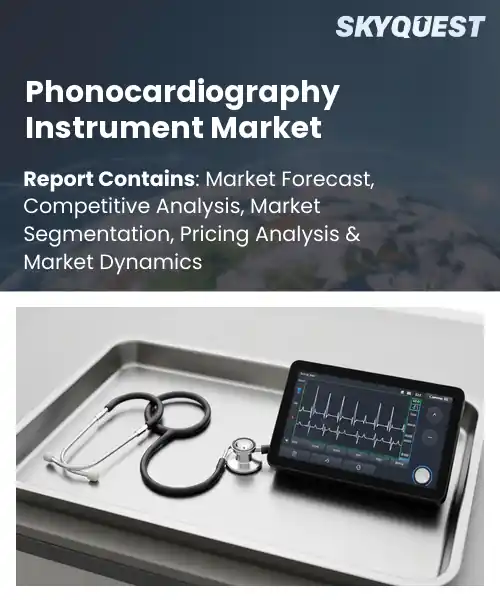
Phonocardiography Instrument Market
Report ID: SQMIG35A4321
Report ID: SQMIG35A4321
[email protected]
USA +1 351-333-4748
Report ID:
SQMIG35A4321 |
Region:
Global |
Published Date: August, 2026
Pages:
157
|Tables:
92
|Figures:
76


Global Phonocardiography Instrument Market size was valued at USD 418.0 Million in 2024 and is poised to grow from USD 441.83 Million in 2025 to USD 688.42 Million by 2033, growing at a CAGR of 5.7% during the forecast period (2026-2033).
The phonocardiography instrument market revolves around devices that record and analyze acoustic heart signals to support cardiovascular diagnosis. Its importance stems from the growing burden of heart disease, which drives demand for screening tools that can be deployed outside hospitals. Historically, the sector began with bulky analog stethoscopes equipped with simple recording heads, but advances in digital signal processing and artificial intelligence have transformed these systems into compact units. For instance, a handheld phonocardiograph introduced in 2018 enables rural clinics in India to capture murmurs and transmit them to urban specialists, illustrating how technology and epidemiology together fuel market expansion. Building on earlier diagnostic relevance, the primary growth driver for the phonocardiography instrument market is its integration with telehealth platforms and AI analysis algorithms. As healthcare systems face aging populations and cardiology shortages, remote acoustic monitoring shortens referral cycles; consequently, European insurers now reimburse virtual heart‑sound assessments, prompting manufacturers to embed secure data‑streaming modules. An illustration occurs in a US network where AI‑augmented phonocardiographs flag abnormal murmurs in infants, enabling clinicians to schedule echocardiograms within days, thereby decreasing intensive‑care admissions. Partnerships with phone makers open distribution channels in emerging economies, making affordability a catalyst for global market penetration and sustained significant long‑term revenue growth.
How are AI and IoT shaping the phonocardiography instrument market?
AI and IoT are redefining the phonocardiography instrument market by turning simple heart sound recordings into data rich diagnostic tools. AI algorithms now filter noise, segment cardiac cycles and flag abnormal murmurs, while IoT connectivity lets devices upload recordings to cloud platforms for instant clinician review. This convergence enables remote monitoring, early disease detection and integration with electronic health records. Hospitals are adopting smart phonocardiographs to reduce bedside time and improve workflow efficiency. New innovators are pairing wearable sensors with machine learning models to deliver continuous cardiac monitoring outside the clinic. The result is a market that values accuracy, speed and interoperability.In June 2024, Eko introduced an AI enhanced digital stethoscope that streams heart sounds to a cloud service for real time analysis, showing how AI and IoT improve diagnostic speed and enable remote cardiology care. This launch is driving wider adoption of smart phonocardiography devices.
Market snapshot - (2026-2033)
Global Market Size
USD 418.0 Million
Largest Segment
Digital Phonocardiography Systems
Fastest Growth
Portable Phonocardiography Devices
Growth Rate
5.7% CAGR
To get more insights on this market click here to Request a Free Sample Report
Global phonocardiography instrument market is segmented by product type, application, end user and region. Based on product type, the market is segmented into Digital Phonocardiography Systems, Portable Phonocardiography Devices, PC-Based Phonocardiography Systems and Accessories & Software. Based on application, the market is segmented into Cardiac Disease Diagnosis, Cardiac Screening and Medical Education & Research. Based on end user, the market is segmented into Hospitals, Cardiology Clinics, Diagnostic Centers and Academic & Research Institutes. Based on region, the market is segmented into North America, Europe, Asia Pacific, Latin America and Middle East & Africa.
Digital Phonocardiography Systems segment dominates because it integrates high‑fidelity acoustic capture with immediate digital analysis, enabling clinicians to detect subtle murmurs that were previously missed. Its seamless connectivity to hospital information systems facilitates rapid data sharing, supporting timely decision‑making and enhancing diagnostic confidence. This combination of technical superiority and workflow integration drives its leading position in the market. Moreover, continuous firmware updates ensure that the system stays aligned with emerging clinical guidelines, reinforcing its relevance across evolving care pathways.
Meanwhile, Portable Phonocardiography Devices segment emerges as the fastest expanding area as clinicians seek point‑of‑care solutions that can be deployed in ambulatory settings and remote clinics. Lightweight design, battery operation, and wireless data transmission address accessibility challenges, spurring adoption across diverse care environments and fueling broader market growth.
PC‑Based Phonocardiography Systems segment dominates because it offers scalable software platforms that can be customized for teaching modules and research protocols, allowing institutions to leverage existing computer infrastructure. The flexibility to integrate advanced signal‑processing algorithms and simulation tools promotes deep learning and innovation, making it the preferred choice for academic environments focused on cardiac acoustics. Additionally, open‑source development communities contribute extensions that keep the system at the forefront of methodological advances, further cementing its dominance in scholarly and training settings.
On the other hand, Accessories & Software segment witnesses the strongest growth momentum as developers introduce AI‑driven annotation tools, cloud‑based storage solutions, and interactive training modules. These enhancements expand functional capabilities of core devices, attract new user groups, and create recurring revenue streams, accelerating overall market expansion and opening novel application pathways.
To get detailed segments analysis, Request a Free Sample Report
North America leads the global phonocardiography instrument market due to a confluence of advanced clinical infrastructure, robust research ecosystems, and strong financial support for innovative diagnostics. The region benefits from early adoption of cutting‑edge cardiac monitoring technologies within major hospital networks and a regulatory framework that encourages rapid product approvals. Leading manufacturers and academic institutions collaborate closely, accelerating the translation of novel acoustic imaging concepts into commercial devices. Reimbursement policies that recognize the clinical value of detailed heart sound analysis further drive widespread procurement. Additionally, a skilled workforce and extensive training programs ensure that clinicians are proficient in interpreting phonocardiographic data, reinforcing the market’s depth and sustainability. The presence of major venture capital firms also fuels start‑up activity, expanding the ecosystem of specialized suppliers and service providers.
Phonocardiography Instrument Market in United States thrives on a dense network of tertiary care centers that prioritize early detection of cardiac anomalies. Strong collaboration between device innovators and leading cardiology research institutes accelerates product refinement. Reimbursement frameworks that reward diagnostic precision encourage hospitals to integrate acoustic heart monitoring into routine assessments. Moreover, a culture of continuous professional development equips clinicians with the expertise needed to leverage detailed phonocardiographic insights for patient management.
Phonocardiography Instrument Market in Canada benefits from a publicly funded health system that emphasizes preventive cardiology and evidence‑based technology adoption. Provincial health authorities support pilot programs that evaluate acoustic heart sound analysis in community hospitals, fostering broader acceptance. Academic medical centers collaborate closely with manufacturers to tailor devices for local clinical workflows. This supportive environment, combined with a strong emphasis on clinician training, drives steady integration of phonocardiography into routine cardiac care.
Europe experiences rapid expansion of the phonocardiography instrument market driven by coordinated regulatory standards, substantial public research investment, and a growing emphasis on non‑invasive cardiac diagnostics. Harmonized approval pathways across the region reduce time to market, encouraging manufacturers to introduce advanced acoustic imaging solutions. Health systems increasingly recognize the value of detailed heart sound analysis for early disease identification, prompting integration into routine screening protocols. Collaborative networks linking universities, hospitals, and technology firms accelerate innovation cycles and facilitate clinical validation. Moreover, reimbursement models that reward preventive care create financial incentives for widespread adoption, reinforcing Europe’s position as a dynamic hub for phonocardiographic technology development and deployment. Continual professional education programs ensure clinicians remain adept at interpreting acoustic signatures, thereby improving diagnostic confidence and patient outcomes across diverse healthcare settings.
Phonocardiography Instrument Market in Germany stands as the dominant force within Europe, underpinned by a strong engineering tradition and extensive clinical research infrastructure. Leading medical device firms collaborate closely with university hospitals to refine acoustic imaging technologies for high‑precision cardiac assessment. Reimbursement policies that prioritize diagnostic accuracy support widespread procurement across tertiary centers. Additionally, national health initiatives promote early detection of heart disease, encouraging integration of phonocardiography into routine cardiology workflows.
Phonocardiography Instrument Market in United Kingdom experiences the fastest growth across Europe, propelled by proactive health policy and a vibrant academic ecosystem. Government‑backed research grants stimulate development of next‑generation acoustic sensors, while NHS pilot programs evaluate clinical benefits in diverse patient populations. Strong collaborations between biotech startups and established manufacturers accelerate product commercialization. The emphasis on preventive cardiology within primary care settings further drives adoption, positioning the United Kingdom as a leading incubator for innovative phonocardiographic solutions.
Phonocardiography Instrument Market in France is emerging rapidly, supported by national health strategies that emphasize early cardiac screening and digital health integration. Collaborative research consortia link Parisian medical schools with device innovators to explore novel acoustic analysis algorithms. Reimbursement frameworks are evolving to include phonocardiographic assessments, encouraging hospitals to adopt the technology. Growing awareness among clinicians about the non‑invasive nature of heart sound imaging further fuels interest, positioning France as a promising frontier for market expansion.
Asia Pacific is strengthening its position in the phonocardiography instrument market through a combination of rising healthcare investment, rapid technology adoption, and strategic government initiatives. Both Japan and South Korea prioritize integration of advanced acoustic diagnostics within their national cardiac care programs, recognizing the potential for early disease detection and cost‑effective monitoring. Robust collaborations between leading electronics manufacturers and medical research institutions accelerate the development of high‑resolution, portable phonocardiographic devices. Emerging digital health platforms incorporate AI‑driven analysis of heart sounds, enhancing diagnostic accuracy and enabling remote patient management. Additionally, growing clinical awareness of non‑invasive cardiac assessment drives demand across tertiary hospitals and community clinics, solidifying the region’s role as a dynamic hub for innovative phonocardiography solutions. The emphasis on training programs ensures clinicians acquire the expertise needed to interpret acoustic data, further embedding the technology into routine practice.
Phonocardiography Instrument Market in Japan benefits from a mature healthcare system that values precision diagnostics and technological innovation. Strong partnerships between leading electronics firms and university hospitals drive the creation of compact, high‑fidelity acoustic devices. Government health policies encourage the incorporation of non‑invasive cardiac monitoring into standard care pathways, supporting widespread clinical adoption. Continuous professional development programs equip cardiologists with the skills to interpret nuanced heart sound patterns, reinforcing Japan’s leadership in phonocardiographic technology.
Phonocardiography Instrument Market in South Korea is propelled by aggressive digital health strategies and a strong emphasis on early cardiac risk assessment. Collaboration between biotech startups and major medical device conglomerates yields innovative, AI‑enhanced phonocardiographic platforms that are both portable and highly accurate. National health insurance schemes are expanding coverage to include acoustic heart sound analysis, encouraging hospitals to integrate the technology into routine examinations. Focused training initiatives ensure clinicians can effectively leverage these tools for improved patient outcomes.
To know more about the market opportunities by region and country, click here to
Buy The Complete Report
Growing Cardiac Screening Initiatives
Adoption of Portable Devices
High Equipment Acquisition Costs
Limited Clinician Training Programs
Request Free Customization of this report to help us to meet your business objectives.
The competitive landscape is shaped by major OEMs expanding their digital cardiology portfolios through strategic acquisitions and joint ventures, while emerging innovators drive differentiation with AI‑enhanced acoustic analysis and portable sensor integration; recent M&A activity such as Philips’ acquisition of a cloud‑based cardiac monitoring firm and GE Healthcare’s partnership with a wearable ECG startup illustrate the market’s focus on technology convergence and rapid product rollout.
Top Player’s Company Profile
Recent Developments
SkyQuest’s ABIRAW (Advanced Business Intelligence, Research & Analysis Wing) is our Business Information Services team that Collects, Collates, Correlates, and Analyses the Data collected by means of Primary Exploratory Research backed by robust Secondary Desk research. As per SkyQuest analysis the global phonocardiography instrument market is being propelled primarily by expanding cardiac screening initiatives that create steady demand for non‑invasive acoustic diagnostics, while the rapid uptake of portable devices adds a second boost by enabling point‑of‑care assessments across diverse settings. High equipment acquisition costs remain the main restraint, limiting uptake in budget‑constrained facilities until clear cost‑benefit data emerge. North America dominates the market thanks to advanced clinical infrastructure, strong reimbursement frameworks and intensive R&D activity. Within product categories digital phonocardiography systems lead the segment mix, offering high‑fidelity capture, instant analytics and seamless EMR integration that drive hospital adoption.
| Report Metric | Details |
|---|---|
| Market size value in 2024 | USD 418.0 Million |
| Market size value in 2033 | USD 688.42 Million |
| Growth Rate | 5.7% |
| Base year | 2024 |
| Forecast period | (2026-2033) |
| Forecast Unit (Value) | USD Million |
| Segments covered |
|
| Regions covered | North America (US, Canada), Europe (Germany, France, United Kingdom, Italy, Spain, Rest of Europe), Asia Pacific (China, India, Japan, Rest of Asia-Pacific), Latin America (Brazil, Rest of Latin America), Middle East & Africa (South Africa, GCC Countries, Rest of MEA) |
| Companies covered |
|
| Customization scope | Free report customization with purchase. Customization includes:-
|
To get a free trial access to our platform which is a one stop solution for all your data requirements for quicker decision making. This platform allows you to compare markets, competitors who are prominent in the market, and mega trends that are influencing the dynamics in the market. Also, get access to detailed SkyQuest exclusive matrix.
Table Of Content
Executive Summary
Market overview
Parent Market Analysis
Market overview
Market size
KEY MARKET INSIGHTS
COVID IMPACT
MARKET DYNAMICS & OUTLOOK
Market Size by Region
KEY COMPANY PROFILES
Methodology
For the Phonocardiography Instrument Market, our research methodology involved a mixture of primary and secondary data sources. Key steps involved in the research process are listed below:
1. Information Procurement: This stage involved the procurement of Market data or related information via primary and secondary sources. The various secondary sources used included various company websites, annual reports, trade databases, and paid databases such as Hoover's, Bloomberg Business, Factiva, and Avention. Our team did 45 primary interactions Globally which included several stakeholders such as manufacturers, customers, key opinion leaders, etc. Overall, information procurement was one of the most extensive stages in our research process.
2. Information Analysis: This step involved triangulation of data through bottom-up and top-down approaches to estimate and validate the total size and future estimate of the Phonocardiography Instrument Market.
3. Report Formulation: The final step entailed the placement of data points in appropriate Market spaces in an attempt to deduce viable conclusions.
4. Validation & Publishing: Validation is the most important step in the process. Validation & re-validation via an intricately designed process helped us finalize data points to be used for final calculations. The final Market estimates and forecasts were then aligned and sent to our panel of industry experts for validation of data. Once the validation was done the report was sent to our Quality Assurance team to ensure adherence to style guides, consistency & design.
Analyst Support
Customization Options
With the given market data, our dedicated team of analysts can offer you the following customization options are available for the Phonocardiography Instrument Market:
Product Analysis: Product matrix, which offers a detailed comparison of the product portfolio of companies.
Regional Analysis: Further analysis of the Phonocardiography Instrument Market for additional countries.
Competitive Analysis: Detailed analysis and profiling of additional Market players & comparative analysis of competitive products.
Go to Market Strategy: Find the high-growth channels to invest your marketing efforts and increase your customer base.
Innovation Mapping: Identify racial solutions and innovation, connected to deep ecosystems of innovators, start-ups, academics, and strategic partners.
Category Intelligence: Customized intelligence that is relevant to their supply Markets will enable them to make smarter sourcing decisions and improve their category management.
Public Company Transcript Analysis: To improve the investment performance by generating new alpha and making better-informed decisions.
Social Media Listening: To analyze the conversations and trends happening not just around your brand, but around your industry as a whole, and use those insights to make better Marketing decisions.
REQUEST FOR SAMPLE
 REQUEST FREE CUSTOMIZATION


Want to customize this report? This report can be personalized according to your needs. Our analysts and industry experts will work directly with you to understand your requirements and provide you with customized data in a short amount of time. We offer $1000 worth of FREE customization at the time of purchase.
Feedback From Our Clients


 USA (+1) 351-333-4748

