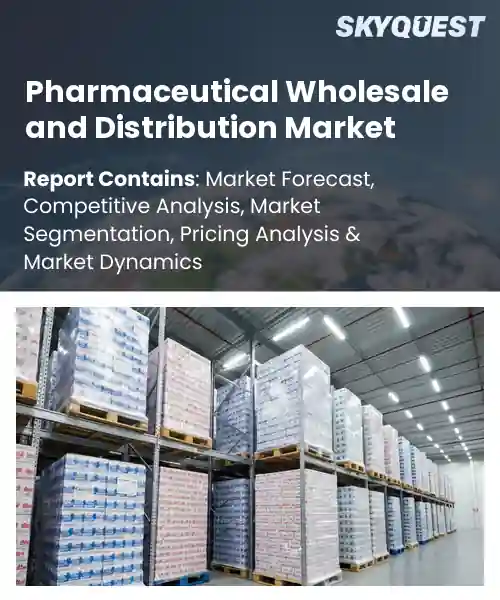
Pharmaceutical Wholesale and Distribution Market
Report ID: SQMIG35C2034
Report ID: SQMIG35C2034
[email protected]
USA +1 351-333-4748
Report ID:
SQMIG35C2034 |
Region:
Global |
Published Date: June, 2026
Pages:
157
|Tables:
114
|Figures:
77


Global Pharmaceutical Wholesale And Distribution Market size was valued at USD 16.4 Billion in 2024 and is poised to grow from USD 17.5 Billion in 2025 to USD 29.4 Billion by 2033, growing at a CAGR of 6.7% during the forecast period (2026-2033).
The primary driver of the pharmaceutical wholesale and distribution market is the growing complexity and volume of drug therapies, particularly specialty biologics and temperature-sensitive vaccines, which demand sophisticated logistics and reliable downstream delivery. Market wholesalers have been serve as intermediaries between different manufacturers and care sites to provide consistent availability and compliance while also absorbing risks associated with inventory, financing, and regulatory compliance on the other side of the distribution chain. As a result of consolidation, many of the major US players are now integrated service providers who are able to offer support for all phases of supply chain management. COVID also accelerated this evolution by creating a greater demand for cold chain investments and digital tracking technologies.
Digitalization and regulatory-driven traceability represent a pivotal factor shaping growth opportunities, because investments in serialization, IoT sensors and automated warehouses reduce diversion risk and enable value-added services. As regulators enforce track-and-trace regimes, wholesalers that deploy end-to-end visibility can offer cold-chain guarantees for mRNA vaccines, support hub-and-spoke distribution for specialty injectables, and integrate into manufacturer portals for real-time replenishment. Consequently firms capture new service revenues, win long-term contracts and expand into emerging markets with improved compliance credentials. For example, adoption of GS1 standards and EU Falsified Medicines Directive compliance has raised entry barriers while catalyzing partnerships between logistics providers and manufacturers.
How is Blockchain Improving Traceability in Pharmaceutical Wholesale and Distribution?
Blockchain increases traceability in healthcare through pharmaceuticals since custody & serialization events of drugs are recorded in an immutable shared ledger, producing an auditable trail of evidence that can follow the drug through the supply chain from manufacturer to wholesaler to logistics provider. Utilizing permissioned networks between trading partners, together with smart contracts, allows trading partners to authenticate the serialized pharmaceutical product during the handover process as well as produce the audit trail leading up to that handover based on the serialized record stored in the blockchain. Adoption is transitioning from pilot projects toward selective production where companies combine blockchain with serialization standards, combined with sensor data, to reduce counterfeiting of medications as well as simplify new medication recalls.
In June 2026, Hashgraph Group and Merck announced a blockchain backed EU digital product passport that links immutable identifiers to physical authentication. That effort helps wholesalers verify authenticity on receipt shortens reconciliation work and makes recalls and compliance reporting smoother while boosting market confidence in distributed pharmaceutical supply chains.
Market snapshot - (2026-2033)
Global Market Size
USD 16.4 Billion
Largest Segment
Indirect Distribution
Fastest Growth
Direct Distribution
Growth Rate
6.7% CAGR
To get more insights on this market click here to Request a Free Sample Report
Global pharmaceutical wholesale and distribution market is segmented by distribution channels, product type, end-users, supply chain type and region. Based on distribution channels, the market is segmented into direct distribution and indirect distribution. Based on product type, the market is segmented into prescription drugs, over-the-counter drugs and biologics. Based on end-users, the market is segmented into healthcare providers and retail customers. Based on supply chain type, the market is segmented into traditional supply chain and integrated supply chain. Based on region, the market is segmented into North America, Europe, Asia Pacific, Latin America and Middle East & Africa.
Direct distribution segment dominates because wholesalers and manufacturers control inventory flow and maintain custody of sensitive pharmaceutical products, enabling stricter temperature controls and faster fulfillment. This direct relationship reduces handling steps and logistical fragmentation, which lowers product risk and supports compliance with regulatory quality requirements. As a result, investment in specialized cold chain assets and real-time monitoring becomes economically justified, reinforcing the preference for direct routes for high-value medicines.
However, indirect distribution is witnessing the strongest growth as third-party wholesalers and distributors expand service bundles and reach pharmacies and retailers. It uses current logistics networks and bulk inventory to quickly onboard new products and create flexible fulfillment options. The rapid growth of outsourcing and demand for more places to reach end customers increases the potential of indirect distribution providers in the market.
Biologics segment leads because their complex manufacturing characteristics and strict cold chain requirements force wholesalers to adopt specialized handling, segregated storage, and dedicated transportation solutions. Traceability and controlled environment have resulted in an increased investment by distributors and manufacturers through the creation of integrated partnerships. In turn, this has raised the standards for distribution capabilities, promoted premium service offerings to customers, and consolidated market share among providers able to comply with strict handling requirements.
However, prescription drugs are emerging as the fastest growing area as expanding therapeutic demand and simplified storage requirements broaden distributor reach. The influx of regulatory streamlining, increasing chronic disease management, and the widespread initiation of prescription drugs have driven distributors to scale their inventory and automate processes to meet the increasing amount and variety of distributions occurring through both healthcare provider and retail channels.
To get detailed segments analysis, Request a Free Sample Report
North America dominates due to an integrated distribution infrastructure, sophisticated regulatory alignment, and concentrated purchasing power among major healthcare providers and payers. A supplier network comprising full-line wholesalers, specialty distributors, and third-party logistics providers allows for efficient inventory management and quick product movement from manufacturers to pharmacies, hospitals, and clinics. Key relationships between distributors and manufacturers will help improve formulary access and/or channel management. Effective regulatory enforcement and reimbursement systems will create incentives to comply with regulations while expanding service offerings such as value-added logistics and patient support programs that help maintain market position and business sustainability. The consolidation of the markets has resulted in the creation of large, nationally-based networks where size can be used to negotiate distribution contracts, whereas smaller, regional, and specialty distributors are developing innovative ways of providing advanced therapies.
Pharmaceutical wholesale and distribution market in United States is characterized by expansive national distribution networks, integrated logistics capabilities, and advanced cold chain systems. Specialty and biologic therapy distribution are critical drivers for distinguishing one's service from that of other distributors. Digitizing the supply chain, as well as adhering to regulatory compliance requirements, provides incentives for maintaining traceability within the system. Regional wholesaler distributors create an additional supply line for national distributors when supporting patient populations and delivery channels that differ.
Pharmaceutical wholesale and distribution market in Canada is supported by coordinated provincial channels, national distributors, and specialized logistics providers that manage geographic dispersion and cold chain requirements. Working with community pharmacies and hospitals helps ensure that there is a supply of medications available, while also ensuring compliance with regulations and tracking makes the overall system more reliable. By tailoring the delivery of products to meet the needs of isolated and Indigenous populations, it is possible to maintain sufficient local coverage so everyone has equal access to treatment throughout a large geographic area.
Rapid expansion across Europe is propelled by a combination of regulatory convergence, a dense healthcare provider network, and a strong domestic pharmaceutical manufacturing base that feeds efficient wholesale channels. Cross-border trade mechanisms and logistics corridors established to facilitate the movement of products have contributed to a growing need for enhanced distribution and cold chain capabilities due to an increase in demand for biologic and specialty therapies, and investments in digital track-and-trace systems, automation of warehouses, and value-added services have all increased distributors’ ability to respond quickly. Various reimbursement systems between countries have created opportunities for distributors to collaborate with payers and providers to gain access to markets. A combination of large national wholesalers and nimble, regional players creates a competitive environment in which service innovation and scalable solutions contribute to continued growth in the market throughout the of the area.
Pharmaceutical wholesale and distribution market in Germany leverages a dense hospital and pharmacy network, sophisticated cold chain capabilities, and strong domestic manufacturing linkages that support robust distribution operations. A concentration on following regulations and having quality checks results in dependable supply sources, while the mix of integrated logistics and centralized wholesale warehouse distributing points creates an efficient nationwide coverage solution. Distributors working with specialized manufacturers in research accelerate the delivery of specialty therapies from manufacturers to physicians as well as provide a system to manage channels throughout complicated regional healthcare delivery systems.
Pharmaceutical wholesale and distribution market in United Kingdom is marked by rapid channel innovation, evolving logistics models, and growing emphasis on specialty therapy distribution. Distributors are pursuing increased digital integration with healthcare providers as well as providing more patient-focused services and improving temperature-controlled solutions to meet the requirements of these complex products. Manufacturers, pharmacy networks and distributors are forming strategic partnerships to allow for greater agility in responding to supply variability.
Pharmaceutical wholesale and distribution market in France combines established national wholesaler networks with strong hospital and community pharmacy connections to ensure medicine availability. Maintaining regulatory compliance and ensuring quality control through cold chain logistics are key components to supporting the distribution of sensitive therapies. Distributors are involved with payer and provider procurement processes for these products, and they are investing in digital capabilities that will provide traceability and services as part of their distribution model.
Asia Pacific is strengthening its role through expanding distribution infrastructure, upgraded cold chain networks, and intensified collaboration between regional manufacturers and logistics specialists. Digital capabilities are being integrated into business processes in order to provide greater visibility for market players (e.g., demand forecasting and temperature monitoring), which is especially important when distributing biologics and specialty therapies. Market participants are continuing to experience reducing barriers to cross-border logistics as a result of the modernization and harmonization of regulations in many different markets. In addition, many market participants are using their last mile delivery model investments to extend access to rural areas. Additionally, domestic and international distributors are developing new strategic partnerships through joint ventures or capacity expansion to provide greater depth of service and more extensive geographic coverage. Advanced manufacturing hubs and increased regulatory sophistication in the strategic key markets provide the foundation to build capabilities within specialty therapy and clinical supply services globally.
Pharmaceutical wholesale and distribution market in Japan is defined by precise regulatory standards, advanced cold chain infrastructure, and close integration with hospital systems and community pharmacies. Logistics for specialty and biologic products must be reliable with proper temperature monitoring and serialisation processes. By working with manufacturers and technology providers, distributors are able to improve visibility of supply chain activities. Increased emphasis on patient support services and home deliveries allows for the appropriate adaptation of distribution in order to meet new healthcare delivery methods and/or changing demographics.
Pharmaceutical wholesale and distribution market in South Korea features strong technology adoption, streamlined logistics corridors, and collaboration between manufacturers and distributors. Pharmaceutical distributors are expanding patient-focused services such as home delivery and adherence to their medication; at the same time, specialized logistics providers are managing complicated supply chain needs. Regulations and public-private collaborations provide clear, efficient channel management for national urban health systems; therefore, allowing for responsive distribution throughout urban health systems across the nation.
To know more about the market opportunities by region and country, click here to
Buy The Complete Report
Expansion Of Chronic Disease Treatments
Adoption Of Digital Supply Solutions
Regulatory Compliance Complexity
Insufficient Cold Chain Infrastructure
Request Free Customization of this report to help us to meet your business objectives.
Consolidation and digital disruption define the competitive landscape, with major distributors pursuing targeted M&A, strategic partnerships, and logistics automation to lock specialty pipelines and scale. Cardinal Health expanded its specialty service offerings by completing multiple acquisition strategies throughout 2024. McKesson completed its acquisition of a non-controlling interest in June 2025, then partnered with Microsoft to enhance tech-based processes for distributing its oncology analytics division into the marketplace sooner than previously planned.
Top Player’s Company Profile
Recent Developments
SkyQuest’s ABIRAW (Advanced Business Intelligence, Research & Analysis Wing) is our Business Information Services team that Collects, Collates, Correlates, and Analyses the Data collected by means of Primary Exploratory Research backed by robust Secondary Desk research.
As per SkyQuest analysis, the global pharmaceutical wholesale and distribution market is being driven primarily by the growing complexity and volume of drug therapies, particularly biologics and temperature-sensitive vaccines, which require sophisticated logistics and cold chain capabilities, while digitalization and regulatory-driven traceability further accelerate investment in serialization, IoT and automated warehousing. However, complex and heterogeneous regulatory compliance requirements remain a significant restraint, increasing costs and slowing cross-border expansion. North America remains the dominant region due to mature distribution networks and high technology adoption and direct distribution is the dominant segment because tighter custody and control of sensitive products supports reliability and higher-value service offerings.
| Report Metric | Details |
|---|---|
| Market size value in 2024 | USD 16.4 Billion |
| Market size value in 2033 | USD 29.4 Billion |
| Growth Rate | 6.7% |
| Base year | 2024 |
| Forecast period | (2026-2033) |
| Forecast Unit (Value) | USD Billion |
| Segments covered |
|
| Regions covered | North America (US, Canada), Europe (Germany, France, United Kingdom, Italy, Spain, Rest of Europe), Asia Pacific (China, India, Japan, Rest of Asia-Pacific), Latin America (Brazil, Rest of Latin America), Middle East & Africa (South Africa, GCC Countries, Rest of MEA) |
| Companies covered |
|
| Customization scope | Free report customization with purchase. Customization includes:-
|
To get a free trial access to our platform which is a one stop solution for all your data requirements for quicker decision making. This platform allows you to compare markets, competitors who are prominent in the market, and mega trends that are influencing the dynamics in the market. Also, get access to detailed SkyQuest exclusive matrix.
Table Of Content
Executive Summary
Market overview
Parent Market Analysis
Market overview
Market size
KEY MARKET INSIGHTS
COVID IMPACT
MARKET DYNAMICS & OUTLOOK
Market Size by Region
KEY COMPANY PROFILES
Methodology
For the Pharmaceutical Wholesale and Distribution Market, our research methodology involved a mixture of primary and secondary data sources. Key steps involved in the research process are listed below:
1. Information Procurement: This stage involved the procurement of Market data or related information via primary and secondary sources. The various secondary sources used included various company websites, annual reports, trade databases, and paid databases such as Hoover's, Bloomberg Business, Factiva, and Avention. Our team did 45 primary interactions Globally which included several stakeholders such as manufacturers, customers, key opinion leaders, etc. Overall, information procurement was one of the most extensive stages in our research process.
2. Information Analysis: This step involved triangulation of data through bottom-up and top-down approaches to estimate and validate the total size and future estimate of the Pharmaceutical Wholesale and Distribution Market.
3. Report Formulation: The final step entailed the placement of data points in appropriate Market spaces in an attempt to deduce viable conclusions.
4. Validation & Publishing: Validation is the most important step in the process. Validation & re-validation via an intricately designed process helped us finalize data points to be used for final calculations. The final Market estimates and forecasts were then aligned and sent to our panel of industry experts for validation of data. Once the validation was done the report was sent to our Quality Assurance team to ensure adherence to style guides, consistency & design.
Analyst Support
Customization Options
With the given market data, our dedicated team of analysts can offer you the following customization options are available for the Pharmaceutical Wholesale and Distribution Market:
Product Analysis: Product matrix, which offers a detailed comparison of the product portfolio of companies.
Regional Analysis: Further analysis of the Pharmaceutical Wholesale and Distribution Market for additional countries.
Competitive Analysis: Detailed analysis and profiling of additional Market players & comparative analysis of competitive products.
Go to Market Strategy: Find the high-growth channels to invest your marketing efforts and increase your customer base.
Innovation Mapping: Identify racial solutions and innovation, connected to deep ecosystems of innovators, start-ups, academics, and strategic partners.
Category Intelligence: Customized intelligence that is relevant to their supply Markets will enable them to make smarter sourcing decisions and improve their category management.
Public Company Transcript Analysis: To improve the investment performance by generating new alpha and making better-informed decisions.
Social Media Listening: To analyze the conversations and trends happening not just around your brand, but around your industry as a whole, and use those insights to make better Marketing decisions.
REQUEST FOR SAMPLE
 REQUEST FREE CUSTOMIZATION
Global Pharmaceutical Wholesale And Distribution Market size was valued at USD 16.4 Billion in 2024 and is poised to grow from USD 17.5 Billion in 2025 to USD 29.4 Billion by 2033, growing at a CAGR of 6.7% during the forecast period (2026-2033).
Consolidation and digital disruption define the competitive landscape, with major distributors pursuing targeted M&A, strategic partnerships, and logistics automation to lock specialty pipelines and scale. Cardinal Health executed acquisitions to expand specialty services in late 2024. McKesson closed a controlling stake acquisition in June 2025 and partnered its oncology analytics unit with Microsoft to accelerate tech enabled distribution. 'McKesson Corporation', 'AmerisourceBergen', 'Cardinal Health', 'Owens & Minor', 'Alliance Healthcare', 'HD Smith', 'B. Braun Melsungen AG', 'DMS Health Technologies', 'Schein Pharmaceutical', 'Morris & Dickson Co.', 'FFF Enterprises', 'ProPharma Group', 'Smith Drug Company', 'Anda, Inc.', 'Henry Schein Medical', 'Bergen Brunswig', 'Utah Medical', 'The Harvard Drug Group', 'Pharma Logistics', 'Bellco Health'
The rising prevalence and longer treatment regimens for chronic illnesses increase demand for a wide range of pharmaceuticals, prompting wholesalers and distributors to scale procurement, inventory management, and distribution networks to ensure steady supply. This sustained requirement encourages investment in diversified product portfolios, enhanced cold chain logistics, and strategic partnerships with manufacturers and providers to maintain continuous availability. As a result, distribution channels strengthen recurring revenue streams and operational resilience, supporting market growth through improved reach, efficiency, and service offerings across healthcare systems.
Digital Supply Chain Integration: Pharmaceutical wholesalers are increasingly adopting end-to-end digital integration to enhance visibility, collaboration and responsiveness across manufacturers, distributors. Cloud platforms, interoperable data standards and AI-enabled forecasting enable coordinated inventory replenishment, faster issue resolution and improved regulatory traceability. Integration reduces disruptions by enabling scenario planning and supplier risk monitoring, while facilitating transparency for partners and payers. The trend supports more agile distribution networks that can adapt to product complexity, shorten lead times, and improve patient access through synchronized ordering and distribution workflows.
Why does North America Dominate the Global Pharmaceutical Wholesale and Distribution Market? |@12


Want to customize this report? This report can be personalized according to your needs. Our analysts and industry experts will work directly with you to understand your requirements and provide you with customized data in a short amount of time. We offer $1000 worth of FREE customization at the time of purchase.
Feedback From Our Clients


 USA (+1) 351-333-4748

